1010 week 7 flashcards
Oct. 25th Lecture Notes
WEEK 7 - Chapter 5 Electronic Commerce and Enterprise Systems
Electronic Commerce:
- Conducting business activities electronically over computer networks
- Business activities that are strong candidates for conversion to e-commerce are:
- Paper based
- Time-consuming
- Inconvenient for customers
Business to Business E-commerce
- B2B e-commerce is a subject of e-commerce
- All the participants are organizations
- Useful tool for connecting business partners in a virtual supply chain to cut resupply times and reduce costs
- Many organizations use both:
- Buy-side e-commerce to purchase goods and service from suppliers
- Sell-side e-commerce to sell products to their customers
Business-to-Consumer E-Commerce
- B2C e-commerce
- Customer deal directly with an organization and avoid intermediaries; this is called disintermediation
- Reasons for steady growth
- Cheaper goods and services via the web
- Online shoppers can design a personalized Web
- The use of social media networks to promote products and reach customers
Consumer to consumer E-Commerce
- C2C e-commerce
- Involves electronic transactions between consumers are facilitated by third party
- Popular sites include
- eBay, Bidz.com, Craigslist, eBid, Etsy, Fiverr, Ibidfree, Kijiji, Ubid, and Taobao
- Companies and individuals involved in C2C must be careful
- Sales must not violate the rules of various county, state, and country legal jurisdictions
E-Government
- E-government is use of information and communications technology to:
- Simplify sharing of information
- Speed formerly paper-based processes
- Improve relationship between citizens and government
- Forms of e-government:
- Government-to-consumer (G2C)
- Government-to-business (G2B)
- Government-to-government (G2G)
Mobile Commerce
- M-commerce relies on the use of wireless devices
- The Internet Corporation for assigned names and numbers (ICANN):
- Created a mobi domain to help attract mobile users to the web
- The Market for m-commerce in North America
- Maturing much later than in Western Europe and Japan
- Worldwide, m-commerce accounted for 35% of all retail e-commerce sales in the fourth quarter of 2015 (49% by the end of 2025)
- The number of mobile websites worldwide is growing rapidly
- Because of advances in wireless broadband technologies
- Advantage of E & M-Commerce:
- Reaching new customers
- Reducing business cost
- Increase speed flow of goods and information
- Increase in accuracy for order-processing
- Improving customer service
E-commerce Challenges
- Dealing with consumer privacy concerns
- About one-third of all adult internet users will not buy online due to privacy concerns
- Overcoming consumers’ lack of trust
- In online sellers
- Overcoming Global issues
- Cultural, language, time and distance, infrastructure, currency, and legal challenges
Figure 5.9
Transaction processing activities
A transaction processing cycle includes data collection, data editing, data correction, data processing, data storage, and document production
Enterprise Systems
An enterpriseExamples of E & M-Commerce Applications:
- Areas include:
- Retail and wholesales - Manufacturing
- Marketing - Advertising - very significant industry
- Battering - Retargeting
- Price comparison - Couponing
- Investment and and Finance - Banking - banks may cost less for buying stocks
Manufacturing
- Electronic exchange: electronic forum where manufacturers, suppliers, and competitors buy and sell goods, trade market information, and run back office operations
- Private exchanges are owned and operated by single company
- Independent exchanges are run by group of traditionally competing companies with common procurement needs
- Independent exchanges are open to any set of buyers and sellers within a given market
Figure 5.2
Shows model of electronic exchange
An electronic exchange is an electronic forum where manufacturers, suppliers, and competitors buy and sell goods, trade market information, and run back-office operations.
Technology infrastructure required to support E-commerce and M-commerce
- Poor website performance drives consumers to abandon some e-commerce sites in favor of those with better, more reliable performance
Figure 5.5
- E-commerce systems require specific kinds of hardware and software to be successful. Ex. high speed connection to network - E commerce software - server software - server software - server operating system - web server hardware
Marketing
- Market segmentation: the identification of species markets to target them with advertising messages.
- Dividing the pool of potential customers into subgroups usually define in terms of demographic characteristics.
- eXelate a (subsidiary of Nielson)
- Provides data as a service solution that customers can use to access a database of more than 250 million business records
Advertising
• Methods of buying mobile ad impressions
o Cost per thousand (CPM)
o Cost per click (CPC) o Cost per action (CPA)
• Three main measures of success
o Number of users reached
o Click through rate (CTR)
o Number of actions users take
Bartering
• With economic downturn, many people and businesses have turned to bartering to gain goods and services
• A number of Web sites have been created to support bartering
Ex. websites like craigslist, swapagift.com, swapstyle.com
Retargeting
• An average of 74 percent of all online shopping carts are abandoned
• Retargeting is used by advertisers to recapture those shoppers by using targeted and personalized ads to direct shoppers back to a retailer’s site
Price Comparison
- Mobile phone apps enable shoppers to compare prices and products online
• In some cases, shopper can simply scan an item’s barcode or snap a photo of the item
Couponing
• In 2015, over $515 billion in consumer incentives were distributed in North America
• Less than one percent were redeemed
• Shoppers can subscribe to mobile coupon aggregators
• Mobile coupon redemption rate is expected to increase due to coupon integration in social networks
Investment and Finance
• The Internet has revolutionized the world of investment and finance
• The brokerage business adapted to the Internet faster than any other arm of finance
Banking
• Online banking customers can:
o Check balances of their savings, checking, and loan accounts
o Transfer money among accounts
o Pay their bills
• Many banks enable customers to perform online banking activities via mobile phone
Hardware
Web servers required storage capacity and computing power depend on:
- Software that must run on the server
- Volume of e-commerce transactions that must be processed
Successful e-commerce solutions are designed to be highly scalable
- Can be upgraded to meet unexpected user traffic
Key website performance measures
- Response time
- Transaction success rate
- System availability - want to have it running almost always if possible
Key decision for a new e-commerce company
- Choosing whether to host its own site or enlist a third-party web service provider
Web Server Software
Fundamental services needed in web server software
- Security and identification
- Retrieving and sending web pages
- Web site tracking
- Web site development
- Web page development
E-commerce Software
Five core tasks that must be supported by e-commerce software
- Catalog management
- Product Configuration
- Shopping cart Facilities
- E-commerce transaction processing
- Web traffic data analysis
Mobile Commerce Hardware and Software
• Limitations of handheld devices that complicate their use:
o Screens are small
o Input capabilities are limited to a few buttons
o Less processing power and less bandwidth than desktop or laptop computers
o Operate on limited-life batteries
• For these reasons
o Web developers must often rewrite Web applications so users with mobile devices can access them
Electronic Payment Systems
Table 5.5 comparison of payment systems
Ex of payment systems:
credit card, - carries preset spending limit based on users credit history
charge card, - looks like credit card but carries no preset spending limit
debit card, - looks like a credit card or automated teller machine (ATM) card
smart card - is credit card device with embedded microchip capable of storing facts about cardholder
Transaction Processing systems
Transaction processing systems (TPSs)
- Capture and process detailed data necessary to update orgainzations records about fundamental business operations
- Include order entry, inventory control, payroll, accounts payable, accounts receivable, general ledger, etc.
A TPS provides valuable input to:
- Management information systems
- Decision support system
- Knowledge management systems
Traditional Transaction Processing Methods and Objectives
Figure 5.6
Batch versus online transactions processing
- Batch processing inputs and processes data in groups. (b) in online processing, transactions are completed as they occur
Traditional Transaction processing Methods and objectives
Organizations expect there TSPs to:
- Capture, process, and update databases
- Ensure that data is processed accurately and completely
- Avoid processing fraudulent transactions
- Produce timely user responses and reports
- Reduce clerical and other labor requirements
- Help improve customer service
- Achieve competitive advantage
Transaction Processing Activities
Transaction processing cycle
- Data collection
- Capturing and gathering all data necessary to complete processing of transactions
- Data collection can be: manual or automated via special output devices
- Source data automation
- Involves capturing data as its source and recording it accurately in a timely fashion with minimal manual effort and in an electronic or digital format so that it can be entered directly in computer
- Ex. scanner reading a UPC code
- Cloud-based POS systems provide a range of capabilities
- Things like advanced integration with digital loyalty programs
- Data editing
- Checking data for validity and completeness to detect any problems
- Ex. quantity and cost data must be numeric
- Names must be alphabetic
- Data correction
- Systems should provide error messages that alert those responsible for editing the data
- Error messages should specify problem for corrections
- Systems should provide error messages that alert those responsible for editing the data
- Data processing
- Performing calculations and other data transformations related to business transactions including:
- Classifying data
- Sorting data into categories
- Performing calculations
- Performing calculations and other data transformations related to business transactions including:
- Data storage
- Involves updating one or more databases with new transactions
- After being updated, data can further be processed and manipulated by other systems
- Document production
- Involves generating output records, documents and reports
- Hard-copy papr reports
- Displays on computer screens (soft copy)
- Results from one TPS can be input to another system
- Most TSPs provide other useful management information, such as:
- Printed or on screen reports that help managers and employees perform various activities
- Involves generating output records, documents and reports
Reports show current inventory system is central to individuals and organizations of all sizes
- Ensures that information can be shared across all business functions and all levels of management to support running and managing of a business
- Ultimate goal is to satisfy customers and provide significant benefits by reducing cost and improving services
- Business rely on enterprise systems to perform daily activities in areas like
- Product supply and distribution
- Sales and marketing
- Human resources
- Manufacturing
- Accounting and taxes
Enterprise Resource planning
Enterprise resource planning (ERP)
- Set of integrated programs that manage company’s vital business operations for an entire organization
Business process
- Set of coordinated and related activities that takes one or more kinds of input and creates an output of value to customer of that process
Figure 5.11
Enterprise Resource Planning System
An ERP integrates business processes and the ERP database
ERP database(s) - production and supply chain management, customer relationship management and sales ordering, financial and managerial accounting
Advantages of ERP
- Improved access to quality data for operational decision making
- Elimination of costly, inflexible legacy systems
- Improvement of work processes
- Opportunity to upgrade and strategize technology infrastructure
Customer relationship management
Customer relationship management (CRM) system
- Helps company manage all aspects of customer encounters, including marketing, sales, distribution, accounting, and customer service
- Goal of CRM is to understand and anticipate needs of current and potential customers
- CRM used primarily in sales, marketing and serves organizations:
- To capture and view data about customers and improve communications
- CRM software:
- Automates and integrates the functions of sales, marketing, and service in an organization
Key features of a CRM system include:
o Contact management
o Sales management
o Customer support
o Marketing automation
o Analysis
o Social networking
o Access by smartphones
o Import contact data
Product Lifecycle Management
Product lifecycle management (PLM)
- Enterprise business strategy that creates a common repository of product information and processes
- Supports collaborative creation, management, dissemination, and use of product and packaging definition information
- • Product lifecycle management (PLM) software
- o Provides a means for managing the data and processes associated with the various phases of the lifecycle of a product
- o The scope of PLM software may include computer-aided design, computer-aided engineering, and computer-aided manufacturing
Computer-aided design (CAD):
o The use of software to assist in the creation, analysis, and modification of the design of a component or product
• Computer-aided engineering (CAE):
o The use of software to analyze the robustness and performance of components and assemblies
• Computer-aided manufacturing (CAM)
o The use of software to control machine tools and related machinery in the manufacture of components and products
Discrete manufacturing
o The production of distinct items e.g., autos, airplanes, furniture, or toys that can be decomposed into their basic components
• Process manufacturing
o The production of products that are the result of a chemical process, e.g., gasoline and pharmaceutical drugs that cannot be easily decomposed into its basic components
Hosted software model for enterprise software
Many business application software vendors are pushing the use of hosted software model for businesses
- Goal is to help customers acquire, use, and benefit from new technology while avoiding much of associated complexity and high start-up costs
Using hosted software model enables business to:
- Experiment with powerful software capabilities without making major financial investment
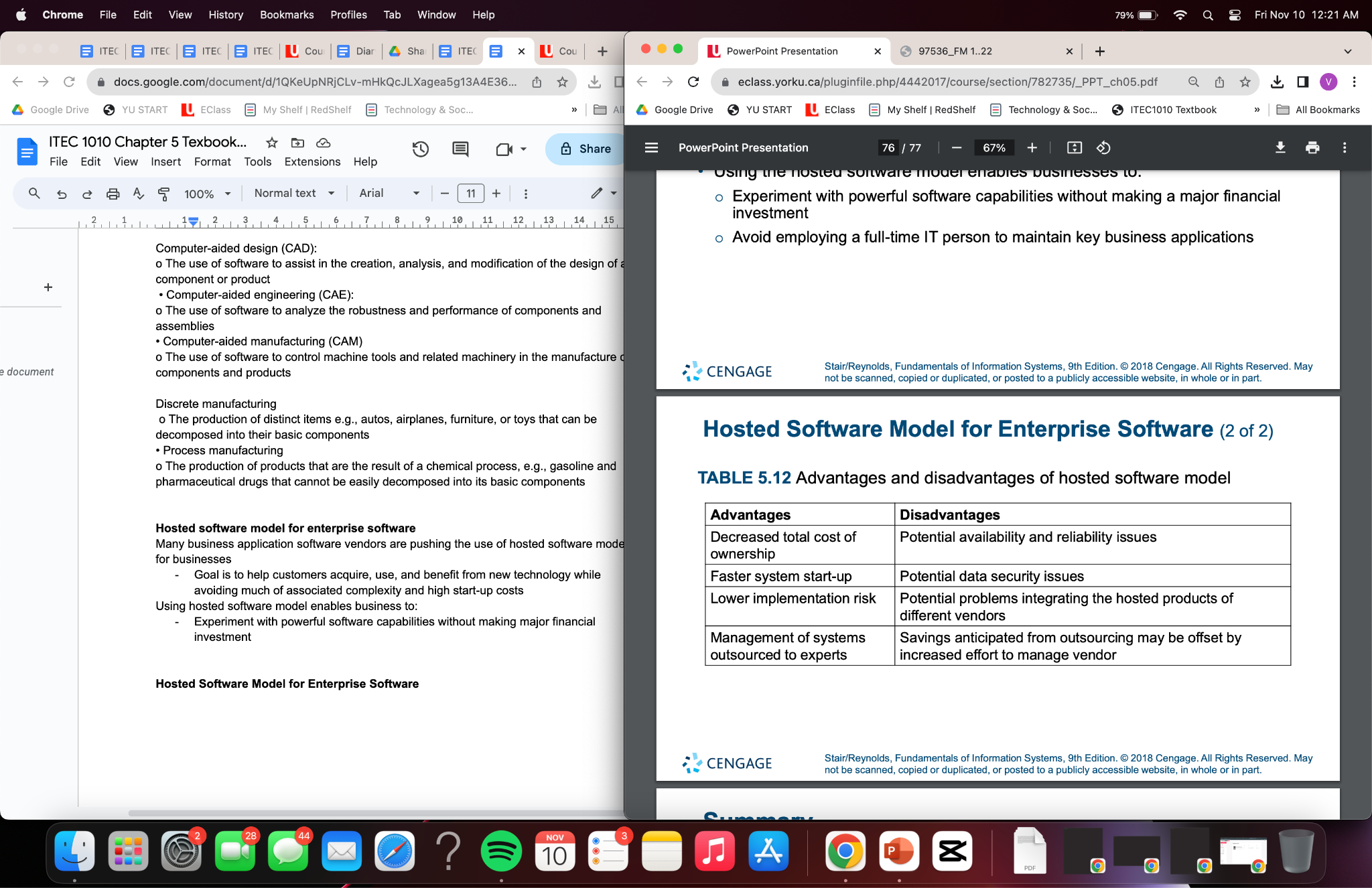
Hosted Software Model for Enterprise Software
Summary
Electronic and mobile commerce are evolving, providing new ways of conducting business that present both potential benefits and problems
• E-commerce and m-commerce require the careful planning and integration of a number of technology infrastructure components
• An organization must have information systems that support routine, day-today activities and that help a company add value to its products and services
• An organization that implements an enterprise system is creating a highly integrated set of systems, which can lead to many business benefits
TEXTBOOK NOTES
- Business-to-business (B2B) e-commerce: is subset of e-commerce in which all the participants are organizations
- B2B e-commerce is a useful tool for connecting business partners in virtual supply chain to cut resupply times and costs.
Summary of notes:
- B2B (business-to-business) market is larger and growing faster than the B2C market.
- In 2015, B2B sales in the United States exceeded $780 billion, twice the size of B2C commerce.
- Top e-commerce priorities for B2B buyers include transparent pricing, easily accessible product details, purchase tracking, and personalized recommendations.
- Grainger is a B2B distributor specializing in facilities maintenance, repair, and operations (MRO) with over 1.5 million products online.
- In 2015, Grainger's online sales surpassed $4 billion, accounting for over 40 percent of the total sales.
- Grainger's e-commerce success is attributed to its suite of mobile apps, allowing customers to access and order products conveniently.
- 15 percent of Grainger's e-commerce traffic comes from mobile devices.
Business-to-consumer E-commerce
- Business-to-consumer (B2C) e-commerce: form of e-commerce in which customers deal directly with an organization and avoid intermediaries
Summary of notes:
- B2C e-commerce allows producers or providers of consumer products to sell directly to consumers, eliminating intermediaries.
- This direct selling model can reduce costs and inefficiencies in the supply chain, potentially leading to higher profits for businesses and lower prices for consumers.
- The elimination of intermediaries between the producer and the consumer is known as disintermediation.
- The Internet serves as more than just a platform for placing orders, enabling consumers to compare prices, features, and value.
- Shoppers can easily access information about various products and services, including automobiles, cruises, loans, insurance, and home prices.
- Online tools, such as shopping bots and websites like eBay, Shopping.com, Google Shopping, Shopzilla, PriceGrabber, Yahoo! Shopping, and Excite, allow consumers to browse the Internet, compare items, prices, and merchants, and make informed purchasing decisions.
- Shoppers are drawn to B2C e-commerce due to cost savings on various goods and services like stocks, books, newspapers, airline tickets, and hotel rooms.
- Personalization: is the process of tailoring web pages to specifically target individual consumers
- Personalization plays a role in B2C e-commerce growth, with examples like Nike's NIKEiD service allowing customers to customize shoes.
- Effective use of social media networks by companies, such as Vera Bradley, contributes to reaching consumers, promoting products, and generating online sales.
- The trend of consumers researching products online and then making purchases at local stores, termed Web-influenced sales, is significant, estimated to exceed $1.7 trillion or about 40 percent of total retail sales.
- Amazon is highlighted as the dominant B2C retailer in the United States, with nearly $72 billion in web sales in 2015.
Consumer-to-consumer e-commerce
- Consumer-to-consumer (C2C) e-commerce: subset of e-commerce that involves electronic transactions between consumers using a third party to facilitate the process.
- eBay is a prominent example of a C2C (customer-to-customer) e-commerce site where users buy and sell items to each other.
- Founded in 1995, eBay has become one of the most popular websites globally, with a net revenue of $8.5 billion in 2015.
- Other popular C2C sites include Bidz.com, Craigslist, eBid, Etsy, Fiverr, Ibidfree, Kijiji, Ubid, and Taobao.
- The growth of C2C has led to a significant decline in the use of classified pages in newspapers for advertising and selling personal items and services, negatively impacting the newspaper industry.
- However, C2C has created opportunities for individuals to earn a living by selling items on auction websites.
- In 2015, eBay reported a gross merchandise volume of $82 billion for items sold on its platform.
- Table 5.2 is mentioned as summarizing the key factors that differentiate B2B, B2C, and C2C e-commerce.
E-Government
- E-government is use of information and communication technology to simplify the sharing of information, speed formerly paper-based processes, and improve the relationship between citizens and government
Government E-Government Categories:
- G2C: Citizens use applications for tasks like tax returns, license renewals, and healthcare enrollment.
- G2B: Procurement support for businesses, with platforms like Business.USA.gov and FedBizOpps.gov.
- G2G: Facilitates transactions between government entities, such as reporting services like Government to Government Services Online (GSO).
Examples:
- U.S. GSA Auctions for public bidding on government assets.
- Healthcare.gov for healthcare options and enrollment.
- State e-government services, like Oregon's program, promoting digital government and saving taxpayer money.
Mobile Commerce
- - Mobile commerce (m-commerce) relies on mobile devices like tablets and smartphones for placing orders and conducting business.
- - Smartphone manufacturers such as Apple, Huawei, Lenovo, LG, Samsung, and Xiaomi collaborate with communications carriers like AT&T, Sprint/Nextel, T-Mobile, and Verizon to support m-commerce.
- - The .mobi domain, created by ICANN in 2005, aims to attract mobile users to the web, administered by Afilias to ensure compatibility with all mobile devices.
- - M-commerce is rapidly growing, with Japan, the United Kingdom, and South Korea leading globally.
- - In North America, m-commerce adoption is later due to fragmented network infrastructure and credit card dominance.
- - Worldwide, m-commerce constituted 35% of retail e-commerce sales in Q4 2015, with the U.S. seeing a 15% growth in mobile e-commerce transactions.
- - The growth of mobile websites is fueled by advances in wireless broadband, application development, and the availability of powerful yet affordable smartphones.
- - Challenges for m-commerce include the relative clumsiness of mobile browsers and security concerns, which need addressing for further growth.
Advantages of Electronic and Mobile Commerce
- Conversion to an e-commerce or m-commerce system enables organizations to reach new customers, reduce the cost of doing business, speed the flow of goods and information, increase the accuracy of order processing and order fulfillment, and improve the level of customer service.
Reach New Customers
The establishment of an e-commerce website provides organizations with the opportunity to reach new customers in new markets, a primary motivation for creating a web presence.
- Founded in 1978, Shoe Carnival, a chain with over 400 footwear stores, initially used its website for informational purposes.
- Recently, the company launched a full e-commerce site, incorporating social shopping tools like customer-generated reviews.
- The e-commerce site expands Shoe Carnival's reach to areas without physical stores.
- The company focuses its national advertising on driving traffic to the online platform, aiming to recreate its "surprise and delight" concept online to stand out from other online shoe stores.
Reduce costs
Streamlining e-commerce processes offers significant benefits:
1. Increased Efficiency:
- By eliminating or reducing time-consuming steps, more sales can be completed with increased accuracy.
2. Inventory Optimization:
- Improved speed and accuracy reduce the need for excess inventory at various points in the manufacturing, storage, and transportation process.
BloomNation Example:
- BloomNation, a community marketplace for unique bouquets, addresses high commissions from floral wire services.
- Over 1,500 florists benefit from increased exposure without some staffing costs.
- BloomNation charges lower per-order fees (10%) compared to larger wire services (27%), providing cost advantages for florists.
In essence, optimizing e-commerce processes enhances efficiency, reduces costs, and fosters a more competitive marketplace.
Speed the Flow of goods and information
The connection between organizations and customers through e-commerce accelerates the flow of information, facilitated by established electronic connections and communications. This allows for easy, direct, and rapid transmission of information from buyers to sellers.
Shutterfly Example:
- Shutterfly, an online provider of photographic products, achieves $1 billion in annual sales.
- While primarily B2C focused, Shutterfly also offers B2B marketing products and services through its website.
- Business customers benefit from e-commerce capabilities, automated workflows, and large-scale production centers, allowing quick customization and order placement, reducing project completion times from weeks to days.
In summary, e-commerce facilitates swift information exchange, and businesses like Shutterfly showcase how it streamlines processes and enhances efficiency for both B2C and B2B transactions.
Increase Accuracy
- E-commerce enables buyers to input product specifications directly, eliminating data-entry errors for suppliers and ensuring order accuracy. Domino’s, a major pizza chain, exemplifies this by allowing customers to order directly through its e-commerce site, with half of its sales coming from online orders. Features like Easy Order and Pizza Profiles streamline the process, making ordering efficient and error-free.
Improve Customer service
- Detailed information on delivery and order status enhances customer loyalty by ensuring timely delivery of quality goods. Sticker Mule's user-friendly e-commerce site streamlines the ordering process, with quick approvals and consolidated customer support channels. Their sophisticated help center and interactive features contribute to customer satisfaction and engagement.
E-commerce Challenges
- A company must overcome many challenges to convert its business processes from the traditional form to e-commerce processes, especially for B2C e-commerce. As a result, not all e-commerce ventures are successful.
- The following are three key challenges to e-commerce:
- (1) dealing with consumer privacy concerns,
- (2) overcoming consumers’ lack of trust, and
- (3) overcoming global issues.
Dealing with consumer privacy concerns
- - Two-thirds of U.S. Internet users shop online for convenience, but about one-third refrain due to privacy concerns or mistrust.
- - Companies must invest substantially in the latest security technology and skilled experts to safeguard customer data and avoid potential legal action.
- - Class action lawsuits are common for privacy breaches, with damages often seeking millions for emotional distress and loss of privacy.
- - Companies also incur expenses for customer credit monitoring and identity theft insurance to ensure data security.
- - Both large and small companies invest in robust security measures, with smaller ones often relying on services like Symantec for enhanced customer confidence in e-commerce transactions.
Overcoming consumers lack of trust
- Lack of trust in online sellers is a common reason consumers hesitate to purchase online.
- Concerns include uncertainty about the legitimacy of the seller, whether the purchased item will be sent, and potential issues with the product or service received.
- Online marketers must employ trust-building strategies, such as offering first-time incentives, loyalty programs, and soliciting customer feedback.
- Demonstrating a long business history, substantial website investment, and brand endorsements from experts can enhance trust.
- Participation in regulatory programs or industry associations, along with displaying accreditations from organizations like the Better Business Bureau Online or TRUSTe, can further establish trustworthiness.
Overcoming Global issues
E-commerce and M-commerce Opportunities:
- Enable manufacturers to source supplies globally at low costs.
- Offer enterprises immediate access to a global market.
- Provide developing countries with opportunities to enter the global marketplace, potentially reducing the wealth gap.
Cultural challenges. Great care must be taken to ensure that a Web site is appealing, easy to use, and not offensive to potential customers around the world.
● Language challenges. Language differences can make it difficult to understand the information and directions posted on a Web site.
● Time and distance challenges. Significant time differences make it difficult for some people to be able to speak to customer services representatives or to get technical support during regular waking hours.
● Infrastructure challenges. The Web site must support access by customers using a wide variety of hardware and software devices.
● Currency challenges. The Web site must be able to state prices and accept payment in a variety of currencies.
State, regional, and national law challenges. The Web site must operate in conformance to a wide variety of laws that cover a variety of issues, including the protection of trademarks and patents, the sale of copyrighted material, the collection and safeguarding of personal or financial data, the payment of sales taxes and fees, and much more.
Manufacturing
- Electronic exchange: an electronic forum where manufacturers, suppliers, and competitors buy and sell goods, trade market information, and run back-office operations
- This approach speeds up the movement of raw materials and finished products and reduces the amount of inventory that must be maintained. It also leads to a much more competitive marketplace and lower prices.
**Types of Exchanges:**
1. Private Exchanges:
- Owned and operated by a single company.
- Exclusively for trading with established partners.
- Example: Walmart's Retail Link.
2. **Consortium-Operated Exchanges:**
- Run by competing companies with common procurement needs.
- Example: Covisint, serving major auto manufacturers.
3. **Independent Exchanges:**
- Open to any buyers and sellers within a market.
- Provide services and a common platform for a fee.
- Example: Tinypass, an e-commerce platform for flexible content publishing.
Tinypass Example:
- Enables flexible e-commerce for content publishers.
- Offers various payment models and allows crowdfunding on websites directly.
- Bypasses third-party platforms like GoFundMe or Kickstarter.
Marketing
- Market segmentation: the identification of specific markets to target them with tailored advertising messages
Web-enabled Customer Data Analysis:
- The Web facilitates extensive gathering of customer behavior and preferences during information gathering and purchase decisions.
- Data analysis is complex due to the interactive nature of the Web and customers voluntarily providing or withholding personal data.
- Internet advertisers utilize this data for market segmentation, dividing potential customers based on demographic characteristics like age, gender, marital status, income, and location.
B2B Market Segmentation Advancements:
- Historically, B2B market segmentation was challenging due to limited firmographic data accessibility.
- eXelate, a Nielsen subsidiary, partnered with Dun & Bradstreet to offer a data-as-a-service solution.
- Provides access to a database with over 250 million business records, including vital company information like contact names, job titles, locations, employee count, sales figures, and industry codes (SIC and NAICS).
- Enables analysts to identify, access, and segment potential B2B audiences, estimate sales potential, and rank businesses against each other.
Advertising
Mobile Ad Networks:
- Distribute mobile ads to publishers like websites, app developers, and mobile operators.
- Ads bought through CPM, CPC, or CPA; success measured by user reach, CTR, and actions like downloads.
- Advertisers value data for assessing effectiveness and may purchase it from networks or third parties.
InMobi's Approach:
- Reaches 1 billion users with 130 billion monthly ad impressions.
- Uses "appographic targeting" based on attributes of 10,000+ apps to categorize users into 200 segments for precise targeting in app-install campaigns.
M-Commerce Advantages:
- Single-user m-commerce devices enable easy access to personal info for targeted messaging.
- Companies can establish one-to-one marketing relationships, communicating conveniently with individual consumers anytime, anywhere.
Bartering
Bartering in Economic Slowdown:
- Slow economic growth and stagnant wages led to a resurgence in bartering for goods and services.
- Various websites, as listed in Table 5.3, support this bartering trend.
- Businesses engage in bartering to reduce excess inventory, gain new customers, or avoid cash payments for raw materials/services.
- Bartering appeals to cash-strapped customers as an alternative to using scarce dollars.
Bartering Considerations:
- Bartering transactions involve tax-reporting, accounting, and record-keeping responsibilities.
- The IRS hosts a Bartering Tax Center providing details on tax laws and responsibilities for bartering transactions.
Retargeting
Shopping Cart Abandonment and Retargeting:
- Approximately 74% of online shopping carts are abandoned, representing over $4 trillion worth of merchandise in 2013.
- "Retargeting" is a technique used to recapture abandoned cart shoppers through personalized ads directing them back to a retailer's site.
- Example: A visitor abandoning the men's clothing section might see banner ads featuring men's clothing items, possibly even the exact items viewed.
- Retargeting can include comments and recommendations from other consumers who purchased the same items, ensuring potential consumers see relevant ads for products they've shown interest in.
Price Comparison
**Mobile Price Comparison Apps:**
- Many companies offer mobile apps facilitating online price and product comparisons.
- **RedLaser:** Enables quick price comparison by scanning a product's barcode.
- **Amazon's Price Check App:** Allows searching for pricing by taking a picture of a book, DVD, CD, or video game cover.
- **Barcode Scanner App:** Permits scanning UPC or Quick Response codes for price comparison and accessing the latest product reviews.
Couponing
**Coupon Distribution:**
- In 2015, $515 billion in incentives via 286 billion FSI coupons, with only 0.95% redemption.
**Digital Coupons:**
- Businesses offer high-redeeming digital coupons, including printables, email, and mobile coupons via SMS.
**Proximity Marketing:**
- In-store beacons with Bluetooth tech deliver mobile coupons, estimated to reach 1.5 billion by 2020.
**Online Marketplaces:**
- Groupon, LivingSocial introduce modern digital couponing, requiring a minimum sign-up and a fee (up to 50%) upon customer purchase.
Investment and Finance
**Internet's Impact on Finance:**
- The Internet revolutionized the finance and investment industry, addressing inherent inefficiencies.
**Online Trading Evolution:**
- The brokerage sector swiftly adapted to online trading, outpacing other finance segments.
- Online trading enables quick, cost-effective share purchases after thorough research.
**Fidelity's Mobile Trading Apps:**
- Fidelity embraces the allure of online trading, providing mobile apps for tablets, smartphones, and Apple Watch.
- The apps offer a secure platform for investors to monitor portfolios, access real-time stock quotes, track preferred stocks, and execute trades.
Banking
**Online Banking Benefits:**
- Online banking provides customers with features like checking balances, transferring money, and bill payments.
- Customers enjoy the convenience, reduced paperwork, and environmental benefits of online bill payment.
**Banking Trends in the U.S.:**
- Major and smaller U.S. banks offer online bill payment, extending support to mobile devices.
- Banks encourage online bill payment, eliminating associated fees to attract and retain customers.
**Mobile Banking Advantages:**
- Mobile banking users can check credit card balances before purchases and transfer funds to prevent overdrafts.
**M-Pesa Mobile Payment System:**
- M-Pesa, operated by Safaricom and Vodacom, is a leading mobile payment system in Kenya and Tanzania.
- With 20 million users worldwide, M-Pesa offers services such as deposits, withdrawals, transfers, loans, savings, bill pay, and salary disbursements.
- In 2013, over 40% of Kenya's GDP flowed through M-Pesa, showcasing its significant impact.
Hardware
**E-Commerce Infrastructure:**
- Robust web server hardware and software are essential for e-commerce.
- Scalability is crucial for handling varying transaction volumes.
**Performance Measures:**
- Key metrics include response time (<1 second), transaction success rate (99% or better), and system availability (minimal downtime).
**Hosting Considerations:**
- Companies decide between hosting their site or using third-party providers.
- Third-party providers offer cost-effective solutions with rented space, high-speed internet, and trained personnel.
**Example: Key Performance Measures for Popular Online Retailers:**
| Retailer | Response Time | Transaction Success | System Availability |
|------------|---------------|----------------------|----------------------|
| Amazon | < 1s | 99% or better | Minimal downtime |
| eBay | < 1s | 99% or better | Minimal downtime |
| Walmart | < 1s | 99% or better | Minimal downtime |
| Target | < 1s | 99% or better | Minimal downtime |
| Best Buy | < 1s | 99% or better | Minimal downtime |
Web server software
- Essential for fundamental services like security, identification, page retrieval, tracking, and development.
- Apache HTTP Server and Microsoft Internet Information Services are the most widely used software packages.
E-commerce software
**E-Commerce Software Essentials:**
1. **Catalog Management:**
- Create and update the product catalog.
2. **Product Configuration:**
- Assist customers in selecting components and options.
3. **Shopping Cart Facilities:**
- Track selected items for purchase.
4. **Transaction Processing:**
- Facilitate e-commerce transactions.
5. **Web Traffic Data Analysis:**
- Provide insights for site operation adjustments.
Mobile Commerce Hardware and Software
1. **User Interface Improvement:**
- Make wireless purchases as easy as on a PC.
2. **Network Speed Improvement:**
- Ensure faster network speeds for a seamless experience.
3. **Security Measures:**
- Address concerns with secure transmission and trusted transactions.
- Encryption for secure transmission.
- Digital certificates to verify parties involved.
4. **Overcoming Device Limitations:**
- Small screens, limited data entry, and lower processing power.
- Web applications adaptation for mobile users.
Electronic Payment Systems
**Key Components of E-Commerce Payment Systems:**
1. **User Identification and Encryption:**
- Utilize user identification and encryption for transaction security.
2. **Payment Methods:**
- Electronic cash.
- Electronic wallets.
- Smart, credit, charge, and debit cards.
3. **Diversified Payment Options:**
- Accept multiple payment types for increased customer conversion.
- Offering various payment methods enhances user experience.
- Digital certificate: an attachment to an email message or data embedded in a web site that verifies the identity of a sender or web site
- Certificate authority (CA): a trusted third party organization or company that issues digital certificates
1. **Digital Certificates:**
- Attachments to emails or embedded in websites.
- Verify the identity of a sender or website.
- Issued by a trusted Certificate Authority (CA).
2. **Payment Card Industry (PCI) Security Standard:**
- Adopted by organizations handling credit card transactions.
- Ensures security measures to protect card issuers, cardholders, and merchants.
- Includes firewall configuration, secure passwords, data encryption, antivirus software, and restricted data access.
**Credit Card Security Measures:**
1. **AVS (Address Verification System):**
- Compares card issuer's address with the billing address.
2. **CVN (Card Verification Number):**
- Checks additional digits on the card for added security.
3. **Visa's Advanced Authorization:**
- Considers factors like transaction value, merchant type, and purchase time.
- Provides instant fraud rating for each transaction.
4. **FFIEC Guidelines:**
- Recommends two-factor authorization for internet banking.
- Options include biometrics, one-time passwords, and hardware tokens.
5. **Biometric Technology:**
- Slow adoption due to cost and privacy concerns.
- MasterCard's Identity Check captures facial features for authentication.
- ApplePay uses fingerprint sensors for secure transactions on iPhones.
Transport Layer Security
- Transport Layer Security (TLS): a communication protocol or system of rules that ensures privacy between communicating applications and their users on the internet
Electronic cash
- Electronic cash: an amount of money that is computerized, stored, and used as cash for e-commerce transactions
- Ex. paypal
Traditional transactions processing methods and objectives
- batch processing systems: a form of data processing whereby business transactions are accumulated over a period of time and prepared for processing as a single unit or batch
- Online transaction processing (OLTP): form of data processing where each transaction is processed immediately without the delay of accumulating transactions into a batch
- Essential for businesses like airlines, ticket agencies, stock investment firms
Because of the importance of transaction processing, organizations expect their TPSs to accomplish a number of specific objectives, including the following:
● Capture, process, and update databases of business data required to support routine business activities
● Ensure that the data is processed accurately and completely
● Avoid processing fraudulent transactions
● Produce timely user responses and reports
● Reduce clerical and other labor requirements
● Help improve customer service
● Achieve competitive advantage
**Key Transaction Processing Systems:**
1. Order Processing Systems:
- Crucial for organizational functioning, often referred to as the "lifeblood."
- Begins with receiving customer orders and checking inventory availability.
- Planning and shipment process with a pick list generated at the warehouse.
- Items are gathered, inventory updated, and a customer invoice is created.
- The invoice is included in the customer shipment.
2. Accounting Systems:
- Track data related to all cash flows affecting the organization.
- Order processing system generates invoices, updating accounts receivable.
- Payments received are used to update customer accounts.
- Accounting transactions are sent to the general ledger system.
- Manages amounts owed by customers and due to vendors.
- Records and reports all financial transactions for the company.
3. Purchasing Systems:
- Includes inventory control, purchase order processing, receiving, and accounts payable.
- Employees place purchase order requests in response to inventory shortages.
- Purchase order information flows to receiving and accounts payable systems.
- Record creation upon receiving ordered items.
- Invoices from suppliers are matched to the order and receiving report.
- Check generation if all data is complete and consistent.
**Past Approach:**
- Organizations used a mix of systems, often a patchwork of in-house, contracted, and off-the-shelf applications.
- Customization and modification were common to ensure efficient integration.
- Manual data reentry between systems was sometimes necessary, leading to increased effort, delays, and errors.
**Contemporary Approach:**
- Many organizations now prefer integrated transaction processing systems.
- Implemented from a single or limited number of vendors.
- Automatic data flow between applications without delays or manual reentry.
- Streamlines processes, reduces errors, and enhances efficiency.
**Example: Lukas Nursery:**
- Adopted an integrated retail business management solution.
- Consolidated systems for Point of Sale (POS) and other operations.
- Provided by a single vendor, enhancing business practices, inventory management, customer loyalty, and analytics capabilities.
Transaction Processing Systems for Small- and Medium-Sized Enterprises
- Designed for small- and medium-sized enterprises (SMEs).
- Tailored for legally independent businesses with up to 500 employees.
- Quick and easy installation.
- User-friendly operation.
- Affordable, with a low total cost of ownership.
- Ideal for firms outgrowing current software.
- Cost-effective alternative to high-end integrated systems.
Transaction Processing activities
- Transaction processing cycle: process of data collection, data editing, data corrections, data processing, data storage, document production
Data collection
- Data collection: capturing and gathering all data necessary to complete the processing of transactions
- Can be done manually sometimes, like by collecting handwritten sales orders or inventory update forms.
- Source data automation: capturing data at its source and recording it accurately in a timely fashion, with minimal manual effort and in an electronic or digital form so it can be directly entered into the computer
- An example of source data automation is an automated device at a retail store that speeds the checkout process—either UPC codes read by a scanner or RFID signals picked up when the items approach the checkout stand.
Data editing
- Data editing: checking data for validity and completeness to detect any problems
Data correction
- Data correction: reentering data that was not typed or scanned properly
Data processing:
- Data processing: Performing calculations and other data transformations related to business transactions
- Performing calculations and other data transformations related to business transactions
Data storage
- data storage: Updating one or more databases with new transactions.
Document production
- document production: Generating output records, documents, and reports.
- These can be hard-copy paper reports or displays on computer screens (sometimes referred to as soft copy). Printed paychecks, for example, are hard-copy documents produced by a payroll TPS, whereas an outstanding balance report for invoices might be an electronic report displayed by an accounts receivable TPS.
Enterprise Resource Planning
**Enterprise Resource Planning (ERP):**
- **Definition:** Integrated programs managing vital business operations for entire organizations.
- **Scope:** Covers even complex, multisite, and global organizations.
- **Business Procedure Focus:** Coordinates and manages activities to generate valuable outputs for both external and internal customers.
- **Example:** Capturing a sales order or managing the shipment process.
- **Core Component:** Centralized database shared by all users.
- **Purpose:** Provides current and consistent data for operational decision-making and planning.
Advantages of ERP
- **Drivers for Demand:**
- Increased global competition.
- Executive need for control over total cost and product flow.
- Growing number of customer interactions.
- **ERP Contribution:**
- **Integrated Software:** Provided by a single vendor.
- **Primary Benefits:**
- Improved access to quality data for operational decision-making.
- Elimination of costly, inflexible legacy systems.
- Improvement of work processes.
- Opportunity to upgrade and standardize technology infrastructure.
- **Specialized Solutions:**
- ERP vendors offer industry-specific systems for effective solutions in diverse sectors and market segments.
Improved Access to Quality Data for Operational Decision Making
**ERP System Integration and Benefits:**
- **Integrated Database:**
- ERP systems use one integrated database for all business functions.
- Supports decisions on sourcing and cost accounting across the enterprise.
- **Data Integration:**
- Data is integrated from the start, avoiding the need for multiple data sources.
- Creates a seamless organization for improved decision-making and customer interactions.
- **Quality Data for Decision Making:**
- High-quality data is crucial for ERP systems to enhance decision-making.
- **Case Example - Women’s World Banking:**
- Implemented ERP for streamlined operations and transparent financials.
- Significant time savings in accounts payable and grant reporting.
- Improved visibility into spending across entities, grants, donors, and projects.
Improvement of Work Processes
Best practices: the most efficient and effective ways to complete a business process
Customer Relationship management
- customer relationship management (CRM) system: A system that helps a company manage all aspects of customer encounters, including marketing, sales, distribution, accounting, and customer service.
- **Purpose:**
- Advanced address book tracking customer interactions.
- **Objective:**
- Understand and predict customer needs.
- Enhance retention, loyalty, and sales optimization.
- **Usage:**
- Key for sales, marketing, distribution, accounting, and service teams.
- **Impact:**
- Improves customer satisfaction, retention, and reduces operating costs.
CRM software automates and integrates the functions of sales, marketing, and service in an organization. The objective is to capture data about every contact a company has with a customer through every channel and to store it in the CRM system so that the company can truly understand customer. Actions
Key features of CRM system are:
- Contact management. The ability to track data on individual customers and sales leads and then access that data from any part of the organization. See Figure 5.14, which shows the SAP Contact Manager.
- Sales management. The ability to organize data about customers and sales leads and then to prioritize the potential sales opportunities and identify appropriate next steps.
- ● Customer support. The ability to support customer service representatives so that they can quickly, thoroughly, and appropriately address customer requests and resolve customer issues while collecting and storing data about those interactions.
- ● Marketing automation. The ability to capture and analyze all customer interactions, generate appropriate responses, and gather data to create and build effective and efficient marketing campaigns.
- ● Analysis. The ability to analyze customer data to identify ways to increase revenue and decrease costs, identify the firm’s “best customers,” and determine how to retain and find more of them.
- ● Social networking. The ability to create and join sites such as Facebook, where salespeople can make contacts with potential customers.
- ● Access by mobile devices. The ability to access Web-based customer relationship management software by smartphones, tablets, and other mobile devices.
- ● Import contact data. The ability for users to import contact data from various data service providers that can be downloaded for free directly into the CRM application.
Product Lifecycle Management (PLM)
- product lifecycle management (PLM): An enterprise business strategy that creates a common repository of product information and processes to support the collaborative creation, management, dissemination, and use of product and packaging definition information.
- product lifecycle management (PLM) software: Software that provides a means for managing the data and processes associated with the various phases of the product life cycle, including sales and marketing, research and development, concept development, product design, prototyping and testing, process design, production and assembly, delivery and product installation, service and support, and product retirement and replacement.
The scope of PLM software may include computer-aided design, computer-aided engineering, and computer-aided manufacturing
computer-aided design (CAD): The use of software to assist in the creation, analysis, and modification of the design of a component or product.
computer-aided engineering (CAE): The use of software to analyze the robustness and performance of components and assemblies.
computer-aided manufacturing (CAM): The use of software to control machine tools and related machinery in the manufacture of components and products.
- **Users:**
- **Internal:** Engineering, operations, procurement, marketing, QA, customer service, etc.
- **External:** Design partners, packaging/raw material suppliers, contract manufacturers.
- **Collaboration:**
- Essential for defining, maintaining, updating, and securely sharing product information.
- Nondisclosure agreements often required for external users to protect proprietary data.
- **Case Study: Water Pik:**
- **Industry:** Personal and oral healthcare products.
- **Challenges:** Inefficiencies in development and manufacturing processes.
- **Solution:** Implemented SofTech’s ProductCenter PLM software.
- **Benefits:** Efficient management of CAD product data and business processes, ensuring compliance with industry standards.
Overcoming challenges in implementing enterprise systems
1. **Complexity:**
- Resource-intensive and demanding.
- Requires top-tier IT and business professionals and strong management support.
2. **Failure Rates:**
- High failure rates observed, with around half of evaluated implementations deemed unsuccessful.
3. **Case Example - H.B. Fuller vs. Accenture:**
- H.B. Fuller received $14 million due to a failed SAP ERP system implementation handled by Accenture.
- Issues arose post-launch, leading to additional unplanned expenses.
**Common Challenges:**
- **Scope Creep:** Expanding project scope.
- **Resistance to Change:** Employee and organizational resistance.
- **Inadequate Training:** Lack of training for end-users.
- **Poor Planning:** Insufficient planning and management support.
- **Data Migration Issues:** Problems with transferring data.
- **Communication Challenges:** Poor communication among stakeholders.
- **Vendor-related Problems:** Issues with software vendors and consultants.
The following list provides tips for avoiding many common causes for failed enterprise system implementations:
● Assign a full-time executive to manage the project.
● Appoint an experienced, independent resource to provide project oversight and to verify and validate system performance.
● Allow sufficient time to transition from the old way of doing things to the new system and new processes.
● Allocate sufficient time and money for training staff; many project managers recommend budgeting 30 to 60 days per employee for training.
● Define metrics to assess project progress and to identify project-related risks.
● Keep the scope of the project well defined and contained to essential business processes. ● Be wary of modifying the enterprise system software to conform to your firm’s business practices.
Hosted Software Model for Enterprise Software
**Advantages:**
1. **Cost-Efficiency:**
- Lower upfront costs.
- Pay-as-you-go model, reducing financial risk.
- No need for a full-time IT person.
2. **Flexibility:**
- Allows experimentation with powerful software capabilities.
- Easy disposal if the software doesn't meet expectations.
3. **Savings:**
- Reduced hardware costs.
- Lower expenses associated with maintaining a computer environment.
**Disadvantages:**
1. **Dependency on Internet Connectivity:**
- Relies on a stable internet connection.
2. **Limited Customization:**
- Some hosted solutions may limit customization options.
3. **Data Security Concerns:**
- Potential security concerns with data stored off-site.
4. **Vendor Dependency:**
- Reliance on the vendor for updates, support, and system availability.
5. **Subscription Costs:**
- Monthly subscription costs can accumulate over time.
**Key Software Vendors:**
- Applicor
- Intacct
- NetSuite
- SAP
- Workday
*Note: ERP = Enterprise Resource Planning, CRM = Customer Relationship Management.*
DO SELF ASSESSMENT
LOOK AT CAMERA ROLL FOR QUIZ