Domain and Range
domain of f(x) - set of allowable inputs (usually x)
range of f(x) - set of possible outputs (usually y)
f(x) = √x+1
domain is what x can be, from a starting number to an end number
range is what f(x) can be, from a starting number to an end number
x+1 ≠ -y, so x has to be greater than or equal to -1 (bcs -1 + 1 = 0)
this means the domain is [-1, ∞)
the √x of 0 = 0, so f(x) must be greater than or equal to 0
this means the range is [0, ∞)
x/0 = undefined
√-x = undefined
() = endpoint is not included in set
(0,5) = all numbers from 0-5, but not including 0 or 5
infinity signs (-∞,∞) always use parentheses
on a graph, () is represented with an OPEN dot
[] = endpoint is included in set
(0,5) = all numbers from 0-5, including 0 and 5
on a graph, [] is represented with a CLOSED dot
(x, ∞) = all numbers greater than x;
(-∞, x) = all numbers less than x
(-∞,∞) - all real numbers
domain limitations
(0,∞) - starts and includes 0, goes on for infinity
(-∞, 0) - starts and includes negative infinity numbers, ends at 0
f(x) = x²; domain (-∞,∞) , range (0,∞)
f(x) = √x; domain (0,∞), range (0,∞)
f(x) = log(x); domain (0,∞), (-∞,∞)
f(x) = ax; domain (-∞,∞), range (0,∞)
f(x) = 1/x; domain and range (-∞, 0) ∪ (0,∞)
polynomials = domain (-∞,∞) all real numbers
absolute value = domain (-∞,∞) all real numbers
integers - whole numbers (positive, negative, zero)
real numbers - all numbers (integers, fractions, decimals etc)
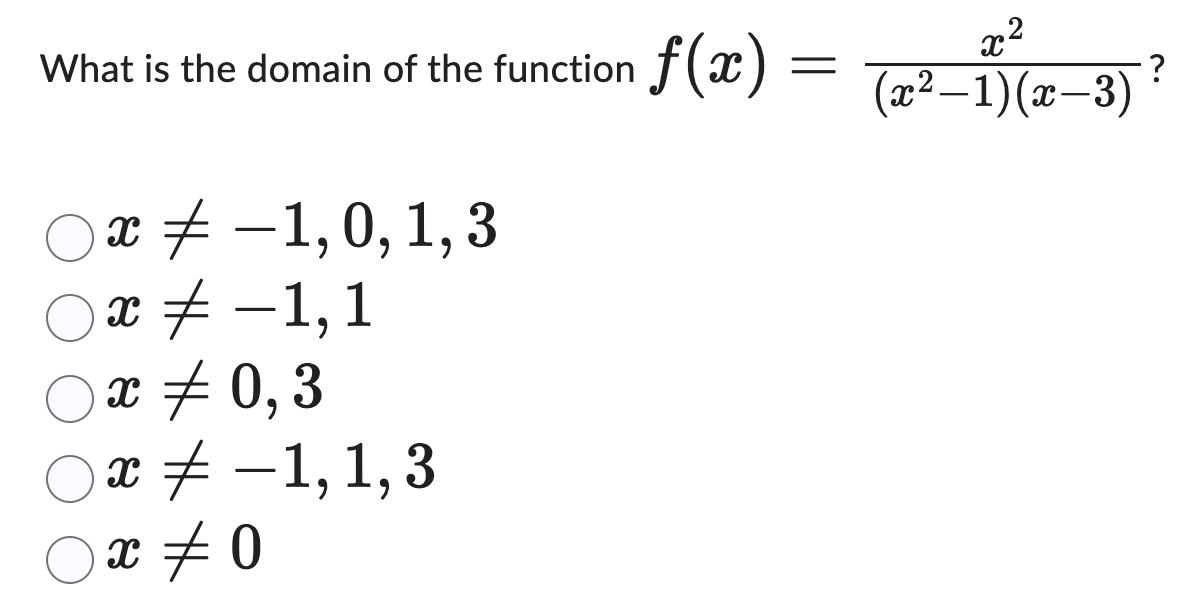
denominator can’t be 0 bcs it’s undefined
0² / (0² - 1) (0-3)
0 / (-1)(-3)
0/3; 0 is included in domain
3² / (3² - 1) (3-3)
9 / (8)(0)
9/0 = undefined; 3 is not included in domain
answer is x ≠ -1, 1, 3
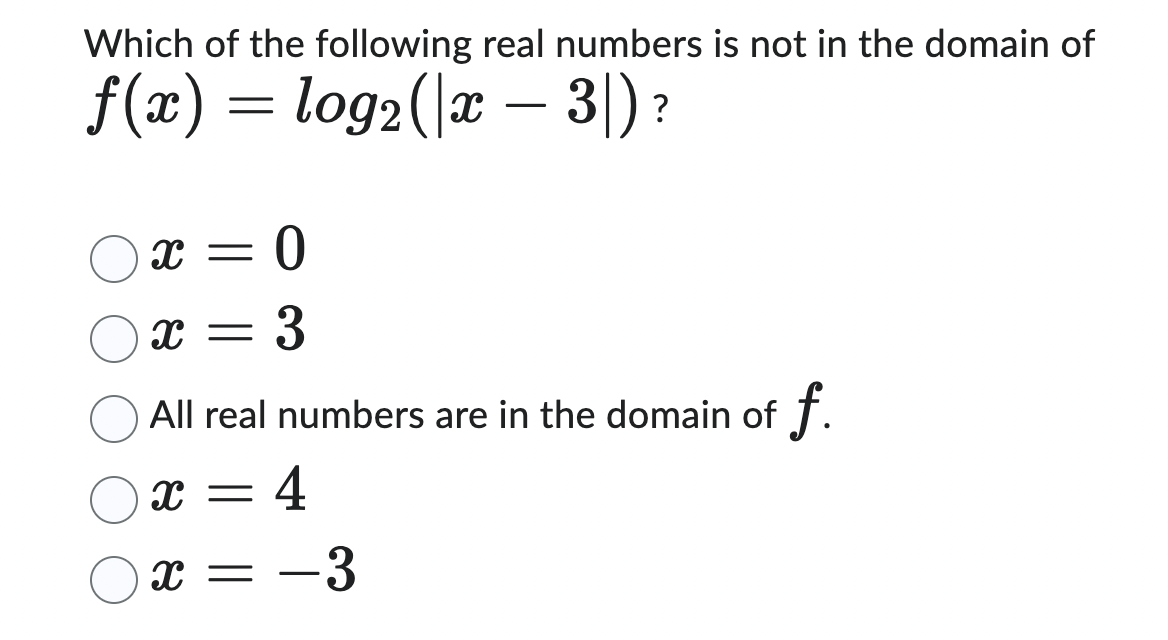
can’t be log 0 bcs its undefined
log2( |3-3| )
log2( |0| )
log20 = undefined; 3 is not included in domain
answer is x = 3
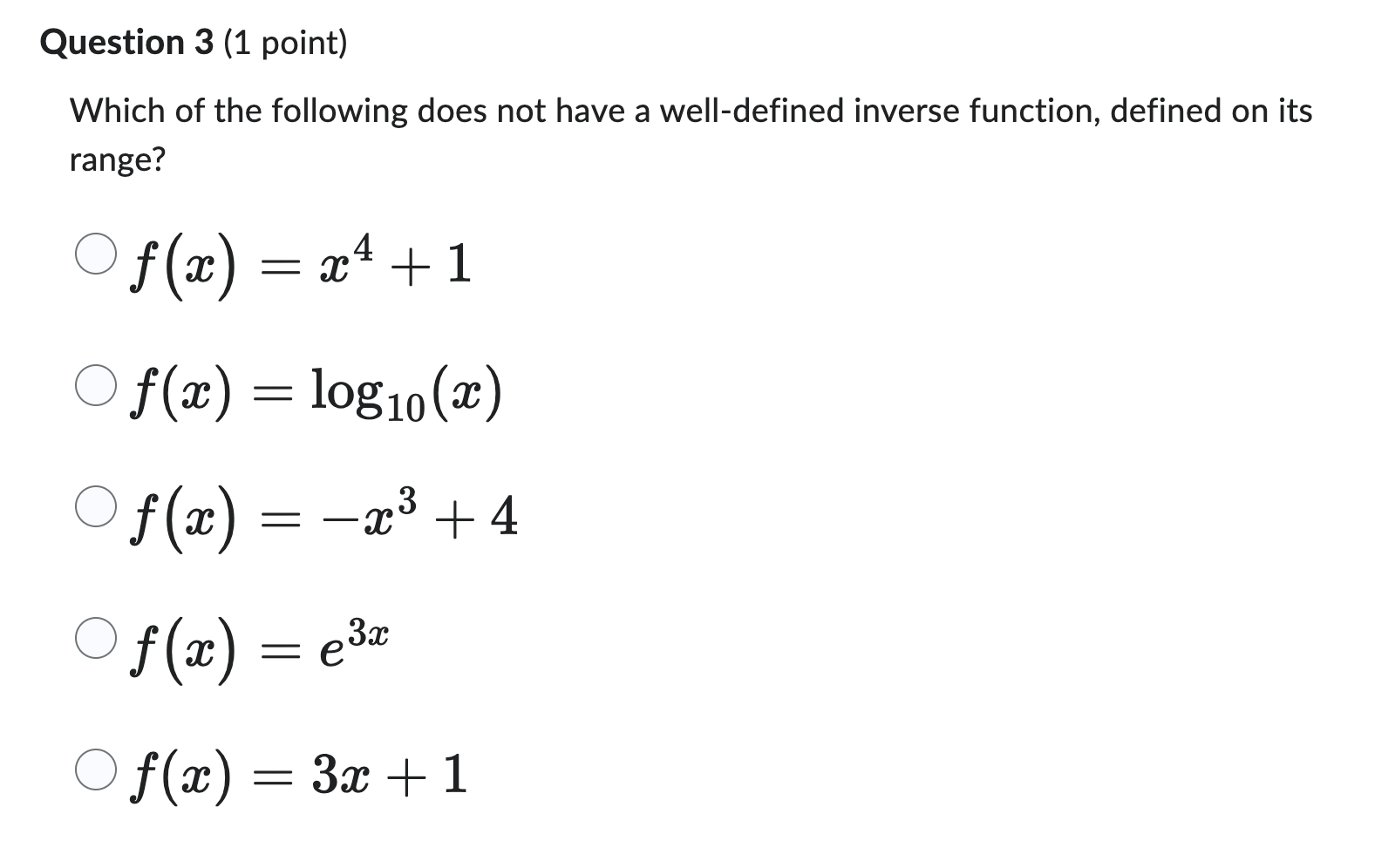
the range (y) can’t have a repeating output
f(x) = x4 + 1
f(-2) = 17
f(-1) = 2
f(0) = 1
f(1) = 2
f(-2) = 17
the range has multiple repeating outputs, so it doesn’t have a well defined inverse
answer is f(x) = x4 + 1