Medical Interventions 1.2.1 - 1.2.3
1.2.1: Antibiotic Therapy
Key Terms:
antibiotic: a substance produced by or derived from a microorganism and able in dilute solution to inhibit or kill another microorganism
Bacteria Cell Structure Functions
capsule: provides protection and aids in attachment
cytoplasm: houses cellular components and facilitates metabolic processes
flagella: enables movement and motility
inner cell membrane: controls transport of substances in and out of the cell
nucleoid DNA: contains the cell’s genetic information
outer cell membrane: serves as a protective barrier and regulates entry/exit of substances
peptidoglycan layer: offers structural support and maintains cell shape
pili: facilitate attachment to surfaces and genetic material exchange
plasmic DNA: carries additional genetic traits and can confer advantages
ribosomes: synthesize proteins necessary for cell functions
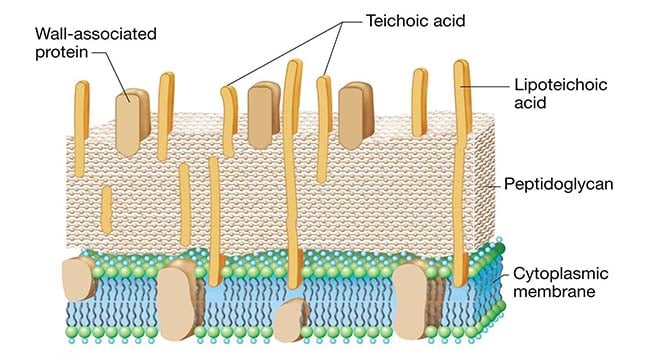
Gram + Bacteria Cell Wall
90% made up of peptidoglycan
single layer
teichoic acid
regulates:
cell shape & division
autolytic activity
ion homeostasis (Ca2+ & Mg2+)
protection from host defenses and antibiotics
surface charge
hydrophobicity
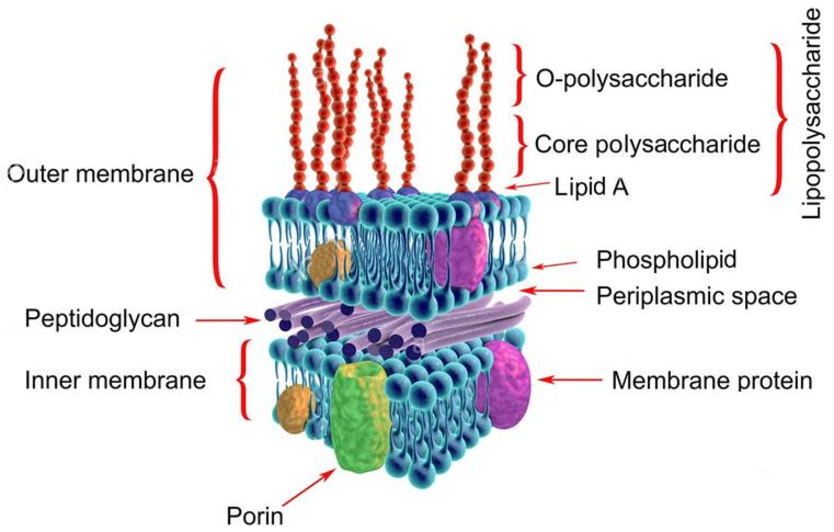
Gram - Bacterial Cell Wall
contains an outer membrane
double layer layer
doesn’t have teichoic acid
periplasm (periplasmic space)
not an empty space
contains many proteins with various functions
proteases
nucleases
phosphatases
beta-lactamases
What cellular components do some bacterial cells have that make them powerful pathogens?
Bacteria have components such as pili, flagella, and toxins that enhance the ability to adhere to host tissues and evade the immune system, making them powerful pathogens.
Why are penicillins often more effective against Gram-positive bacteria than Gram-negative bacteria?
Gram-positive bacteria have a thick peptidoglycan layer that penicillin can easily target, whereas Gram-negative bacteria have an outer membrane that protects them from penicillins.
Why is it important to understand the structure of a bacterial cell when developing an antibiotic?
Researchers can target specific components, such as the cell wall or ribosomes. Targeting these components helps kill'/inhibit bacteria survival and growth. This helps reduce the risks of harming human cells and resistance.
What is the purpose of prescribing corticosteroids for someone diagnosed with meningitis?
Corticosteroids are prescribed for meningitis to reduce inflammation and swelling in the brain, which can help alleviate symptoms and prevent further complications.
How do antibiotics work without harming the surrounding human cells?
Antibiotics work by targeting specific bacterial processes, such as cell wall synthesis or protein synthesis, which are absent in human cells, allowing them to eliminate bacteria without harming human tissues.
Why are antibiotics NOT effective against viruses?
Antibiotics are not effective against viruses because viruses lack the cellular structures and metabolic processes that antibiotics target. Instead, viruses hijack host cells to replicate, making them fundamentally different from bacteria.
1.2.3: Attack of the Superbugs
Bacteria Genetic Information
genes necessary for growth and reproduction are carried in the bacterial chromosomes
bacteria contain genes carried on rings of DNA outside of the nucleoid region
Gene Transfer Between Bacterial Cells
Conjugation: A process where bacteria transfer genetic material directly through physical contact, often via a pilus.
Two bacterial cells come into close proximity, often involving a pilus.
One bacterium (the donor) extends its pilus to attach to the other bacterium (the recipient).
The membranes of the two cells fuse, creating a conjugation bridge.
The donor bacterium replicates a portion of its plasmid DNA and transfers it through the conjugation bridge to the recipient cell.
The transferred plasmid DNA can remain as an independent plasmid or integrate into the recipient's chromosome through recombination.
The recipient cell expresses the new genetic traits conferred by the acquired DNA, which can include antibiotic resistance or metabolic capabilities.
Transformation: a bacterial cell takes up free DNA from its environment and incorporates it into its own genome, leading to genetic change
Bacteria die and release their DNA into the environment.
A competent bacterial cell takes up free DNA from its surroundings.
The imported DNA is integrated into the recipient cell's genome through recombination.
The new genetic traits are expressed, potentially altering the cell's characteristics.
Transduction: genetic material is transferred from one bacterium to another through the action of a bacteriophage (a virus that infects bacteria
A bacteriophage infects a donor bacterial cell and injects its own DNA.
The host bacterial DNA is fragmented during the viral replication process.
Some of the bacterial DNA is mistakenly packaged into new bacteriophage particles.
The bacteriophage bursts the donor cell, releasing new phages with bacterial DNA.
A bacteriophage infects a recipient bacterial cell, injecting the previously packaged bacterial DNA.
The transferred DNA can integrate into the recipient's genome through recombination.
The new genetic traits are expressed in the recipient cell.
F+ Bacterium
Definition: F+ bacteria possess the F (fertility) plasmid, which contains genes necessary for the formation of a pilus and the transfer of genetic material during conjugation.
Role in Conjugation: They act as donors in the conjugation process, capable of transferring genetic material to F- bacteria through a conjugation bridge.
Characteristics: F+ bacteria can produce sex pili, allowing them to connect with F- bacteria for genetic exchange.
F- Bacterium
Definition: F- bacteria lack the F plasmid and do not have the genes required for pilus formation or conjugation.
Role in Conjugation: They act as recipients during conjugation, receiving genetic material from F+ bacteria.
Characteristics: F- bacteria do not possess the capability to initiate conjugation but can become F+ if they successfully receive the F plasmid during the process.
1.2.4: When Antibiotics Fail
Antibiotic Resistance
the ability of bacteria to survive and grow in the presence of antibiotics that would normally kill them or inhibit their growth
occurs when bacteria acquire mutations or gain new genes (often through mechanisms like conjugation, transformation, or transduction) that enable them to withstand the effects of antibiotics
infections caused by resistant bacteria can be harder to treat
leads to:
longer hospital stays
higher medical costs
increased risk of mortality.
What would happen if you stopped antibiotic treatment too early or didn’t follow dosage instructions?
can allow some bacteria to survive and potentially develop resistance
creates selective pressure that promotes the growth of resistant strains, which can then spread to others and contribute to wider antibiotic resistance.
What would happen if you did not properly take your antibiotics? What role would this play in the development of antibiotic-resistant bacteria?
some bacteria may survive the treatment —> leading to a prolonged infection.
allows those surviving bacteria to develop resistance mechanisms, which can then spread to other bacteria, contributing to the overall increase in antibiotic-resistant strains.
Describe several ways in which a bacterium can defeat an antibiotic: efflux pumps, blocked penetration, target modification, and inactivation of enzymes.
Efflux Pumps: actively transport antibiotics out of the cell, reducing the intracellular concentration of the drug and thereby minimizing its effectiveness
Blocked Penetration: Some bacteria alter their outer membrane or cell wall structure to prevent antibiotics from penetrating the cell
Target Modification: Bacteria can modify the molecular targets of antibiotics to reduce the drugs' binding affinity.
can occur through mutations in genes encoding target proteins, such as ribosomal subunits or enzymes, allowing the bacteria to survive despite the presence of the antibiotic.
Inactivation of Enzymes: produce enzymes that chemically inactivate antibiotics
Rolling Circle Replication
Enzyme nuclease makes a single-strand break in the circular DNA molecule, typically at a unique origin of replication.
The break exposes a 3' hydroxyl (OH) group, which serves as a starting point for new DNA synthesis.
The 3' end of the broken strand begins to act as a primer for the synthesis of a new complementary strand.
DNA polymerase binds to the 3' OH and starts adding nucleotides complementary to the circular template strand, effectively displacing the original strand.
As the new strand elongates, it wraps around the circular template, displacing the original strand further.
This synthesis continues in a 5' to 3' direction, leading to a rolling motion where the circular DNA is uncoiled and copied.
The newly synthesized strand keeps growing until it reaches a designated termination point or until the template is fully replicated.
The result is one circular DNA molecule and one or more linear DNA fragments that can be further processed or used in various cellular functions, such as protein synthesis or genome integration.