Comprehensive Study Guide on Calcium Hydroxide in Dentistry
Handling and General Considerations for Calcium
Calcium hydroxide is a relatively weak cement commonly employed as direct or indirect pulp capping agents. due their alkaline nature they also serve as a protective Barrier against irritants from certain restoration
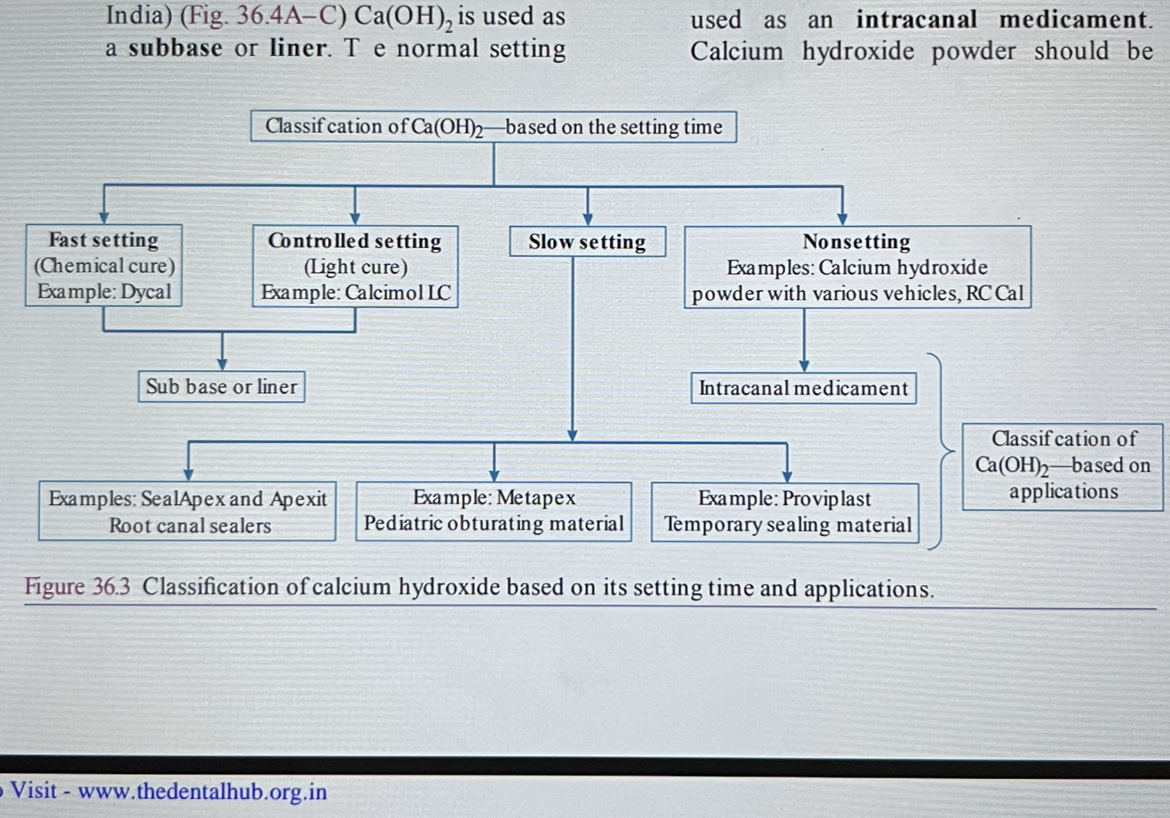
Applications of Calcium Hydroxide
Conservative Procedures:
Pulp Capping: Includes both Direct and Indirect methods.
Endodontics:
Pulpotomy.
Apexification.
Management of resorption.
Management of traumatized teeth.
Use as an intracanal medicament.
Use as an endodontic sealer.
Pediatric Dentistry:
Serves as a pediatric obturation material.
Calcium Hydroxide in Vital Pulp Therapy
Material of Choice: Calcium hydroxide is considered one of the primary materials for vital pulp therapy, specifically for direct and indirect pulp capping in permanent teeth.
Superior Alternative: Currently, Mineral Trioxide Aggregate (MTA) is recognized as the best material for pulp therapy.
Contraindication in Primary Teeth: is not used in primary teeth for pulpotomy involving carious exposure. It is believed to cause internal resorption, likely due to an existing inflammatory response in the radicular pulp.
Historical Context: Cvek (1972) demonstrated that favorable responses were optimal when inflammatory conditions were managed correctly.
Commercially Available Example: Dycal is the most commonly used commercial preparation for pulp capping.
Dycal: Properties and Composition
Definition: Dycal is a rigid, self-setting, and radiopaque formulation of .
Base Paste Composition:
1,3-Butylene glycol disalicylate: Reacts with and .
Zinc oxide (): Primary ingredient.
Calcium phosphate: Component of the base.
Calcium tungstate: Provides radiopacity to the material.
Iron oxide pigments: Added to render the appropriate color.
Catalyst Paste Composition:
Calcium hydroxide: One of the primary reactive ingredients.
Zinc oxide: Also acts as a primary reactive ingredient.
N-ethyl-o/p-toluene sulfonamide: Functions as the plasticizer.
Titanium dioxide: Primarily used to provide radiopacity.
Manipulation and Setting of Dycal
Dispensing: Equal amounts of the two pastes are dispensed onto a manufacturer-supplied paper pad.
Mixing Technique: The pastes are mixed until a uniform color is achieved, with an ideal mixing time of .
Setting Time on Pad: At a bench temperature of and relative humidity of , the material sets in to .
Clinical Setting Time: The material sets much faster in the mouth due to higher temperature and moisture levels.
Environmental Factors:
Increased Humidity/Temperature: Reduces the available working time and accelerates setting time.
Decreased Humidity/Temperature: Increases the available working time and prolongs setting time.
Calcium Hydroxide in Pulpotomy
Target Case: Young permanent teeth with open apices where only the coronal pulp is inflamed.
Procedure Steps:
Removal of the coronal pulp (tissue within the pulp chamber).
Placement of a suitable medicament, such as .
Coverage with a high-strength base.
Placement of a final restoration.
Objective: To preserve the vitality of the radicular pulp (tissue in the root canals) to permit the uninterrupted physiological completion of the root and root canals. Once root formation is complete, routine endodontic procedures are performed.
Calcium Hydroxide in Apexification
Application: Used to pack canals in traumatized, immature, nonvital teeth.
Method: Powder is mixed with a vehicle like chlorhexidine or used as a commercial paste (e.g., Calasept, Pulpdent, Hypo-cal, or Calyxl).
Mechanism: It induces the formation of a hard calcific barrier at the root apex. Histologically, this involves the differentiation of adjacent connective tissue cells and the subsequent deposition of calcified tissue.
Calcium Hydroxide as an Intracanal Medicament
Composition: Contains the powder, a radiopacifier, and a vehicle.
Performance Requirements: The material should not set. It must maintain a high pH and provide sufficient radiopacity.
Function of Vehicles: Ideally, a vehicle allows for the gradual and slow release of and ions into the tissues. It should have low solubility in tissue fluids and must not interfere with hard tissue induction.
Biological Properties of Calcium Hydroxide (Short Note)
Anti-inflammatory action: Neutralizes acidic products and reduces pulpal inflammation.
Calcific barrier formation: Stimulates formation of reparative dentin (dentin bridge).
Antibacterial effect: High pH destroys microorganisms and neutralizes bacterial toxins.
Tissue-dissolving property: Dissolves necrotic tissue and organic debris in the root canal.