C4: The Atmosphere
C4.1 Composition Of The Atmosphere:
Composed of: Nitrogen (78%), Oxygen (21%), Carbon Dioxide (0.04%), and Rare Gases (1%)
Natural processes are in a state of balance (maintaining average composition of atmosphere - only changes over very long timescale). Know as dynamic equilibrium.
Photosynthesis and aerobic respiration are important processes
Although they roughly balance each other out, occurrence rates vary over different timescales, so the concentration of each gas fluctuates around a mean concentration.
The atmosphere is a thin layer of gases, surrounding the earth which are held in place by gravity.
The atmosphere is essential to life on earth (provides vital life support systems eg: protection from solar radiation, aiding transport of energy and water around globe, gas resources)
Many of the processes that affect the atmosphere are interconnected… So if one process changes it can cause changes in other processes.
meaning human action can tigger a sequence of events.
Not possible to accurately predict the impact of a human activity on specific atmosphere processes.
C4.2 How The Atmosphere Supports Life:
Gasses for natural processes:
Atmosphere contains carbon, oxygen, hydrogen and nitrogen (they are needed to make biological molecules used by living organisms).
They’re extracted from atmosphere as N2, O2, CO2 and H2O.
Carbohydrates, lipids and proteins all contain carbon, oxygen and hydrogen. Proteins also contain nitrogen.
Absorption Of Electromagnetic Radiation From The Sun:
Much of the biologically damaging radiation in ‘Solar Wind’ is prevented from reaching earth by upper atmosphere
Most of the Ultraviolet light that passes through upper atmosphere is prevented from reaching the earth’s surface by various forms of oxygen present in the stratosphere.
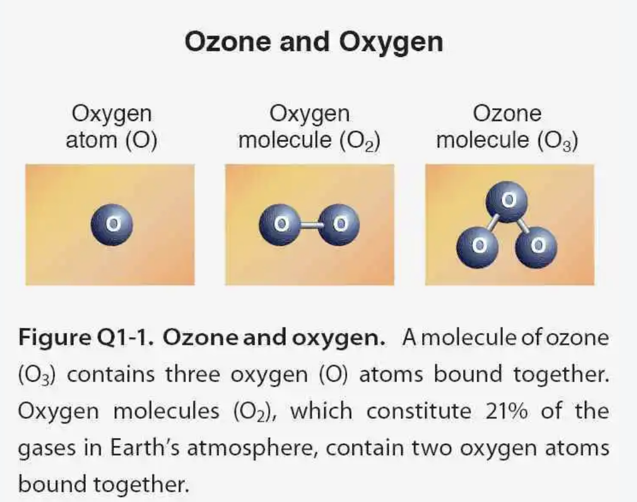
The element oxygen is presented in the atmosphere in three ways O (monatomic), O2 (diatomic), O3 (triatomic). Together the three form a dispersal layer in the stratosphere called the ozone layer (also known as ozonosphere)
These gases absorb Ultraviolet light, producing a dynamic equilibrium of chemical reactions, forming and destroying the ozone.
Delaying The Escape Of Infrared Energy:
Much of the incoming visible light is absorbed → converted to heat → re-emitted as infrared energy. Naturally occurring atmospheric gasses absorb this infrared energy → convert to heat (increasing the temperature of the atmosphere). This raises temperature in two ways:
1. The warm atmosphere emits infrared energy, which is absorbed by earths surface.
2. The warm atmosphere reduces heat loss by conduction from land and oceans.
Heat Distribution:
Most energy from sun, absorbed by earths surface is absorbed in tropical regions.
The warm surface heats atmosphere above, and this heat is distributed to higher latitudes by warm winds. (Eg: south-westerly winds bring heat energy to UK, from Caribbean seas)
Ocean Currents:
Winds blowing over oceans create currents that distribute heat by carrying warm water from tropical areas to higher latitudes (eg North Atlantic conveyer). These currents also distribute dissolved nutrients.
Transport Of Water Vapour:
Winds transport water vapour to areas that would otherwise get little or no precipitation.
Atmospheric Pressure:
Atmospheric pressure controls how easily water molecules can evaporate / escape from water surface.
If atmospheric pressure was much lower → there would be no liquid water on earth.
Gases For Human Exploitation:
Humans extract industrially important gases from atmosphere including nitrogen, oxygen, carbon dioxide and inert gases (eg: argon, neon, krypton and xenon)
The Structure Of The Atmosphere:
Altitude effects composition and physical features of the atmosphere, resulting in a series of layers (troposphere and statosphere)
These layers are affected by human activities.
Energy Processes In The Atmosphere:
Solar energy arriving at earth, and energy being radiated to space are generally in a state of dynamic equilibrium.
The wavelengths of electromagnetic radiation arriving are mainly ultraviolet, visible light and near infrared.
The wavelengths of radiation leaving involve mainly long wavelength far infrared radiation.
This energy (and processes it drives) controls factors like climate, ocean currents, hydrological cycle (therefore the distribution of species)
Any human activity affecting movement of energy could affect any of these factors (thus the survival of living organisms)
The Natural Greenhouse Effect:
This describes the atmospheric process that warm the troposphere.
Visible light passes through atmosphere easily → absorbed by earths surface → warms up.
Warm surface emits infrared radiation (cannot pass through easily as visible light as it’s absorbed by gases in atmosphere (greenhouse gases).
Greenhouse gases = any gases that are better than at absorbing infrared than the average for the atmosphere.
The most important natural greenhouse gases are: carbon dioxide and water vapour.
Without natural greenhouse effect, the mean temperature of Earth would be 33 degrees cooler.
C4.3 The Enhanced Greenhouse Effect & Global Climate Change:
Global climate change involves changes to the composition of the atmosphere that alter energy processes, the climate, the physical / biological processes they control
Anthropogenic Changes = changes resulting from human activity
Human activities are controlling the concentration of greenhouse gases that absorb infrared eradication and warm the atmosphere
Some are gases that naturally occur in the atmosphere, others are only released by humans
Carbon Dioxide: combustion of fossil fuels and wood, ploughing of soil (1 relative effect)
Methane: Anaerobic respiration by microbes in paid fields, landfill sites and livestock intestines, produced in formation of fossil fuels and released by ventilation of coal mines, knacks from natural gas fields and pipelines (25 reactive effects)
Oxides Of Nitrogen: Oxygen and Nitrogen from air react at high temperatures in vehicle engines and power stations. Then released into atmosphere in exhaust gases. Fertiliser use can increase NOx emissions, including nitrous oxides (160 relative effect)
Consequences Of Local Climate Change:
Relatively small temperature increases involved in climate change have a range of direct / indirect Impact outs on biotic / abiotic conditions on Earth
Ecological Changes:
species may be affected by temperature, changes to other species, or changes tot natural processes (they rely on)
Temperature rise may cause higher plant growth (provide more food for herbivores), many plants produce toxins that build up in their leaves (protects leaves from being eaten). Kill caterpillars, as toxins may build up sooner in year.
Precipitation changes may cause wetland habits to enlarge or shrink
Droughts (oak trees able to survive better due to their deep roots, compared to beach trees with shallow roots)
Dormouse hibernation may be disturbed by warmer winters, causing them to use up stored fat.
Timing of Flowering, migration and nesting (interdependent species may be reduced)
Species distribution may change as conditions change (colonise areas that have become suitable), but for some this isn’t possible (may colonise new areas more slowly than rate of disappearance, suitable new areas may not be available, human land use blocks movement, species living in inter-dependent communities).
Species most likely to be effected are already endangered (closest to the edge of their range of tolotance)
Some may be unaffected, but the species they depend upon may be
Change in food supply, predetoration, disease, survival of pollinations / seed dispersal species
Bats In the UK:
Effects bats in both positive / negative ways
Warmer, shorter winters may increase survival during hibernation
Warmer weather may increase populations of food species (night flying insects)
Wetter, stormier weather may reduce time for which bats are able to feed, reducing survival
Population may decline in one area (local extinction), but survival may increase in another (leading to colonisation of new areas)
Colonisation is only possible if suitable new areas exists and there are biological corridors linking the areas)
Birds and flying insects often colisneas energy areas quite easily, but plants and less mobile animals cannot
As conditions for survival change small populations may become isolated from rest of population
May be little / no population movements between isolated populations, causing several problems threatening future survival: 1. Gene pool would be divided into several smaller gene pools, inbreeding more likely. 2. Not possible for surplus individuals from other areas to repopulate an areas where local population has died out. 3. Overall population may be viable, smaller ones may not be.
Increase in greenhouse gases predicted to have significant impacts on abiotic conditions of earth (survival of species)
Simplistist effect is absorption of more infrared energy emitted by earths surface → converted to heat → warmer atmosphere
Mean global temperature rise over past 100 years is about 1 degrees.
Changes In Climatic Processes:
Retention of more heat energy in atmosphere produces changes in Atmopsheric pressure and the evaporation of water that produce new weather pattens
Wind pattern Changes: Jet streams (strong winds blowing west → east along a meandering path in the upper trio-sphere) caused by difference in temperature and density between two air masses such as warm air in mid latitudes and the cold air polar regions)
Winds blow to equalise pressure difference, but don’t blow in straight line from high pressure areas to low pressure areas due to rotation of the earth creates a coriolid force causing wind to blow in a spiral fashion
Changes in the Cryosphere:
Changes In The Cryosphere:
Warmer temperatures can have a direct effect on the ice of the earth (luckily to melt), but increased evaporation may increase precipitation and snowfall.
Extremely cold areas may have very low snowfall as precipitation falls before it gets there.
Higher temperatures may allow more precipitation to reach such areas.
Higher temperatures reduce amount of ice and snowfall, and length of time it remains on the ground before it melts.
Less snow / ice cover reduces the albedo of the earths surface, so less sunlight is reflected away and more is absorbed, causing further heating.
Changes in extent and speed of movement of land ice:
Snow that falls on land may collect → become compacted into ice → flows gradually downhill as mass builds up forming a glacier. At the moving ice reachers lower altitudes, it warms up and melts.
It may reaches sea before it melts, producing icebergs, or may melt before it reaches sea and add to river flow
Warmer temperatures may cause front of glacier to melt faster than its moving so the ice front retreats up in the valley.
Meltwater from glaciers surface may flow down through cracks in ice to bottom of the glacier where it can lubricate the ice as it slides over the rock, causing it to move more quickly.
If increased speed is due to the lubricated movement is greater than the fast melting, then the glacier front may move further down the valley, although its extending further, the total volume of ice in the glacier may fall if there is no increase in snowfall where glacier is formed.
Ice Sheet = ice covering area over 50,000km2. (Only 2 exist: Antarctica, Greenland)
Ice Cap = ice covering area less than 50,000km2 (ice thick enough to have its own topography)
Ice Field = ice covering area less than 50,000km2 ((topography of ice follows underlying area)
Glacier = large body of dense ice moving over land under its own weight
Ice Shelf = floating ice mass attached to ice on land (form when glacial ice flows off land onto sea)
Iceberg = large piece of ice floating in sea that broke off a glacier or ice shelf
Sea Ice = relatively thin ice that forms on sea as water freezes (forms from sea water but ice crystallises as freshwater)
Changes In Ice Thickness and Area:
During Artic / Antarctic winters, ice area that forms on sea surface increases as temperatures drop, area decline as temperatures rise (thin ice that forms ice crystallises in the sea)
Sea ice area forming around Antarctica each winter has increased in recent years, possibly due to increased freshwater flowing off land, floating on the denser sea water, then freezing
Ice has big impact of future temperatures as ice has high albedo (reflecting most sunlight). If ice melts then more sunlight would be absorbed, causing a further increase in temperatures and even more ice melting.
Ice Lakes:
Water produced by melting ice can collect on surface of glaciers, producing ice lakes
If the front ice wall of the lake melts then the water may be released, rushing down the valley below, causing sudden flooding
As glaciers melt more rapidly, such events may become more common
Ice and Snow-fed rivers:
Warmer conditions reduce snowfall, and increase rainfall, affecting river flowing off land pattens
Rainwater flows into rivers soon after it has fallen, in some areas it may build up (cold weather), then melt gradually during warmer weather. So rivers fed by meltwater may have a more even flow than if they were fed directly by rainwater.
In other areas precipitation falling as snow may reduce river flowing off land as snow accumulates, but causes a big increase in river flowing off land if climate suddenly warms (eg during a spring thaw)
C4.4 Ozone Depletion: