Plant Growth and Development
Growth:
- Growth is regarded as ==one of the most fundamental and conspicuous characteristics of a living being.==
- ==Growth can be defined as an irreversible permanent increase in the size of an organ or its parts or even of an individual cell.==
- Generally, growth is accompanied by metabolic processes (==both anabolic and catabolic==), that occur at the expense of energy. * Therefore, for example, ==expansion of a leaf is growth==
Plant Growth Generally is Indeterminate:
\
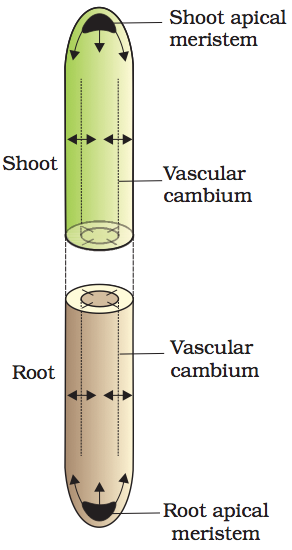
- Plant growth is unique because plants ==retain the capacity for unlimited growth== throughout their life. * This ability of the plants is due to the ==presence of meristems== at certain locations in their body. * The cells of such meristems have the capacity to ==divide and self-perpetuate.== * The product, however, soon ==loses the capacity to divide== and such cells make up the plant body. * This form of growth wherein new cells are always being added to the plant body by the activity of the meristem is called the ==open form of growth.== * The root apical meristem and the shoot apical meristem are responsible for the ==primary growth== of the plants and principally contribute to the ==elongation of the plants along their axis.== * In ==dicotyledonous plants and gymnosperms==, the lateral meristems, vascular cambium, and cork-cambium appear later in life. * These are the meristems that cause the ==increase in the girth== of the organs in which they are active. * This is known as the ==secondary growth of the plant.==
Growth is Measurable:
- Growth, at a cellular level, is principally a consequence of the ==increase in the amount of protoplasm.== * Since the increase in protoplasm is difficult to measure directly, one generally measures some quantity that is more or less proportional to it.
- Growth is, therefore, measured by a variety of parameters some of which are: ==an increase in fresh weight, dry weight, length, area, volume, and cell number.== * One ==single maize root apical meristems can give rise to more than 17,500 new cells per hour==, whereas cells in ==watermelon may increase in size by up to 3,50,000 times.== * In the former, growth is expressed as an increase in cell number; the latter expresses ==growth as an increase in the size of the cell.== * While the ==growth of a pollen tube is measured in terms of its length,== an ==increase in surface area denotes the growth in a dorsiventral leaf.==
Phases of Growth:
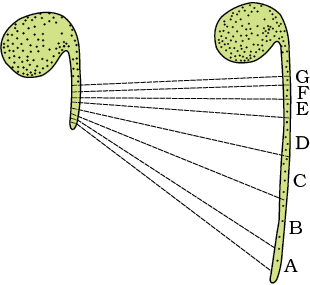
- The period of growth is generally divided into three phases, namely, ==meristematic, elongation, and maturation.== * The constantly dividing cells, both at the ==root apex and the shoot apex==, represent the ==meristematic phase of growth.== * The cells in this region are ==rich in protoplasm and possess large conspicuous nuclei.== * Their ==cell walls are primary in nature, thin and cellulosic with abundant plasmodesmata connections.==
- The cells proximal to the meristematic zone represent the phase of elongation. * ==Increased vacuolation, cell enlargement, and new cell wall deposition== are the characteristics of the cells in this phase.
- Further away from the apex, i.e., more proximal to the phase of elongation, lies the portion of the axis which is undergoing the phase of maturation. * The cells of this zone, attain their maximal size in terms of ==wall thickening and protoplasmic modifications.==
Growth Rates:
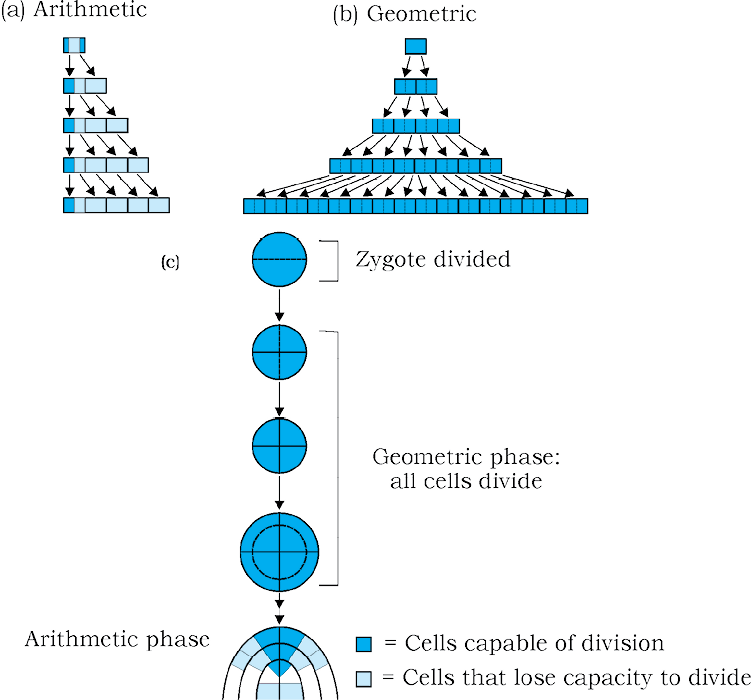
- The increased growth per unit time is termed the ==growth rate.==
- Thus, the rate of growth can be expressed mathematically. * An organism or a part of the organism can produce more cells in a variety of ways.
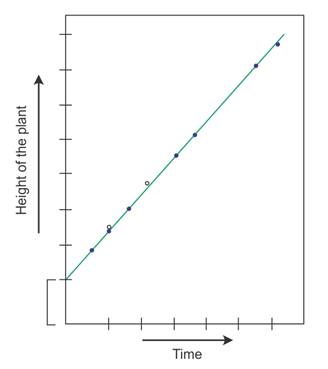
- The growth rate shows an increase that may be ==arithmetic or geometrical.== * In arithmetic growth, following mitotic cell division, only ==one daughter cell continues to divide while the other differentiates and matures.== * The simplest expression of arithmetic growth is exemplified by a ==root elongating at a constant rate.== * On plotting the length of the organ against time, a linear curve is obtained. * Mathematically, it is expressed as: * Lt = L0 + rt * Lt = length at time ‘t’ * L0 = length at time ‘zero’ * r = growth rate / elongation per unit time
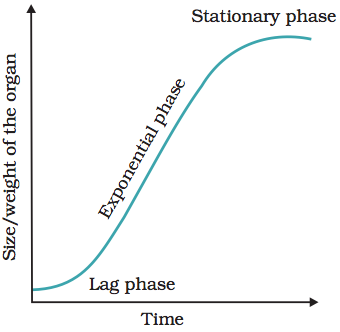
- In most systems, %%the initial growth is slow (lag phase), and it increases rapidly%% thereafter – at an exponential rate (log or exponential phase). * Here, %%both the progeny cells following mitotic cell division retain the ability to divide%% and continue to do so.
- However, with a limited nutrient supply, the growth slows down leading to a stationary phase.
- If we plot the parameter of growth against time, we get a typical sigmoid or S-curve. * A %%sigmoid curve is a characteristic of living organisms%% growing in a natural environment. * It is typical for all cells, tissues, and organs of a plant. * The exponential growth can be expressed as * W1 = W0 e^rt * W1 = final size (weight, height, number, etc.) * W0 = initial size at the beginning of the period * r = growth rate * t = time of growth * e = base of natural logarithms
- Here, %%r is the relative growth rate and is also the measure of the ability of the plant to produce new plant material, referred to as the efficiency index.%%
- Hence, the final size of W1 depends on the initial size, W0.
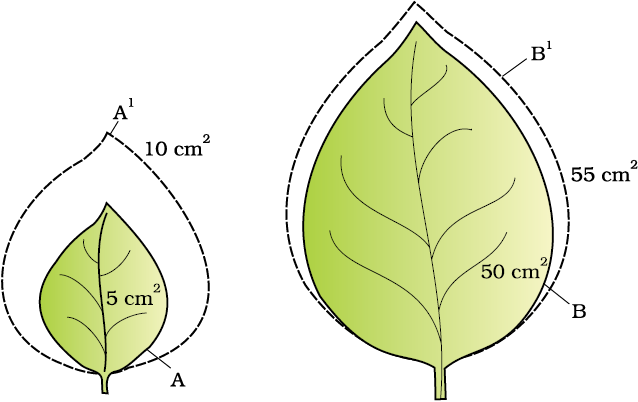
- Quantitative comparisons between the growth of the living system can also be made in two ways: * %%Measurement and the comparison of total growth per unit time is called the absolute growth rate.%% * The growth of the given system per unit of time is expressed on a common basis, * e.g., per unit initial parameter is called the relative growth rate. * Two leaves, A and B, are drawn that are of different sizes but show an absolute increase in area in the given time to give leaves, A1 and B1. However, one of them shows a much higher relative growth rate.
Conditions for Growth:
- This list may have water, oxygen, and nutrients as very essential elements for growth. * The plant cells grow in size by cell enlargement which in turn requires water. * The %%Turgidity of cells helps in extension growth.%% * Thus, plant growth and further development are intimately linked to the water status of the plant. * %%Water also provides the medium for enzymatic activities%% needed for growth. * %%Oxygen helps in releasing metabolic energy essential for growth activities.%% * Nutrients (%%macro and micro essential elements%%) are required by plants for the synthesis of protoplasm and act as a source of energy. * In addition, every plant organism has an optimum temperature range best suited for its growth.
- Any deviation from this range could be detrimental to its survival.
- Environmental signals such as light and gravity also affect certain phases/stages of growth.
Differentiation, Dedifferentiation, Redifferentiation:
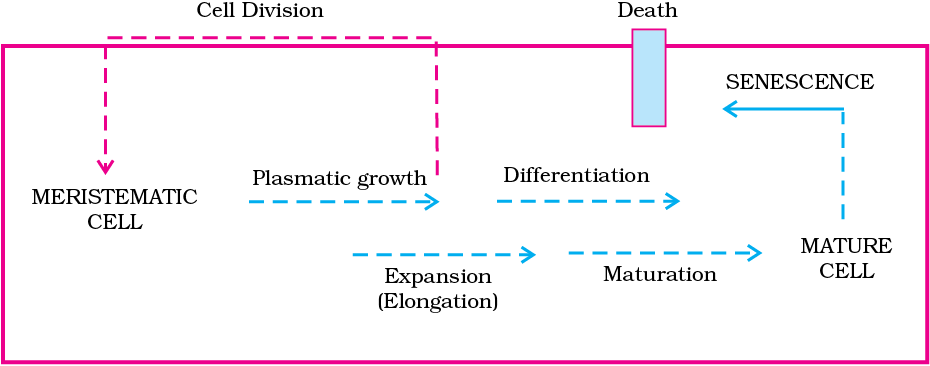
- The cells derived from %%root apical and shoot-apical meristems and cambium%% differentiate and mature to perform specific functions. * This act leading to maturation is termed differentiation.
- During differentiation, cells undergo few to major structural changes both in their cell walls and protoplasm. * For example, to form %%a tracheary element, the cells would lose their protoplasm.%% * They also develop very %%strong, elastic, lignocellulosic secondary cell walls%%, to carry water too long distances even under extreme tension.
- The living differentiated cells, that by now have lost the capacity to divide can regain the capacity of division under certain conditions. * This phenomenon is termed dedifferentiation. * For example, the formation of meristems – %%interfascicular cambium and cork cambium from fully differentiated parenchyma cells.%%
- While doing so, such meristems/tissues are able to divide and produce cells that once again lose the capacity to divide but mature to perform specific functions, i.e., get redifferentiated. * %%Differentiation in plants is open%% because cells/tissues arising out of the same meristem have different structures at maturity.
- The final structure at maturity of a cell/tissue is also determined by the location of the cell within. * For example, cells positioned away from %%root apical meristems differentiate as root-cap cells%%, while those pushed to the periphery mature as the epidermis.
Development:
- Development is a term that includes all changes that an organism goes through during its life cycle from germination of the seed to senescence.
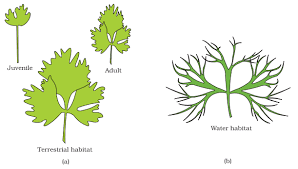
- Plants follow different pathways in response to the environment or phases of life to form different kinds of structures. * This ability is called plasticity * E.g., %%heterophylly in cotton, coriander, and larkspur.%% * In such plants, %%the leaves of the juvenile plant%% are different in shape from those of mature plants. * On the other hand, the difference in %%shapes of leaves produced in air and those produced in water in buttercup%% also represent the heterophyllous development due to the environment. * This %%phenomenon of heterophylly is an example of plasticity.%%
- Thus, growth, differentiation, and development are very closely related events in the life of a plant. * Broadly, development is considered the sum of ^^growth and differentiation.^^ * Development in plants (i.e., both growth and differentiation) is under the control of intrinsic and extrinsic factors. * The former includes both %%intracellular (genetic) and intercellular factors (chemicals such as plant growth regulators)%% while the latter includes light, temperature, water, oxygen, nutrition, etc.
Plant Growth Regulators:
Characteristics:
- Plant growth regulators (PGRs) are small, simple molecules of diverse chemical composition. * They could be %%indole compounds (indole-3-acetic acid, IAA); adenine derivatives (N6 -furfurylamino purine, kinetin), derivatives of carotenoids (abscisic acid, ABA); terpenes (gibberellic acid, GA3 ) or gases (ethylene, C2H4 ).%%
- Plant growth regulators are variously described as plant growth substances, plant %%hormones, or phytohormones%% in literature.
- The PGRs can be broadly divided into two groups based on their functions in a living plant body. * One group of PGRs is involved in %%growth-promoting activities, such as cell division, cell enlargement, pattern formation, tropic growth, flowering, fruiting, and seed formation.%% * These are also called plant growth promoters. * %%E.g., auxins, gibberellins, and cytokinins.%% * The PGRs of the other group plays an important role in plant responses to wounds and stresses of biotic and abiotic origin. * They are also involved in various growth inhibiting activities such as %%dormancy and abscission.%% * The %%PGR abscisic acid belongs to this group.%% * The %%gaseous PGR, ethylene%%, could fit either of the groups, but it is largely an inhibitor of growth activities.
The Discovery of Plant Growth Regulators:
- The discovery of each of the five major groups of PGRs has been accidental. * All this started with the observation of %%Charles Darwin and his son Francis Darwin when they observed that the coleoptiles of canary grass%% responded to unilateral illumination by growing towards the light source (phototropism). * After a series of experiments, it was concluded that %%the tip of the coleoptile%% was the site of transmittable influence that caused the bending of the entire coleoptile. * %%F.W. Went isolated auxin from tips of coleoptiles of oat seedlings.%% * The %%‘bakanae’ (foolish seedling) disease of rice seedlings, was caused by a fungal pathogen Gibberella fujikuroi. E. Kurosawa%% (1926) reported the appearance of symptoms of the disease in rice seedlings when they were treated with sterile filtrates of the fungus. * The active substances were later identified as %%gibberellic acid.%% * F. Skoog and his co-workers observed that from the internodal segments of %%tobacco stems the callus%% (a mass of undifferentiated cells) proliferated only if, in addition to auxins the nutrients medium was supplemented with one of the following: * Extracts of vascular tissues, yeast extract, coconut milk, or DNA. Miller et al. (1955), later identified and %%crystallized the cytokinesis-promoting active substance that they termed kinetin.%% * During the mid-1960s, three independent researchers reported the purification and chemical characterization of three different kinds of inhibitors: %%inhibitor-B, abscission II and dormin.%% * Later all three were proved to be chemically identical. * %%It was named abscisic acid (ABA).%% * H.H. Cousins (1910) confirmed the release of a %%volatile substance from ripened oranges%% that hastened the %%ripening of stored unripened bananas.%% * Later this volatile substance was identified as %%ethylene, a gaseous PGR.%%
Physiological Effects of Plant Growth Regulators:
Auxin:
- Auxins were %%first isolated from human urine.%%
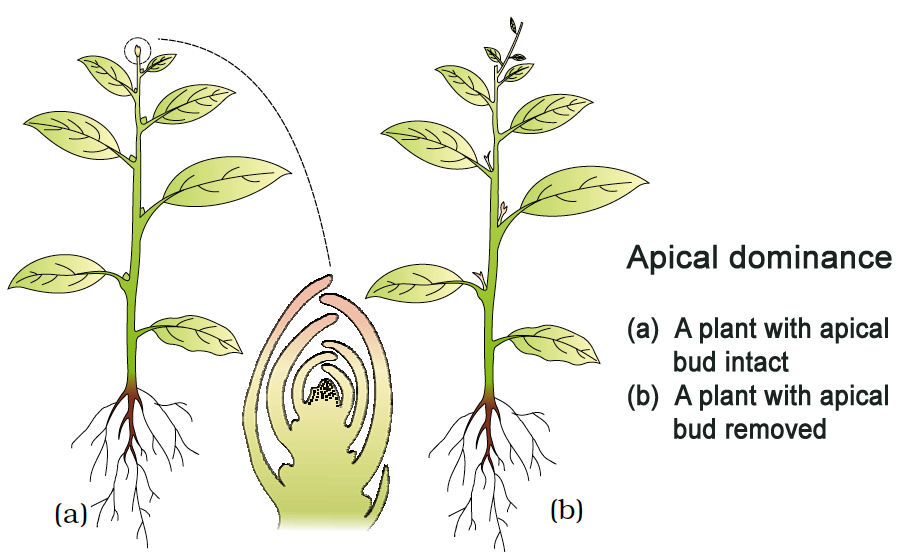
- The term ‘auxin’ is applied to the %%indole-3-acetic acid (IAA)%%, and to other natural and synthetic compounds having certain growth regulating properties. * They are generally produced by the %%growing apices of the stems and roots,%% from where they migrate to the regions of their action. * Auxins like %%IAA and indole butyric acid (IBA)%% have been isolated from plants. * %%NAA (naphthalene acetic acid) and 2, 4-D (2, 4-dichlorophenoxyacetic) are synthetic auxins.%% * All these auxins have been used extensively in %%agricultural and horticultural practices.%% * They help to %%initiate rooting in stem cuttings,%% an application widely used for plant propagation. * %%Auxins promote flowering e.g. in pineapples.%% * They help to prevent fruit and leaf drop at early stages but promote the %%abscission of older mature leaves and fruits.%% * In most higher plants, the growing apical bud inhibits the growth of the lateral (axillary) buds, a phenomenon called %%apical dominance.%% * %%Removal of shoot tips (decapitation)%% usually results in the growth of lateral buds. * It is widely applied in %%tea plantations, and hedge-making.%% * Auxins also induce %%parthenocarpy%%, e.g., in tomatoes. * They are widely used as herbicides. * %%2, 4-D, widely used to kill dicotyledonous weeds%%, does not affect mature monocotyledonous plants. * It is used to prepare %%weed-free lawns by gardeners.%% * Auxin also controls %%xylem differentiation and helps in cell division.%%
Gibberellins:
- Gibberellins are another kind of %%promotory PGR.%%
- There are more than %%100 gibberellins%% reported from widely different organisms such as fungi and higher plants. * They are denoted as %%GA1, GA2, GA3, and so on.%% * However, Gibberellic acid (GA3 ) was one of the first gibberellins to be discovered and remains the most intensively studied form.
- All GAs are acidic. * They produce a wide range of physiological responses in plants. * Their ability to cause an %%increase in the length of the axis is used to increase the length of grapes stalks.%% * Gibberellins, cause fruits like apples to %%elongate and improve their shape.%% * They also %%delay senescence.%% * Thus, the fruits can be left on the tree longer so as to extend the market period. * GA3 is used to speed up %%the malting process in the brewing industry.%% * Sugarcane %%stores carbohydrates as sugar in its stems.%% * Spraying sugarcane crops with gibberellins %%increases the length of the stem,%% thus increasing the yield by as much as 20 tonnes per acre. * Spraying juvenile conifers with GAs %%hastens the maturity period%%, thus leading to early seed production. * Gibberellins also %%promote bolting (internode elongation just prior to flowering) in beet, cabbages, and many plants with rosette habits.%%
Cytokinins:
- Cytokinins have specific effects on cytokinesis and were discovered as kinetin (%%a modified form of adenine, a purine%%) from the autoclaved herring %%sperm DNA.%% * %%Kinetin does not occur naturally in plants.%%
- Search for natural substances with cytokinin-like activities led to the %%isolation of zeatin from corn kernels and coconut milk.%% * Since the discovery of zeatin, several naturally occurring cytokinins, and some synthetic compounds with cell division-promoting activity, have been identified. * Natural cytokinins are synthesized in regions where rapid cell division occurs, for example, %%root apices, developing shoot buds, young fruits, etc.%% * It helps to produce new leaves, chloroplasts in leaves, lateral shoot growth, and adventitious shoot formation. * Cytokinins help %%overcome apical dominance.%% * They %%promote nutrient mobilization which helps in the delay of leaf senescence%%
Ethylene:
- Ethylene is a %%simple gaseous PGR.%%
- It is synthesized in large amounts by tissues undergoing %%senescence and ripening fruits.%% * Influences of ethylene on plants include horizontal growth of seedlings, swelling of the axis, and apical hook formation in dicot seedlings. * Ethylene promotes %%senescence and abscission of plant organs, especially of leaves and flowers.%% * Ethylene is highly effective in fruit ripening. * %%It enhances the respiration rate during the ripening of the fruits.%% * This rise in the rate of respiration is called %%respiratory climactic.%% * Ethylene breaks %%seed and bud dormancy and initiates germination%% in peanut seeds, and sprouts of potato tubers. * Ethylene %%promotes rapid internode/petiole elongation%% in deep-water rice plants. * It helps %%leaves/ upper parts of the shoot to remain above water.%% * Ethylene also promotes root growth and root hair formation, thus helping the plants to %%increase their absorption surface.%% * Ethylene is used to %%initiate flowering and for synchronizing%% fruit-set in pineapples. * It also %%induces flowering%% in mango. * Since ethylene regulates so many physiological processes, it is one of the most widely used PGRs in agriculture. * The most widely used compound as a source of %%ethylene is%% ethephon. * Ethephon in an aqueous solution is readily absorbed and transported within the plant and %%releases ethylene slowly.%% * Ethephon %%hastens fruit ripening%% in tomatoes and apples and %%accelerates abscission%% in flowers and fruits (thinning of cotton, cherry, walnut). * It promotes %%female flowers in cucumbers%% thereby increasing the yield.
Abscisic acid:
- Abscisic acid (ABA) was discovered for its role in %%regulating abscission and dormancy.%%
- But like other PGRs, it also has other wide-ranging effects on %%plant growth and development.%% * It acts as a general %%plant growth inhibitor and an inhibitor of plant metabolism.%% * ABA %%inhibits seed germination.%% * ABA stimulates the %%closure of stomata and increases the tolerance of plants%% to various kinds of stresses. * Therefore, it is also called the %%stress hormone.%% * ABA plays an important role in %%seed development, maturation and dormancy.%% * By inducing dormancy, ABA helps seeds to %%withstand desiccation%% and other factors unfavourable for growth.
- In most situations, ABA acts as an %%antagonist to GAs.%%
Photoperiodism:
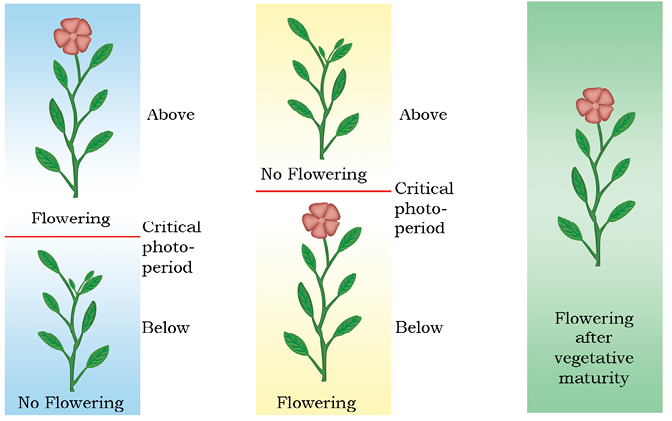
- It has been observed that some plants require %%periodic exposure to light to induce flowering.%% * It is also seen that such plants are able to %%measure the duration%% of exposure to light. * For example, some plants require exposure to light for a period exceeding a well-defined critical duration, while others must be exposed to light for a period less than this critical duration before the flowering is initiated in them. * The %%former group of plants is called long-day plants%% while the latter ones are termed short-day plants. * The critical duration is different for different plants. * There are many plants, however, where there is no such correlation between exposure to light duration and induction of flowering response; such %%plants are called day-neutral plants.%% * It is now also known that not only the duration of the light period but that the %%duration of the dark period is also of equal importance.%% * Hence, it can be said that flowering in certain plants depends not only on a combination of light and dark exposures but also on their relative durations. * This %%response of plants to periods of day/night is termed photoperiodism.%% * It is also interesting to note that while shoot apices modify themselves into flowering apices prior to flowering, they (i.e., shoot apices of plants) by themselves cannot perceive photoperiods. * %%The site of perception of light/dark duration is the leaves.%% * It has been hypothesized that there is a hormonal substance(s) that is responsible for flowering. * This hormonal substance migrates from %%leaves to shoot apices for inducing flowering%% only when the plants are exposed to the necessary inductive photoperiod.
Vernalization:
- There are plants for which flowering is either quantitatively or qualitatively dependent %%on exposure to low temperature.%% * %%This phenomenon is termed vernalization.%% * It prevents %%precocious reproductive development%% late in the growing season and enables the plant to have sufficient time to reach maturity. * Vernalisation refers especially to the %%promotion of flowering during a period of low temperature.%% * Some important food plants, wheat, barley, and rye have two kinds of varieties: winter and spring varieties. * The ‘spring’ variety is normally planted in the spring and comes to flower and produce grain before the end of the growing season. * Winter varieties, however, if planted in spring would normally fail to flower or produce mature grain within a span of a flowering season. * Hence, %%they are planted in autumn.%% * They %%germinate, and over winter come out as small seedlings, resume growth in the spring,%% and are harvested usually around mid-summer. * Another example of vernalization is seen in %%biennial plants.%% * Biennials are monocarpic plants that normally flower and %%die in the second season.%% * %%Sugarbeet, cabbages, and carrots%% are some of the common biennials. * Subjecting %%the growing of a biennial plant to a cold treatment%% stimulates a subsequent photoperiodic flowering response.
Seed Dormancy:
- There are certain seeds that fail to germinate even when external conditions are favorable.
- Such seeds are understood to be undergoing a %%period of dormancy%% that is controlled not by the external environment but under endogenous control or conditions within the seed itself. * %%Impermeable and hard seed coat; the presence of chemical inhibitors%% such as abscissic acids, phenolic acids, para-ascorbic acid; and %%immature embryos%% are some of the reasons which cause seed dormancy. * This dormancy however can be overcome through natural means and various other man-made measures. * For example, the seed coat barrier in some seeds can be broken by mechanical abrasions using knives, sandpaper, etc., or vigorous shaking. * In nature, these ==abrasions are caused by microbial action==, and passage through the ==digestive tract of animals.== * The effect of inhibitory substances can be removed by subjecting the seeds to chilling conditions or by the application of certain chemicals like ==gibberellic acid and nitrates.== * Changing the environmental conditions, such as light and temperature are other methods to overcome seed dormancy.
\