meiosis
human cells: 46 total chromosomes (23 pairs)
- 44 autosomes, 2 sex chromosomes
diploid: 2 sets of chromosomes (1 copy from mom and 1 copy from dad)
- called 2n (2 copies of each chromosome)
- somatic cells: all normal body cells
- humans
- 2 sets of 23 chromosomes = 46 total
- chromosomes pairs 1-22 are called autosomes
- last pair of chromosomes (set 23) are called sex chromosomes
- new diploid cells formed by mitosis
- when mitosis is used to form a new organism = asexual reproduction
haploid: 1 set of chromosomes (1/2 of total)
- called 1n (1 copy of each chromosome)
- also known as gametes (sex cells → egg/sperm)
- in humans: haploid cells have 23 chromosomes
- new haploid cells formed by meiosis
asexual reproduction: when one parent produces genetically identical offspring by budding, single cell division, or entire organism divides into 2 or more parts
- genome of offspring = exact copy of parent
- no genetic variability
- evolutionary advantage: if parent can survive, then offspring will as well
- evolutionary disadvantage: if environment changes, there is little chance of survival due to lack of variability (cannot adapt)
- ex
- binary fission: bacterial cell division
- prokaryotes ONLY
- cloning
- producing genetically identical individuals
- any organism / ex. dolly the sheep
- budding
- outgrowth from parent, pinches off / genetically identical
- ex. hydra (sea anemone), fungi, yeast
sexual reproduction: involves the production and fusion of haploid gametes (sex cells → egg/sperm)
- 2 parents that each contribute 1/2 of offspring’s genes → genetic variability
- performed by mammals, amphibians, reptiles, aves/birds, fish… fungi, plants?
- meiosis (gamete production) → fertilization (union of gametes into zygote) → mitosis (multiplication into organism)
- evolutionary advantage: genetic variability → if environment changes, there is a greater chance of survival from adaptations as offspring are different from parents
- evolutionary disadvantage: requires mate, longer process
cell cycle of sex cells
- interphase: same as before
- g1, s, g2
- growth, copying DNA and organelles, basic cell activities (CR/P), protein synthesis
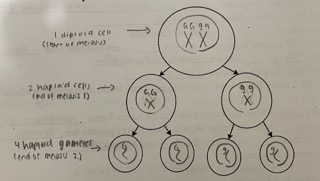
- meiosis: produces 4 haploid cells from a diploid parent cell
- divided into 2 parts
- meiosis 1: prophase 1, metaphase 1, anaphase 1, telophase 1 (+ cytokinesis)
- meiosis 2: prophase 2, metaphase 2, anaphase 2, telophase 2 (+ cytokinesis) → interphase again
meiosis 1: 4 sets of chromosomes (2 sets bc diploid ; replicated)
- prophase 1 ==[diagram]==
- chromatin coils into chromatids, sisters pair up
- centrosomes move to poles
- nuclear membrane/nucleolus disappear
- synapsis occurs → tetrads are formed ==[diagram]==
- tetrad: paired homologous chromosomes
- homologous (nonsister) chromosomes: matching chromosomes (same chromosome set) from 2 parents with the same length and genes at the same locations but may have different alleles (not genetically identical)
- crossing over: homologous chromosomes exchange genetic information
- increases genetic diversity by creating a unique combination of genes in gametes
- metaphase 1 ==[diagram]==
- tetrads line up on the equator/metaphase plate
- spindle fibers from one pole attaches to one set of sister chromatids, spindle fibers from other pole attaches to other set of sister chromatids
- anaphase 1 ==[diagram]==
- spindle fibers split the tetrad and pull sets of sister chromatids to opposite poles
- telophase 1 ==[diagram]==
- sister chromatids reached opposite poles
- nucleus forms
- each end has two sets of each chromosome
- cytokinesis into 2 independent cells → cleavage furrow forms
- straight to prophase 2 after this / no further DNA replication, interphase…
meiosis 2: now we have 2 cells each doing the following steps
- prophase 2 ==[diagram]==
- spindle fibers appear
- centrioles move to poles
- nuclear membrane and nucleolus disappears again
- sister chromatids begin to move to metaphase plate
- tetrads do NOT form
- metaphase 2 ==[diagram]==
- sister chromatids line up on the equator/metaphase plate
- spindle fibers attach to centromeres
- anaphase 2 ==[diagram]==
- sister chromatid pairs split
- single stranded chromosomes pulled to opposite poles by spindle fibers
- telophase 2 ==[diagram]==
- chromatid → chromatin
- nucleolus/nuclear membrane reappear
- cytokinesis → cleavage furrow forms
- each of the 4 cells end up with 1 copy of each chromosome → haploid
- (at the end of meiosis 1, all cells are haploid → divide in meiosis 2 into haploid)
result of meiosis
- formation of 4 haploid gamete cells w/ 1 copy of each chromosome
- egg/ovum: female gamete cell
- sperm: male gamete cell
- when egg and sperm fuse, it forms a zygote
- zygote: diploid cell formed by fertilization between two gametes / single fertilized egg
- with meiosis, resulting zygote has the same number of chromosomes as regular body cells
- gender is caused by the presence of X and Y chromosomes
- eggs only give X, sperm gives X or Y
- XX makes female, XY makes male
| mitosis | meiosis | |
|---|---|---|
| location where process occurs | body cells | sex cells |
| number of cells produced | 2 | 4 |
| chromosome # of parent cell | diploid | diploid |
| chromosome # of offspring cell | diploid | haploid |
| type of cell produced | body cells | gametes |
| function of process | growth/repair | sexual reproduction |
| replicates | once | once |
| divides | once | twice |
| cells are identical/unique | identical | unique |
meiosis summary
diagrams / identifying specific stages
- meiosis 1: tetrads → sister chromatid pairs
- meiosis 2: sister chromatid pairs → single chromatids
- identical to mitosis but may have 2 cells in picture
reasons for meiosis
- random assortment ==[diagram]==: chromosomes distributed at random during A1
- sister chromosomes from mom and dad may end up in different cells → random genes in gametes
- crossing over ==[diagram]==: parts of homologous chromosomes are exchanged during P1
- recombinant chromosomes with unique genes
- reduction of chromosome number: prevents cells in organism from having ever increasing chromosome number
- zygotes have correct number of chromosomes (23+23=46)
- prevents genetic disorders (ex. extra chromosome 21 = down syndrome / too many → death)
increasing genetic diversity
- random assortment, independent assortment
- crossing over
- random fertilization: do not know which egg will be fertilized by which sperm
mutations: changes in DNA sequence
- variety of causes
- normal mistakes in DNA replication
- chemical mutagens
- UV radiation, ionizing radiation
- somatic cell mutations: occurs in body cells
- not transmittable to offspring
- cancer is a frequent result
- germ cell mutation: occurs in gametes
- transmitted to offspring
- result in birth defects and genetic disorders
chromosomal defects
- nondisjunction: failure of homologous pairs of chromosomes (tetrads) to separate properly during meiosis A1 ==[diagram]==
- all 4 cells end up with the wrong number of chromosomes
- some cells have extra chromosomes and some have missing chromosomes
- trisomy: cells have 3 copies (extra) of a chromosome → n +1
- ex. trisomy 21 = down syndrome
- monosomy: cells have only 1 copy (missing) of a chromosome → n -1
- ex. turner syndrome (x chromosome)
- (polyploidy: multiple copies of ALL chromosomes → lethal in animals, common in plants for growth)
- problems with meiotic spindle cause errors in daughter cells
- (nondisjunction) tetrads do not separate properly during meiosis 1 (all cells are defects)
- sister chromatids fail to separate during meiosis 2 (1/2 of cells are defects)
- too few or too many chromosomes
- karyotype: a person’s complete set of chromosomes
- use to identify genetic disorders (chromosomal defects) and gender