Global I Honors Midterm Study Guide
Format:
- 25 Multiple Choice (2 points each- 50 Points)
- Short Answer Question (10 points)
- Essay (40 points, see next page)
Unit I – Development of Civilization
Basic geography and geographic terms
Difference between primary and secondary sources
- Primary Sources – originated at the time being studied
- Secondary Sources – analyses written later by historians
How do we know? Archeological teams
- Archeologist: study the remains of ancient human societies and cultures, including buildings, artwork, tools, and pottery
- Botanist: study ancient pollen found in soil and rocks
- Chemist: determine how old ancient objects are
- Geologist: study the changes in the earth's surface that occur over time
- Linguist: study language
- Paleoanthropologist: study the biological and cultural development of humans
Early humans and the development of the Neolithic Revolution
- Neolithic Revolution: period when humans began farming, domesticating animals, making advanced stone tools, and creating settlements (c 30,000 B.C.E.)
- Population Increased – better, more stable diet, life safer.
- Artisans – skilled workers. Make tools and weapons.
- Specialization
- Cultural Diffusion
- Early Government – people need leaders to live together.
- Early Religion – Polytheism
- Priests
- Food supply
- agriculture increased the reliable food supply
- people did not have to wander in search of food
- people could settle in one area
- Occupations
- people occupied their time with many activities in addition to obtaining food
- people developed special skills such as sewing, building, and toolmaking
- house builders began to pay attention to homes’ artistic and religious purposes
- Population/settlement
- Neolithic settlements became larger and more permanent
- growth in population allowed people to share work responsibilities
- many people working together improved food production and living conditions
- Resources
- trade grew when people began to seek resources that did not exist in their immediate area
- people improved the strength and beauty of their buildings, crafts, and tools
- people traded goods such as obsidian and materials used to enhance their appearance
- Shelter
- people began to build more permanent shelters
- people built stronger homes from mud bricks, stones, and branches
- people added features, such as ovens, basins, and clay benches, to homes to improve living conditions
- Technology
- people made better tools out of sharpened stones, obsidian, and metal
- rough animal skins were replaced with lightweight wool, cotton, and silk clothing
- stone bowls and clay pottery were used for cooking and keeping food
The four “River Valley Civilizations” (Nile, Tigris-Euphrates of Mesopotamia, Indus, and Huang He or Yellow)
- Early civilizations develop in river valleys
- Proximity to water and better soil
- Transportation
- Civilization: A complex human society with cities that have priests, artisans, merchants, government officials, and warriors
- Ancient Egypt (5000 BCE – 1000 BCE)
- Nile River
- Government: Monarchy – Pharaohs. Dynasty – Ruling Family
- Felt their power came from the Gods, divine right. Pharaohs eventually thought they were gods.
- Hieroglyphics
- Papyrus
- Mummification
- Pyramids
- Ancient Mesopotamian Civilizations (5000 BCE – 1600 BCE)
- Mesopotamia: land between the rivers
- Tigris and Euphrates Rivers
- Fertile Crescent
- Egypt was one unified kingdom; Mesopotamia was many city-states (explain) and a couple of empires.
- Sumer/Akkad
- Babylon/Assyria
- Hammurabi: became king of Babylon 1792 BCE, known as the great lawgiver
- Code of Hammurabi: 282 laws; one of the world’s first legal systems, though harsh, gave society consistency and order. The laws protecting property promoted trade, which promoted harmony; kept the empire together.
- Cuneiform
- Ziggurat
- Zoroaster (monotheism, battle between good and evil, judgment day)
- Wheeled chariots
- Ancient Indus Valley Civilizations (2700 ECE – 500 BCE)
- City-states
- monsoons
- Sanskrit
- Hinduism (Reincarnation, Caste system)
- Ancient Chinese Civilizations (2500 BCE – 700 BCE)
- Huang He (Yellow River)
- monsoons
- government: dynasties
- Mandate of Heaven
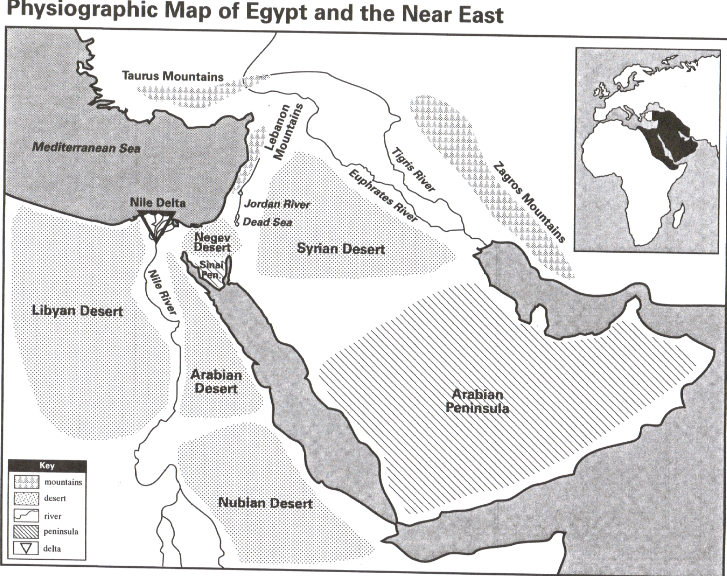
The Basic Geography of the Middle East (Where is it? What are its main geographic features? How did/does the geography of the Middle East affect settlement patterns there?
Unit II – Belief Systems
Development of Monotheism – Judaism
- Animism: Early peoples in Africa and China believed all objects, living or not, have a spirit.
- Polytheism: belief in many gods
- to explain the natural world and search for order.
- Monotheism: belief in one god
- More Order
- Concept of afterlife tied to ethical life here on earth
- Zoroastrianism
- The prophet Zoroaster – developed in ancient Persia (edge of Mesopotamia)
- Life is a struggle between the forces of Good (Light) and the forces of Evil (Darkness)
- People have a choice
- Judgment Day – Forces of Light triumph over the forces of Evil signaling the end of the Earth
- Abraham: 1st prophet – we are all descendents of Abraham according to all three faiths
- Judaism (began in Palestine aka Canaan c. 1500-1000 B.C.E.)
- King David and King Solomon
- Kingdom of Israel united c. 1000 BCE
- Babylonian Empire attacked Ancient Israel 586 BCE
- Jews enslaved and exiled (the Diaspora): dispersal of the Jewish people
- 1st Temple destroyed
- Persian Empire conquered the Babylonians 539 BCE
- Persians allowed Jews to return
- Jews rebuilt the Temple
- Roman Occupation began – 63 BCE
- Jewish Revolt leads to destruction of the 2nd Temple- 70 CE
- Practices:
- Passover
- Rosh Hashanah (Jewish New Year)
- Yom Kippur (Day of Atonement for Sin – Holiest Day of the Year)
Development of Christianity
- Christianity (began in Palestine – 1st century C.E.)
- Ethical life / Love one another – promise of eternal salvation.
- Belief in final judgment day at the end of time.
- Theological Beliefs
- Jesus – Son of God
- Sent to fulfill Jewish prophecies as Messiah (Savior) to save man from sin.
- Christ (Greek) – anointed one (savior).
- Jesus crucified by Romans (treason against the emperor)
- Three days later – he rose from the dead (Easter)
- Pontius Pilate: the Roman procurator for Palestine
- Trinity: Belief in one God with three personifications (Father, Son [Jesus], and Holy Spirit)
- Holy Text – Christian Bible (Jewish Scriptures + New Testament)
- Early History
- Continued as a Jewish Sect
- Saul, later known as St. Paul: a Pharisee (a Jewish sect) who originally persecuted the early Christians but later converted and helped spread the message of Christianity to non-Jews.
- Message of eternal salvation appealed to the poor of the Roman Empire – spread quickly to non-Jews (Gentiles)
Muhammad and the development of Islam
- Islam (began on the Arabian Peninsula – between 6th and 7th centuries C.E.)
- Arabia Before Muhammad:
- Mecca
- important trade stop and religious center of Arabia
- people settled there because of the fresh water well
- location of Kaaba (shrine with 300 religious idols)
- population very diverse: Arabs, Christians, Jews, etc
- Arabs
- practiced animistic polytheism (many gods)
- no strong central government
- Quraysh
- powerful local tribe of Arabs
- encouraged tribes to deposit idols in the Kaaba and protected them for free
- Muhammad’s Call to Prophethood:
- Muhammad’s Early Life
- born into family of the powerful Quraysh tribe
- raised by uncle, Abu Talib
- The Divine Revelations
- received first revelations while on retreat to Mt. hira
- neighbor convinced Muhammad he had been chosen as God’s prophet
- learned in another revelation that sinners must submit to the mercy of God (islam)
- Muhammad Spreads the Word of Allah
- Muhammad’s Teachings
- there was only one God (Allah) and all should submit to him
- all believers in God were equal
- the rich should share with the poor
- people should live righteously
- all people would be subjected to a Judgement day
- Miracles: the “Night Journey”
- Angry Meccans
- Protection for the Prophet
- Muhammad able to remain in Mecca because of powerful and respected family
- The Emigration to Medina
- The Hijrah: Muhammad decided to leave Mecca after death of uncle, Abu Talib, traveled to oasis city of Medina
- Muhammad’s Welcome: welcomed by Jews and Arabs of Medina
- believers in Islam began to call themselves Muslims (“those who submit to God’s will”)
- Conflict in Medina: some Jewish leaders did not accept Muhammad as God’s latest prophet, Jews who opposed Muhammad were expelled from Medina
- The Return to Mecca
- the Battle of Badr
- THE FIVE PILLARS OF FAITH
- Faith
- Prayer
- Alms
- Fasting
- Pilgrimage (Hajj)
Development of Hinduism
- Brahman: supreme God or spirit
- everything in the world is part of Brahman
- Hindus spiritual goal is to unite their soul with Brahman
- Multiple Gods
- all of the gods are aspects of Brahman
- some gods have humanlike personalities
- each hindu person/family may be devoted to one god/goddess
- most important: Vishnu, Shiva, Brahma
- Dharma: to hold/support
- duty or moral responsibility
- dharmas are determined by different things
- following dharma contributes to harmony and balance of society and universe
- Karma: total of good and bad actions a human soul/atman carries with it from life to life
- determines if soul returns as human or animal, family rich/poor
- Samsara: continuous cycle of birth, death, and rebirth
- reincarnation
- goal is to reach Moksha
- achieved by path of dharma, karma, worshiping Gods faithfully, and having direct/personal experience of God by following spiritual practices
- Caste System: 4 main classes
- Brahmins - Priests
- Kshatriyas - warriors
- Vaisyas - merchants/herders/artisans/farmers
- Svaras - servants/laborers
- Outcastes: Pariahs: untouchables (slaves, dirty work)
- Dharma is doing everything your Varna (class) requires
- 1947: Indian Constitution outlawed discrimination based on caste, caste system breaking down in urban areas but still endures in rural areas
Development of Buddhism
- Buddha: awakened or enlightened one
- Four Noble Truths:
- There is suffering
- suffering comes from worldly desires
- suffering ends if giving up those cravings
- there is a way to end suffering - Eightfold Path
- this leads to Nirvana (enlightenment, cycle of reincarnation ended)
- Siddhartha’s Birth
- He had 2 possible destinies:
- If he is raised as a prince, he will certainly rule over the universe
- If he is allowed to see the suffering of the world, he will leave his life as a prince and wander as a spiritual seeker destined to become a Buddha (awakened one)
- Siddhartha’s Life in the Palace
- father tried to shelter him, prediction that he would become an ascetic (one who abandons worldly desires)
- lived in luxurious palace, got married and had son
- Siddhartha’s Discovery
- he ventured out four times and saw sickness, death, old age, and an ascetic, who convinced Siddhartha that suffering can only be alleviated by giving up the desires and pleasures of the world
- Siddhartha Leaves
- left palace to live in the forest as an ascetic, where he learned to meditate
- learned self-deprivation, but found that useless
- realized there must be a middle way between wealth and self deprivation
- Under the Bodhi Tree
- he began to eat regularly and his strength regained
- Under a Bodhi (enlightenment) tree, Siddhartha was tempted by the god of self deprivation who tried to get Siddhartha to go back to the palace
- Siddhartha resisted and became enlightened - he was a Buddha
Development of Chinese Schools of Thought (Daoism, Confucianism & Legalism)
- Confucianism
- a system of beliefs based on the teachings of Kong Fu Zi (Confucius), who lived in China from 551 to 479 BC
- Confucius developed a practical philosophy for life and government which focused on proper conduct, respect for elders, education, and government service that he felt would create a peaceful, stable society
- based his ideas on ancient Chinese traditions of respect and hard work
- code of behavior revolved around 5 relationships:
- ruler and subject
- parent and child
- husband and wife
- sibling and sibling
- friend and friend
- Daoism
- a religion based on the teachings of Laozi, believed to be the first Daoist philosopher, who lived from 606 to 530 B.C.
- Laozi taught that the goal of life was to achieve oneness with the Dao, a universal force connected to nature that cannot be defined, only experienced and felt
- teaches that humans should see themselves as part of nature and should understand change as part of everything
- stresses that the best way for humans to find peace is by living simply, in harmony with nature
- Daoists do not believe in strong government, but that happiness and peace can be achieved by contemplating about nature and leading a balanced life in tune with nature, not by following societal rules and laws
- teaches that harmony comes from balancing the opposing forces of nature, called yin and yang
- Legalism
- a philosophical belief founded by Hanfeizi and Li Si
- idea that highly efficient and powerful government is the key to social order, punishments are useful to maintain social order, thinkers and their ideas should be strictly controlled by the government
Unit III – Classical Civilizations
Ancient Greece (geography, Sparta & Athens as rival city-states, different political systems, Age of Pericles & Athenian democracy, Greek philosophers Socrates, Plato & Aristotle, great achievements, Alexander the Great & Hellenistic culture
- classical civilization: Civilizations that made long-lasting contributions in a variety of fields, such as science and technology, that had a long-lasting impact, even to the present day, on future cultures.
- golden age: A high point in a culture’s or civilization’s development.
- Contributions of the Ancient Greeks:
- Democracy
- Medicine – Hippocratic Oath
- Olympics
- Architecture (columns: doric, ionic, corinthian)
- Geography of Ancient Greece:
- Greece is very mountainous with about ¾ of the land covered by various mountain ranges. It also lacks major rivers.
- The rugged land reduced farming possibilities. But the proximity to the sea allowed for travel and trade with neighboring areas.
- Rather than one unified country/empire, the ancient Greeks developed separate city-states (polis)
- city-state: a city and its surrounding area that is governed independently and not as part of a larger country
- Different Political Structures Develop
- Monarchy: Hereditary rule by a king. Some rulers claimed divine rights (Mycenae).
- Aristocracy: Rule by the land-owning nobility. Hereditary, based on family ties, social rank, wealth. (Athens prior to 594 BCE).
- Oligarchy: Rule by a small group of citizens based on wealth and ability. Nobility joined by wealthy merchants and artisans. (Sparta).
- Democracy: Rule by the citizens. Majority rule by vote. (Athens by 500 BCE).
- Athens develops “Limited Democracy” by 500 BCE
- Participation was limited to adult male property owners
- In ancient Athens, education stressed logic and public speaking, which would be important for a democracy
- Sparta develops a Militaristic Oligarchy by 500 BCE
- spartan male: left home at the age of seven and moved into army barracks until the age of 30
- spartan female:also received some military training and taught to put service to Sparta above everything else, even family
- Persian Wars (499 BCE – 448 BCE)
- The city-states of Athens and Sparta and their Greek city-state allies united against the Persian Empire (modern-day Iran).
- A case of cultural ties (Greek) overcoming political differences and rivalry.
- Battle of Marathon (490 BCE)
- Battle of Thermopylae (480 BCE)
- all the spartans were killed, but the Greeks won the war
- Aftermath of the Persian Wars - Athens forms Delian League
- Athens formed this alliance of approximately 200 city-states. Athens was the dominant member and the League became like an Athenian Empire.
- positive: Athens grew wealthy and was about to enter into its “golden age.”
- negative: Athens would renew and worsen the rivalry with Sparta.
- The Great Achievements of Ancient Greek Culture
- The Age of Pericles – Ancient Athens’ Golden Age (461 – 429 BCE)
- Democracy expanded – Direct Democracy.
- Achievements in the Golden Age of Ancient Athens & Greece
- Philosopher – People who study the process of thinking, reason and judgment.
- Socrates (470-399 BCE)
- the Socratic Method
- He always encouraged his students to ask questions of themselves in a constant search for truth. He would ask a series of questions in order to show that people held contradictory positions on issues.
- Plato (427-347 BCE)
- a student of Socrates’ and in fact it is because of his writings that we know of Socrates since Socrates didn’t leave any writings behind.
- Plato’s ideal society was not a democracy but actually a monarchy with citizens falling naturally into three categories: Farmers and artisans (provide the necessity of life); warriors or soldiers (defense); philosophers ruling class with the brightest being a philosopher-king.
- Aristotle (384-322 BCE)
- Aristotle was a student at Plato’s school. He used logic to try to discover the nature of the world and is credited with providing the basis of the scientific method.
- Art & Architecture
- purpose: to glorify Athens
- Greek sculpture aimed to create figures that were graceful, strong and perfectly formed – serenity.
- Drama and History
- tragedy: common theme such as love, hate, war or betrayal is explored
- comedy: slapstick situations and crude humor making fun of politics and respected people of the time
- Peloponnesian War (431-404 BCE) helps bring Athens’ Golden Age to an End
- Athens and Sparta were rivals for leadership among the Greek city-states. They had completely different societies – Athens was a democracy, Sparta an oligarchy.
- Alexander the Great (356-323 BCE)
- Macedonia (considered themselves Greeks) invaded Greece in 338 BCE
- Alexander conquered the Persian Empire and reached India
- Alexander’s conquests brought about…
- Hellenistic Age (324-27 BCE)
- The blending of Greek (Hellenic), Egyptian, and Persian cultures through cultural diffusion.
Ancient Rome (origins of Rome, the formation of the Roman republic, the end of the republic and the beginning of the empire, Pax Romana, spread of Christianity, Fall of the Roman Empire, great achievements)
- Foundations of the Republic in Rome
- When Rome was founded, it was a city-state, much like the various city-states in ancient Greece. However, in the case of Rome, it is going to establish an empire that ruled a vast area in Europe, Africa, and Asia.
- Free-vorn males had voting rights
- Patricians and Plebeians
- Patricians were the wealthy landowners (aristocracy); Plebeians were the common farmers, artisans and merchants who made up the majority of the population.
- Rome’s leaders allowed the plebeians to form their own assembly and elect representatives called tribunes.
- The Twelve Tables
- A codified system of laws. They were carved onto 12 tablets and hung in the Forum for all to see. This ensured that laws would be consistently interpreted and not be arbitrary.
- can be compared to the Code of Hammurabi
- Dictator: A person who, during times of crisis, could be granted absolute power for a period of six months.
- The Roman Empire begins to form
- Empire had great size and was located on all sides of the Mediterranean Sea, allowing for ease of travel and trade.
- It is located in the middle of the Italian peninsula which is itself located in the middle of the Mediterranean. Rome is built on the Tiber River, which allowed trade and transportation for the city itself.
- The Roman Republic ends as the Roman Empire Grows
- The Republic Collapses and is Replaced
- Rome had expanded through wars (such as the Punic Wars against Carthage)
- Aristocrats (rich landowners) benefited from additional territory being acquired by Rome
- Slaves grew in numbers – approximately 1/3 of Rome’s population was slaves.
- common farmers/peasants can’t compete
- average people were taxed heavily to pay for wars
- leads to rebellion & civil war
- Julius Caesar
- dictator who brought about the end of the Roman Republic and leading to the further growth of the Roman Empire
- became popular due to military victories
- A group of senators plotted and assassinated him because they feared he would end the Republic and make Rome a monarchy.
- Caesar Augustus (Octavian)
- Julius Caesar’s nephew
- He won a power struggle for control of Rome. Octavian, after defeating Antony and Cleopatra in battle, had Caesar’s son killed. Antony and Cleopatra committed suicide. Octavian took the couple’s three children back to Rome and paraded them through the streets.
- Octavian took the title Caesar Augustus (exalted one) and Rome was officially an empire with an emperor leading it. The republic was no more. All the Roman emperors would take the title “Caesar.”
- A Vast Empire – the Pax Romana
- The “Peace of Rome” was Rome’s “Golden Age.”
- Efficient government provided safety and stability
- Public works – buildings constructed
- Efficient civil service set up (manage state affairs, grain supply, tax collection, postal system).
- Agriculture expanded
- Roads constructed and trade flourished by sea and land.
- Achievements: Arches and Domes, Aqueducts, The Colosseum, Roads, Sculpture, Mosaics, Literature, Medicine
- Christianity Spreads through the Roman Empire
- Church Hierarchy
- Bishop of Rome (Peter) becomes the leader of the Church and is known as the Pope
- Below the Pope are the cardinals, archbishops, bishops, priests.
- The Church was run almost like a country with a government.
- The Fall of the Roman Empire (476)
- Possible Causes for the Collapse
- Barbarian Invasions
- Decline of Morals and Values
- Environmental and Public Health Problems (lead poisoning)
- Excessive Military Spending to Defend the Empire
- Inferior Technology
- Inflation
- Political Corruption
- Rise in Christianity
- Unemployment
- Urban Decay
- Reforms of Emperor Diocletian
- Diocletian split the empire into the Latin-speaking West and the Greek-speaking East, thinking that it was too large to rule by one man.
- Emperor Constantine moves the capital from Rome to Byzantium (Constantinople)
- It was strategically located for trade and defense (Dardanelles-Sea of Marmara-Bosporus-Black Sea)
- This decision moved the center of power in the empire from Rome to the east and would help lead to the collapse of the West in 476.
- The East carried on as the Greek-speaking Roman Empire which historians have called the Byzantine Empire.
- Contributions of the Romans to Modern Western Civilization
- Government – the idea of a republic (elected representatives)
- Architecture & Engineering – arch and dome
- Law – Rome’s most lasting contribution and the basis for Western legal systems. Equal treatment under the law; innocent until proven guilty; burden of proof on the accuser; punished for actions not thoughts.
- Art – Sculpture, Mosaic
- Language – Latin (modern languages plus many words in English)
- Preserved Hellenic Culture (Greco-Roman)
Ancient India & the Gupta Empire (basic geography, Indus Valley Civilization, Aryan migrations, Maurya Empire, Gupta Empire & its achievements)
- The Indian subcontinent
- It is called this because it is separated from the rest of Asia due to the Hindu Kush, Karakoram, and Himalayan Mountains and juts off below the rest of Asia. It is also called a subcontinent because of its vast size.
- Physiographic Features
- Brahmaputra River
- Deccan Plateau
- Eastern and Western Ghats
- Ganges River
- Himalayan Mountains
- Hindu Kush Mountains
- Indus River
- Thar Desert
- Indo-Gangetic Plain
- Monsoons
- From Oct.-Feb. the winter monsoons blow down from the mountains bringing dry air. From mid-June-October, the monsoon winds shift and blow off the water bringing moist, warm air and lots of rain.
- unlike the flooding of the Nile, they are unpredictable, can cause drought or flooding
- Languages
- India has 16 official languages (including Hindi and English) and 845 others are also spoken
- Only 11 percent of the people speak English, but it is the language of commerce, government, and higher education
- Pakistan had two official languages (Urdu, related to Hindi, and English)
- In Bangladesh, the language is Bengali, which is related to Hindi and Urdu
- languages derived from the ancient language, Sanskrit
- Ancient Indus Valley Civilizations – Harappan Civilizations (c. 3000 BCE – c. 1500 BCE)
- Harappa was discovered in 1826
- Mohenjo-Daro was discovered in 1922
- Both cities well planned along a grid and divided into two areas: a fortress-type area known as a citadel, which is raised above a lower city, which was made up primarily of houses
- strong central government
- Written documents have been found but they cannot be deciphered as of yet
- Plumbing is one of the greatest achievements of this civilization, with all dwellings having indoor plumbing.
- The Aryan “Invasions” (began c. 1500 BCE)
- Aryans “Invade” (or Migrate to) the Indus Valley
- Tectonic plate shifts caused earthquakes and volcanic activity which shifted the course of the Indus River and also led to the Saraswati River drying up
- the people migrated eastward into the Ganges River Valley, Aryans likely migrated to rather than invaded the Indus River Valley
- Results of the Aryan Migrations
- Hinduism based on ancient Aryan beliefs blending with beliefs of Indus Valley people (Dravidians)
- Caste System based on Aryan classes – native Dravidians put at the bottom
- A blending of Aryans and Dravidians
- Northern Indian languages (like Hindi, Urdu, Bengali) derived from the Aryans’ Sanskrit, an Indo-European language
- Dravidian-derived languages dominate southern India
- Hitler and his Aryan Race Theory
Possible Essay Questions. The essay on the Mid-Term will be ONE of the follow three choices.
- Compare and contrast Classical Civilizations
- Compare and contrast universal religions
- Compare and contrast ancient civilizations (River Valley Civilizations)