#3:Thermochemical Equations and Molar Enthalpy
Unit 1 Lesson 3
A. First and Second Laws of Thermodynamics
Euniverse=constant
we use: qsystem+qsurroundings = 0
Second Law of Thermodynamics
When two objects are in thermal contact. Heat is always being transferred from a warmer object to a cooler object until they reach the same temperature.
Enthalpy: is the total amount of energy of a system, plus the pressure times the volume: H = E + PV
Enthalpy equation: △H = ±|q|
If △H is + = endothermic
if △H is - = exothermic
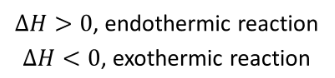 When its △H: the system is absorbing thermal energy from it surrounding (endothermic)
When its negative H: the system is releasing thermal energy to its surrounding (exothermic)
Why is heat released or absorbed?
Answer: breaking bonds (reactants) requires energy whereas making bonds releases energy (products)
H2 (g) + ½ O2 (g) 🡪 H2O (l) + 285.8 kJ (Exothermic)
117.3 kJ + MgCO3 (s) 🡪 MgO (s) + CO2 (g) (Endothermic)
Three ways to calculate enthalpy of reactions:
Measure in the lab: use calorimetry or q=mc△t
Use Hess’s Law
Use enthalpies of formation
Molar Enthalpy:
A thermochemical equation represents a chemical reaction while also showing whether the reaction releases or absorbs heat energy. Ex; 2 H2 (g) + O2 (g) → 2 H2O (g) + 570 KJ
Molar enthalpy, represented as ΔHr, is a measure of how much heat is either released or absorbed when a substance undergoes a specific type of change, with "r" denoting the type of change happening.
**Values must be per mole of substance being reacted.
To calculate an enthalpy change:  Where n is the # of moles; triangle hr = molar enthalpy (kJ/mol)
IMPORTANT: In an endothermic reaction, energy is absorbed from the surroundings, and the potential energy of the products is greater than that of the reactants. This is because energy is required to break the bonds within the reactants, leading to an increase in potential energy in the products.