1: Living Online - How We Got Here
Globalization and an Interconnected World
Globalization: the study of integration at an international level
Interconnection is fostered through neoliberalism, technological developments
e.g. the distribution of information at affordable prices, long-distance phone calls. 4G/5G cellular comms.
as a result of the global realignment following the downfall of communism.
Neoliberalism: an ideology that favours the expansion of global trade and opposes restrictions placed by government or regulations.
Institutional, economic, social and legal barriers have been cleared; e.g. tariff reduction.
Pre-globalization, consumed goods were local. Monumental ideas were slow to migrate.
Transport costs have been reduced, e.g. lower fuel costs; the shipping container.
“Global village” concept — attempts to explain the structures that influence all of humanity. Increased ability for people and processes to operate internationally. → “shrinking of the world”
Information and innovation are critical towards globalization. Capital is dependent on the transfer of information, communication, technology and knowledge. Technology is the catalyst for globalized change. It’s revolutionized the way that we produce and market products.
We see globalization transcend economics, politics, cultures. The rise of technology has fuelled this. Old ways will no longer suffice.
The creation of global supply chains have created newly industrialized countries, e.g. China. They are the biggest winners of globalization, as they’ve been lifted out of extreme poverty.
Canada and the United States have experienced both opportunities and threats via new markets and competition with newly industrialized countries.
Sub-Saharan Africa has had highly limited technology adoption, therefore they suffer from globalization.
Internet
The internet, born in 1982, is an intentionally decentralized network, “network of networks”. There is no direct control by any one person, group or government.
The World Wide Web was founded in 1989 by Tim Berners-Lee and is the core foundation of the global information society.
Comparable to industrial and agricultural revolutions — except larger in scope worldwide.
We’ve seen more innovation with the internet’s complexity, power and utility.
This class focuses on the social implications of the internet: power & influence has become globalized; socioeconomic inequalities have expanded; information has become more diverse and accessible.
Group Discussion re. the Internet
Interactions: return to face-to-face, verbose written communications transmitted fax machine, mail, telephones, telegraphs
News & information would return to television formats — but interestingly, public trust in the news would likely be higher.
Printed literature and letters
Communication would return to verbosity, telephone communications are less instant.
Services would be through physical interaction, branches, shopping centres etc. Giving up convenience in contrast to online shopping.
Information Age
Information: Dr. Meyer describes characteristics of information:
attribute to alleviating uncertainty
an essential intrinsic component of technology
catalyst to enhance economic growth
extends the knowledge base
Industrial age: modes of operation were transformed by the communication revolution, which fuelled the growth of an information age.
1991 was the first year where more money was spent on IT than industrial technologies.
Different types of technologies develop with different forms of civilization. Hunters and gatherers, agrarians and industrial civilizations each produced their own technologies and machineries.
The “know-how” advancement and progress has become a way of life — it enhances the meaning of our civilization.
Subsequently, the information age has led to a new Information Society, which crosses traditional boundaries.
Bell: Post-Industrial Information Age
Predicted the coming of a “postindustrial society” where the computer would be central.
Commodity-producing becomes a service society.
Concentrates on the codification of theoretical knowledge for technological innovation
Creates “intellectual technology” which serves system analysis and decision theory, e.g. an algorithm.
Manufacturing becomes the service economy. 1995: 80% work in the service economy.
Technology and the information revolution has resulted in the information civilization.
Story of Globalization: interpreted from Avengers
People might be overmatched by globalization.
Critically, Infinity War works as a good analogy as it was a global production. Records were set for its trailer view count and had the best opening weekend globally.
People coming together around a superhero movie: international markets for Hollywood are critical.
How are cultures affected? How are films adapted for various cultures? e.g. Inside Out replacing broccoli.
As globalization expanded, global trade exploded. The industrial revolution transformed quality of life.
Then, cheap and fast communication was developed: the information revolution. Global ideas were shared, 200 companies make the iPhone’s components.
The next frontier of globalization is virtual presence: what if robots enabled remote work, e.g. remote surgery?
AI and automation rise questions about the future of work.
Totalitarian Technocracy
Many believe that technology has gone too far and that technology has come to dominate humanity.
“technology is not just used, it is lived.” — Hunter
Technological Determinism
Veblen and Ayres propose that technology is taking a life of its own, and that individuals have little control over the technologies that affect their existence. Technological change determines social change in a prescribed manner.
Social Constructivism
The opposite of technological determinism.
Technology is shaped by social, cultural, economic and political arrangements. Technology is not an independent source of social change.
e.g. Amish farmers who haven’t adopted technology.
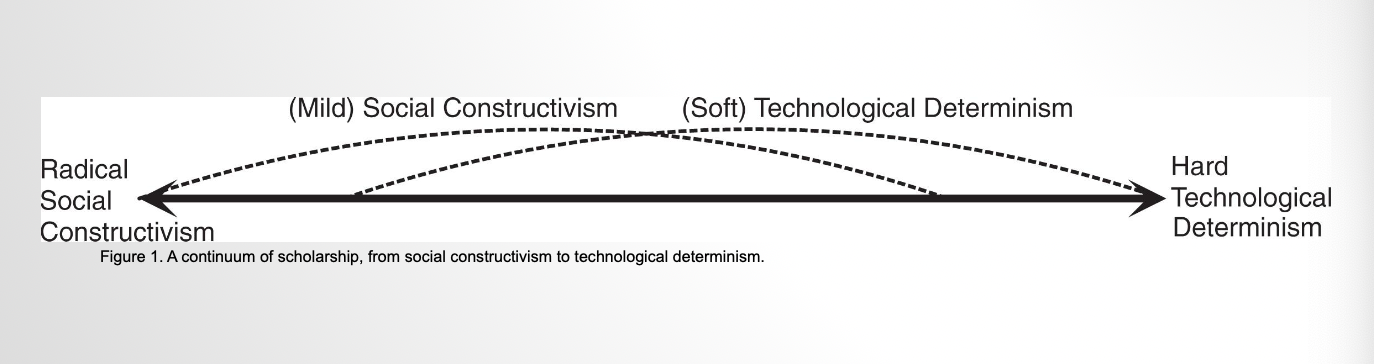
What technologies are powerful and autonomous?
Impact on Economy, Politics & Culture
Production has drastically changed
Fordism: localized within certain national borders. Assembly lines in big plants and factories.
Post-Fordism: economic nationalism is an impediment to growth. Decentralized, geographically scattered production sharing is more efficient. Has created a borderless world.
Political participation has included, but has fuelled polarization and the spread of misinformation.
Culturally, technology has become a core part of our social identities, our relationships and day-to-day life.
Costs of Technological Change
Economically: new technology results in displaced workers, but simultaneously creates new job opportunities.
In reality, we see unemployment. This is an impact of creative destruction.
Creative destruction:
Schumpeter: the continual process of innovation where new products and services replace old ones.
Example: the transition to digital cameras from film and polaroids.
Polaroid and Kodak had large employee bases. Kodak is now bankrupt because Kodak failed to adapt.
Job changes have historically been beneficial; they take up new jobs that have been created by technology.
The solution is better education and training programs to enable more technological-centric work.
Now, people may lose jobs to people anywhere on the planet. Work is evolving — and we need to adapt to ensure that people are capable of finding new work.
Driving prosperity out of destruction. New products, technologies and markets can threaten the lives of currently existing products. Know examples!!
Capitalistic and economic progress:
Laptops and technological devices have planned obsolesce.
We’re just as vulnerable now as we were in the industrial era. Well-educated people
Costs of technological change:
Post-September 11th: questions are raised about restrictions of individual freedoms and threats to privacy because of electronic intrusions and surveillance.
e.g. the PATRIOT Act, surveillance of phone calls, library records; erosion of civil liberties. A balancing act between individual rights and public safety.
Online communications: Businesses and interpersonally communications have evolved, e.g. email, instant messaging.
From when the internet was new, we expected an age of emboldened political participation and the creation of a “global village’ → Marshall McLuhan.
Concerns lie with online communications matching face-to-face interactions.
Communication styles have become more sparse, seeping into academics and business.
Social impact
Virtual communities can allow people to make friends easier.
But the same virtual communities are excessively commercialized and may be predatory.
Can virtual communities match real-life connections? Are they being drawn away from real-world communities?
Social benefits have been offset by forms of oppression and manipulation of the individual through technology. → regulation is required.
e.g. wire tapping and regulations.
Post-industrial information economies have replaced previous aristocratic, middle classes and working classes. Instead, different forms of inequality have arisen.