Chapter 9 - Fission and Fusion
9.1 Nuclear Fission and Energy
In 1905, Albert Einstein theorised that mass (m) and energy (E) are equivalent through the equation E = mc².
This led to the realisation of vast amounts of energy in atomic nuclei.
Nuclear fission was realised in 1945 with the first atomic bomb explosion in New Mexico, USA
This section explores nuclear fission and the energy it unleashes.
Inside the Nucleus
Current understanding of the nucleus comes from early 20th-century work by scientists like Becquerel, Rutherford, Chadwick, Geiger, Marsden, and Harkins
Recall from Chapter 8: Strong nuclear force acts within the nucleus to overcome electrostatic repulsion between protons.
Nuclei are made of quarks held by gluons.
Electrostatic vs strong nuclear forces
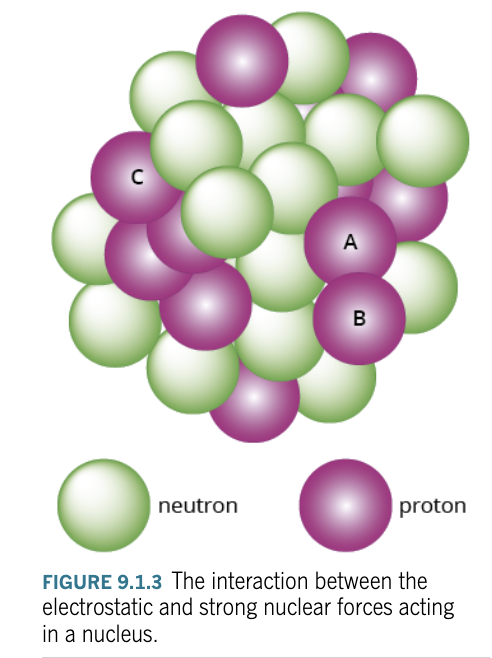
Protons repel each other via electrostatic force (longer range).
Strong nuclear force attracts at very short distances and holds nucleons together.
Example: Proton A repels proton B but is held by stronger attraction; proton A attracts and repels proton C but net stability due to adjacent nucleons.
Nuclear Fission
Discovery of the neutron (James Chadwick, 1932) allowed exploration of larger nuclei.
Neutrons are neutral → not repelled by positively charged nuclei → easily absorbed (Figure
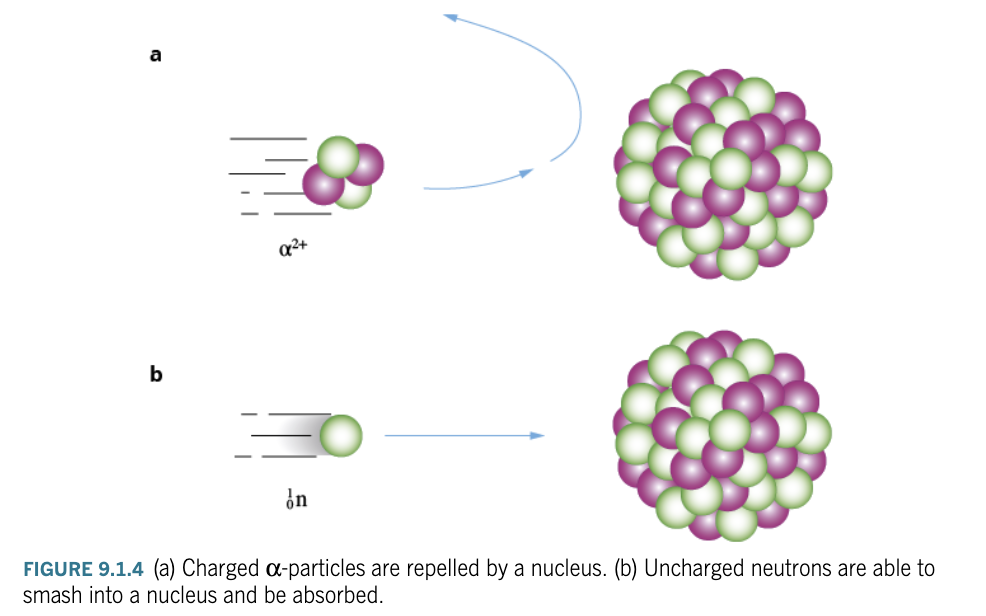
Nuclear fission: An atomic nucleus splits into two or more pieces, usually triggered by absorbing a neutron.
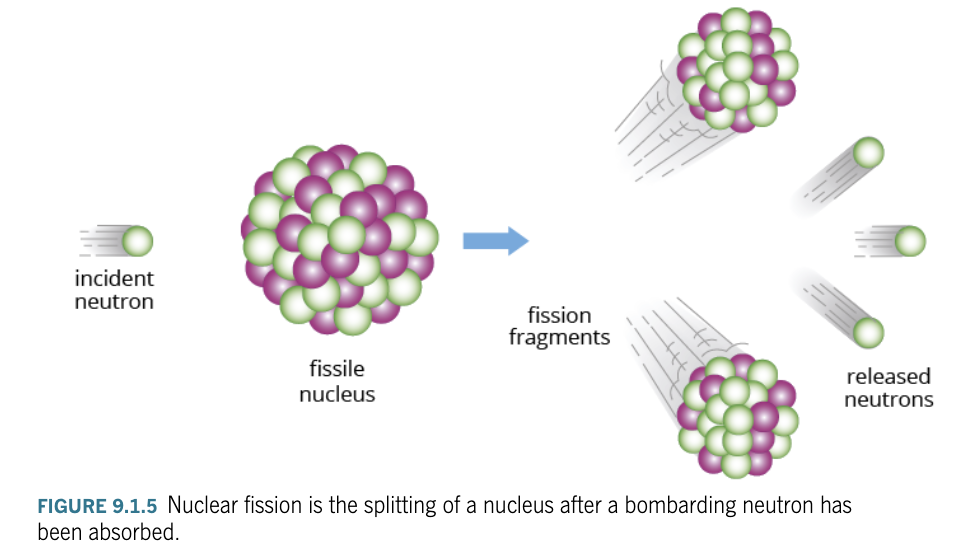
Fissile nuclides: Capable of undergoing fission after absorbing a neutron (mostly high atomic number elements, few in nature).
Strong nuclear force: First proposed by Hideki Yukawa (1935); complex properties required mathematical modelling until 1975.
Fissile Materials and Release of Neutrons
Common fissile nuclides: Uranium-235 and Plutonium-239.
Absorb slow-moving neutron (~2.2 km/s⁻¹) → become unstable → split.
Uranium-238 and Thorium-232 are non-fissile (require very high-energy neutrons).
Uranium: Heaviest naturally occurring element; isotopes formed ~6.6 billion years ago; radioactive decay contributes to Earth's core heat.
Uranium-235 fission example:
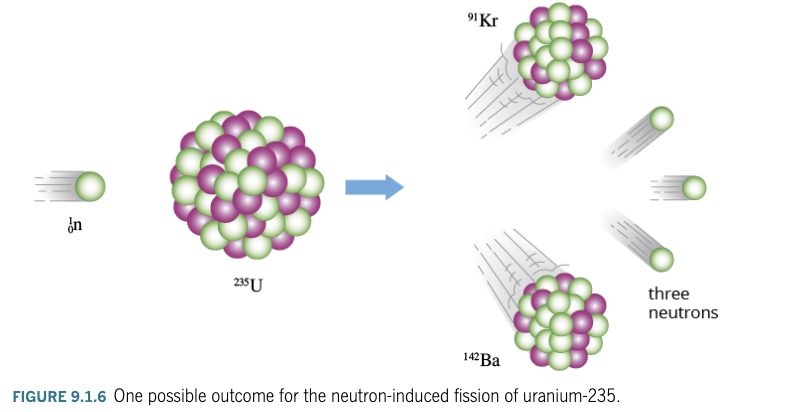
Splits into two smaller nuclei + releases neutrons (average ~2.47 per fission).
Example: Krypton-91 + Barium-142 + 3 neutrons.
Equation: ¹₀n + ²³⁵₉₂U → ⁹¹₃₆Kr + ¹⁴²₅₆Ba + ³₁₀n + energy
Fission fragments (daughter nuclei): Krypton-91 and Barium-142.
Plutonium-239: Average ~2.89 neutrons per fission (harder to induce fission than U-235).
Energy Released During Nuclear Reactions
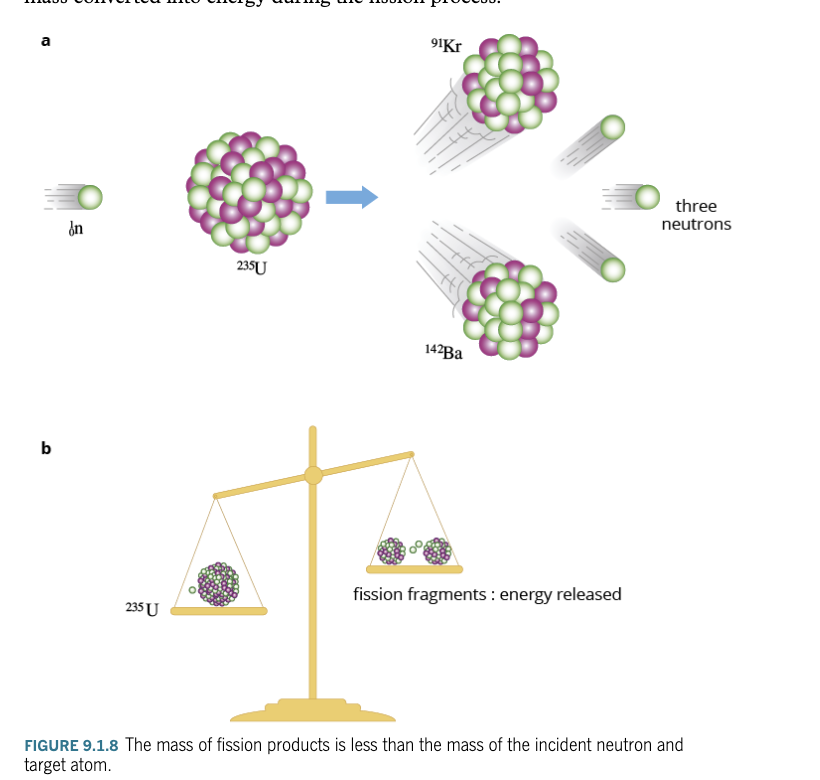
Mass of any nucleus < sum of individual nucleons (mass defect, Δm).
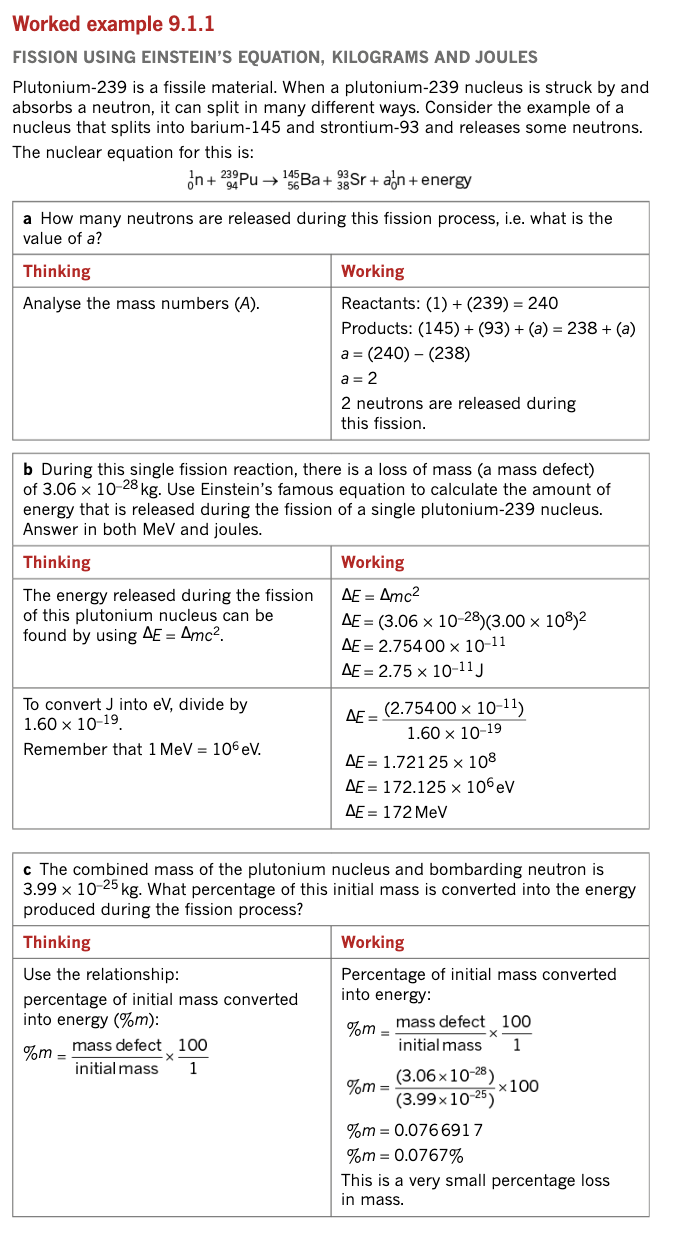
Energy released from mass defect via Einstein’s equation: ΔE = Δmc² (where ΔE in joules, Δm in kg, c = 3.00 × 10⁸ m/s).
Mass-energy equivalence:
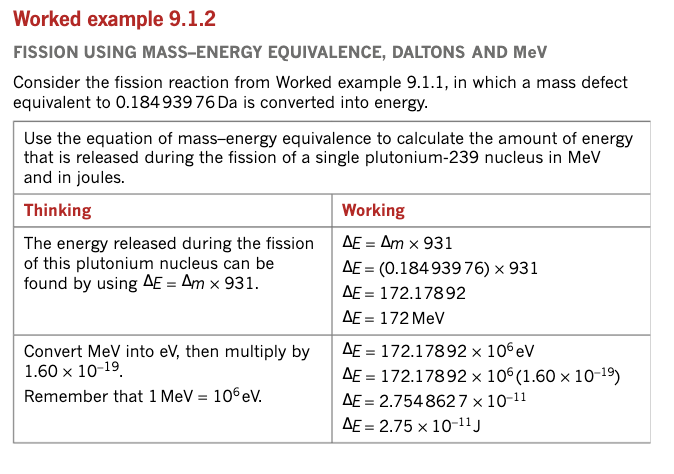
Preferred units: dalton (Da) for mass (1 Da = 1.66 × 10⁻²⁷ kg); MeV for energy (mega electronvolts).
Conversion: ΔE (MeV) = Δm × 931 (where Δm in Da).
Electronvolt (eV): Energy gained by electron accelerated by 1 volt = 1.60 × 10⁻¹⁹ J.
1 MeV = 10⁶ eV.
Typical fission energy release: ~200 MeV (mostly kinetic energy of fragments + neutrons + gamma radiation).
Only ~0.1% of original mass converted to energy (e.g., 1 kg U-235 → ~0.999 kg remains).
Worked Examples and Calculations (Breakdown)
Products and Waste
Fission products often radioactive → form high-level waste.
Management depends on radiation type and decay.
Physics in Action: Enrico Fermi, Lise Meitner and Nuclear Fission
Fermi: Bombarded U-238 with neutrons → produced transuranic elements (neptunium, plutonium).
Hahn & Strassmann (1938): Found barium (lighter element) instead of heavier ones → fission insight.
Meitner & Frisch: Explained energy release from mass defect.
Fermi built first nuclear reactor (1942) producing ~200 W.
9.2 Chain Reactions and Nuclear Reactors
Following discovery of nuclear fission, research focused on harnessing energy for both weapons and electricity.
Section covers: chain reactions, fuels, reactors, waste storage.
Chain Reactions and Critical Mass
Chain reaction: One fission releases 2–3 neutrons → each triggers more fissions → exponential increase.
Example: In U-235, rapid escalation in tiny fraction of a second (Figure 9.2.1: Uncontrolled chain reaction of uranium-235 nuclei — branching diagram showing neutron multiplication: 1 → 2 → 4 → 8 → 16...).
In 1 kg U-235: ~8 × 10¹³ J energy released in ~1 millionth of a second (uncontrolled → explosion).
Nuclear Fuel
Natural uranium: 99.3% U-238 (non-fissile), 0.7% U-235 (fissile).
Enrichment: Increases U-235 proportion (difficult/expensive).
Methods: ultracentrifuge, electromagnetic, gaseous diffusion.
Weapons: >90% U-235 (e.g., Hiroshima bomb: 40 kg at 95% purity).
Reactors: ~4% U-235 (lower enrichment for safety/control).
Critical Mass
Minimum fissile material for sustained chain reaction (depends on purity, shape, size).
Subcritical: Too many neutrons escape (e.g., flat sheet).
Supercritical: Sustains/explodes (e.g., spherical shape retains more neutrons)
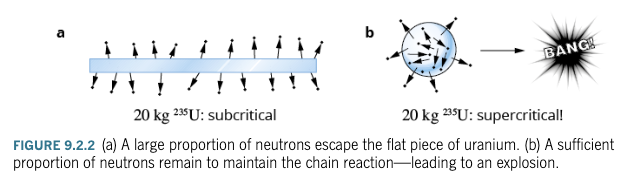
Larger pieces or better geometry → higher chance of sustained reaction.
Nuclear Reactors
Since 1950s: Control fission for electricity (over 440 plants worldwide; ~10% global electricity).
Australia: Exports uranium; operates OPAL research reactor (Lucas Heights) for medical isotopes (not power).
Thermal Nuclear Reactor (most common):
Uses slow (thermal) neutrons for U-235 fission.
Design elements:
Fuel rods: Pellets of enriched uranium in tubes (~3–5 m long; ~1000 per core).
Moderator: Slows neutrons (graphite, normal water, heavy water, CO₂).
Control rods: Absorb neutrons (cadmium/boron steel) — raise/lower to control rate.
Coolant: Removes heat (water, etc.) → steam for turbines.
Radiation shield: Concrete/steel/graphite to contain radiation.
Moderators (breakdown):
Slow fast neutrons without absorbing too many.
Heavy water: Best but expensive.
Normal water: Cheap, common.
Graphite: Good but less effective than water in some ways.
Putting It All Together:
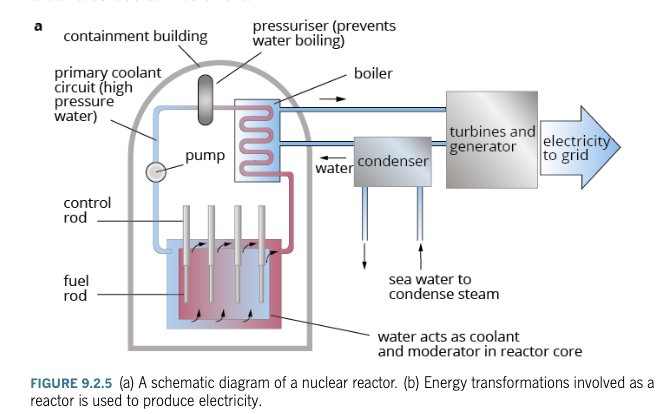
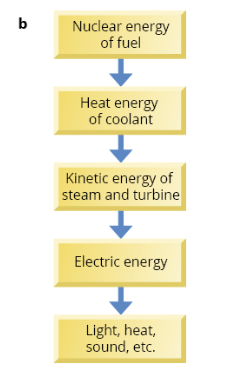
Core heat → primary coolant → steam → turbines → electricity.
Australia Context:
No commercial power reactors; focuses on renewables + uranium exports.
OPAL: Research/medical use.
PhysicsFile - Nuclear Disasters; Fukushima
Fukushima (2011): Earthquake + tsunami → loss of cooling → meltdowns, hydrogen explosions, radiation release.
Management of Nuclear Waste
Major challenge: Spent fuel rods (~25 tonnes/year per 1000 MW reactor).
Waste types:
Low-level: Contaminated items (compacted/buried).
Intermediate-level: Reactor parts/sludges (solidified, trenches).
High-level: Fission products + transuranics (highly radioactive, long-lived).
Storage: Cooling ponds → dry casks → geological repositories .
Activity decreases over time.
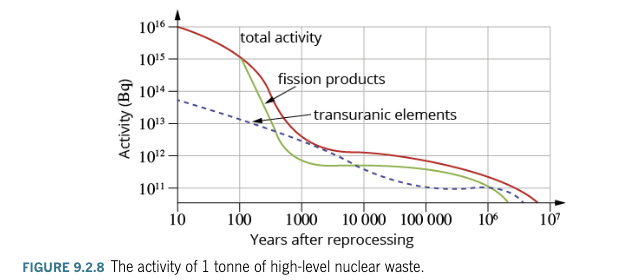
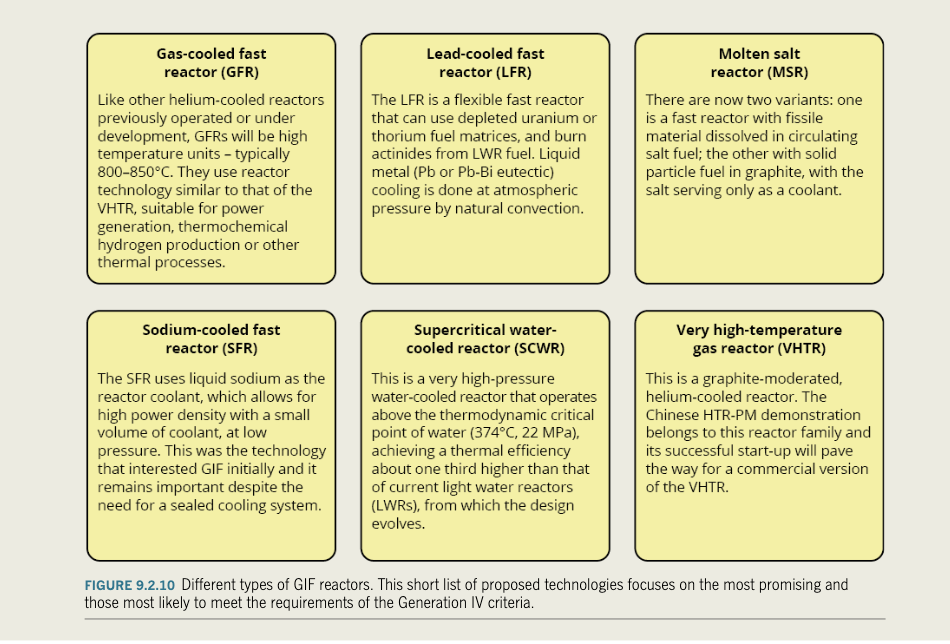
(Physics in Action) - Generation IV Fission Reactors
Improve safety, efficiency, sustainability, reduce waste/proliferation risk.
Examples;
Gas-cooled fast reactor (GFR)
Lead-cooled fast (LFR)
Molten salt (MSR)
Sodium-cooled fast (SFR)
Supercritical water-cooled (SCWR)
Very high-temperature gas (VHTR)
9.3 Nuclear Fusion
Nuclear fusion: Combining (fusing) small nuclei (e.g., hydrogen, helium) to form a larger nucleus.
Releases more energy per nucleon than fission; powers the Sun and stars; no long-lived radioactive waste.
Experimental reactors: ITER (France, delayed to ~2025+); NIF (USA) achieved "target gain" (more energy out than in for ignition) in 2022–2023
Energy and Mass Changes in Nuclear Fusion
Fusion example: Two hydrogen-2 (deuterium) nuclei → helium-4 + energy
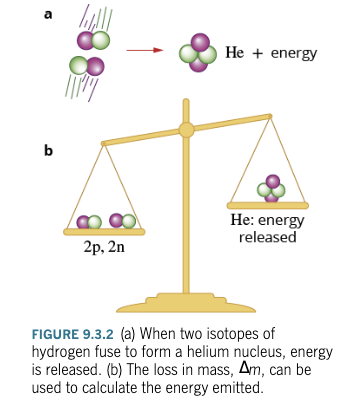
Equation: ²₁H + ²₁H → ⁴₂He + energy.
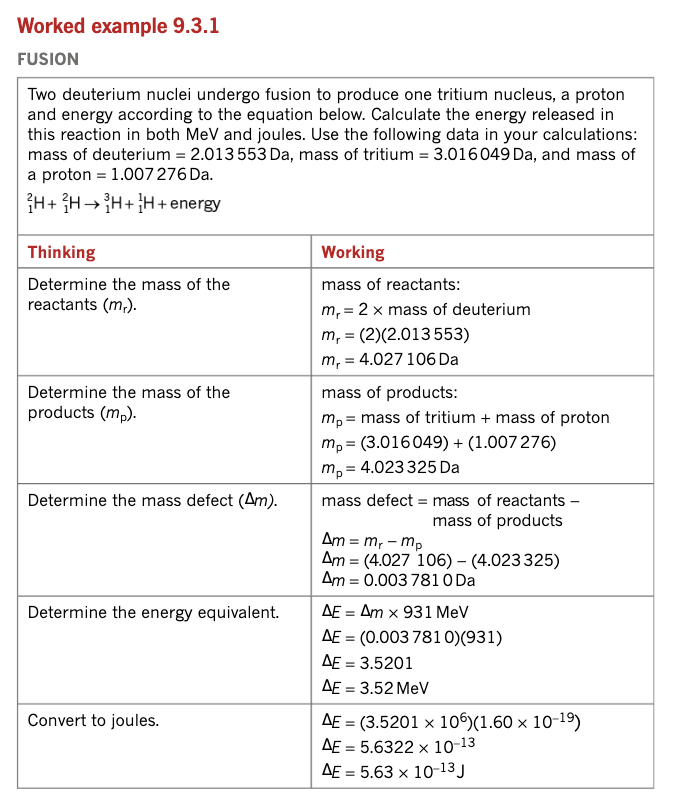
Mass defect (Δm): Total mass of reactants > products → converted to energy via ΔE = Δmc² (or ΔE = Δm × 931 in MeV/Da).
Atomic & mass numbers conserved.
Challenges of Achieving Fusion
Nuclei are positively charged → strong electrostatic repulsion (long-range).
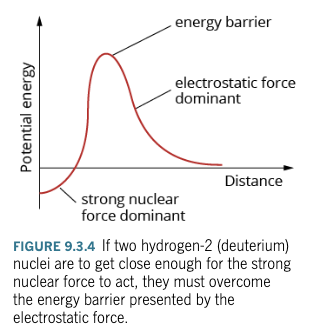
Need extremely high kinetic energy to overcome repulsion so strong nuclear force (short-range) can bind them.
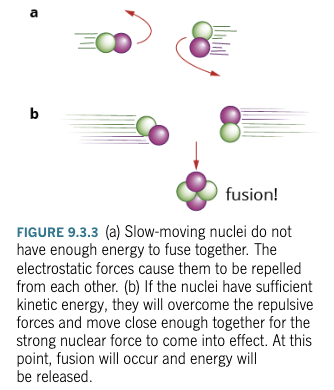
Requires temperatures of hundreds of millions °C (as in Sun's core) → plasma state.
Energy barrier
Binding Energy
Binding energy: Energy needed to separate nucleus into individual protons/neutrons (from mass defect).
Binding energy per nucleon:
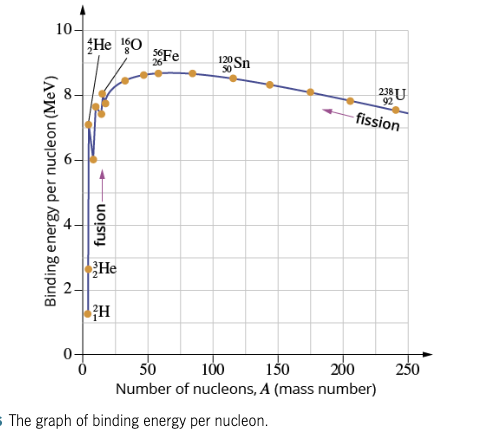
Peaks around iron (Fe-56) — most stable.
Light nuclei (e.g., H, He): Low binding energy → fusion releases energy (increases per nucleon).
Heavy nuclei (e.g., U): Fusion not favourable; fission releases energy.
Small nuclei fuse → higher stability/energy release; large nuclei fission.
Worked Example 9.3.1
Fusion in the Sun and Stars
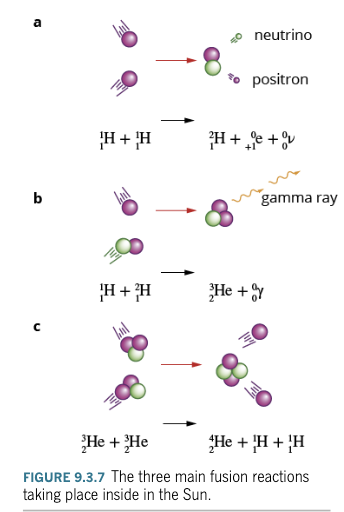
Main reactions (Figure 9.3.7: Proton-proton chain):
¹H + ¹H → ²H + e⁺ + ν (positron + neutrino).
Further steps produce ⁴He + energy.
Sun: ~657 million tonnes H → 653 million tonnes He per second; tiny mass defect powers life on Earth for billions of years.
Nuclear Fusion Reactors
Goal: Controlled fusion for clean power (deuterium from seawater — vast supply).
Tokamak design (magnetic confinement of plasma) — e.g., ITER
Challenges: Sustain 100+ million °C; contain plasma; net energy gain; materials durability.
Progress: JET tokamak records; ITER aims for full operation ~2030s.
From the Big Bang to the First Stars
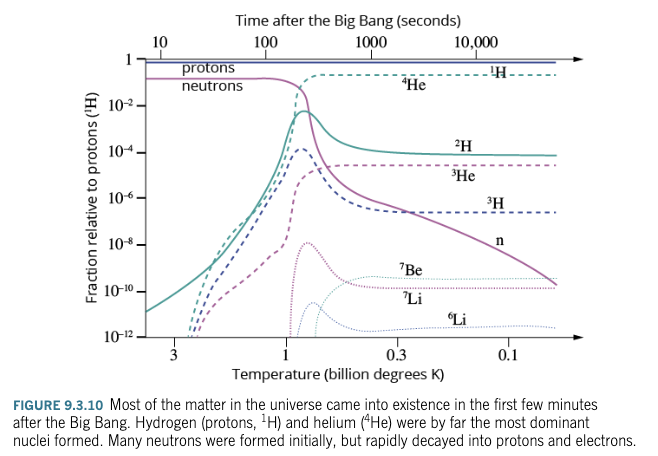
Big Bang → rapid expansion → cooling → formation of protons, neutrons, light nuclei (H, He, Li) via fusion
First stars: Gravitational collapse → high temperatures → fusion → heavier elements (up to iron) via supernovae.