4c. Monopolistic competition
Different Market Structures
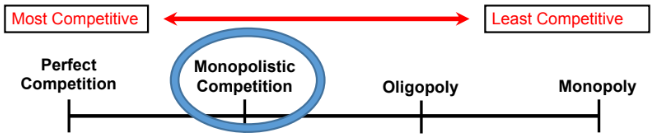
Market characteristics – Monopolistic competition
Price makers
Widespread knowledge but unlikely to be perfect
No barriers to entry
Products are similar but differentiated in some way
Profit maximisers
A large number of independent firms
Differentiated products
Physical product differentiation is where firms use size, design, colour, shape, performance, and features to make their products different. For example, consumer electronics can easily be physically differentiated.
Marketing differentiation is where firms try to differentiate their product by distinctive packaging and other promotional techniques. For example, breakfast cereals can easily be differentiated through packaging.
Human capital differentiation is where the firm creates differences through the skill of its employees, the level of training received, distinctive uniforms, and so on.
Differentiation through distribution, including distribution via mail order or through internet shopping, such as Amazon.com, which differentiates itself from traditional bookstores by selling online.
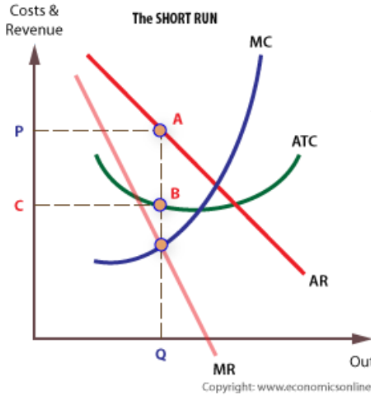
At profit maximisation, MC = MR, and output is Q and price P. Given that the price (AR) is above ATC at Q, supernormal profits are possible (area PABC).
As new firms enter the market, demand for the existing firm’s products becomes more elastic and the demand curve shifts to the left, driving down prices. Eventually, all super-normal profits are eroded away.
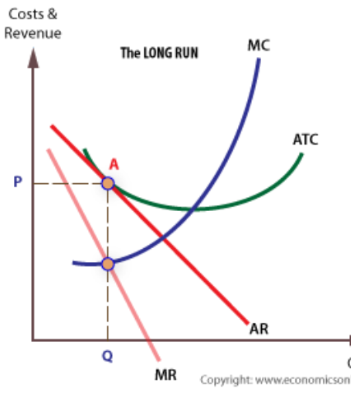
Super-normal profits attract new entrants, which shifts the demand curve for existing firms to the left. New entrants continue until only normal profit is available. At this point, firms have reached their long-run equilibrium.
Clearly, the firm benefits most when it is in its short run and will try to stay in the short run by innovating, and further product differentiation.
Advantages of monopolistic competition
There are no significant barriers to entry; therefore markets are relatively contestable.
Differentiation creates diversity, choice, and utility. For example, a typical high street in any town will have a number of different restaurants from which to choose.
The market is more efficient than monopoly but less efficient than perfect competition - less allocatively and less productively efficient. However, they may be innovative in terms of new production processes or new products. For example, retailers often constantly have to develop new ways to attract and retain local customers.
Disadvantages of monopolistic competition
Some differentiation does not create utility but generates unnecessary waste, such as excess packaging. Advertising may also be considered wasteful, though most are informative rather than persuasive.
As the diagram illustrates, assuming profit maximisation, there is allocative inefficiency in both the long and short run. This is because the price is above the marginal cost in both cases. In the long run, the firm is less allocatively inefficient, but it is still inefficient.
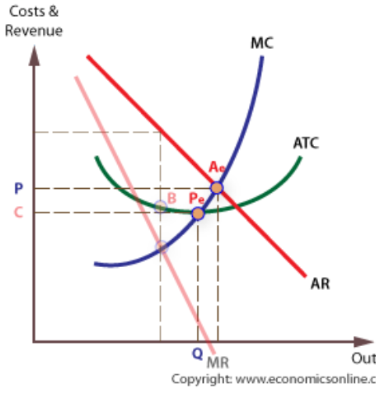
The firm is allocative and productively inefficient in both the long and short run. There is a tendency for excess capacity because firms can never fully exploit their fixed factors because mass production is difficult. This means they are productively inefficient in both the long and short run. However, this may be outweighed by the advantages of diversity and choice. As an economic model of competition, monopolistic competition is more realistic than perfect competition - many familiar and commonplace markets have many of the characteristics of this model.
Discuss with the use of a diagram, how a firm operating in a market with a large amount of independent retailers might be affected in the long run (12)
In monopolistic competition, firms sell differentiated products and have some control over price, but there are low barriers to entry (KAA). In the short run, a monopolistically competitive firm can earn super normal profits by selling where P>ATC, as shown in the diagram. Here the firm produces output Q1, sets a price P1 above average total cost ATC, and earns super normal profit represented by the shaded area.
However, in the long run, new firms are attracted by the super normal profits and enter the market (KAA). This increases competition and makes the demand curve for existing firms more elastic, shown by the demand curve shifting left to D2. Existing firms must reduce their prices in response, evident by the lower price P2.
The lower price reduces the gap between price and average total cost, eliminating super normal profits in the long run. Firms earn only normal profit where P=ATC. This is the long run equilibrium for a monopolistically competitive firm.
While differentiation gives firms some market power and super normal profits in the short run, competition erodes these in the long run (EVAL). The firm is still allocatively inefficient in the long run as P>MC at output Q2. But super normal profits are unsustainable long-term due to low barriers to entry and competition from independent retailers. The firm produces lower output for a lower price in long run equilibrium.