Grammar: Subject and Predicate
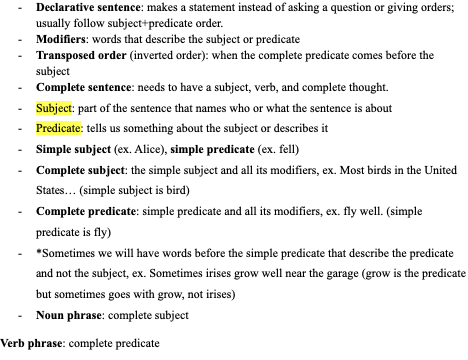
- Declarative sentence: makes a statement instead of asking a question or giving orders; usually follow subject+predicate order.
- Modifiers: words that describe the subject or predicate
- Transposed order (inverted order): when the complete predicate comes before the subject
- Complete sentence: needs to have a subject, verb, and complete thought.
- Subject: part of the sentence that names who or what the sentence is about
- Predicate: tells us something about the subject or describes it
- Simple subject (ex. Alice), simple predicate (ex. fell)
- Complete subject: the simple subject and all its modifiers, ex. Most birds in the United States… (simple subject is bird)
- Complete predicate: simple predicate and all its modifiers, ex. fly well. (simple predicate is fly)
- *Sometimes we will have words before the simple predicate that describe the predicate and not the subject, ex. Sometimes irises grow well near the garage (grow is the predicate but sometimes goes with grow, not irises)
- Noun phrase: complete subject
Verb phrase: complete predicate
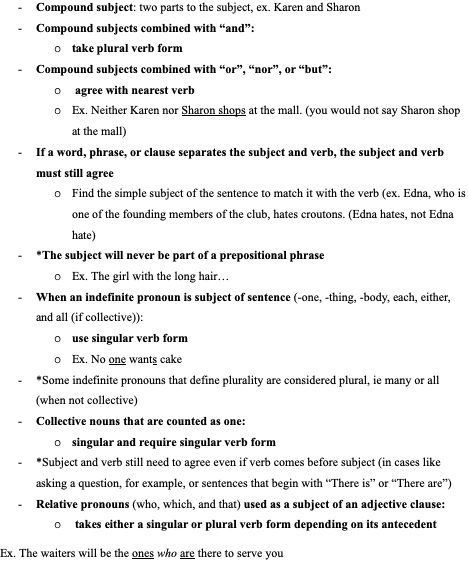
- Compound subject: two parts to the subject, ex. Karen and Sharon
- Compound subjects combined with “and”:
o take plural verb form
- Compound subjects combined with “or”, “nor”, or “but”:
o agree with nearest verb
o Ex. Neither Karen nor Sharon shops at the mall. (you would not say Sharon shop at the mall)
- If a word, phrase, or clause separates the subject and verb, the subject and verb must still agree
o Find the simple subject of the sentence to match it with the verb (ex. Edna, who is one of the founding members of the club, hates croutons. (Edna hates, not Edna hate)
- *The subject will never be part of a prepositional phrase
o Ex. The girl with the long hair…
- When an indefinite pronoun is subject of sentence (-one, -thing, -body, each, either, and all (if collective)):
o use singular verb form
o Ex. No one wants cake
- *Some indefinite pronouns that define plurality are considered plural, ie many or all (when not collective)
- Collective nouns that are counted as one:
o singular and require singular verb form
- *Subject and verb still need to agree even if verb comes before subject (in cases like asking a question, for example, or sentences that begin with “There is” or “There are”)
- Relative pronouns (who, which, and that) used as a subject of an adjective clause:
o takes either a singular or plural verb form depending on its antecedent
Ex. The waiters will be the ones who are there to serve you