Genome Organisation
Key Definitions
Genome - The entire set of genetic material in a cell.
RNA - A temporary copy of genetic information.
Central Dogma - How genetic information flows through a cell.
Transcription - The synthesis of mRNA from the DNA template strand, for protein coding genes.
Translation - The synthesis of a polypeptide strand from mRNA at the ribosomes.
Ribosomes - The site of translation consisting rRNA and proteins.
Subnuclear Aggregate - A cluster of molecules inside the nucleus that carry out similar roles
Topoisomerase - Unwinds the DNA molecule
Primase - Makes a short RNA primer, giving DNA polymerase a starting point to begin copying DNA.
dNTPs - Deoxynucleotide triphosphates
Genome
The entire set of a cells genetic information in its complete DNA sequence
The genome determines the cells protein:
Nature
Precise timing and location of their production
Key features
Form
Double stranded DNA molecules
4 Nucleotides
Adenine (A), Guanine (G), Cytosine (C) & Thymine (T)
Hereditary vehicle
Contains the hereditary information that defines each species.
When a cell grows/divides, it must replicate the entire genome, so information is passed between cells.
DNA contains genes that determine characteristics such as eye colour, blood type, and many other traits.
Hardware and Software
Genome has genes coding for its proteins and functional RNA (hardware)
Genome also contains regulatory DNA (software) which is used to turn genes on and off
Size and Complexity
the size of an organism doesn’t directly correlate with the size of a genome
Species | Genome Size | Common Name |
|---|---|---|
T2 phage | 170,000 bp | Virus |
Escherichia coli | 4.6 million bp | Bacteria |
Drosophila melanogaster | 130 million bp | Fruit fly |
Homo sapiens | 3.2 billion bp | Human |
Paris japonica | 150 billion bp | Canopy Plant |
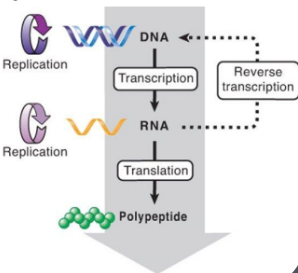
Central Dogma
Describes how genetic information flows through a cell.
Genetic information can’t be transferred from:
Protein to Protein
Protein to Nucleic acids
Instead it flows:
DNA → RNA → Protein
DNA: stores information
DNA is converted into mRNA (Transcription)
mRNA is converted into proteins (Translation)
History of Discovering DNA

Mechanism of DNA Replication (1958): The experiment by Meselson and Stahl demonstrated exactly how DNA replicates in E. coli, showing that the two strands pull apart to serve as templates for new strands.
Discovery of Messenger RNA (1961): Research identified an "unstable intermediate" (mRNA) that carries genetic information from the DNA archive to the ribosomes for protein synthesis.
Development of DNA Sequencing (1977): Scientists developed chemical methods to read the complete sequence of nucleotides in any DNA molecule, allowing them to decipher the hereditary information an organism contains.
First Eukaryotic Genome Sequenced (1997): The complete genome sequence of the budding yeast Saccharomyces cerevisiae was determined, revealing approximately 13 million nucleotide pairs.
First Multicellular Genome Sequenced (1998): The nematode worm Caenorhabditis elegans became the first multicellular organism to have its full genome sequenced.
Initial Human Genome Sequence (2001): The first sequencing and analysis of the human genome (over 3 billion nucleotide pairs) was published, identifying the "full set of parts" from which we are made.
Refinement of Eukaryotic Origins (Recent/2010s): Detailed genomic analyses have recently revealed that the first eukaryotic cell likely formed when an ancient archaeal cell engulfed a bacterium, explaining the hybrid nature of modern eukaryotic genomes.
Precision Genome Editing (Recent/2010s): The bacterial CRISPR system has been adapted as a powerful tool to edit the genomes of a wide variety of species.
Nucleolus
Nucleolus - the dense regions inside the nucleus that contains DNA
Roles
Ribosome production
transcribes ribosomal RNA genes
transports assembled ribosomes to cytoplasm
Subnuclear Aggregate
Within the nucleolus all the molecules with a similar purpose will group together to form clusters
The clusters don’t have membranes to separate them from their environment so inside create their own chemical environments
Nucleic Acids
Nucleic acids - Long polymers called polynucleotides that store and transmit genetic information (DNA & RNA)
DNA - Cells permanent information archive, containing the genome in a double stranded helix, with complementary base pairs and a sugar phosphate backbone.
RNA - Intermediary from of genetic information, single stranded.

Nucleotide Structure
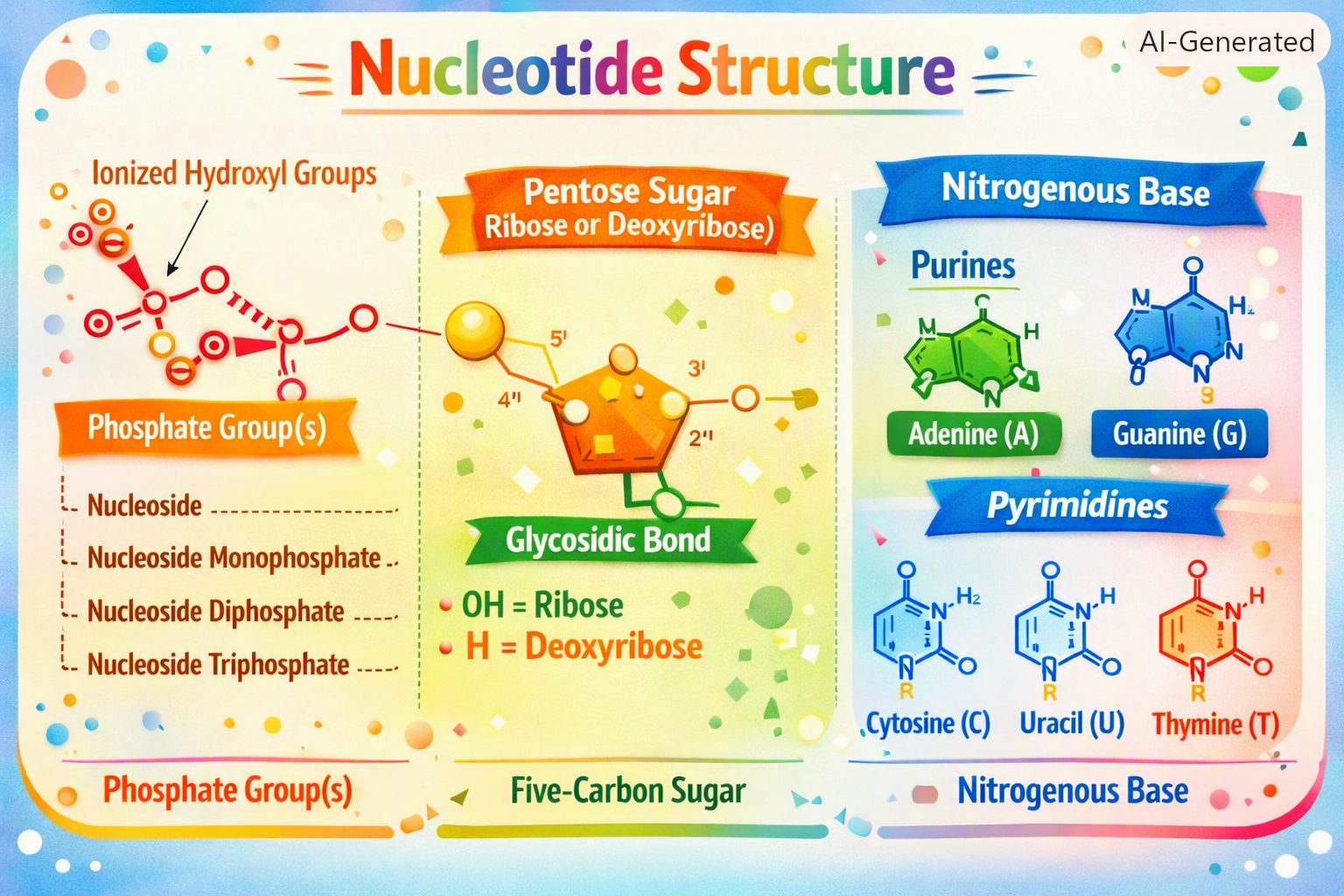
Purines = 2 rings Pyrimidines = 1 ring
Bonding
The purines will bind to the pyrimidine
2 x H bonds between A&T
3 x H bonds between C&G
The different bonding between the 2 sets of bases means that the parts of DNA that may be richer in G&C may need more energy to break the 2 strands.

Chargaff’s rules
in any organism:
The amount of A = T and the amount of G = C
The number of Purines (A + G) = the number of pyridines (C + T)
DNA structure
Double-helix:
Composed of two antiparallel strands of polynucleotides.
So one strand is parallel so one strand will go from 5 at the top and the anti parallel strand will start with 3 at the top.
Stability:
Hydrogen bonds between bases in opposite strands and base stacking within each strand contribute to stability.
B-Form DNA
A double helix consisting of 2 polynucleotide chains that run antiparallel
Å is Armstrong which is a tenth of a nanometer
Each turn is composed of a major and minor groove.
20 Å diameter
10 base pairs per turn = 34Å per turn
Complementary base pairing: A with T, C with G according to Chargaff’s rules.
Chromosomes and Chromatin
Chromosomes - Long, coiled strands of DNA wrapped around histone proteins
Chromatin - Loose, uncoiled form of DNA wrapped around histone proteins
Nucleosomes - 8 histones with DNA wrapped around them

Structure of chromosomes
Sister chromatids: The 2 halves of a chromosome }
Telomere: Half of the sister chromatids
Centromere: The center of the chromosome
P arm: The upper telomeres
Q arm: The lower telomeres

Why is DNA packaged into chromosomes ?
When it is fully stretched out it is 2m long
DNA needs to fit inside the nucleus
What is the problem with chromosomes?
it is compact but not very accessible.
so the machinery for the synthesis for DNA and transcription cannot access all sections of DNA as some parts are hidden in the nucleosome structure.
2 forms of chromatin?
Euchromatin - open conformation enables replication and transcription.
Heterochromatin - closed conformation
Chromatin remodelling allows DNA to be exposed in the open conformation and accessed for replication, transcription, repair, etc
Methods of Chromosome Visualisation
FISH - Fluorescence in situ hybridization
Process
A fluorescent DNA prob is added onto a gene on the chromosome
Before Replication
What must happen for DNA replication?
DNA must be copied and then separated through segregation before cell division
This needs to be accurate and fast (otherwise there can mutations)
Mitosis key phases for DNA replication
G0 - cell cycle rest
G1 - organelles replicate
S - chromosome replication
G2 - Double checks duplicated chromosomes for errors and repairs
Mitosis - IPMAT
Cytokinesis - Cell splits
DNA replication
Key facts:
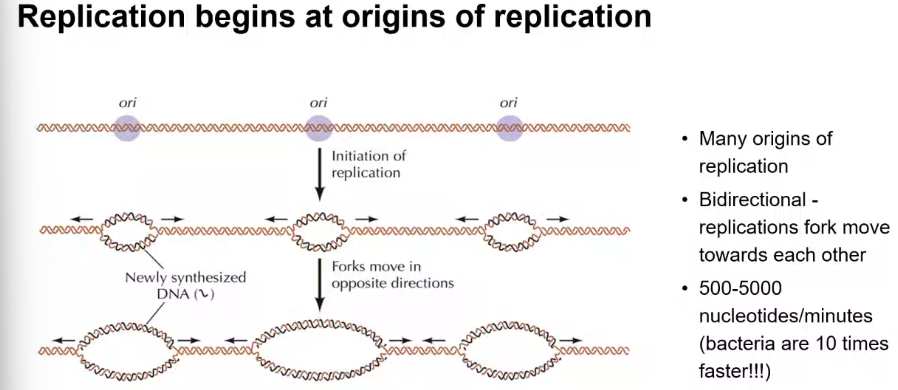
Semi-conservative
each strand serves as a template for a new strand
Starts at origins of replication, proceeding bidirectionally, with speeds of 500 to 5000 nucleotides/minute.
DNA Replication Process (simple)
When we start DNA replication we have a double helix
This is separated into 2 strands
DNA bases will line up next to complementary bases on the template strands
2 new DNA strands will form
DNA Replication Process (detailed)
Chromatid in euchromatin
initiator proteins
DNA helicase
Topoisomerase
Primase
Elongation
Okazaki fragments
Exonuclease
DNA ligase.
Chromatid in Euchromatin - Allows relevant proportions of DNA to be accessible.
Origins of replication - This is where the DNA strands splits in multiple places, this increases efficiency.
Initiator proteins - Helps open strand
4. DNA Helicase - Opens the DNA helix by breaking the hydrogen bonds
Topoisomerase - unwinds the DNA molecule
Primase - Makes a short RNA primer, giving DNA polymerase a starting point (3'-OH) to begin copying DNA.
Elongation - Requires dNTPs and DNA polymerases which joins the new strand
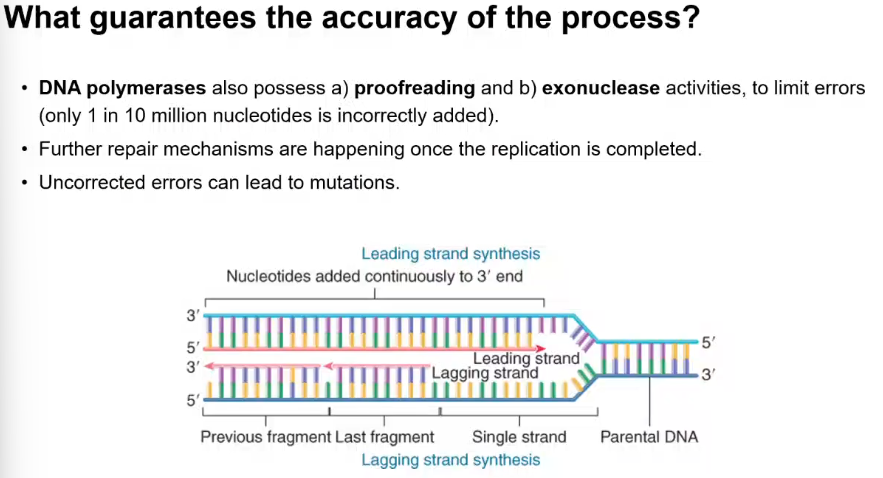
Okazaki fragments - Formed on the lagging strand due to discontinuous synthesis
Exonuclease - Removes nucleotides from the end of a DNA strand and helps correct mistakes made during DNA replication.
DNA ligase - Joins Okazaki fragments
dNTPs
DNTPs are deoxynucleotide as they find the oxygen in the 3 prime molecules
each monomer of DNTP joins the DNA strand
it looses 2 phosphate groups as a molecule of pyrophosphate.
Leading and Lagging strands
The concept of directionality is important because DNA replication is not happening in the same way on both strands
in the leading strand replication will be continuous as DNA polymerase can follow DNA helicase
In the lagging strand the DNA polymerase is going opposite to the replication fork. this is called discontinuous synthesis. The way that theses cells adapted to this is that shorter fragments of DNA are synthesised each time. so there is a primer.

Accuracy in DNA Replication
DNA polymerases possess:
Proofreading activity
the Polymerase will detect of the wrong nucleotide is added.
Exonuclease activity, correcting errors (1 in 10 million nucleotides).
it can also removes these wrong nucleotide.
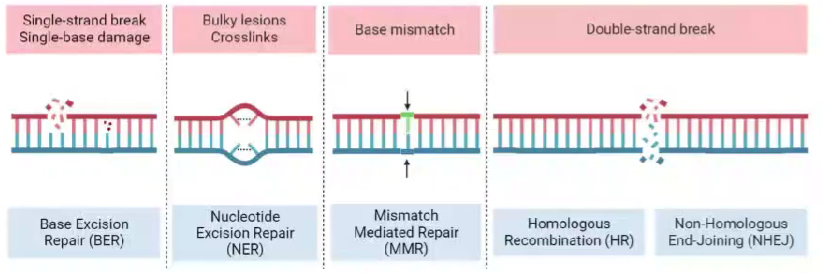
Repair mechanisms are crucial post-replication to rectify potential mutations.
Telomere Dynamics
Telomere - Special nucleotide sequence rich in G at the ends of chromosomes.
Telomerase - Elongates telomeres, playing a critical role in cellular aging processes.
What is the purpose of telomeres?
prevent erosion of important genes
They don’t prevent shortening (ageing)
DNA Repair Mechanisms
DNA repair mechanisms exist to rectify mutations, maintaining genomic stability.
Mutations - Inherited alterations in DNA sequence due to replication errors or external agents.
DNA repair mechanisms exist to rectify mutations, maintaining genomic stability.
These include:
Replicating the ends of linear DNA molecules