HM-Vocab and Review Questions Quiz 2
Quiz 2- Vocabulary
Ch. 6
Vocabulary
Chapter 6 OMIT: Endotoxin, Life-Change Unit, Preparatory Response Hypothesis, Safety Hypothesis,
Adrenaline: A stress hormone that prepares the body for fight or flight by increasing heart rate, breathing capacity, and sending blood to the muscles
Affordance: features of a stressful situation that allow for some action, such as reappraisal.
Burnout: being emotionally, exhausted and cynical, as a result of unfulfilling work or study.
Comfort food: foods like ice cream, chocolate potato chips that are eaten in order to reduce stress or to feel better
Comorbidity: when two negative states are associated together, as when a person uses psychoactive drugs to alleviate stress, such as PTSD.
Controllability: the extent person can alter change, or reduce the effects of a stressor.
Coping: behavior that is motivated to meet. Life’s demand is as in solving managing, or dealing with those events (potential stressors) satisfactorily.
Cortisol: a stress hormone that prepares the body for fight or flight, by releasing glucose into the bloodstream.
Cytokines: specialized cells of the body’s immune system that communicate the presence of pathogens to the brain the result is sickness behavior.
Distancing: an emotion focused coping strategy that involves fighting ones time before doing anything or trying to forget about the problem.
Distraction: a coping method to prevent negative emotions by diverting wants attention away from the stressor towards a more pleasant event.
Distress: term that emphasizes stress has being psychologically negative i.e. negative stress
Dose response relationship: the degree of exposure (does) one has to a stressful event, determines the extent of stress symptoms (response).
Effort/reward imbalance: an indication of a chronic stressor the imbalance results winning individuals efforts are much greater than the rewards received from that effort.
Emotion-focused coping: involves managing the negative reactions that accompany stress to alleviate symptoms of distress, but not dealing with the source of the stressor
Emotion regulation: a coping strategy for the control of positive and negative emotions, such as what one experiences, when how intensely and their expression.
Eustress: physiological arousal, that results from positive events, considered positive stress, and is opposite of distress.
Experiential-avoidance: a component of PTSD that refers to the reluctance to indoor painful sensations memories. Are thoughts about an experience traumatic event.
Hormones: chemical messengers released by glands in order to affect a particular organ certain hormones are released as part of stress.
Immune system: a system of the body that is designed to attach and destroy, pathogens and protect humans from disease.
Migraine headaches: extremely painful, long, lasting headaches, which may be accompanied by nausea, and may require a person to lay down in a dark room.
Pathogens: bacteria and virus that invaded human body to produce diseases.
PTSD: a long lasting source of distress from experiencing or witnessing very traumatic events.
Predictability: likelihood that a stressor will occur.
Primary appraisal: an event is evaluated as to whether it is relevant, benign positive, or stressful for a persons will being.
Problem-focused coping: trying to identify the problem or stressor, and she consider potential solutions to deal with a stressor and then doing so.
Psychoneuroimmunology: the science that studies, the relationship among stressors the bodies, immune system and diseases.
Psychophysiological or psychosomatic disorders: medical conditions like asthma, headaches, and hypertension, that are a consequence of or are made worse by stressors.
Race related vigilance: anticipating, and being prepared for racial discrimination.
Reappraisal: a coping strategy that involves reinterpreting, a stressor usually in a positive light.
Same Domain effect: valence of event and reaction to it, are the same dimension.
Secondary appraisal: Individuals inventory of coping resources determines the ability to cope with an stressor.
Self-blame: an emotion, focused coping strategy that involves excepting responsibility for one’s actions and the consequences.
Self-isolation: an emotion focused coping strategy in which people keep others ignorant of their problems, and avoid people in general.
Self-medication hypothesis: when a person uses alcohol, nicotine, or other drugs, in order to alleviate symptoms of stress.
Sickness behavior: behavior exhibited when ill.
Stress: negative physiological, or psychological reactions, that result, when life’s demands exceed coping resources for dealing with the stressors.
Stressors: environmental demands that produce stress because the person cannot cope with them adequately.
Tension headache: Dull, aching, pain and tightness of the foreheads sides and back of head.
Tension reduction: an emotion, focused coping strategy that may involve smoking, drinking, eating and jogging, in order to feel less tense and thus feel better.
Wishful thinking: that focuses on the desire that the stressor will somehow go away, or that the person would feel differently about it.
6.2.
a. What are features of life-events that can make them become stressors resulting in stress.
ANS: Conditions that are challenging, demanding, and threatening are considered stressors. The features of stressors include the ability to handle (control) a situation, how long the stressor lasts (duration), the intensity (magnitude) of the stressor, and the ability recognize that the stressor will happen (predictability).
b. What is the dose-response relationship for stressors and stress.
ANS: The dose-response relationship is based on the amount of exposure to a stressor and the severity of stress responses. Example: Not doing as well on an assignment (dose), and either letting it go, becoming agitated, or dropping out of the class or university (response).
6.3. Describe Selye’s General Adaptation Syndrome to explain short-term vs long-term stressors effects on the immune system
ANS: Seyle’s General Adaptation Syndrome is based on alarm, resistance, and exhaustion. Alarm refers to the perception of a threat, where fight-or-flight (fawn, or freeze) is initiated as a form of self-preservation, which results in activation of the sympathetic nervous system and releases epinephrine in the body. Resistance occurs when the body begins to mobilize a response to replenish the body after alarm. The sympathetic nervous system is activated to increase levels of cortisol, blood pressure, and heart rate. If the stressor is long-lasting, the body adapts to this change and stabilizes around the increased levels of cortisol. These long-lasting stress levels lead to a compromised immune system, due to attempting to maintain these high levels of stress. This leads to burnout and potential physical ailments from being overloaded with stress and cortisol levels finally decreasing.
6.5.
a. What are the two major types of coping?
ANS: The two major types of coping are emotion-focused, and problem-focused. Emotion-focused is a better strategy revolving around coping with negative emotions associated with the stressor. Problem-focused focuses on determining the cause of the stressor and analyzing potential solutions.
b. Describe how the effectiveness of a coping strategy depends on the nature of the stressor. In other words, why does the characteristic of the stressor determine which coping strategy is best?
ANS: The characteristic of the stressor determines what coping strategy will be most effective by its ability to be coped with directly. If the stressor can be resolved by solving a problem, then the problem-focused strategy is used, meaning there is more control and predictability over a situation. If the stressor is out of one’s control, the better coping mechanism is the emotion-focused strategy, where the coping is based on controlling the negative reactions.
6.6. What steps are involved in Lazarus’ transactional (cognitive) coping theory?
ANS: Lazarus’ transactional coping theory is based on the appraisal of a situation. This occurs in two stages, the primary and secondary appraisal. The primary appraisal occurs when the event’s impact is determined (harmful, stressful, benign, or positive). The secondary appraisal is based on determining if one has the means to cope with the situation. The person then introduced to the stress, copes through problem-focused or emotion-focused and reassesses the stressor at that time
Ch.7
Chapter 7 OMIT: Explicit Motive, Implicit Motive, Operational Definitions, Projective Test, Redintegration, TAT (Thematic Apperception Test),
Belongingness Hypothesis: Motive for people to form long-lasting, positive, meaningful interpersonal relationship.
Better-Than-Average: The tendency to overestimate strengths and underestimate weaknesses.
Contingencies of Self-Worth: Domains in people’s lives that they consider important for their self-esteem.
Counter-factual Thinking: Method of restoring meaning by considering alternatives to the current situation
Drive: A state created by depriving the organism of an incentive; similar to a psychological need.
Hierarchy of needs: Needs are arranged in a hierarchy of potency: physiological, safety, belonging, esteem, and an ultimate final need.
Intrinsic Motivation: Behavior driven by an internal force.
Maslow’s hierarchy of needs: Theory that postulates needs are satisfied from physiological to self actualization.
Meaning making: hypothesis stating that people attempt to make sense of tragedies.
Motive to achieve success (Ms): Disposition to engage in task-oriented behavior or achievement behavior characterized by doing things better than before or surpassing a high external or internal standard of excellence.
Motive to avoid failure (Maf): Opposite of the need to achieve; inhibits a person from attempting achievement tasks; characterized by anxiety and fear about failing a task.
Need for affiliation: Affiliation refers to frequent contacts with others, who are accepting but yet tend toward indifference
Need for Belonging: Regular and intimate contact with others for whom one has deep feelings and attachment
Need for autonomy: Individuals behave according to their own volition; do what they want; opposite of being coerced by guilt, shame, rewards, punishers.
Need for closure: Motive for firm answers and an dislike toward ambiguity; “seize and freeze”. Measured with the Need for Closure Questionnaire
Need for cognition: A desire to understand one’s situations and experiences by thinking about them. Measured with the Need for Cognition Scale
Need for competence: Individuals feel capable and successful in dealing with their physical and social environments. When made to feel incompetent, this need provides the motivation to become capable
Need for meaning: Motivation aimed at achieving predictable relationships between individuals and their physical and social environments
Physiological need: deviation from the set point of homeostasis
Psychological needs: Internal motive to resolve discrepancy between a set point and incentive
Recovery sleep: How long a person sleeps after sleep deprivation.
Self-determination theory: Motivation is based on free-choice
Self-esteem: emotional outcome of self-evaluation
Sleep latency: how soon one falls asleep
Socially desirable responding: acting in a socially acceptable way.
State: temporary deficit between current and desired state.
Trait: permanent requirements to maintain function.
Two-process model of psychological needs: Need motivates behavior two ways
1. satisfying a need reduces its aversiveness (negative reinforcement)
2. addition of positive feelings at end of the need satisfaction process (positive reinforcement)
Vitality: subjective feeling of being alive
7.2. What is the difference between an implicit motive and an explicit motive?
ANS: Implicit motives are based on how people are driven by incentives and receiving pleasure from fulfilling a need, such as getting to sleep after a long day. Explicit motives are the outwardly expressed motivations that differ from person to person, like waiting in a long line to meet a musician. 7.2-level of awareness (implicit = lower; explicit = higher)
7.3. What does it mean that psychological needs or motives can be both permanent and temporary?
ANS: Needs can be based on a temporary unbalance of a desired incentive level (State) or be these needs may be constant, due to the continuous needed for optimal functioning of an animal (Trait).
7.5. What is the relationship between need intensity and
a. psychological well-being
ANS: As need intensity increases, psychological well-being decreases, due to the disruption in homeostasis levels.
b. frequency of behavior that satisfies a need?
ANS: When the need intensity increases, the frequency of behavior that satisfies a need also increases, as an attempt to restore these levels.
7.6.
a. Describe Maslow’s hierarchy of needs.
Maslow’s hierarchy of needs is a theory developed to explain where different needs exist in relation to each other. The theory suggests that the physiological needs (shelter, food, water, sleep) are fulfilled first while needs related to psychological development (self-development, love, and belonging) are established later. It is important to recognize that the needs on the bottom can surface at any time and become more dominant over other higher levels of needs.
b. List and define all of the tiers of the hierarchy.
ANS:
Bottom Tier: This tier consists of the physiological needs relating to sleep, food, water, and shelter. These needs are the first to be resolved but may arise again at any time.
Second-From Bottom Tier: The tier relates to the needs of safety and self-protection, such as avoiding anxiety and moving towards a secure environment.
Middle Tier: The middle level is based on affiliation and belonging within social systems, like friends, family, community, and romantic relationships.
Second-From Top Tier: This is the tier based on development of respect for oneself from others, self-esteem, and recognition.
Top Tier: This final tier is about self-fulfillment through using one’s strengths, mating and parenting, understanding the meaning of life, and finding happiness.
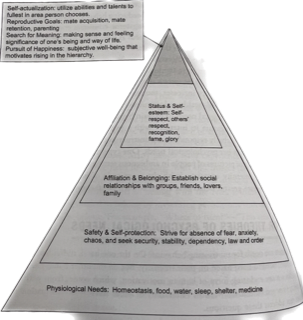
c. What different proposals have been made for the top tier of the hierarchy?
ANS: The proposals have been self-actualization (focuses on using ones talents), reproductive goals (acquiring and keeping a mate and being a mate), search for meaning (understanding why life operates in the way it does), and looking for happiness (growth of subjective self-esteem through going through the hierarchy).
7.7.
a. What is self-determination theory?
ANS: The ability to make choices based on their own free will.
b. What are the major needs in self-determination theory? Describe each of these needs.
ANS: The major needs are autonomy, belongingness, and competence. Autonomy is based on being able to do what you want, belongingness is when you are regularly associated with and share a close relationship, and competence refers to feeling as though you understand and take care of a situation effectively. This theory also discusses the need for self-esteem development, meaning that when these needs are fulfilled, an individual’s view on themselves improve.
7.7-Self-determination theory assumes that motivation originates within the person and does not result from being coerced (forced, obligated, required) by outside sources like positive or negative incentives or external goals. In addition, individuals are presumed capable of satisfying their psychological needs.
7.8. Describe the psychological needs described in this chapter: achievement, autonomy, belonging (affiliation), closure, cognition, competence, meaning, power, and self-esteem.
ANS:
Achievement: Need based on successfully reaching a high standard.
Autonomy: Need based on independence in decision making and freely choosing goals.
Belonging (Affiliation): Need based on finding individuals that care about your wellbeing and continue to maintain relationships.
Closure: Need based on finding concrete solutions to abstract problems.
Cognition: Need to achieve understanding of the world through thinking.
Competence: Need to feel confident and capable of coping with abilities for situations.
Meaning: Desire to understand how one relates to other systems including communities and geographic environments.
Power: The need to have influence on other people and be seen as having high status.
Self-Esteem: Need to have successes that influence how you feel about yourself.
7.9. Select any two needs and describe how a high degree of each need can cause conflict within an individual.
Here is an example: The need for closure versus the need for cognition: In the case of closure an individual prefers to seize and freeze, that is, arrive at a decision quickly or answer quickly and stick with it. They dislike ambiguous situations. In the case of cognition, however, an individual wants to ponder or think about a situation and then make a decision. Thus, the conflict is one of rapidity and certainty versus slow deliberation.
ANS: Need for Power vs Need for Affiliation/Belonging: The need for power is based on being influential and being recognizable in different situations. When becoming influential in society, relationships often fall apart, which hinders the need for belonging in social environments. However, when focused on the need for belonging, one is not gaining popularity or dictating how people will act. The conflict arises when deciding to pursue power and influence or focus on building relationships with members of society.
7.10.
a. Describe what factors cause a person’s level of self-esteem to rise or fall and why that is also dependent on the domain of the person’s contingency of self-worth?
ANS: The formula proposed to assess self-esteem is based on number of successes and perceived number of possible selves (pretensions). When amount successes decrease, self-esteem is lowered but when the number of possible selves decrease or number of successes increase, self-esteem rises. Factors of self-esteem include approval from others, appearance, competition, academic achievement, family support, virtue, and religious ties. Higher scores in each area mean that one has higher self-esteem in that domain.
b. How does self-esteem motivate behavior?
ANS: People’s behavior is motivated by the desire to increase their self-esteem. This is done through taking credit for success and avoiding blame, believing that one is better at something than they are, omitting memories that do not help with the portrayal of self, and acting in a socially desirable way. All of these are behaviors that attempt to protect and raise one’s self-esteem.
Ch. 8
Chapter 8 OMIT: Operational Definitions
Active Correlation: Part of trait-environment correlation: individuals seek and create environments that match their personality traits.
Agreeableness: One of the five-factor model personality dimensions that ranges from cold, hard, rude, to kind, sympathetic, and warm.
Behavioral Genetics: Science of genetic inheritance relevant to behavior.
Boredom susceptibility: Component of sensation seeking that is an aversion to boredom resulting from repetitive experiences and lack of stimuli.
Channeling Hypothesis: Personality traits channel or convey how psychological motives are represented and satisfied.
Conscientiousness: One of the five -factor model personality dimensions that ranges from careless, disorganized to practical, systematic, and efficient.
Cybernetic Big Five Theory: Theory based on proposing what goals one is drawn to.
Disinhibition: Component of sensation seeking relying on variety based letting yourself go.
Evocative Correlation: Trait-environment correlation wherein an individuals personality trait determines the type of reaction they evoke from others.
Extraversion: A personality trait (dimension) that ranges from quiet, reserved, shy to active, assertive, dominant.
Extraverts: People at the upper end of the extraversion scale characterized by bold, energetic, and talkative.
Five-Factor Model: Theory that postulates five major personality traits (OCEAN) Openness, Conscientiousness, Extraversion, Agreeableness, and Neuroticism.
Heritable: Similarities/differences among people in their personality traits stem from similarities/differences in the variation of genes for those traits.
Grit: Trait that focuses on consistency of interest and perseverance of effort.
Impulsiveness: Tendency to give into impulses, even if it is less beneficial than delayed outcomes.
Individual differences: Individual variations among personality dimensions.
Introverts: Lower end of the extraversion dimensions and characterized with shyness and quietness.
Mental Fatigue: Feeling tired and expressing reluctance to continue with a course of action.
Neuroticism: One of the five -factor dimensions that ranges from relaxed to extreme apprehensiveness.
Openness-to-Experiences: Personality traits range from shallowness to curiosity.
Passive Correlation: Trait-environment correlation where the biological parents create the environment for their children.
Personality States: Temporary behaviors that represent a personality trait.
Power Motive: Wish to influence the lives of others and to be noticed.
Personality Traits: Consistency in a specific set of behaviors over time and relevant situations.
Reward Sensitivity: A person is aroused with the prospect of obtaining rewards.
Self-control: Ability to inhibit desires in order to pursue a long-term goal.
Strength Model: Self-control relies on energy to inhibit desires and impulses.
Sensation Seeking: Personality trait characterized by looking for intense stimuli and taking drastic action to achieve them.
Subjective Well-Being: Term for overall satisfaction with life and control over one’s circumstances.
Thrill-and-Adventure Seeking: Component of sensation seeking characterized by risky behaviors.
Trait-Environment Correlation: Personality traits associated with their effects on behavior because traits determine the situations one chooses.
Trait-Environment Interaction: A person’s reaction to the environment is dependent on how much of a trait they possess.
8.1. How do psychological needs or motives motivate behavior versus how personality traits motivate behavior?
Psychological needs motivate behavior based on survival and development of self, to maintain homeostasis. Personality traits motivate behavior due to the patterns across time and similar situations, that continue to be stable over time.
8.3. Distinguish between trait-environment interaction and trait-environment correlation?
ANS: Trait-environment correlation is based on personality traits associated with their effects on behavior because traits determine the situations one chooses. This means that personality traits determine the environments that one chooses to be a part of (experiences). Trait-environment interaction is based on a person’s reaction to the environment is dependent on how much of a trait they possess. This means that how one reacts is dependent on the levels of traits that one has (biological).
8.4. The big five personality traits are openness-to-experience, conscientiousness, extraversion, agreeableness, and neuroticism. Select two traits and describe how differences within those two traits are associated with differences in what motivates people. That is, how would individuals with a high amount of a trait differ from individuals with a low amount of that trait in what motivates them?
ANS: Openness-to-experience vs neuroticism: Openness-to-experience is motivation based on the desire to experience new, out of the ordinary events. High levels of openness-to-experience result in the desire to explore novel or interesting circumstances, such as sensory-seeking behavior, whereas low levels of openness-to-experience result in limited desire to explore these experiences. Neuroticism is motivation based on worries or anxieties over certain situations. High levels of neuroticism result in anxious behavior and the avoidance of unfamiliar experiences, where low levels of neuroticism result in low levels of anxieties or worries (relaxed). For example, individuals that would be eager to go on a new rollercoaster have high levels of the openness-to-experience trait and low levels of neuroticism. Individuals that want to ride the same they have experience with have high levels of neuroticism and low levels of openness-to-experience in this circumstance.
8.5. What is the channeling hypothesis and how does it link to psychological needs with personality traits to explain motivation?
ANS: The channeling hypothesis is how personality traits determine how certain psychological needs are satisfied. This hypothesis posits that the traits are used to determine how an individual, who varies in levels of each trait, works to satisfy each need or motive.
8.6. In addition to the Big Five personality traits, other personality traits are sensation seeking, grit, and self-control. Describe how a low versus high amount of each these traits motivates individuals differently.
ANS: High levels of sensation-seeking result in taking drastic action to expose oneself to intense stimuli, where low levels result in avoidance or not taking action to have experiences with intense sensory based stimuli. Grit revolves around overall perseverance, where high levels result in an individual not giving up on a task, while low levels result in a person continuously choosing to give up on a task when it becomes too difficult, or the reward is not worth the effort. Self-control is based on the ability to control one’s impulses, meaning that high levels result in people focusing on achieving a long-term goal and not deviating from the plan for short-term impulses, while low levels of self-control result in a person continuously giving into or getting distracted by short-term impulses.
8.8. Personality traits are fairly stable throughout life. What are some ways that personality traits have had a cumulative effect on individuals throughout their lives? Describe one.
Example: Happiness or subjective well-being. When comparing very happy versus very unhappy university students, researchers discovered that they differed in three of the Big Five personality traits. Very happy students are high in extraversion and agreeableness and low in neuroticism. These traits persists over an individual’s life and hence his/her happiness.
ANS: Coping during stress: The ability to cope with a stressful event is based on the number of times the stressor is presented and how one chooses to cope reflects their personality traits. Individuals that are high in conscientious tend to avoid unpredictable stressors and individuals low in neuroticism may be able to cope with the stressors, due to their relaxed nature. The traits from the Big 5 are consistent over time, resulting in an individual coping with stress similarly each time they are exposed to it.