Reproduction
Importance: Managing population size for all species
Female Reproduction
Estrous Cycle: endocrine/physical events that prepare the reproductive tract for pregnancy
Estrus: Period of receptivity to be bred by male (being in heat)
Menstrual Cycle: endocrine/physical events that prepare the reprocuvitve tract for pregnancy *HUMANS AND PRIMATES*
OVARIES (2 functions)
Exocrine - Gamete Production
ovum
Female Gamete
not an egg, only the genetic material
Follicle
ovum + cells that aid in development
follicle grows & grows until ovulation
Ovulation = release of ovum from follicle of ovary
Endocrine - Hormone Production
Chemical signals or messages transported via blood to target tissue
need testosterone & estrogen
excess production of estrogen causes the animal to enter estrus
produced by follicle
Corpus Luteum
Produces progesterone (P4) “hormone of pregnancy”
Temporary structure formed in ovaries after ovulation
OVIDUCT (Fallopian Tube)
Functions: *captures ovum at ovulation & moves towards uterus*
transports sperm & ovum
site of fertilization
nutrition for embryo during transportation
UTERUS
Functions:
site of gestation
placental attachment
nourishment for growing fetus
CERVIX
protection of the uterine environment
usually closed except during estrus & parturition
VAGINA
semen deposition
EMBRYO
ovum = haploid
½ chromosome material
Sperm = haploid
½ chromosome material
zygote = diploid
sperm + ovum
zona pellucida: cover around the embryo
PLACENTA
fetal origin
out pocketing of the small intestine
attaches to uterine wall of fam
exchange of products
nutrients & waste, 02 & C02
Hydraulic dampener: shock absorption
supports a stable environment for baby
cushions from impact & sudden movements
designed to handle changes in blood flow/pressure from mother
during parturition helps to dilate cervix & provide fluid lubrication
Parturition Process
Stage I
final preparation
seeks solitude
contractions
cervical dilation
stage ends w/ the rupture of chorioallantoic sac (water breaks)
Stage II
fetal expulsion
Stage III
removal of placenta from uterus
separation of placental uterine attachment points
Dystocia: When there is any problem during the pregnancy “difficult birth”
Common causes:
ratio of birth weight in relation to size of dam
conditions of dam
malpresentation (fetal position/orientation in the uterus)
Avian Female
LEFT OVARY
(they don’t have a right one)
follicle (ovum + yolk)
branched lobes(follicles) allow for production of multiple eggs
ensures steady supply of eggs for laying
MODIFIED LEFT OVIDUCT
Infundibulum
captures follicle
fertilization site
sperm nests (where sperm stores)
Magnum
protein source
thick and thin layers
chalazae (holds yolk in center of eggs)
Isthmus
packaging area
creates inner and outer shell membrane (paper looking thing on inside of the shell)
semi-permeable (keeps bacteria out while letting 02 and C02 in and out)
Uterus aka Shell Gland
polar salts
pigmentation comes from cells in the shell gland
color of egg has nothing to do w nutrition/quality
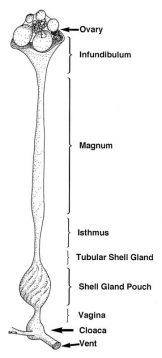
Ovulation
every 25-28 hrs
Infundibulum → magnum → isthmus → shell gland → cloaca
Incubation
ground nesting
25-27 hrs between oviposition
8-10 eggs per clutch
all eggs hatch within 12hr period
embryonic communication (so that they can all sync and hatch within 12 hours)
fast clicks = decrease neighbors development
slow clicks = increase neighbors development
Tree nesting
no embryonic communication to sync hatching
hatch according to schedule in which they were laid
smaller clutches (2-4)
Male Reproduction
Organs:
2 testes
2 epididymis
2 vas deferens
urethra → accessory fluids → penis
TESTES
Exocrine - gamete (sperm)
seminiferous table: sperm production
sperm goes through mitosis & meiosis (multiple stages and changes)
lots of sperm variation
3 components
head: DNA
Mid piece: mitochondrial helix
ATP → motility
“engine” or “motor”
Principle piece (not a tail)
spins like a propeller
Endocrine
2 main hormone
testosterone (T) and estrogen (E2)
Cooling System
*purpose is to regulate optimal temp for spermatogenesis(sperm production)
keep testes 2-5F below body temp
pampiniform plexus: vein network
scrotum: more swear glands on testes than any other surface
panting
EPIDIDYMUS
collects sperm from testes
transports/maturation
storage/ejaculation
nutrition
VAS DEFERENS
The long tube!
One function: rapid transport from epididymus to urethra
ACCESSORY GLANDS
produce accessory fluids
semen= sperm + accessory fluids
3 glands *not all species have all 3
seminal vesicles (vesicular glands)
produce thick alkaline fluids
prostate (acidic af)
liquifies semen after ejaculation
bulbourethral (cowper’s gland)
PRECUM
Functions:
adds nurtients
adds volume
in some species stimulates contractions in the uterus
PENIS
delivery of semen from urethra into the female reproductive tract
vascular (stallions and humans)
more vascular tissue = blood influx
increase in length & diameter
increase in stiffness (BONER)
Fibrous (boar, ram, bull)
less vascular tissue
no change in length/diameter during erection
increase in stiffness
Avian Male
TESTES
endocrine and exocrine
located internally as opposed to externally
VAS DEFERENS
transports sperm from testes to cloaca
EPIDIDYMUS
stores and matures sperm after being produced in the testes