ict
BIO
PLASMA MEMBRANE
- thin, flexible boundary between a cell and its environment
- it is present in all types of cells
- FUNCTIONS:
a. regulates the flow of materials going inside and outside of the cell
SEMI-PERMEABLE – allows the passage of small molecules such as carbohydrates, amino acids and prevents the passage of the large molecules.
b. serves as protective layer
c. cell communication – cell to cell recognition
FLUID MOSAIC MODEL
- most widely accepted model structure
of the plasma membrane
- Seymour Jonathan Singer and Garth Nicholson
- FLUID = dynamic and flexibility nature of the
cell membrane
- MOSAIC = plasma is made up of different types of molecules
- COMPONENTS:
a. phospholipid bilayer
b. membrane lipids
c. membrane proteins
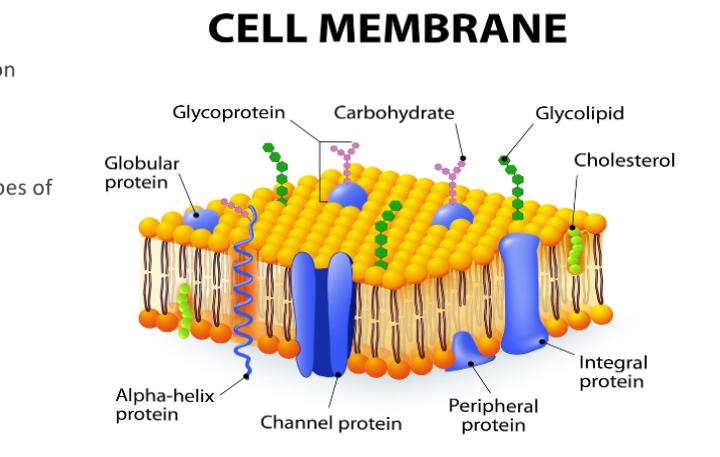 d. membrane carbohydrate
PHOSPHOLIPID BILAYER
- double layer of lipid molecules;
arranged tail to tail
- has a head and two tails
– the phosphate group is the head –
polar and attached to water (hydrophilic)
- the two fatty acids make up the tail –
non –polar and repelled by water ( hydrophobic)
- amphipathic – both hydrophilic and hydrophobic
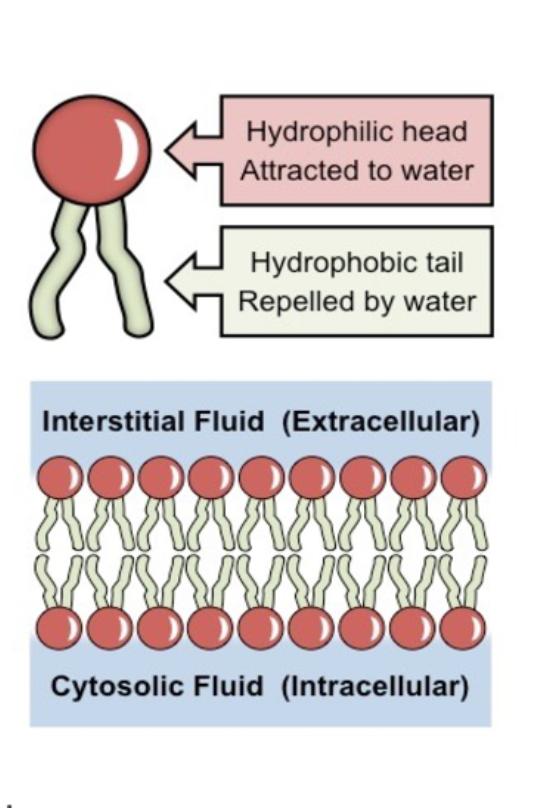 - polar heads facing outside; nonpolar tails facing
MEMBRANE LIPIDS (40%)
a. CHOLESTEROL – regulates the membrane’s fluidity and permeability
- prevents the membrane from freezing or crystallizing
b. GLYCOLIPIDS – lipids with attached carbohydrates molecules
- stabilize the cell membrane
- facilitate communication between cells
MEMBRANE PROTEINS (60%)
A. INTEGRAL PROTEINS – span the
entire lipid layer
a.k.a TRANSMEMBRANE PROTEINS
1. CHANNEL PROTEIN – passageway of molecules
2. RECEPTOR PROTEIN – cell Recognition, certain hormones, Enzymes and other molecules
MEMBRANE PROTEINS
3. GLYCOPROTEINS – give the cells
of each person its own “identity”
B. PERIPHERAL PROTEINS
- mainly work with cytoskeleton
to support the cell
- enzymes – lipase and oxygenase
C. ANCHORED PROTEINS / LIPID-ANCHORED PROTEINS
- bound to the membrane via covalent bond.
- propagate signals an enhance activities of
other proteins
CELL TRANSPORT
-Explain the transport mechanisms in cells (diffusion, osmosis, facilitated transport, active transport)
-Differentiate exocytosis and endocytosis
-It is the movement of substances across the cell membrane either into or out of the cell.
TWO TYPES OF CELL TRANSPORT:
a. Passive transport
b. Active transport
PASSIVE TRANSPORT
- It is the movement of substances across the membrane without energy expenditure
- Does not require the input of metabolic energy
- Simple Diffusion, Osmosis, Facilitated diffusion
SIMPLE DIFFUSION
- Random movement of molecules from an area where there is high concentration to an area of low concentration.
- Does not need energy because molecules are in motion
OSMOSIS
- Diffusion of water across a semi-permeable membrane
HYPERTONIC SOLUTION – a region or a solution that is more concentrated with solute molecules.
-Its fluid environment is more concentrated with solute molecules
-its water molecules will move out of the cell, causing the cell to shrink.
HYPOTONIC SOLUTION – a region or a solution that is less concentrated with solute molecules
-Its fluid environment is less concentrated with solute molecules --- the water molecules will move towards the inside of the cell, causing the cell to swell/ expand and could even burst or lyse.
ISOTONIC SOLUTION – a region or solution where the solute concentration is at equilibrium with that of another solution.
There is no net movement of water molecules.
FACILITATED DIFFUSION
- Uses transport proteins to move ions and small molecules across the plasma membrane
Proteins act as facilitators of the diffusion process
a. CHANNEL PROTEIN - serves as tunnels or passageways of water molecules or small ions
- Aquaporins – allow the faster flow o water molecules in the cell
b. Carrier Proteins – carry the ions across the membrane
c. Glucose transporter - allows the passage of glucose
ACTIVE TRANSPORT
- It is the movement of molecules or particles against the concentration gradient with the use of energy or ATP.
A cell may perform active transport through either pumps or vesicles
PUMPS – are carrier proteins that aggressively and actively pump ions in and out of the cell.
Na-K Pump – most active
- Sodium ion -outside the cell (extracellular)
- Potassium ion - inside the cell
- function: to maintain the level of sodium and potassium ions inside and outside of the cell.
VESICLE TRANSPORT – use of vesicles in moving larger molecules and particles
TWO KINDS: ENDOCYTOSIS and EXOCYTOSIS
ENDOCYTOSIS
‘”endo” – inside; -cyto – cell; -osis – process
Cellular process wherein a cell moves a molecule or particle into its inside or its cytoplasm
PHAGOCYTOSIS – “cell eating” – takes in a solid particle through invagination or engulfing
PINOCYTOSIS – “cell drinking” – takes in extremely small particles
EXOCYTOSIS
Is a cellular process wherein cell releases molecules or particles to the outside or the extracellular fluid.
ICT
Collaborative ICT Development
Communication Tools
• Oldest forms of online communication but still the most widely
used service until today.
• E-mail helps you create a message to a recipient and send files as
an attachment(file, text, graphics, sounds, videos).
• E-mails can be sent simultaneously to different recipients.
• Conversations are threaded upon exchange.
❑ Chat and Instant Messages
• Instant messages(IM) is a faster and simpler alternative to email.
• Conversations are held in virtual “chat rooms,” generally among
family, friends, colleagues, or acquaintances
• Public chat rooms also exist
❑ Voice Chat
• These are free and inexpensive calls using the internet.
• Some IM and chat services include voice chat
• Allow users to call any phone number
• Uses VoIP(Voice over Internet Protocol)- delivers voice
communications and multimedia sessions via the Internet.
❑ Mobile Messaging Apps
• Users can send messages and make free calls anywhere in the
world.
• These apps are available in iOS and Android platforms.
Mobile Messaging Apps
• Started 2009
• Most popular
• Free for the first year and cost $0.99 annually for the succeeding years.
• PC version was released 2016
Viber
• Free IM and calling application
• Offers a large collection of stickers
• Available on PC and mobile devices
• Operated by Chinese
Internet giant Tencent
• Offers free exchange of messages, free calls
• Allows user to find new friends
• Stickers available
❑ Video Chat
• Uses audio and video features
• Commonly used between two or more people
• Video conference call – calls held by more than two people
• Often used in the workplace, collaborative projects, and webinars.
Coordination Tools
Tools that enables the user to prepare a list of deliverables, schedules, milestone and assignment of task assigned which you can then track later.
Bitrix24
• It is a project management system that provides free storage
up to 5GB. Larger storage cost $39/month
• Can be used either as a cloud server or a company’s own server
to host contents.
• Features available: Gantt charts, layered task options, time tracking and management, workload planning, group chart and video conferencing.
MindMeister
• Collaborative web-based tool
• Enables users to create mind maps for brainstorming and planning activities to be shared with others
• Features available: templates, SWOT analysis, project planning, and live group chat.
Google Calendar
• This is a downloadable scheduling tool for both Android and Apple
devices
• Accessed by Gmail account
• Can create event and notification depending on when and how
often you want to be reminded
• Time zones can be adjusted
• Google can also determine the location of an event automatically
Reasons of using Online Collaboration Tools
TRELLO
• Easy-to-use software that is perfect for the Kanban board methodology of project management.
• Free online project management tool
KANBAN
• Kanban board is a variation of the traditional Japanese Kanban cards.
• Uses sticky notes, plastic chips, magnets, etc. to represent work items in a production process, and how each item moves along the process.
• Highly visual and focuses more on the stages of process and the quality of execution rather than the deadlines only.
Elements of Kanban Board
1. Board – represents the whole project.
2. Lists – board is divided into list which represent the stages of
project development. Ex. Waiting, doing and done.
3. Cards – lists are composed of cards where your team tasks are
RE
FAITH PROCLAMATION ABOUT JESUS CHRIST
INTRODUCTION
The faith proclamation about Jesus typically centers on the core beliefs held by Christians regarding who Jesus is, what he accomplished, and the significance of his life, death, and resurrection. This proclamation is derived from various passages in the Bible, especially the New Testament, and forms the foundation of Christian faith
This proclamation asserts that Jesus is not just a historical figure or a prophet but the divine Son of God. Christians believe that Jesus is both fully human and fully divine, the second person of the Holy Trinity (Father, Son, and Holy Spirit).
JESUS’ INCARNATION
The faith proclamation acknowledges that Jesus, being the Son of God, took on human form (incarnation) by being born of the Virgin Mary. This emphasizes the belief that Jesus lived among humanity, experiencing human joys and sufferings.
JESUS’ TEACHINGS
Christians believe in the teachings and moral principles that Jesus imparted during his earthly ministry. His teachings, often conveyed through parables and direct dialogues, are considered foundational for Christian ethics and values.
JESUS’ CRUCIFIXION
Central to the faith proclamation is the acknowledgment of Jesus' sacrificial death on the cross. Christians believe that Jesus willingly died to atone for humanity's sins, offering salvation and reconciliation with God.
JESUS’ RESUTEACHING
The proclamation celebrates Jesus' resurrection from the dead, signifying victory over sin and death. His rising from the grave is seen as a confirmation of his divine nature and the promise of eternal life for those who believe in him.
JESUS’ ASCENSION AND RETURN
Christians also believe in Jesus' ascension into heaven, where he reigns at the right hand of God the Father. Additionally, the faith proclamation includes the anticipation of Jesus' promised return, where he will judge the living and the dead.
CONCLUSION
This proclamation about Jesus encapsulates the core beliefs of Christianity and forms the basis of Christian faith. It is expressed in various creeds (such as the Nicene Creed, and Apostles' Creed) and serves as a unifying statement of beliefs for Christians worldwide. Different Christian denominations may articulate these beliefs with slight variations in emphasis or interpretation, but these core elements about Jesus remain central to the faith
JESUS CHRIST IN THE FILIPINO CONTEXT
Filipino Catholics exhibit a unique blend of religious devotion, cultural practices, and community spirit that significantly influence the way they practice their faith within the Christian framework. Here are some key aspects that characterize how Filipino Catholics approach and practice their Christianity
STRONG SENSE OF COMMUNITY
Filipino Catholics emphasize the communal aspect of their faith. They often come together as a community to celebrate religious events, participate in church activities, and support each other in times of need. The "Bayanihan" spirit, a concept of communal unity and cooperation, is deeply embedded in Filipino culture and often reflected in religious gatherings and church-related initiatives.
EXPRESSIVE FORMS OF WORSHIP
Worship among Filipino Catholics is often characterized by vibrant and expressive forms, incorporating music, dance, and colorful rituals. Novenas, processions, and fiestas dedicated to patron saints are common, often accompanied by lively celebrations with music, food, and parades. Traditional Filipino music and dance are frequently integrated into religious ceremonies, adding a unique cultural flavor to worship.
DEEP DEVOTION TO SAINTS AND MARIAN PIETY
Filipino Catholics have a profound reverence for saints and a strong devotion to the Blessed Virgin Mary. Many Filipinos have personal devotions to specific saints believed to intercede for them in various aspects of life, such as Saint Jude for desperate situations or Saint Anthony for finding lost items. Marian piety is also widespread, with numerous Marian apparitions and shrines across the country, drawing large numbers of devotees who seek Mary's intercession.
EXPRESSIVE FORMS OF WORSHIP
Worship among Filipino Catholics is often characterized by vibrant and expressive forms, incorporating music, dance, and colorful rituals. Novenas, processions, and fiestas dedicated to patron saints are common, often accompanied by lively celebrations with music, food, and parades. Traditional Filipino music and dance are frequently integrated into religious ceremonies, adding a unique cultural flavor to worship.
SYNCRETISM OF INDIGENOUS PRACTICES
There is a fascinating interweaving of indigenous beliefs and practices with Catholicism in the Philippines, known as "Filipino Folk Catholicism." Many rituals and customs from pre-colonial indigenous religions have been incorporated into Catholic practices. This syncretism manifests in various ways, such as healing rituals, use of amulets or talismans alongside religious symbols, and folk traditions observed during religious celebrations.
PDV
The Power of the Mind:
The Whole Brain Theory
What is the Whole Brain Theory?
Paul Broca
- conducted a study on the language and left-right brain specialization on a
patient who had problems with language.
- theorized that some language functions reside on the left side of the brain.
"Split-Brain Theory“
(The Split Brain Experiments)
Dr. Roger Sperry
- conducted a study for epilepsy, which gave him the 1981 Nobel Prize for Physiology or Medicine.
- explained that the brain has two hemispheres that perform tasks differently from each other.
- discovered that the right hemisphere of the brain was performing tasks that were intuitive, creative, and synthesizing; while the left hemisphere of the brain was more adept with analytical, logical, reasoning, and critical thinking
The Triune Brain Theory
Dr. Paul MacLean
- a neuroscientist, came up with a theory that identified Three Distinct
Parts of the Brain, namely: neocortex, limbic system, and reptilian complex.
Neocortex or Rational Brain - intellectual tasks (language, planning,
abstraction, and perception)
Limbic System or Intermediate Brain - motivation and emotion
involved in feeding, reproductive behavior, and parental behavior.
Primitive brain or Reptilian Complex - which controls the self-
preservation and aggressive behavior of humans similar to the survival
instincts of animals.
Brain Dominance Theory
Ned Herrmann
- an engineer at General Electric
- the “Father of Brain Dominance Technology.”
- asked to determine why some humans were more creative than others.
- Derived from observations and tests that the human body, although
symmetrical and paired in almost all aspects, do not necessarily function equally.
-People normally have a more dominant part of their body
- Herrmann extended this dominance theory to the brain, which he
concluded to having not just two parts but four, the upper left and right hemispheres, and the lower left and right limbic halves. They are all
connected to each other.
ANALYTICAL
A. Upper left
Logical
Analytical
Fact-Based
Quantitative
ORGANIZED/PRACTICAL
B. Lower left
Organized
Sequential
Planned
Detailed
Cerebral Mode
Limbic
IMAGINATIVE/INNOVATIVE
D. Upper right
Holistic
Intuitive
Integrating
Synthesizing
INTERPERSONAL/RELATIONAL
D. Lower right
Inter-personal
Feeling-
based
Kinesthetic
Emotional
Hermann’s Four Dominant Quadrants
Herrmann labeled the four quadrants.
of the brain as:
1. Upper Left (A) – ANALYTICAL
2.Lower Left (B) -ORGANIZED/PRACTICAL
3. Lower Right (C)– INTERPERSONAL/RELATIONAL
4. Upper Right (D)– IMAGINATIVE/INNOVATIVE
Hermann’s Four Dominant Quadrants
Based on this model:
Herrmann developed the Herrmann Brain Dominance Instrument (HBDI), a 120-question survey instrument that measured the preference
strengths of the four quadrants. This is very useful in identifying occupational profiles (Herrmann International).
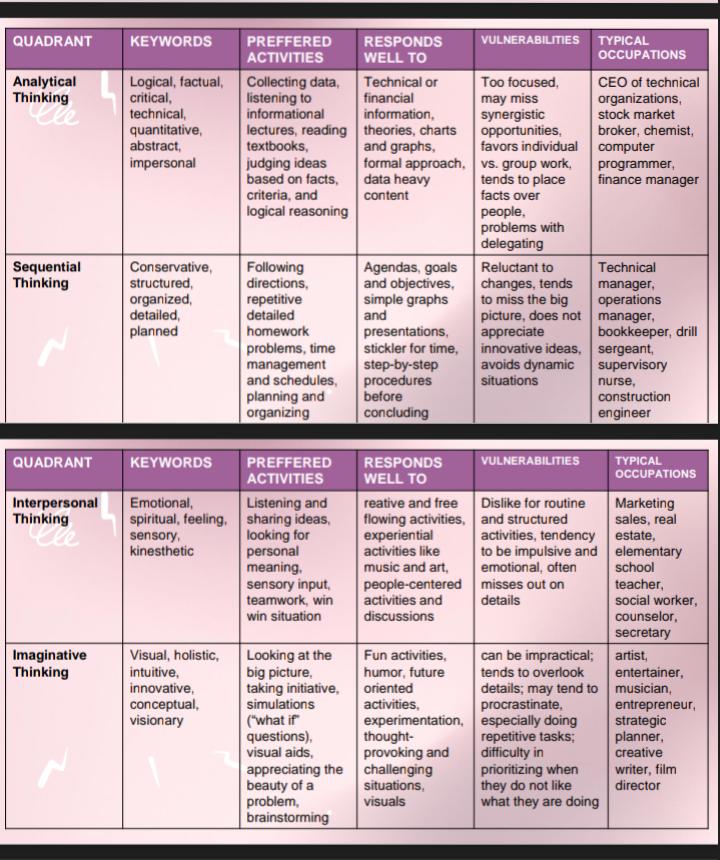
Analytical Thinking
-Logical, factual, critical, technical quantitative abstract, impersonal
-Collecting data, listening to informational lectures, reading textbooks, judging ideas based on facts, criteria, and logical reasoning
-Technical or financial information, theories, charts and graphs, formal approach, data heavy content
-Too focused, may miss synergistic opportunities, favors individual vs. group work tends to place facts over people, problems with
-CEO of technical organizations, stock market broker, chemist, computer programmer, finance manage
Sequential Thinking
-Conservative, structured, organized detailed, planned
-Following directions. repetitive detailed homework problems, time management and schedules. planning and organizing
-Agendas, goals and objectives, simple graphs and presentations, stickler for time, step-by-step procedures before concluding
-Reluctant to to miss the big changes, tends picture, does not appreciate innovative ideas, avoids dynamic situations
-Technical manager, operations manager, bookkeeper, drill sergeant, supervisory nurse, construction engineer
Interpersonal Thinking
-Emotional, spiritual, feeling, sensory kinesthetic
-Listening and sharing ideas, looking for personal meaning. sensory input, teamwork, win win situation
-reative and free flowing activities, experiential activities like music and art. people-centered activities and discussions
-Dislike for routine and structured activities, tendency to be impulsive and emotional, often misses out on details
-Marketing sales, real estate, elementary school teacher, social worker, counselor, secretary
Imaginative Thinking
-Visual, holistic, intuitive, innovative. conceptual, visionary
-Looking at the big picture, taking initiative, simulations (what if questions), visual aids, appreciating the beauty of a problem,brainstorming
-Fun activities, humor, future oriented activities. experimentation, thought- provoking and challenging situations, visuals
-can be impractical; tends to overlook details; may tend to procrastinate, especially doing repetitive tasks; difficulty in prioritizing when they do not like what they are doing
-artist, entertainer, musician, entrepreneur. strategic planner, creative writer, film director
Whole Brain Theory in Learning
Quadrant A learners are very much into logical thinking.
• enjoy analyzing information and understand better when
presented with numbers and quantities, and they are also
good at theorizing or concluding based on facts and
information that support their theories.
• expect exact information that are straight to the point, and
they would also want to be fed with lots of theories, numbers,
data, logical explanations, and results of research studies.
❑ They find it difficult to express their inner thoughts and
emotions and may struggle with unclear or undefined
concepts or ideas.
Quadrant B learners easily grasp things in sequence, enjoy organizing ideas and things, assess situations and information,
and apply what they have learned into practice.
• Learners will always demand for clear instructions or
directions, and would rather apply what they have learned in
practical situations rather than just theories.
• Being a sequential thinker, the B learner needs to be able to
see the sequence of things, which are consistent and in
proper order.
❑ They may find it difficult to understand concepts without any
examples to show how these are applied. Their big challenges
are in taking risks and doing things that are not clearly defined
to them.
Quadrants A and B learners
are often characterized as
practical, reality-based,
and down-to-earth persons.
Quadrant C learners are very sociable learners who enjoy
learning with a group with whom they share ideas and
projects.
• They are very focused and involved when trying to learn
something.
• They tend to reflect on what they have understood and
acquired in terms of knowledge, and most of the time use.
their bodies and movement while learning.
• The C learner is also emotional and would share them
emotions with a group. Personal feedback is therefore.
important to them.
❑ They get bored with data and intellectual discussions
without activities and participation.
Quadrant D learners are the curious ones who enjoy
discovering, experimenting, and exploring activities.
• They are strong thinkers when it comes to conceptualizing
and putting all the seemingly unrelated parts and
connecting these parts together, synthesizing, and in
creating new ideas and concepts.
• Enjoys games and surprises, is a visual learner, and needs
different varieties of approaches to learning.
❑ Being spontaneous in character, the D learner will have
difficulty meeting deadlines and rigid environments.
Quadrants C and D learners are often
characterized as fun, flexible, and open-
minded persons.
Knowing the different styles of learning, the adolescent high school students…
• can easily adapt their own learning styles with that of
their classmates and even those of their teachers.
• they will have an appreciation of the diversity found
inside their classroom, and even outside their school.
• can become a better collaborator at work, a very
important skill that is currently in demand in the
workplace.
• In their personal lives, the adolescent high school student
will also have improved interpersonal relationships once
they understand and accept the differences in people's
learning and thinking styles.
MIND MAP
Tony Buzan
- a British psychology author and consultant who also developed the technique in creating such map, popularized the use of the phrase "mind map.”
“A mind map is a diagram used to represent ideas or information
branching from a central key word or idea and used as an aid in study, organization, problem solving, decision-making, an writing.”(Dictionary.com)
• useful visual tools that help in linking together concepts and information in such a way that the interconnection and interrelation of these are clearly laid out and easily accessible to help in problem solving and for reference and review (MindTools.com).
• useful during brainstorming sessions, making decisions, organizing
information, simplifying complex ideas, note-taking, and even for personal use.
Characteristics of Mind Mapping
Main
Idea
Branch
Branch
Twigs
1. The center image represent the main idea, subject, or focus.
2. The main branches radiate from the central image.
3. The branches comprise a key image ow word drawn or printed on its line.
4. Twigs represent the lesser topic
5. The branches form a connected nodal structure.
Steps in creating mind map
1.Write the title of the subject you are exploring in the center of the page, and draw a circle around it
2. Draw lines out of the center circle to label major subject matters
3. Draw additional lines that will connect to the lines for major topics
4. Then, for individual facts or ideas, draw lines out from the appropriate heading line and label them.
5. As you come across new information, link it into the mind map appropriately
Using Mind Maps Effectively
- Use Single Words or Simple Phrases
- Single, strong words, and short meaningful phrases can convey the same meaning more potently. Excess words just clutter the mind map.
Print Words
- Joined up or indistinct writing is more difficult to read. Use Color to Separate Different Ideas - This will help you to separate ideas where necessary. It also helps you to visualize the mind map for recall. Color can help to show the organization of the subject.
Use Symbols and Images
- Pictures can help you to remember information more effectively than words, so if a symbol or picture means something to you, use it.
Use Cross-Linkages
- Information in one part of a mind map may relate to another part. Here, you can draw lines to show the cross- linkages. This helps you to see how one part of the subject affects another.
Financial Literacy
Expenses - The cost required for something; the money spent on something.
Financial Literacy
✓it involves self-control, appreciation of the value of money and hardork, planning for one's future and financial security. Joined up or indistinct writing is more difficult to read.
✓ is a core life skill in an increasingly complex world where people need to take charge of their own finances budget, financial choices managing risks, savings, credit and financial transactions.
Components of Financial Literacy
a) Financial products: savings, credit, payment transactions, insurance, remittance
b) Values formation: understand the value of money, fiscal discipline, and the consequences of not having enough money: the importance of savings, prudence in spending, and perils of gambling
c) Budgeting: having a clear appreciation of spending capacity. learning to prioritize, learning to sacrifice, learning to delay gratification, and making an actual budget that works
d) Cash flow management: keeping track of inflows and outflows of money, building up positive cash flow to generate savings, and learning how to use productivity tools such as Excel
e) Savings and investment: how to make your money work for you. learn the print
FILIPINO
PHOTO ESSAY
-Noong 1930s nagsimula ang tinatawag na “photo essay” dahil sa “photographic essay.”
-Ang LIFE MAGAZINE ang bumuo ng terminong “Photographic Essay”
-Country Doctor ang pinakaunang “photographic essay” na nalathala at ito ay mula kay W. Eugene Smith.
-Ito ay isang dokumentaryo ng panggagamot ni Dr. Ceriani, isang doctor na naglalakbay sa mga lalawigan sa Estados Unidos.
Gertrude Buck (1901)
-Nagsulat ng “Recent Tendencies in the Teaching of English Composition”
-Matatagpuan sa Educational Review na mayroong 3 tagubilin sa pagsulat.
Ben Lauren at Rich Rice (2012)
-Artikulo na “Teaching Style in Basic Writing Through Remediating Photo Essay”
-Ang photo essay ay maaring makapagbigay ng isang imahe na kakatawan sa mga ideya na nahihirapan ang mga mag-aaral na isulat o ilapat sa papel.
Rudolf Arnheim (1969)
-“Ang mga imahe ay maaring ituring na isang ganap na larawan o maari rin namang isang simbolo lamang”
Sharon Pannen (2017)
-Isang sikat na litratista
-“Ang pagpaplano ng pagsulat ng photo essay o sanaysay larawan ay simple lang, para ka lang umiisip ng isang paksa na interesado ka o kaya naman gusto mong bigyan ng pagpapakahulugan”
Dr. Florante Garcia (2020)
Ang photo essay ay kalipunan ng mga larawan na isinaayos nang wasto at may layunin na maglahad ng isang konsepto.
Gaya ng isang sanaysay na naising magbigay ng kasiyahan o aliw, mahalagang impormasyon, at malinang ang pagiging malikhain.
PAMPAKAY (thematic)
- Nakatuon lamang sa isang paksa o tema kung saan iikot ang mga larawan at deskripsyon nito.
NARATIBO/SALAYSAY (narrative)
- Isinasalaysay ang mga pangyayari ayon sa wastong pagkakasunod-sunod ng larawan.
(Garcia, 2020)
Istraktura ng Photo Essay
Ang photo essay ay binubuo lamang ng dalawang sangkap.
- MGA LARAWAN
- TEKSTO/DESKRIPSYON
MGA DAPAT ISAALANG-ALANG SA PAGSULAT NG LARAWANG-SANAYSAY AYON KAY DR. FLORANTE GARCIA (2020)
1. Pumili ng paksa ayon sa iyong interes.
2. Magsagawa ng pananaliksik sa iyong paksang gagawin.
3. Isaalang-alang ang kawilihan at uri ng iyong mambabasa.
4. Tandaan na ang isang istoryang nakatuon sa mga pagpapahalaga o emosyon ay madaling nakapupukaw sa damdamin ng mambabasa.
5. Kung nahihirapan ka sa pagsusunod-sunod ng pangyayari gamit ang larawan, mabuting sumulat ka muna ng kuwento at ibatay rito ang mga larawan.
6. Planuhing mabuti ang gagawing sanaysay gamit ang mga larawan. Tandaan na higit na dapat mangibabaw ang larawan kaysa sa mga salita.
7. Palaging tandaan na ang larawang-sanaysay ay nagpapahayag ng kronolohikal na salaysay, isang ideya, at isang panig ng isyu.
8. Siguraduhin ang kaisahan ng mga larawan ayon sa framing, komposisyon, kulay, at pag-iilaw. Kung minsan, mas matingkad ang kulay at matindi ang contrast ng ilang larawan kompara sa iba dahil sa pagbabago ng damdamin na isinasaad nito.
MGA DAPAT ISAALANG-ALANG SA PAGSULAT NG LARAWANG-SANAYSAY AYON KAY FEDERICO ALEGRIA (2020)
1. Pumili ng Paksa
Sa pagpili ng paksa, maging bukas sa iba’t ibang aspeto.
2. Pumili ng tamang pokus/aktor
Sa pagsulat ng photo essay, napakahalaga na maging tiyak ang ating pokus o aktor upang malaman natin ang limitasyon ng mga larawan at deskripsyon na ating kukuhanan at isusulat.
3. Magdesisyon kung ilan ang bilang ng mga larawan o imahe
Kailangang maging tama lamang ang bilang ng mga larawan o imahe na gagamitin upang maipahayag ng maayos at mabigyang diin ang isyu o istorya na gusto mong ilahad sa pamamagitan ng mga larawan.
4. Gawin ang pagkuha ng larawan
Isaalang-alang ang consistency sa framing, komposisyon, anggulo, pag-iilaw, o kulay. Kailangang may kaisahan ang mga larawan.
5. I-edit o ayusin ang mga larawan
9Sa pag-eedit o pag-aayos, hanapin ang “tunay na kuwento.”
Ikonekta ang iyong sanaysay larawan sa madla upang matukoy ang damdaming nakapaloob sa kuwento.
POSISYONG PAPEL
-Ayon kay Jacson et al. (2015), sa kanilang aklat ng Pagbasa at Pagsulat tungo sa Pananaliksik, ang pangangatwitran ay tinatawag ding pakikipagtalo o argumentasyon na maaaring maiugnay sa sumusunod na paliwanag:
a. Ito ay isang sining ng paglalahad ng mga dahilan upang makabuo ng isang patunay na tinatanggap ng nakararami.
kamalian upang maipahayag ang katotohanan.
b. Ito ay isang uri ng paglalahad na nagtatakwil sa kamalian upang maipahayag ang katotohanan.
c. Ito ay isang paraang ginagamit upang mabigyang-katarungan ang mga opinyon at maipahayag ang mga opinyong ito sa iba.
Ayon kay Grace Feming,
 -sumulat ng artikulong “How to Write an Argumentative Essay,” ang posisyong papel ay ang pagsalig o pagsuporta sa katotohanan ng isang kontrobersiyal na isyu sa pamamagitan ng pagbuo ng isang kaso o usapin para sa pananaw o posisyon.
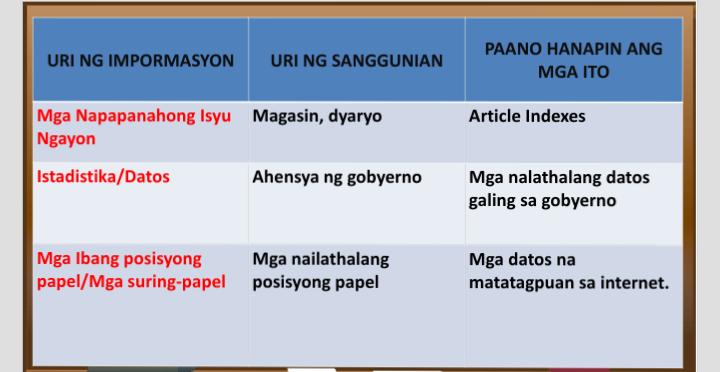
-Kapag nailatag na ang kaso at ang posisyon hinggil sa isyu, mahalagang mapatunayang totoo at katanggap-tanggap ito sa pamamagitan ng paggamit ng mga ebidensyang kinapapalooban ng mga katotohanan, opinyon ng mga taong may awtoridad hinggil sa paksa, karanasan, estadistika, at iba pang uri ng katibayang magpapatibay sa posisyong pinanghahawakan.
-Ayon sa kaniya, sa pagsulat ng posisyong papel ay mahalaga ang pagkakaroon ng isang mahusay at magandang paksa, ngunit higit na mas mahalaga ang kakayahang makabuo ng isang kaso o isyu.
Ayon naman kina Aserold and Cooper (1987)
-sa librong “St. Martin’s Guide to Writing” ang mga manunulat ng posisyong papel ay gumagamit ng pamukaw emosyon na panulat upang mahikayat ang mga mambabasa na maniwala sa kanilang argumento.
-Binibigyang diin din ni Aserold at Cooper na ang maayos na posisyong papel ay nangangailangan may malinaw na kahulugan ng isyu, may tiyak na posisyon sa issue, may lohikal at matatag na argumento at may mapanghikayat na tono.
-Tinutukoy din nina Aserold at Cooper (1987) na ang posisyong papel ay hindi lamang para malaman ng mambabasa ang posisyon ng manunulat tungkol sa isyu. Hindi lamang ito iikot sa opinyon at paniniwala ng manunulat bagkus dapat mayroon itong matibay na ebidensya upang panindigan ang posisyon.
Ayon kay FRASER (2016)
-tulad ng isang debate, ang posisyong papel ay naglalahad ng isang panig na may matibay na argumento tungkol sa isang isyu.
-Ang posisyong papel ay dapat mahikayat ang mga mambabasa na maniwala na ang iyong argumento ay totoo base sa mga ebidensya na iyong nailahad. Inilahad rin ni Fraser ang mga dapat tandaan sa pagsusuri ng isyu at pagbuo ng posisyong papel.
HAKBANG SA PAGSULAT NG POSISYONG PAPEL
1. PAGBUO NG THESIS STATEMENT
- ito ay isang mahalagang sangkap ng isang posisyong papel dahil ito ay nagbibigay direksyon sa tutunguhin ng isang posisyong papel.
2. PAGSULAT NG INTRODUKSYON
- ang panimula o introduksyon ay siyang unang pupukaw sa interes at atensyon ng mambabasa.
3. PAGSULAT NG KATAWAN NG POSISYONG PAPEL
- dito nailalahad ang dalawang panig ng isyu. Ngunit dito rin dapat ilahad ang mga ebidensya o puntos sa panig na nais panigan ng manunulat.
4. PAGSULAT SA KONKLUSYON NG POSISYONG PAPEL
- dito papasok ang pagbubuod ng mga pangunahing ebidensya o puntos. Kailangan maging tiyak, malinaw at maayos ang pagkakalahad nito.
5.PAGBANGGITSA MGA SANGGUNIAN O REFERENCES
- ilista ang mga sangguniang iyong ginamit.
6. PROOFREADING
 - I-proofread ang iyong ginawang posisyong papel. Ito ay para masigurado na tama ang iyong mga sinulat at maiwasan ang mga maling pagbaybay at gramatika.