The Neuron Doctrine
Lecture 1: The Neuron Doctrine
A Note on Notes
Outline of Lecture Content
The fine structure of the nervous system
The Reticulum Debate: neurons and information flow
The Synapse Debate: chemical neurotransmission
The challenges of being a neuron
Learning Objectives
Structural Components: Describe the components of neurons and synapses including the direction of information flow.
Information Flow: Explain using structural information about neurites to infer information flow direction in neurons.
Synaptic Transmission: Analyze benefits and costs of synaptic transmission.
Methods Comparison: Compare anatomical vs physiological methods for demonstrating chemical synapses.
Neuronal Features: Discuss how structural and physiological features produce unique metabolic constraints.
The Function of the Nervous System
Primary Function: Coordination of body functions through rapid and specific integration and transfer of information among different systems and regions.
Anatomical Specializations of the CNS
Students are encouraged to observe real anatomical images from the Central Nervous System (CNS) in practice.
Cellular Structure Visualization Techniques
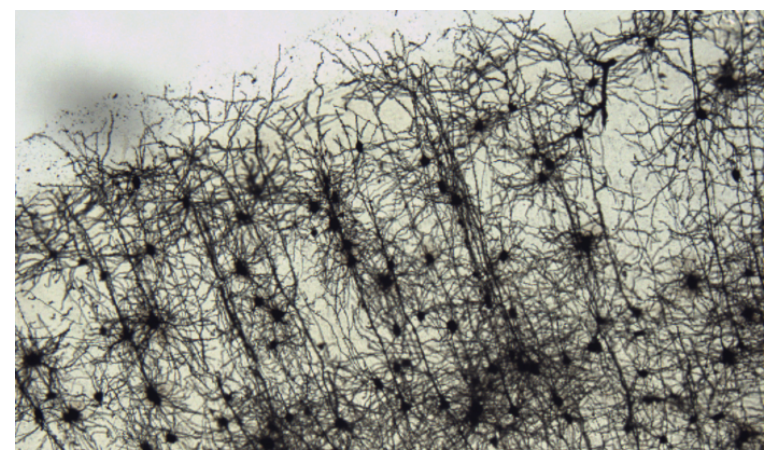
Golgi Stains
Technique: Developed in the late 19th century by Camillo Golgi; revealed cellular structure with a distinctive 'black substance' stain.
Observation: Golgi stains show that the cellular organization in the brain appears to be a "tangled mess" when visualized, allowing for the first microscopic insights into brain structure.
Example Images: Stains on mammalian isocortex and rodent hippocampus
this is a mammilian isocortex.
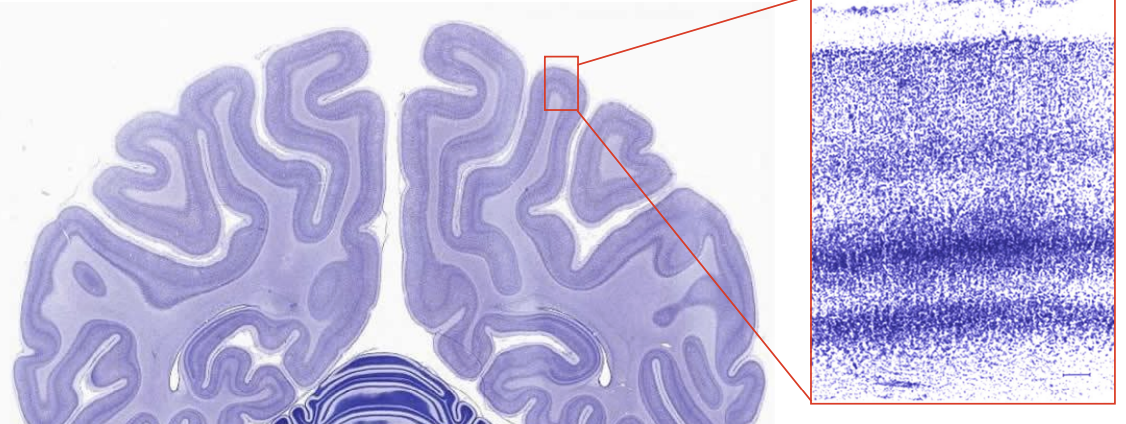
Nissl Stains-Purple
Technique: Developed in the 1890s by German chemists, emphasizing cell nuclei distribution within the brain using cresyl violet dye.
Observation: Section images reveal layered structures within the CNS, showing distinct patterns of cell nuclei.
Electron Microscopy
Development: Since the 1950s, used for the highest spatial resolution images of brain tissues, revealing intricate cellular structures.
Observation: Analysis of hippocampal grey matter shows extreme detail of cellular processes and organization.
Techniques in CNS Tissue Visualization
Students are prompted to describe cellular-level specializations based on their specific staining techniques.
Genetic Techniques
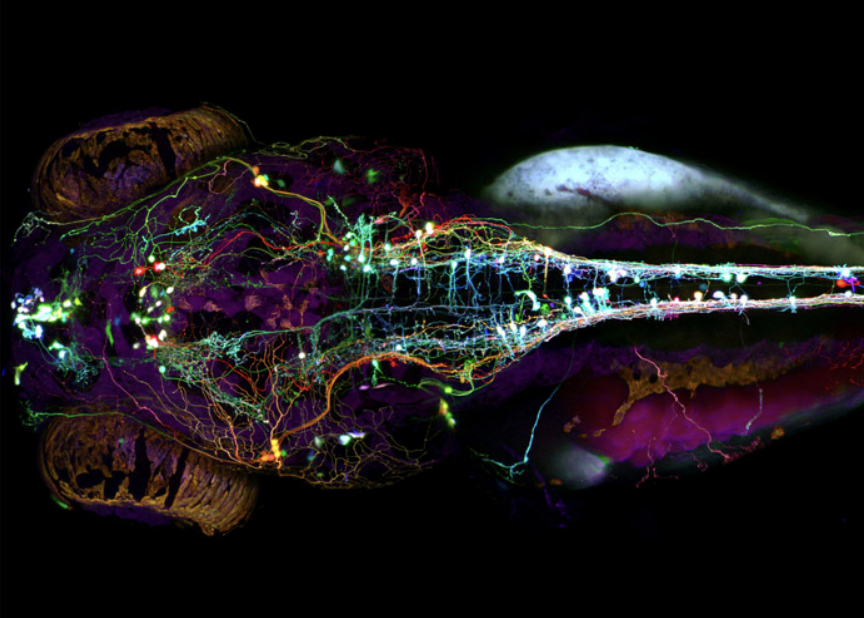
'Brainbow' Technique: Developed in 2007, enables individual neurons to be colored differently using fluorescent proteins, mapping complex connectivity.
Implication: Reinforces understanding of how the brain builds and how individual neurons connect, showcasing their processes and synapse locations clearly.
The Reticulum Debate
Discussion: Whether the observed tangled structures plasma membranes fuse together and join creaying a continous network, or if they remain separate entities, preserving individual identities among neurons and just simply touch.
Definition: Neurite is defined as a long, thin projection that emerges from a neuron's cell body.
Controversy: Difficulty in discerning connections at neurite tips due to limitations in light microscopy.
Historical Context: The debate in 1895 revolved around interpretations of Golgi stains by Golgi and Cajal. While Golgi supported a reticular model, Cajal argued for discrete cells.
The Neuron Doctrine
Concept by Cajal:
The nervous system is made up of distinct, individual units (neurons), and information transfer occurs through contact, not continuity between neurons.
Specialized terminal blobs occur wherever neutrites touch.
Organized sub cellular fibiril structures (cytoskeleton) are continuous within a cell body and its neurites but discontinuous where 2 neurites meet.
Neurties that emerge from cell bodies are longer in later developmental stages as compared to earlier.
Impact: Cajal's work emphasized that neuronal morphology defines functionality and outlines the foundational understanding of neural communication.
Consequences how individual elongated cells that are going to perform the functions of the nervous system as a whole?
Consequence 1) Neurons need a means of encoding and relaying informaytion along neurites.
Consequence 2) Neurons also need a means of passing information
Mechanism: Neuronal information is encoded through electrical signals that arise at the cell membrane.
Neurite Functionality: Neurites are likened to electrical cables—long, with high surface area for rapid information transmission.
Neuronal Compartments
Types of Neuronal Compartments
Dendrites — Receive signals from other neurons
Cell Body/Soma — Contains the nucleus
Axon — Conducts electrical impulses away from the cell body
Axon Terminals — Transmit signals to other neurons or target cells
Neurons typically have one axon but can have multiple dendrites, both capable of branching.
Information Flow in Neurons
Directionality: Information flows predominantly in a unidirectional manner.
Within a neuron: from dendrites to axon.
Between neurons: from axon terminals across synapses to dendrites/soma of the adjacent cell.
Synapse Definition: A synapse refers to the junction where two neurons make contact, facilitating physiological communication.
between neurons, synapses transfer information from a presynaptic cell to a postsynaptic cell.
axon terminal to dendrite
axon terminal to a soma
axon terminal to another axon terminal
rarely also occur between dendrites n
Synaptic Types
Electrical vs. Chemical Synapses
Electrical Synapses: Direct connections allowing current flow from one neuron to another.
Chemical Synapses: Rely on neurotransmitters diffusing across synaptic clefts; account for >99% of synapses in vertebrates.
Advantages of Chemical Synapses
Signal Amplification: Capability of a small axon terminal can depolarize a large somata.
Computational Processing: Chemical signals can be excitatory or inhibitory.
Plasticity: Capacity for modifications in synaptic strength over time, affecting communication efficiency.
Confirmation of Cajal's Observations
Electron microscopy of the 1950s supported Cajal's theories by demonstrating that electrical synapses are far less common than chemical synapses.
Important observations under transmission electron microscopy highlighted that electrical synapses are much rarer than chemical synapses by how often you see the different structures necessary for each type of synapse.
Nobel Prize Contributions
Otto Loewi's Experiment 1921
Loewi demonstrated chemical synaptic transmission using frog heart experiments:
Electrically stimulating nerves can drive or inhibit muscle contractions, including in the heart.
Fluid samples from a stimulated heart lead to slower and smaller heart contractions.
Fluid samples from a non stimulated heart have no effect.
Atropine counteracts the effect of a stimulated heart fluid.
Neuronal Diversity and Challenges
Neuronal Diversity
Neurons exhibit significant diversity, with variations in dendritic structures, axonal properties, and functional specialization.
Examples: Some neurons possess no dendrites or axons, while others may have extensive dendritic trees or large axon terminals.
Challenges Faced by Neurons
Size and Transport: neurons terminal and tips are far away from the soma, where the nucleus and most synthetic organelles are found.
Compartment Distinction: Difficulty in ensuring proper differentiation and targeting of proteins between axons and dendrites.(how can a cell make axons different from dendrites? how can you send specific proteins to the right place.
Metabolic Costs: both electrical signals and neurotransmitter synthesis and recycling add up to make neurons ATP guzzlers. and produce lots of lactate
Integration of Biophysics and Biochemistry: Neurons must convert electrical signals into biochemical responses efficiently.
Specialized Solutions for Neuronal Challenges
Transport Solutions: Use of specialized cytoskeletal networks and transporter proteins (microtubuoles.dynein, kinesis), organelle export example-mitochondria, ribosomes, recycling, endosomes in axon terminals and dendrites and local recycling)
Solutions: polarized cytoskeleton in axons vs dendrites (+/-) microtubuole ends oriented oppositely) anatomical checkpoints, example axon initial segment) specialized ER/golgi/nuclear tagging of transported porteins and RNA, local synthesis ensure proper function and distritbution across neurons
Metabolically extensive signalling-solutions include the neurovascular unit, for highly regulated blood flow, CNA priority in blood flow regulation, glial support with a glucose/lactose shuttle, and possible avoiding use of fatty acids for ATP generation.
Converting between biophysics and biochemistry, solutions include expression of brain/nervous systrem, specific genes and gene isoforms (forms of the rna after splicing)
Restrictions on Neuronal Repair
Neurons are very difficult to repair and replace if they get damaged.
Summary of Key Points
Neurons communicate across gaps through chemical messengers, with information primarily flowing in a unidirectional manner through dedicated compartments.
Neurons are individual cells, they perform their function by communicating with each other across the gaps between them, (chemical messengers)
Information, in the form of electrical activity at the cell membrane, flows through neuronal compartments in a one directional manner.
The common anatomical and physiological features of neurons make them specialized for information transfer within the interal components and between them, despite the energetic and development costs this puts them under.
Neurons are the most diverse cell type in the body, this diversity allows them to make diverse types of computations on the information they pass amongst each other, but poses metabolic and developmental challenges and may limit the ability of the nervous system to effectively regenerate.
Their diversity facilitates a variety of computations needed for information transfer but also imposes metabolic and repair challenges, providing an active area for ongoing research in neuroscience.