Lecture Notes
Empirical: use observation to gather knowledge about the world
Monty Hall Problem:
AKA 3 Prisoners Problem
Like 3 doors in Let’s Make a Deal gameshow
One door has a car, other two have goats
Basically says that if you pick a door, and a different door is revealed to be lose, you have a higher chance of winning when you switch
Good explanation on the lecture slides that I ain’t typing here
Ockman’s Razor
says that the simplest explanation is the best
Explains that simple theories are more testable
Scientific Method
Create hypothesis
Specify problem, definitions, variables, and how to quantify data
Test hypothesis
Experimental and quantifiable data
Experiment must be replicable
Form Theory
What you think is happening after the experiment
Replicate, try again
Try different populations, data, and experiment
Measures
Validity: correct measure?
Reliability: consistent results?
Power: can we detect effect
Types of Data
Descriptive Data
Central Tendency - measures where most of the scores fall
Mean, median, mode
Variability - measures how scores differ
Range, standard deviation
Correlational Data
variable → other variable
R coefficient
Limitations of correlation data
The “third-variable” problem (confounding)
ex: eating more ice cream correlates with sunburn
in reality its because the sun is out and you get hot and that’s why you eat more ice cream
“100% of people who breathe, die”
9/5/24 - M2: Research Methods contd.
Experimental Design
Independent variable - data you control
Dependent variable - data that’s measured
Choosing a sample
Case study: single individual
Random sample: every member of a population has an equal chance of being represented in the sample
Generalizability is important
Control group: group that doesn’t get the experiment
kinda like the baseline to compare experimental with
Experimental group: group that gets experiment
Case of Phineas Gage
Some guy that was detonating Earth for mining
During detonation a railroad iron rod (big af) shot through his face, specifically via the upper jaw, passing back of the left eye, through the top of his head.
Still alive and even walked up a flight of stairs
The rod impacted the Benevolence and Veneration regions of the brain; impacted his personality (more wild behavior, impulsive, etc)
Died later when impairments returned (seizures, etc).
Frontal injury = some disruption of personality for a limited time
Controlled Lesions
Hermann Munk (1884)
Experimented in the Occipital cortex of dogs
Seelenblindheit: psychic blindness
Navigation working, but object recognition was impaired
Mishkin & Underlieder (1980’s)
Found 2 seperate pathways for vision and location
Tested on Macque monkeys
9/9/24 - M2 Research Methods cont.
Direct Brain Stimulation
Done by Wilder Penfield in 1950s
Instead of damaging brain for research, stimulating is harmless
asked people how they felt during stimulation
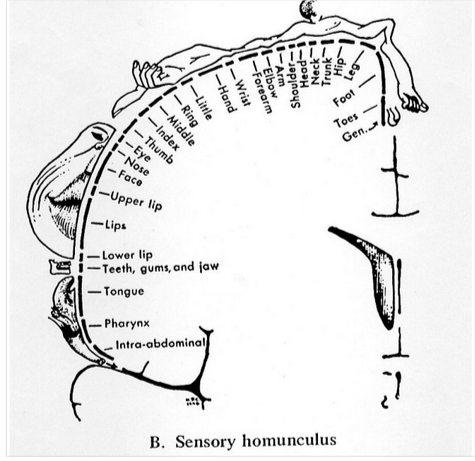
He found map of body in parental cortex
somatosensory cortex
stimulating different areas of somatosensory cortex → feel vibrations etc in different parts of body
Neurophysiology
Single neuron recordings
Lettvin et al. (1959): What the frog’s eye tells the frog’s brain
I think the most cited paper in science or smth like that
Recorded data from single cells in frog eye retinas
Eyes responded to small moving spots of light
Hubel and Wiesel (1962): cat eye’s brain cells
recorded cell reaction in cat occipital cortex
cells responded to oriented lines
neurons make a ton of popping noise when looking at lines (think of Geiger counter going crazy near radiation)
Neuroanatomy
Staining and tracer dyes
traces how information is passed from one brain region to another based on metabolism in brain
like contrast staining in MRI
showed functions of diff brain regions (e.g. orientation-specific cells in visual cortex, like the cells responded to lines from cat study above)
showed structure of neurons (e.g. visual structure)
Neuroimaging
CT - Computed Tomography
Uses X-rays
Achieves tomographic images (slices of sections of brain)
Slices are 2D; multiple slices → 3D
High resolution
EEG - Electroencephalogram
Electrodes on scalp surface detect electrical current
literally measure electrical current in areas of head as a result of brain activity
Directly measures neural activity
great for sleep studies and seizure observations
MEG - Magnetoencephalography
same signal as EEG but instead observing magnetic fields produced by electrical currents
directly measures neural activity
same clinical/experimental applications as EEG
very expensive, but lot easier to setup than EEG cap
PET - Positron Emission Tomography
inject radioactive isotope tracer carried by glucose to brain
less radioactive exposure than when you go on a plane
track neural activity via tracer
Indirect measure of neural activity
expansive and invasive (bc inject in skin)
excellent spatial resolution, not so much temporally
MRI - Magnetic Resonance Imaging
Giant magnet that pulses tissue with an electromagnetic pulse
measures differences in tissue magnetization
basically takes a pic of how cells react to being “knocked over” by magnets
awesome spatial resolution
9/13/24 - M2: Cognition and Brain Overview
Nervous system
maintains contact with the outside world
regulation of inside world
2 nervous systems
Central Nervous System
consists of Brain, Spinal card etc
Split in 5 sections
Cervical
Thoracic
Lumbar
Sacral
Coccygeal
handles automatic reflexes
Peripheral Nervous System
Connects central NS to organs and muscles
basically controls everything that isn’t brain or spinal cord
Somatic Nervous System - Sub system that controls muscles
Afferent nerves bring info in
Efferent nerves take info out
no other divisions for this system
Autonomic Nervous System - Subsystem that controls stuff we don’t think about
breathing, heart beating, glands, muscles, etc
happens automatically
its why we don’t have to worry about breathing or beating our heart
Sympathetic Nervous System - subsystem of Autonomic NS for fight or flight
Fight, fly, freeze
Dilating pupils, sweating, increased heart rates, and dry mouth result from Sympathetic NS triggering during stressful/nervous situations.
Parasympathetic Nervous System - subsystem of Autonomic NS for calmness when body is not doing anything
Homeostasis
lowered heartrate, decreased stress, etc
Neurons
Basic info
Building blocks of central nervous system (CNS)
we have ~100 billion neurons & 1 quadrillion synapses
~600 miles of neurons in our body
we have as many neurons as there are stars in the milky way
rate of neuron growth during fetal development in utero =
Discovering neurons
Golgi Staining: Camillo Golgi
Silver nitrate turned nerve cells dark black for viewing
Santiago Ramon y Cajal: discovered gaps between neurons
shared Nobel Prize with Golgi
Neuron Structure
Like a regular body cell, but with more specific functions
Information processing from receptors called Dendrites
Axon - Information transmission
Lengths: 1mm to 1m
longest axon is sciatic nerve
Dendrite - Information reception and relay
Myelin - protected and speeded information transmission
Fatty material composed of glial cells
Insulates axon
Stores energy
speeds up information transmission
9/16/24 - Missed lecture 💀
9/18/24 - M3 Zaps
Reflection set due date → All ZAPS grades recorded on Canvas
Reflection sets aren’t pledged → collaboration allowed
but you can’t copy answers word for word
Pooling material from all lectures in one response is not expected
instead dr. OH expects everyone to have their own interpretations of the lectures
Reflection will have <15 short answer questions
now onto actual lecture
left and right brained people dont exist
left side of the brain → controls left side of the body
and left visual field → left side of both eyes
right side of the brain → controls right side of the body
and right visual field → right side of both eyes
Lateralization of function
when different mental functions tend to belong in left or right side of brain
examples:
speech comprehension → left side
speech production → left side
language (grammar, vocab) → left side
visual semantics (object recognition) → right side
face processing → right side
language (patterns, rhyme, etc)→ right side
Corpus callosum
connects left and right hemispheres of the brain
cutting the corpus callosum does not actually impact brain that much
ex: guy in video had frequent seizures (2-3 times a day)
scientists cut corpus callosum because it would prevent “electrical storm” that causes seizures from starting
it worked
actually the guy was able to control left and right side of the body easily and independently
ex: he could draw circle and square with respective hands easily
“its like 2 different people doing the same thing in 1 body”
anatomy of brain
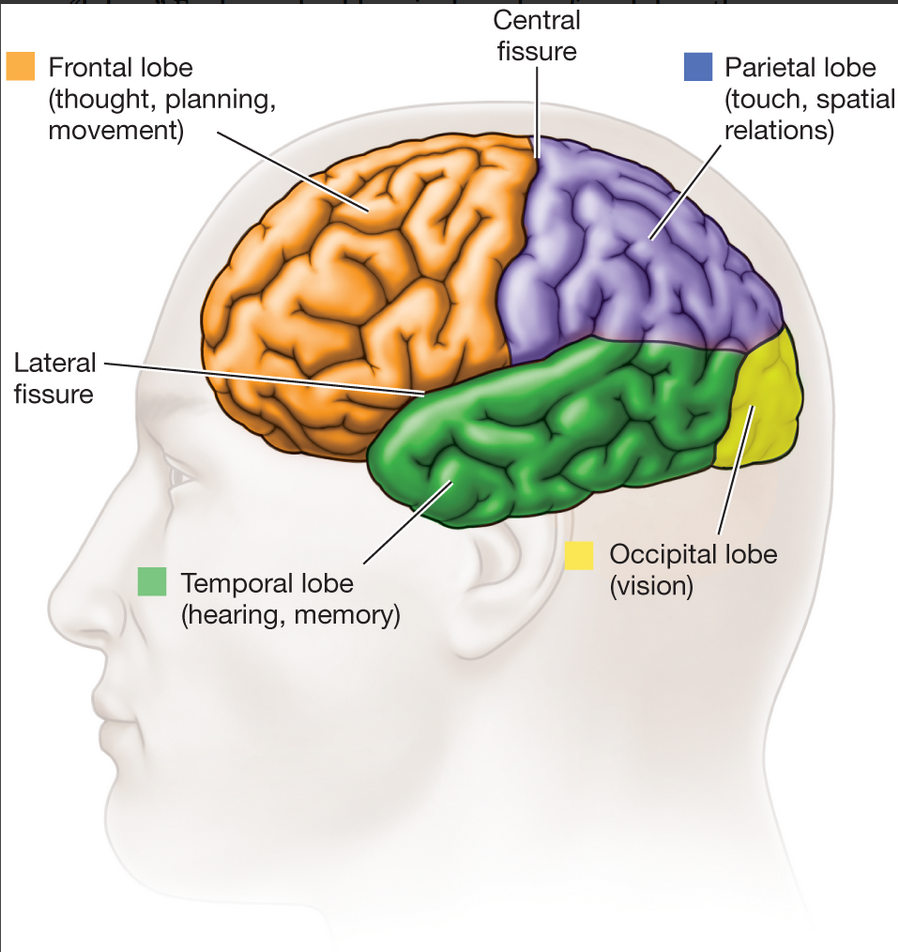
Frontal lobe - Memory and Motor
Speech, motor cortex
Parietal lobe - Sensory and Spatial
Speech, taste, reading, etc.
Occipital lobe - vision
Temporal lobe - language, memory, auditory
Smell, auditory association area, hearing
Directions and planes
Lateral view - side view from outside
Medial view - view as if cut through middle
Anteror - front side
posterior - back side
dorsal - top side (superior)
ventral - bottom side (inferior)
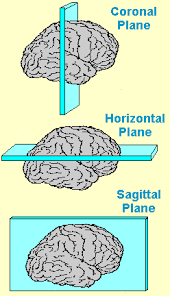
Views for neuroimaging
Saggital - view slice of brain basically
3d scan is a bunch of these slices
angle of slice doesn’t matter
Coronal (Frontal) - slice from front of face
transverse - slice from bottom side
Cerebral cortex - outer layer of brain
Subcortical structures - inner part of brain
Thalamus → sensory relay center
Hypothalamus → basic and essential body needs (heartbeats, breathing, organ function etc).
Hippocampus → memory and learning (super important)
Amygdala → emotion, super primitive
Olfactory bulb → smell
Attempt ZAPS before Friday (9/20/24)
9/23/24 - Sensation and perception
Purpose of perception is survival
Basics of sensation
5 senses
Vision is the most important sense
Phantom limb phenomenon
when painful sensations originate from where an amputated limb is
Vision
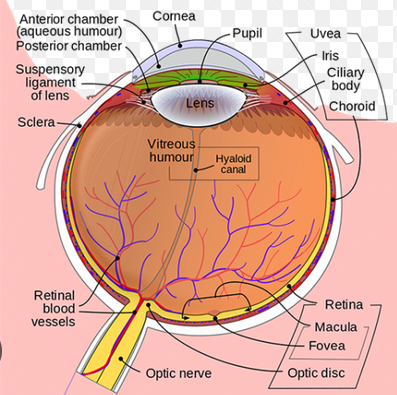
Cornea - light refraction
Pupil - lets light in
Iris - dilates the pupil; eye color
Lens - change shape to change focal structure
Retina
Rods - sensitive to light intensity = better in low light, better with motion
Brightness?
Cones - sensitive to light wavelength = color vision, high acuity
Color!
Fovea - center of visual field, highest concentrations of cones
Optic disc - blind spot
this is because there’s a hole in retina where optic nerves come from
Photoreceptors don’t see color, they sense light
There’s no such thing as color, our brains just interpret color.
optic chiasm - visual field info decussates to contralateral hemisphere
left visual field goes to right brain
right visual field goes to left brain
LGN - relay center in the thalamus
bunch of nuclei in the thalamus that are responsible for vision and other senses (except smell)
LGN sends to the primary visual cortex (V1)
9/25/24 - Pathways for other senses
Dorsal and Ventral Routes
What happens after visual cortex?
Dorsal - where and how; parietal association areas
Ventral - what; temporal lobe
Sound
Functional Utility
Location: binaural cues carry info about where you are and where things are.
we have bad echolocation, but blind people can actually echolocate because they much better sense of sound
basically because the visual cortex isn’t at work in blind people, so the brain reassigns that brainpower towards sound cortex
Identification
Efficiency: travels fairly well in air
Touch
Functional Utility
Somatosensation - feeling on your skin
Proprioception - when you can still know where you and some objects around you are when you cant see
ex: when you get soap in your eyes in the shower and still know where the other stuff is
Nociception and pain perception - help you survive, we percept pain individually
Taste
Functional Utility
helps prevent eating things that will kill you
Bumps (papillae) contain taste buds.
taste buds house taste receptor cells.
all areas of tongue taste the same uniformly
Smell
Functional Utility
Helps us survive — smell fire
social behaviors
Olfactory bulb transmits info to olfactory cortex. Axons also project to:
Medial temporal lobe (hippocampus and adjacent areas): memory
Amygdala: emotion
Smell is a huge memory trigger for humans bc of how closely linked hippocampus is with the olfactory
From sensation to perception
Sensation → transduction → perception
9/27/24 - Missed Lecture
9/30/24 - Cancelled Lecture
10/2/24 - Perception
Bottom-up — what we actually perceieve
Top-down — how our brain processes stimuli?
Unconscious inference — filling in the blanks
Necker cube with holes in slides example.
We see things not as they are, but as we are