Chapter 7
Alonso
Chapter 7
The Age of Jefferson, 1800 - 1816
Lecture Notes
Overview
This lecture offers an overview of the most important developments that occurred during the period from 1800 to about 1820: prosperity, rapid population growth, especially in the West, and the emergence of sectionalism.
I. Commercial Capitalism, Expansion and Conquest
A. Agriculture and trade, carried on in traditional ways, remained the foundation of the economy. American shipping enjoyed a spurt of prosperity between 1793 and 1805 but suffered when England and France restricted America’s rights as a neutral nation. Cities were closely associated with international trade but still played a marginal role in the life of the rest of the nation.
B. Population growth rate was astounding. The population would grow by 35% every decade. With 13 million people by 1830 and 31 million by 1860. Most remarkable was that in 1830, one-third of the population was under ten years of age; the median age was 16.
C. The growth in the West typified the incredible population growth of the whole nation. Areas that had been populated by Indians became the states of Kentucky, Tennessee, and Ohio. The mix of people in the West led to the creation of a new regional culture of a rootless, optimistic folk.
D. The numerous Indian tribes of the region (Shawnee, Miami, etc.) stood in the way of settlement and threatened a territory’s chances of quickly becoming a state (large numbers of Indians in a territory limited immigration of whites and large reservations within a territory threatened its sovereignty and safety.)
E. Many tribes resisted encroachment while others eagerly signed treaties giving away large tracts of land that may or may not have belonged to them. (It is important to remember that Indian tribes had a very different conception of property rights than did Americans.) Nevertheless, these treaties granted Americans large tracts of land, while giving the Indians small reservations, liquor, and trinkets. Also, these treaty boundaries were often ignored by white settlers.
F. Of the numerous tribes that offered resistance, we will only speak of the most well-known – the Shawnees who followed Tecumseh and his brother, Tenskwatawa. Tecumseh, a well-respected Shawnee chief, led a brief alliance of various Indian tribes to collectively resist white encroachment
on their lands in Ohio and Indiana. Tenskwatawa, known as the Prophet, was a Shaman who urged his Shawnees and other tribes to resist whites by abstaining from alcohol and any American made product. They flourished for a while at Prophet’s town on the Tippecanoe River in modern day Indiana and were forced out by General William Henry Harrison (future President) and his army. II. Democratic-Republican Ascendancy
A. Thomas Jefferson personified the contradictions in republicanism: he despised ceremonies and formality and dedicated himself to intellectual pursuits; at the same time, he was a politician to the core.
B. Jeffersonian Reforms
1. Jefferson gave top priority to cutting the federal debt and federal taxes. He trimmed federal expenses, mainly by slashing military spending. Reduction of the army had the further benefit of removing a threat to republican government.
2. Though badgered by loyal Democratic-Republicans for political appointments, Jefferson retained only those bureaucrats he thought competent, no matter what their party. His refusal to purge Federalists hastened the demise of the Federalist Party. Many of its members retired from public life, and the more ambitious of them, John Quincy Adams, became Democratic Republicans.
C. The Louisiana Purchase
1. Americans had assumed that they would some day buy or take New Orleans from Spain, which did not have the military strength to resist the United States. In 1801, however, France, which could block America’s westward expansion or close New Orleans, acquired Louisiana back from Spain.
2. Jefferson sent a mission to France to buy New Orleans. Napoleon offered to sell all of Louisiana, an area roughly the size of the United States at that time, for only $15 million. D. The Lewis and Clark Expedition
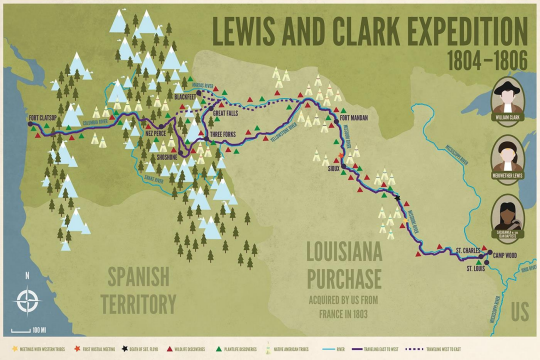
1. Even before purchasing Louisiana, Jefferson sent an exploring party into the area. Their report on its economic prospects reaffirmed Jefferson’s desire that it belong to the United States. 2. The expedition set out from St. Louis in May 1804 and followed the Missouri River upstream.
They spent the winter at a Mandan Indian town in what is now one of the Dakotas. The following spring, they continued upstream to the headwaters of the Missouri. The portaged over the mountains (Bitterroots) and eventually made it into the Columbia River system and hence to the Pacific. They wintered (1805-1806) at Fort Clatsop (modern day Astoria, Oregon) and returned to St. Louis the next year (1806). They entire expedition cost a little
over $2,500 and provided a wealth of scientific, geographic, economic, and cultural
information.
3. When Jefferson received the French offer, he worried that Congress might not have the constitutional right to make the purchase. Jefferson urged Congress to complete the deal anyway, fearing that Napoleon might change his mind.
4. He departed further from republican principles when he established a government for the new territory. Because most of the (white) inhabitants were French and Spanish, Jefferson did not entrust them with self-rule, and the area was governed from Washington. Nonetheless, the American people thoroughly approved of Jefferson’s actions and reelected him in 1804.
E. Conflict with the Barbary States
1. Jefferson ended his first term by sending the Navy into the Mediterranean to fight the North African states who demanded tribute from ships sailing through the Mediterranean. Although the United States could not defeat the Barbary States, the show of force induced them to respect American rights. The American people thoroughly approved Jefferson’s actions, foreign and domestic, and reelected him in 1804.
III. Sources of Political Dissension
A. Attack on the Judges
1. Before transferring power to the Republicans in 1801, the Federalists created a number of new circuit courts, filled with loyal Federalist judges (Midnight Appointments).
2. When Jefferson took office, Congress repealed the law, thus abolishing the new courts. The Federalists complained that this violated the tenure of judges, a right guaranteed by the Constitution.
3. In a related case, Marbury v. Madison (1803), the Supreme Court ruled that the Judiciary Act itself had been unconstitutional. As Chief Justice John Marshall intended, the Democratic Republicans considered the ruling a victory and overlooked the fact that the Supreme Court had judged the constitutionality of an act of Congress (judicial review).
4. The Supreme Court ruled in Fletcher v. Peck (1810) that the state legislature could not revoke a contract (even if it had been obtained by bribery). The ruling established the Supreme Court’s right to nullify STATE laws if they violated the Constitution.
B. Politics of Desperation
1. As the Federalist party waned, so did the need for Democratic-Republican unity.
C. The Burr Conspiracy
1. Vice-President Aaron Burr also broke with Jefferson. In 1804, he ran for governor of New York and tried to enlist Federalist support. He was blocked by Alexander Hamilton, whom Burr then killed in a duel.
2. Burr fled to the West and hatched a scheme to invade Spanish territory. He was arrested for and tried for treason.
3. John Marshall ruled that the Court must follow the very strict criteria the Constitution requires for a conviction of treason and Burr went free. Marshall’s precedent made it difficult for later presidents to use the charge of treason as a political tool.
D. The Slave Trade
1. Congress prohibited the slave trade after 1808, but northern and southern Republicans disagreed over the issue.
2. Northerners wanted to free any black smuggled into the United States, but Southerners succeeded in having a law passed that handed such persons over to state authorities, who could then sell them into slavery.
IV. Failure of Foreign Policy
A. When England and France resumed full-scale hostilities in 1803, American commerce was caught in the middle and American ships were subjected to seizure.
B. Embargo Divides the Nation
1. In 1807, Congress prohibited American ships from leaving port. Jefferson reasoned that France and England needed American goods so badly that they would quickly agree to respect American rights.
2. The Embargo, however, proved to be unpopular at home. In order to enforce it, the government supervised commerce in minute detail, and when smuggling became commonplace, Jefferson sent in the army.
3. New Englanders especially resented the Embargo because it destroyed their economy. Worse, it did not hurt England. In 1809, the Embargo was repealed.
C. A New Administration Goes to War
1. James Madison was selected as Jefferson’s successor by a caucus of Democratic-Republican congressmen. He won the election of 1808 easily but was not temperamentally suited to exercise leadership.
2. Under the terms of the Non-Intercourse Act, the United States committed itself to resume trade with England and France if those nations promised to cease their seizure of American vessels. When a minor English official made such a promise, Madison opened trade with England, but the English government promptly seized those ships Madison had put to sea.
3. Congress replaced the Non-Intercourse Act with another law just as poorly conceived (Macon’s Bill Number Two).
4. This time Napoleon promised to observe American rights but, when Madison opened trade with France, Napoleon broke his word.
D. Fumbling Toward Conflict
1. In 1811, the anti-British mood of the country intensified. In the West, the uprising led by Tecumseh was widely believed to have been the work of British agents. In Congress, a group of representatives, fiercely nationalistic (the War Hawks), demanded a war against Great Britain to preserve American honor.
2. On June 1, 1812, Madison finally sent Congress a declaration of war. Had there been a telegraph between London and Washington, the war might not have begun because Great Britain had just suspended their ‘Orders in Council’ (authorized their seizures of American vessels).
3. This confusing preamble typified the war in general. The vote for war in Congress was close, and nobody seemed to know what the United States intended to gain from victory.
V. The Strange War of 1812
A. Americans expected victory even though they were unprepared for war. To ensure that Democratic Republican financial reforms would not be undone, Congress refused to raise taxes.
B. New England, where the Federalists party was still strong, refused to take an active part in the war effort.
C. The United States Army was small, and state militias proved inadequate to fight well-trained British veterans.
D. In 1814, Great Britain planned a three-pronged attack on the United States: a march from Canada into the Hudson River Valley, an amphibious assault on the Chesapeake Bay region, and occupation of New Orleans.
E. The decisive campaign was in New York State, where Americans stopped the British on Lake Champlain, near Plattsburg. As a result of this defeat, Great Britain agreed to end hostilities. F. In the meantime, however, British operations in the Chesapeake resulted in the burning of Washington, D.C. and a siege of Baltimore. The British attempt to take New Orleans actually took place after the peace treaty had been signed, but there was no way to communicate the news in time to prevent the battle. A ragtag American army, led by Andrew Jackson, annihilated the British invading force in January 1815.
G. Hartford Convention: The Demise of the Federalists
1. The resentment felt by New Englanders over the Embargo grew during the Madison administration. When the war seemed to be going badly for the United States, a group of Federalists met in Hartford, Connecticut, in December 1814 to recommend changes in the Constitution that would have lessened the power of the South and the West.
2. Unfortunately for the Federalists, they met on the eve of the victory of New Orleans and the conclusion of peace. After these events, the Convention’s demands seemed irrelevant as well as disloyal. The Federalist party never recovered from the Hartford Convention.
H. Treaty of Ghent Ends the War
1. After the American victory at Plattsburg, the British government decided to end the war without addressing any of the problems that had started it.
2. Both sides were weary, and the Senate ratified the treaty unanimously.
3. For Americans, the war succeeded splendidly. Many felt that they had won a “second war of independence.”
I. The War’s Legacy
1. America survived two wars against Great Britain – earning other nations’ respect
2. U.S. accepted Canada as part of Great Britain
3. The Federalist party declined
4. Nullification and secession arguments strengthened
5. Native Americans were forced to abandon more land
6. Development of more U.S. factories
7. War heroes become more popular (especially in politics)
8. Growth of nationalism and an American focus westward
VI. Republican Legacy
A. The Founding Fathers began to pass away around 1830. Jefferson and John Adams died on the same day, July 4, 1826, exactly fifty years after the Declaration of Independence had been adopted. B. The last of the Founders, James Madison, died in 1836, in despair that the principles of the Declaration had not yet been extended to African Americans.