Unit 5: Conflict, Crisis, and Reaction in the Late 18th Century (1650-1800)
Topic 3.3: Continuities and Changes to Economic Practice and Development
Class Notes
Agricultural Revolution
- 1500-1700 farming output increased by x3 in England
The Agricultural Revolution Begins
- England
- “Low countries”
- Netherlands
- Belgium
All SET
S - Science
E - Entrepreneur
T - Technology
The Farmer as a Scientist
Agricultural Production
- 4 field crop rotation
- allows fields to never be unused, farmers used turnips, alfalfa, clover
Livestock
- Selective Breeding
- was used to produce larger, healthier animals
More Fields = More Food = More People
The Farmer as an Entrepreneur
- Agricultural production, as a whole, became more mark-oriented and efficient
- Transitioned from a common field system to ENCLOSURES

Bigger Farms = More Food = More People
The Farmer as an Inventor
- New MACHINES allowed farmers to grow more food efficiently
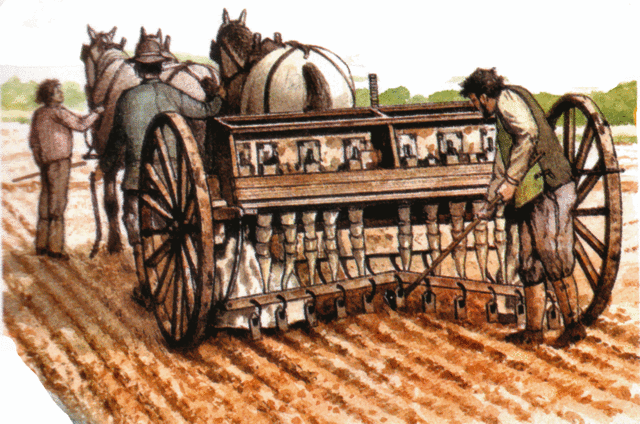
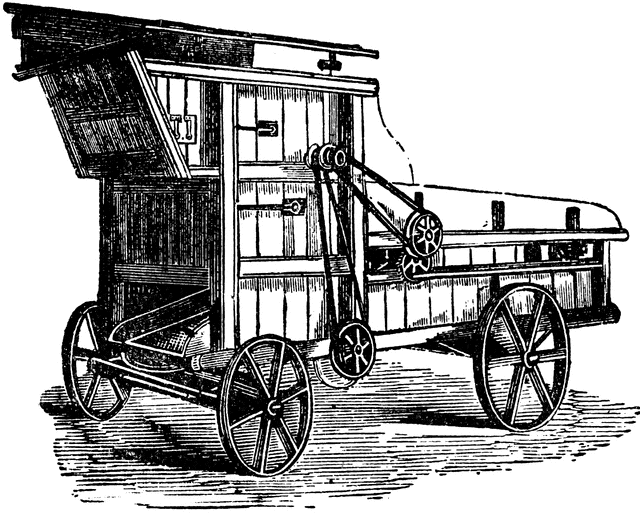
Better Tools = More Food = More People
Working the Land
The Legacy of the Open-Field System
- From the Middle Ages up to the 17th century. much of Europe was farmed through the open-field system.
- The land to be cultivated was divided into several large fields, which were in turn cut up into long, narrow strips.
- The fields were open, and the strips were not enclosed into small plots by fences or hedges.
- The ever-present problem was soil exhaustion. Wheat planted year after year in a field will deplete nitrogen in the soil.
- In the early Middle Ages a year of fallow was alternated with a year of cropping; then three-year rotations were introduced.
- The three-year system was an important achievement because cash crops could be grown two years out of three, rather than only one year in two.
- In addition to rotating fields crops in a uniform way, villages maintained open meadows for hay and natural pasture. After the Harvest villagers also pastured their animals on the wheat or rye stubble.
- Social conditions were better in western Europe where peasants were generally free from serfdom.
New Methods of Agriculture
- By 1700 less than half of the population of Britain and the Dutch Republic worked in agriculture, producing enough to feed the remainder population.
- The key was new ways of rotating crops that allowed farmers to forgo the unproductive fallow period altogether and maintain their land in continuous cultivation.
- Clover was an important crop because it restores nitrogen directly to the soil through its roots.
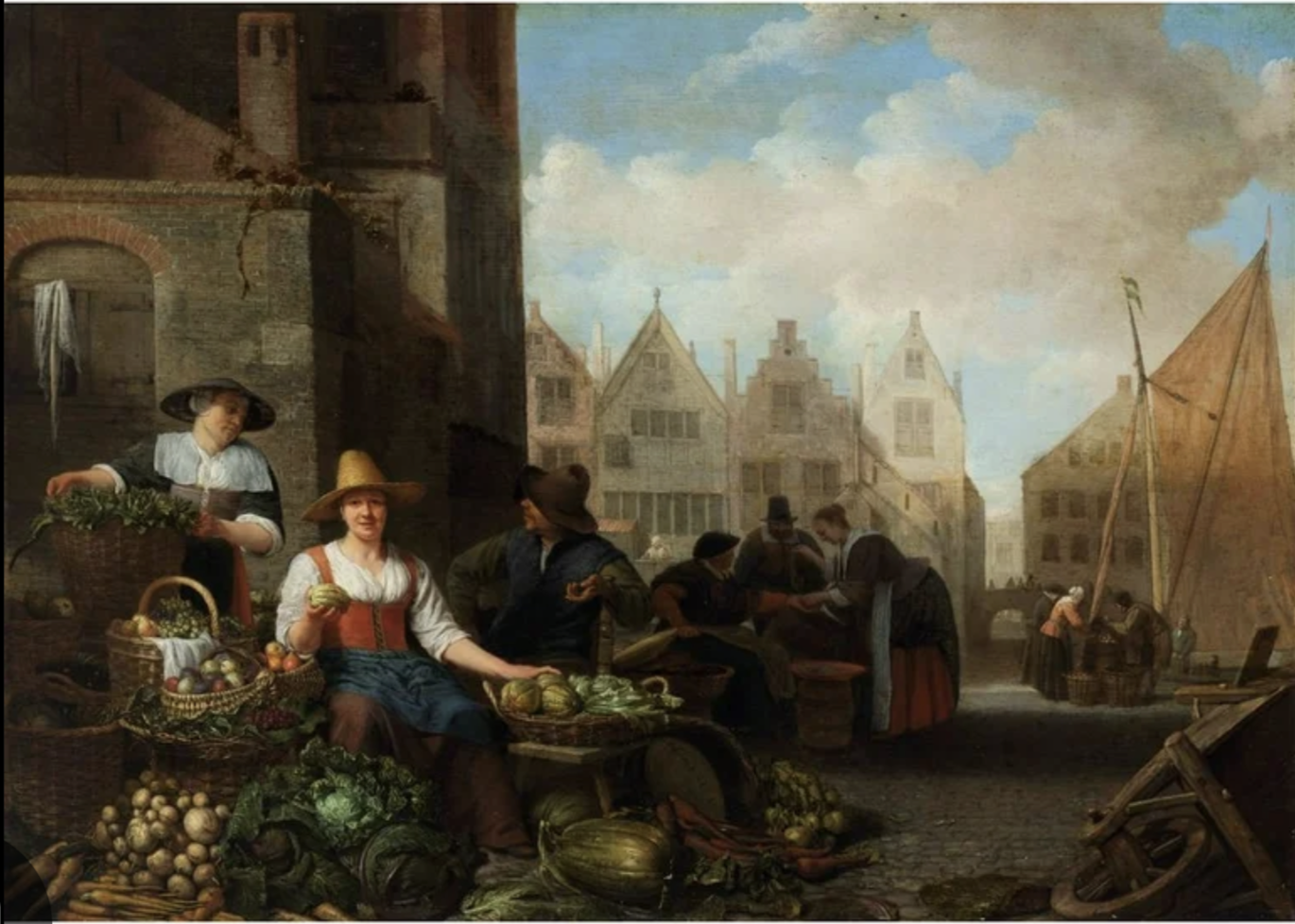
- potatoes made it to the human’s dish and provides a nutritious supplement to the peasant’s meager diet.
- With more fodder, hay, and root vegetables for the winter months, peasants and larger farmers could build up their herds of cattle and sheep.
- More animals meant more manure to fertilize and restore the soil.
- More animals also meant more meat and dairy products as well as more power to pull ploughs in the fields and bring carts to market
- Farmers developed increasingly sophisticated patterns of crops rotation to suit different kinds of soils.
- Advocated of the new crop rotations, who included an emerging group of experimental scientists, some government officials, and a few big landowners, believed that new methods were scarcely possible within the traditional framework to open fields and common rights.
- A farmer who wanted to experiment with new methods would have to get all the landholders in the village to agree to the plan.
- According to proponents of this movement known as enclosure (The movement to fence in fields in order to farm more effectively, at the expense of poor peasant who relied on common fields for farming and pasture), the upheaval of village life was the necessary price of technical progress.
- When the small landholder and the village poor would effectively oppose the enclosure of the open fields and the common lands, they did so.
- Noble landowners who were also wary of enclosure because it required large investments in purchasing and fencing land and thus posed risk for them as well.
- The old system of enclosed open fields and the new system of continuous rotation coexisted in Europe for a long time.
- Throughout the end of the 18th century, the new system of enclosure was extensively adopted only in the Low Countries and England.
The Leadership of the Low Countries and England
- Dutch leadership in farming was that area was one of the most densely populated in Europe.
- In order to feed themselves and provide employment, the Dutch were forced at an early date to seek maximum yields from their land and to increase the cultivated area through the steady draining of marshes and swamps.
- The growing urban population provided Dutch peasants with markets for all they could produce and allowed each region to specialize in what it did best.
- In the mid 17th century english farmers borrowed the system of continuous crop rotation from the Dutch.
- Large parts of the 17th century Holland had once been sea and sea marsh, and the efforts of centuries had made the Dutch the world’s leaders in drainage.
- Dutch experts made a great contributions to draining the extensive marshes, or fens, of wet and rainy England
- The most famous of these Dutch engineers, Cornelius Vermyden, directed one large drainage project in Yorkshire and another in Cambridgeshire.
- Jethro Tull (1674 - 1741) was an english inventor, he was enthusiastic about using horses, rather than slower-moving oxen, for plowing.
- He advocated sowing seed with drilling equipment rather than scattering it by hand. Drilling distributed seed in an even manner and at the proper depth.
- Selective bring of ordinary livestock was a marked improvement over the haphazard breeding of the past.
- More than half the farmland in England was enclosed through private initiatives prior to 1700; Parliament completed this work in the 18th century.
- From the 1760s to 1815 a series of acts of Parliament enclosed most of the remaining common land.
- Arthur Young celebrated large-scale enclosure as a necessary means to achieve progress.
- Region that maintained open-field farming were still able to adopt crop rotation and other innocations suggesting that enclosures were not a prerequisite for increased production.
- The 18th century enclosure movement marked the completion of major historical developments in England - the rise of market-oriented estate agriculture and the mergence of landless rueal proletariat.
- Landless laborers worked very long hours, usually following a dawn-to-dusk schedule six days a week all year long.
- Improvements in technology meant that fewer laborers were needed to work the large farms, and unemployment spread through the country side.
- In no other European country had this proletarianization (The transformation of large numbers of small pesant farmers into landless rural wage earners) - this transformation of large numbers of small peasant farmers into landless rural wage earners - gone so far.
The Beginning of the Population Explosion
Long-Standing Obstacles to Population Growth
- Until 1700 the total population of Europe grew slowly much of the time and it followed an irregular cyclical pattern.
- Black Death of 1348-1350 caused a sharp drop in population and food prices after 1350 and also created labor shortage throughout Europe
- In the mid 16th century, farmers brought new land into cultivation and urban settlements grew significantly.
- The second great surge of population growth outstripped the growth of agricultural production after 1500. There was less food per person, and food prices rose more rapidly than wages, a development intensified by the inflow of precious metals from the Americas.
- The population grew modestly in normal years at a rate of perhaps 0.5 to 1 percent, or enough to double the population in 70 to 140 years.
- New England, where there was a great deal of frontier to be settled, the annual rate of natural increase, not counting immigration, might well have exceeded 1 percent.
- France, where the land had long been densely settled the rate of increase might have been less than 0.5 percent.
- The grim reapers of demographic crisis were famine epidemic disease, and war.
- Europe experienced unusually cold and wet weather, which produced even more severe harvest failures and foods shortages than usual.
- Contagious diseases like typhus, smallpox, syphilis, and the ever-recurring bubonic plague, also continued to ravage Europe’s population on the periodic basis.
- Armies requisitioned scarce food supplies and disrupted the agricultural cycle while battles destroyed precious crops, livestock, and farmlands.
The New Pattern of the Eighteenth Century
- Growth took place unevenly with Russia growing very quickly after 1700 and France much more slowly.
- Europeans grew in numbers steadily from 1720 to 1789, with especially dramatic increases after about 1750.
- Women had more babies than before because new opportunities for employment in rural industry allowed them to marry at an earlier age.
- European population increase as a whole was a decline in mortality - fewer deaths. The mysterious disappearance of the bubonic plague.
- 1720 a ship from Syria and the Levant brought the disease to Marseilles.

- By 1722 the epidemic has passed, and that was the last time plague fell on western and central Europe.
- Stricter measures of quarantine in Mediterranean ports and along the Austrain border with the Ottoman Empire helped by carefully isolating human carriers of plague.
- Advance in preventine medicine in this period was inoculation against smallpox, and this great improvement was long confined mainly to England, probably doing little to reduce deaths throughout Europe until the latter part of the century.
- Improvements in the water supply and sewage, which were frequently promoted by strong absolutist monarchies, resulted in somewhat better public health and hekped reduce such diseases as typhoid and typhus in some urban areas of western Europe.
- Improvements in water supply and the drainage of swamps also reduced Europe’s large insect population.
- The 18th century was a time of considerable canal and road building in western Europe. These advances in transportation, which were also among the more positive aspects of strong absolutism states, lessened the impact of local crop failure and famine.
- Agricultural production in the 17th-18th centuries, which increased the food supply and contributed nutritious new foods, particularly the potato from South America.
- Deprived of land by the enclosure movement, the rural poor were forced to look for new wats to make a living.
The Putting-Out System
- Cottage industry (A stage of industrial development in which rural workers used hand tools in their homes to manufacture goods on a large scale for sale in a market)
- Putting-out system (The 18th century system of rural industry in which a merchant loaned raw materials to cottage workers, who processed them and returned the finished products to the merchant)
- Sometimes rural workers brought their own raw materials and worked as independent producers before they sold to the merchant.
- As industries grew in scale and complexity production was often broken into many stages.
- He would then pass the thread to another group of workers to be bleached, to another for dyeing, and to another for weaving into cloth. The merchant paid outworkers by the piece and proceed to sell the finished product to regional, national, or international markets.
- Since production in the countryside was unregulated, workers and merchants could change procedures and experiment as they saw fit.
- Rural manufacturing did not spread Europe evenly. It was most successful in England.
- By 1500 half of England’s textiles were being produced in the countryside. It was dependent on the putting-out system.
The Growth of Rural Industry
The Lives of Rural Textile Workers
- The making of linen, woolen, and eventually cotton cloth was the typical activity of cottage workers engaged in the putting-out system.
- The rural worker lived in a small cottage with tiny windows and little space.
- The loom changed somewhat in the early 18th century when John Kay’s invention of the flying shuttle enabled the weaver to throw the shuttle back and forth between the threads with one hand.
- All members of the family helped in the work.
- Operating the loom was usually consider a man’s job, reserved for the male head of the family.
- Women and children worked at auxiliary tasks; they prepared the warp threads and mounted them on the loom, wound threads on bobbins for the weft thread, and sometimes operated the wrap frame while the father passed the shuttle.
- The work of four or five spinners was needed to keep one weaver steadily employed.
- Merchants hired the wives and daughters of agricultural workers, who took on spinning work in their spare time.
- In England, many widows and single women also became “spinsters” so many in fact that the word became a synonym for an unmarried woman.
- Merchants accused workers of stealing raw materials, and weavers complained that merchants delivered underweight bales.
- Women’s wages were usually much lower because they were not considered the family’s primary wage earner.
- A single or widowed spinner faced a desperate struggle with poverty.
- From the merchant capitalist’s point of view, the problem was not the low wages but maintaining control over the labor force.
- Cottage workers were scattered across the countryside and their work depended on the agricultural calendar.
- Merchants bitterly resented their lack of control over rural labor because their own livelihood depended on their ability to meet orders on time.
- If workers failed to produce enough thread, they reasoned, it must be because their wages were too hight and they had little incentive to work.
- Merchants thus insisted on maintaining the lowest possible wages to force the '“idle” poor into productive labor.
- Imprisonment and public whipping became common punishments for pilfering small amounts of yarn or cloth.
The Industrious Revolution
- Industrious Revolution (The shift that occurred as families in northwestern Europe focused on earning wages instead of producing goods for household consumption; this reduced their economic self-sufficiency but increased their ability to purchase consumer goods)
- By working harder and increasing the number of wageworkers, rural and urban households could purchase more goods, even in a time of stagnant or failing wages.
- With more finished goods becoming available at lower prices, households sought cash income to participate in an emerging consumer economy.
- When women entered the labor market, they almost always worked at menial, tedious jobs for very low wages.
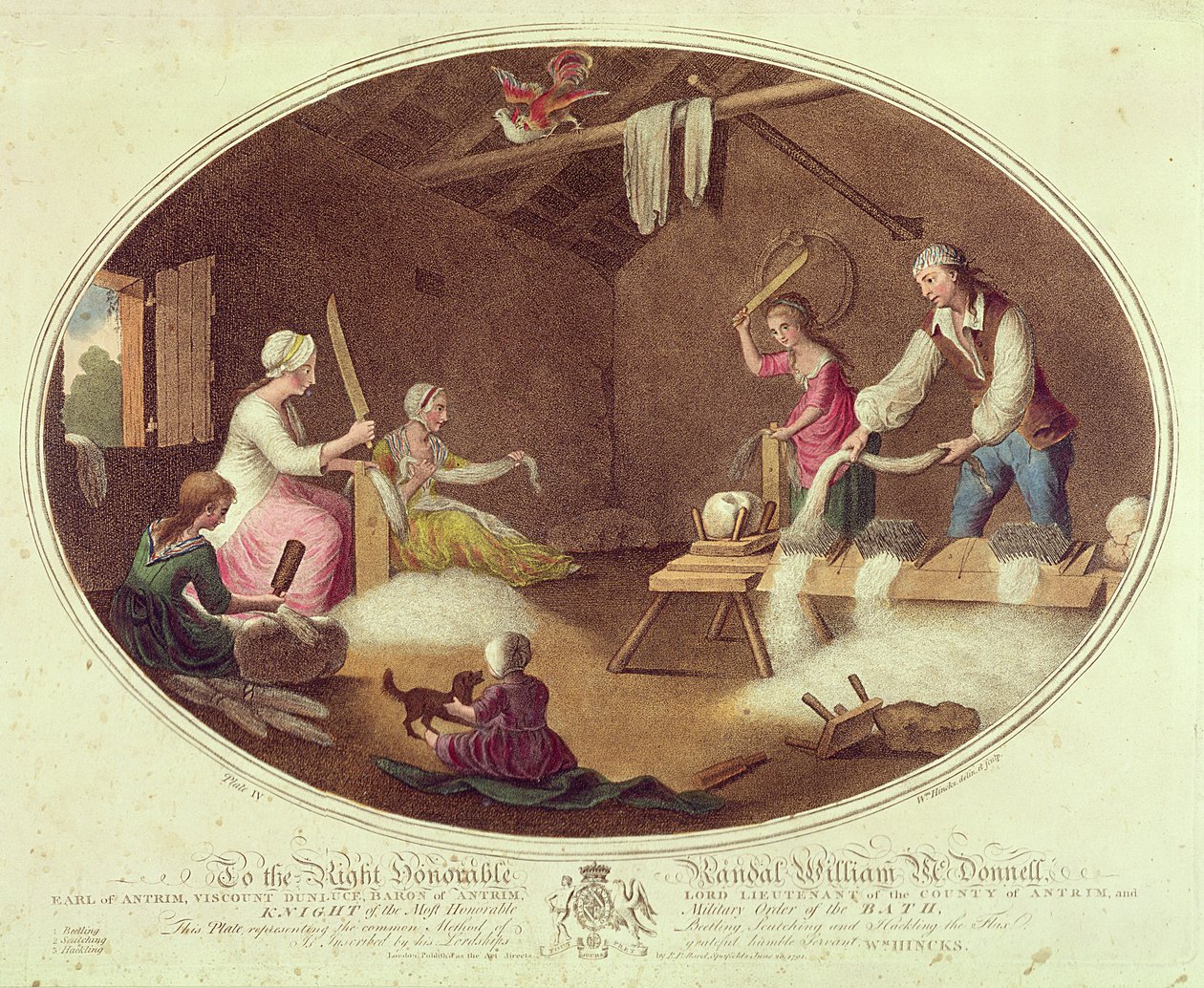
- Yet when women earned their own wages, they also seem to have taken on a greater role in household decision making.
- Women’s use of their surplus income thus helped spur the rapid growth of the textile industries in which they labored so hard.
- They created households in which all members worked for wages rather in a family business and in which consumption relied on market-produced rather than homemade goods.
The Debate Over Urban Guildes
- Guild system (The organization of artisanal production into trade-based associations, or guilds, each of which received a monopoly over its trade and the right to train apprentices and hire workers)
- Those excluded from guild membership - women, day laborers, Jews, and foreigners - worked on the margins of the urban economy.
Urban Guilds
- The guild system reached its peak in most of Europe in the 17th and 18th centuries.
- Urban guilds increased dramatically in cities and towns across Europe.
- Each guild possessed a detailed set of privileges, including exclusive rights to produce and sell certain goods, access to restricted markets in raw materials, and the rights to train apprentices, hire workers, and open shops.
- Any individual who violated these monopolies could be prosecuted.
- Guilds provided a locus of sociability and group identity to the middling classes of European cities.
- Guilds jealously restricted their membership to local men who were good Christians, had several years of work experience, paid stiff membership fees and completed a masterpiece.
- They also favored connections. Masters’ sons got automatic access to their fathers’ guilds, while outsiders were often barred from entering.
- In England, national regulations superseded guild rules, sapping their importance.
- In France, the Crown developed an ambiguous attitude toward guilds, relying on them for taxes and enforcements of quality standards.
- The German guilds were perhaps the most powerful in Europe, and the most conservative.
- While most were hostile to women, a small number of guilds did accept women.
- In 1675 seamstresses gained a new all-female guild in Paris, and soon seamstresses joined trailers’ guilds in part of France.
- By the mid 18th century make masters began to hire more female workers, often in defiance ode to their own guild statutes.
Adam Smith and Economic Liberalism
- 18th century critics derided guilds as outmoded and exclusionary institutions that obstructed technical innovation and progress.
- Adam Smith (1723 - 1790) developed a general idea of freedom to enterprise and established the basis for modern economics in his ground breaking work, Inquiry into the Nature and Cause of the Wealth of Nations (1776).
- Smith criticized guilds for their stifling and outmoded restrictions, a critique he extended to all state monopolies and privileged companies.
- Smith advocated a more highly developed “division of labor,” which entailed separating craft production into individual task to increase workers’ speed and efficiency
- Smith argued that government should limit itself to “only three duties”: it should provide defense against foreign invasion, maintain civil orders with courts and police protection, and sponsor certain indispensable public works and institutions that could never adequately profit private investors.
- He believed that the pursuit of self-interest in competitive market would be sufficient to improve the living conditions of citizens, a view that quickly emerged as the classic argument for economic liberalism (A belief in free trade and competition based on Adam Smith’s argument that he invisible hand of free competition would benefit all individuals, rich and poor)
- In 1776 the reform-minded economics minister Anne-Robert-Jacques Turgot issued a law abolishing all French guilds.
- Vociferous protests against this measure led to Turgot’s disgrace shortly afterwards, but the legislators of the French Revolution were the same liberal mind-set and disbanded the guilds again in 1791.
- In the late 18th and 19th centuries, skilled artisans across Europe espoused the values of hand craftsmanship and limited competition in contrast to the polarization and loss of skills they endured in mechanized production.
- Recent scholarship has also challenged some of the criticism of the guilds, emphasizing the flexibility and adaptability of the guild system and the role it played in fostering confidence.
The Atlantic World and Global Trade
- In the 18th century Spain and Portugal revitalized their empires and began drawing more wealth from renewed colonial development.
- The Atlantic economy that these countries developed from 1650 to 1790.
Mercantilism and Colonial Competition
- Colbert under Louis XIV, mercantilism aimed particularly at creating a favorable balance of foreign trade in order to increase a country’s stock of gold.
- In England, the desire to increase both military power and private wealth resulted in the mercantile system of the Navigation Acts. (A series of English laws that controlled the import of goods to Britain and British colonies)
- These laws gave British merchants and shipowners a virtual monopoly on trade with British colonies.
- The colonies were required to ship their products on British (or American) ships and kj to buy almost all European goods from Britain.
- These economic regulations would eliminate foreign competition, thereby helping British merchants and workers as well as colonial plantations owners and farmers.
- The Navigation Acts were a form of economic warfare. Their intial target was the Dutch, who wer e ahead of the English in shipping and foregin trade in the mid 17th century.
- In conjunction with three Anglo- Dutch wars between 1652 and 1674, the Navigation Acts seriously damaged Dutch shipping and commerce
- The British seized the thriving Dutch colony of New Amsterdam in 1664 and renamed it New York.
- France stood clearly as England’s most serious rival in the competition for overseas empire.
- France allied with Spain, continental Europe’s leading military power was already building a powerful fleet and a worldwide system of rigidly monopolized colonial trade.
- From 1701 to 1763 Britain and France were locked in a series of wars to decide, in pattern which nation would become the leading maritime power and claim the profits of Europe’s overseas expulsion
- The union of France and Spain threatened to encircle and destroy the British colonies in North America.
- Defeated by a great coalition of states after twelve years of fighting.
- Spain was compelled to give Britain control of its West Africa slave trade and let Britain control of merchandise into the Spain colonies annually.
- In North America, French and British settlers engaged in territorial skirmishes that eventually resulted in all-other war that drew in Native American allies on both sides of the conflict.
- By 1763 Prussia had held off the Austrians, and British victory on all colonial fronts was ratified in the Treaty of Paris.(The Treaty that ended the Seven Years’ War in Europe and the colonies in 1763, and ratified British victory on all colonial fronts)
The Atlantic Economy
- Commercial exchange in the Atlantic has traditionally been referred to as the “triangle trade.”
- European commodities, like guns and textiles, to Africa; enslaved Africans to the colonies; and colonial goods, such as cotton, tobacco, and sugar, back to Europe.
- Economies of European nation bordering the Atlantic Ocean, especially England, relied more on colonial exports.
- Exports to England’s colonies in Ireland and India also rose substantially from 1700 to 1800.
- By 1800 sales to European countries - England’s traditional trading partners - represented only half of exports, down from three quarters a century earlier.
- Colonial monopolies allowed the English to obtain a steady supply of such goods at beneficial prices and to re-export them to other nations at high profits.
- Many colonial goods, like sugar and tobacco, required processing before consumptions and thus contributed new manufacturing jobs in England.
- The mercantilist system achieved remarkable success for threshold of the epoch-making changes that would become known as the Industrial revolution.
- The colonies of Saint-Domingue, Martinique, and Guadeloupe remained in French hands and provided immense fortunes in plantations agriculture and slave trading during the second half of the 18th century.
- 1789 the population of Saint-Domingue included 500,000 slaves whose labor had allowed the colony to become the world’s leading producer of coffee and sugar and the most profitable plantation colony in the New World.
- 176, but its influence expanded westward all the way northern California through the efforts of Spanish missionaries and ranchers.
- Spanish landowners developed a system of debt peonage (A form of serfdom that allowed a planter or rancher to keep his workers or slaves in perpetual debt bondage by periodically advancing food, shelter, and a little money to keep indigenous workers on their estates.
The Atlantic Slave Trade
- Atlantic slave trade (The forced migration of Africans across the Atlantic for slave labor on plantations and in other industries; the trade reached its peak in the 18th century and ultimately involved more than 12 million Africans)
- The brutal practice intensified dramatically after 1700 and especially after 1750 with the growth of trade and demand for slave-produce goods like sugar and cotton,
- European traders purchased and shipped 6.5 million enslaved Africans across the Atlantic between 1701 and 1800.
- The rise of plantations agriculture was responsible for the tremendous growth of the slave trade.
- European ships sent boats ashore or invited African dealers to bring traders and slaves out to their ships. Allowing ships to move eailty along the coast from market to market.
- African merchants and rulers who controlled exports profited from the greater demand for slaves.
- The population of Africa stagnated or possibly declined.
- Details of the plight of enslaved people became known, a campaign to abolish slavery developed in Britain.
- British women were prominent in this movement, denouncing the immorality of human bondage and stressing the cruel and sadistic treatment of enslaved women and families.
- 1807 Parliament abolished the British slave trade.
Identities and Communities of the Atlantic World
Identities and Communities of the Atlantic World
- Wealthy Creoles and their counterparts throughout the Atlantic colonies prided themselves on following European ways of life.
- Creole traders and planters increasingly resented the regulations and taxes imposed by colonial bureaucrats, and such resentment would eventually lead to revolutions against colonial powers.
- Numerous poor or middling whites worked as clerks, shopkeepers, craftsmen, and plantation managers,
- Colonial attempts to classify and systematize racial categories greatly influenced developing Enlightenment thought on racial difference.
- Many masters acknowledged and freed their mixed-race children, leading to sizable populations of free people of color.
- Free people of color brought backlash from the white population of Saint-Domingue in the form of new race laws prohibiting nonwhites from marrying whites and forcing them to adopt distinctive attire.
- Masters tended to leave their mixed-race progeny in slavery rather than freeing them.
- Some mixed-race people sought to enter Creole society and obtain its many official and unofficial privileges by passing as white.
- Galvanized by the Protestant Reformation and the perceived need to protect and spread Catholicism, Catholic powers actively sponsored missionary efforts, Jesuits, Franciscans, Dominicans, and other religious orders established missions through Spanish, Portuguese, and French colonies.
- Conversion in North America were less effective because indigenous settlements were more colonial communities.
- Slave owners often refused other baptize their slaves, fearing that enslaved people would use their Christian status to claim additional rights.
- Jews in European colonies faced discrimination; for example, restrictions existed on the early 18th century.
The Colonial Enlightenment
- Following the Scottish model, leaders in the colonies adopted a moderate, “common sense” version of the Enlightenment that emphasized self-improvement and ethical conduct
- Benjamin Franklin’s writings and political career provide an outstanding example of the combination of the pragmatism and economic interests.
- The establisment of a mining school in Mexico City in 1792, the first in the Spanish colonies, illuminates the pratical achievements of reformers.
Trade and Empire in Asia and the Pacific
- 1500 and 1600 the Portuguese had become major players in the Indian Ocean trading world, elimination Venice as Europe’s chef supplier of spices and other Asian luxury goods.
- This situation changed radically with the intervention of the Dutch and then the English
- 1602, the Dutch East India Company had taken control of the Portuguese spice trade in the Indian Ocean in Java as its center of operations
- East Indian states and people maintained independence under the Portuguese, who treated them as autonomous business partners, the Dutch established outright control and reduced them to dependents.
- British turned to India, the source of lucrative trade in silks, textiles, and pepper.
- In 1716 the Mughals conceded empire wide trading privileges.
- British and French forces in India supported opposing rulers in local power struggles.
- English rivalry was finally resolved by the Treaty of Paris which granted all of France’s possessions in India to the British with the exception of Pondicherry, and Indian Ocean port city.
- In 1765 the Mughal shah granted the East India Company diwani, the right to civil administration and tax collection, in Bengal and neighboring provinces.
- James Cook claimed the eat coast of Australia for England in 1770, naming it New South Wales.
- Settlements of the western portion of the continent followed in the 1790s.
- The first colonies struggled for survival and, after an initial period of friendly relations soon aroused the hostility and resistance of aboriginal people.
- Cooks himself was killed by islanders in Hawaii in 1779, having charted much of the Pacific Ocean for the first time.
Marriage and Family
Late Marriage and Nuclear Families
- Three-generation extended family was a raity in western and centrel Europe.
- When young European couples married, they normally established their own households and lived apart from their parents, much like the nuclear families.
- The average person married surprisingly late, many years after reaching adulthood.
- The main reason was that couples normally did not marry until they could start an independent household and support themselves and their future children.
- In the towns, men and women worked to accumulate enough saving to start a small business and establish their own home.
- In some areas couples needed permission from the local lord or landowner in order to marry.
- Historians have argued that this late-marriage pattern was responsible for at least part of the economic advantage western European acquired relative of other world regions.
- Late marriage joined a mature man and a mature woman - two adults who had already accumulated social and economic capital and could transmit self-reliance and skills to the next generation.
Work Away from Home
- In the trades, a lad would enter apprenticeship around age 15 and finish in his late teens or early 20s.
- If he was lucky and had connections, he might eventually be admitted to a guild and establish his economic independence.
- Without craft skills, these youth drifted from one tough job to another: hired hand for a small farmer, wage laborer on a new road, carrier of water or domestic servant in nearby town.
- Apprenticeship female occupations like seamstress, linen draper, or midwife.
- Service in another family’s household was by far the most common jobs for girls, and even middle-class families often sent their daughters into service.
- Constantly under the eye of her mistress, the servant girl had many tasks - cleaning, shopping, cooking, child care.
- Court records are full of servant girls’ complaints of physical mistreatment by their mistresses.
- If the girl became pregnant, she could be fired and thrown out in disgrace.
- Forced to make their own way, these girls had no choice but to turn to a harsh life prostitution and petty thievery.
Premarital Sex and Community Controls
- Many unmarried couples satisfied sexual desires with fondling and petting.
- Condoms, made from sheep intestines, became available in the mid 17th century, replacing unconformable earlier version made from cloth.
- The most common method of contraception was coitus interruptus - withdrawal by the male before ejaculation.
- England shows that around 20 percent of children were conceived before the couple was married, while one 2 percent were born out of wedlock.
- Low rates of illegitimate birth with large numbers of pregnant brides reflects the powerful community controls, (A pattern of cooperation and common action in traditional village that sought to uphold the economic, social, and moral stability of the closely knit community)
- That premarital sex was not entered into lightly and that it was generally limited to those contemplation marriage.
- Replying on degrading public rituals, known as charivari, (Degrading public rituals used by village communites to police personal behavior and maintain moral standards.)
- They would parade the overly brutal spouse-beater or the adulterous couple around the village, loudly proclaiming the offenders’ misdeeds.
New Patterns of Marriage and illegitimacy
- Young people to choose partners for themselves, rather than following the interests of their families.
- This chane occured because social and economic transformations made it harder for families and communites to supervise their behavior.
- A less positive outcome of loosening social control was illegitimacy explosion, (The sharp increase in out-of-wedlock birthed that occurred in Europe between 1750 and 1850, caused by low wages and the breakdown of community controls)
- In Germany, for example, birth out of wedlock rose steadily from about 2 percent of all births in the early 1700s to a peak about 25 percent around 1850
- The loosened social controls that gave young people more choice in marriage also provided them with more opportunities to yield to the attraction of the opposite sex.
- The problem for young women who became pregnant was that fewer men followed through on their promises,
- Some happy couples benefited from matches of love rather than convenience, in many cases the intended marriage did not take place.
- young people were frustrated by low wages, inequality, and changing economic, and social conditions.
Sex on the Margins of Society
- Prostitutes encountered increasingly harsh and preside laws in the 16th and early 17th centuries as officials across Europe closed licensed brothels and declared prostitutions illegal
- If caught by the police, however, they were liable to imprisonment or banishment,
- Prostitutes were subjected to humiliation police examinations for disease, although medical treatments were at best rudimentary.
- Relations between individuals of the same sex attracted even more condemnation than did prostitution, since they defied the Bible’s limitation of sex to the purposes of procreations.
- Protected by their stature, nobles and royals sometimes openly indulged their same-sex passions, which were accepted as long they married and produced legitimate heirs.
- A new self-identity began to form among homosexual men: a belief that their same-sex desire made them fundamentally different from other men.
- Same-sex relations existed among women as well, but they attracted less anxiety and condemnation than those among men.
Children and Education
Child Care and Nursing
- Babies died of dehydration brought about by bad bouts of ordinary diarrhea.
- Many more died in childhood
- Women who bore six children faced a cumulative risk of dying in childbirth of 5 to 10 percent
- They died from blood loss and shock during delivery and infectious caused by unsanitary conditions.
- By nursing their babies, women limited their fertility and spaces their children two or three years apart.
- Nursing saved lives: breast-fed infants received precious immunity producing substances and were more likely to survive than those who were fed other food.
- Areas where babies were not breast fed - typically in northern France, Scandinavian and central and eastern Europe - experienced the highest infant mortality rates.
- Many people believed that breast feeding was bad for a woman’s health or appearance.
- Women of the aristocracy and upper middle class seldom nursed their own children because they found breast-feeding undignified and it interfered with their social responsibilities.
- Wealthy women hired live in wet nurses to suckle their babies.
- Unable to afford live-in wet nurses, they often turned to the cheaper services of women in the countryside.
- Rural wet nursing, (A widespread and flourishing business in the 18th century in which women were paid to breast-feed other women’s babies.
- 20 to 25 percent were placed in the homes of Parisian nurses personality selected by their parents; and another 20 to 25 percent were abandoned to foundling hospitals, which would send them to wet nurses in the country-side.
- Reliance on wet nurses raised levels of infant mortality because of the dangers of travel, the lack of supervision of conditions in wet nurses’ homes and the need to share milk between a wet nurse’s own baby and the one or more babies she was hired to feed.
- Mortality rates were also higher in overcrowded and dirty cities, and during summer months when rural women were busy in agricultural work and had less time to tend to infants.
- Women who did not breast feed their babies or whose children died in infancy became pregnant more quickly and bore more children.
- Critics mounted a harsh attack against wet nursing,
- They were convinced, incorrectly, that the population was declining and blamed this decline on women’s failure to nurture their children properly.
Founding and Infanticide.
- Some women, particularly in the countryside, hid unwanted pregnancies, delivered in secret, and smothered their newborn infants
- If discovered, infanticide was punishable by death.
- Foundling homes (orphanages) first took hold in Italy, Spain, and Portugal in the 16th century, spreading to France in 1670 and the rest of Europe thereafter.
- European foundling hospitals were admitting annually about 100 those abandoned children, nearly all of them infants.
- Many were the offspring of single women, the result of the illegitimacy explousin of the second half to the 18th century.
- One third of the foundlings were abandoned by married couples too poor to feed another child.
- 90 percent did not survive, falling victim to infectious disease, malnutrition, and neglect.
Attitudes Toward Children
- Some scholars have claimed that high mortaility rates prevented parents from forming emotional attactments to young children.
- Historians have drawn ample-evidence from diaries, letters, and family portraits that parents of all social classes did cherish their children.
- In a society characterized by much violence and brutality, discipline of children was often severe.
- They were beaten for lying, stealing, disobeying, and quarreling, and forbidden from playing other neighbor children.
- Children were born with an innately sinful will that parents must overcome.
- Around 1760 critics called for greater tenderness toward children and proposed imaginative new teaching methods.
- Rather than emphasizing original sin, these enlightened voices celebrated the child as an innocent product of nature.
- Rousseau insisted that girls’ education focus on their future domestic responsibilities.
The Spread of Elementary Schools
- Schools changed specifically with educating children of the common people began to appear in the second half the 17th century.
- catholic states pursed their own programs of popular education.
- in 1774 Maria Theresa issued her own compulsory education edict, imposing five hours of school, five days a week, for all children aged six to twelve.
Popular Culture and Consumerism
Popular Literature
- The surge in childhood education in the 18th century led to a remarkable growth in literacy between 1600 and 1800.
- The growth in literacy promoted growth in reading, and historitans have carefully examined what the common people read.
- Prinited on the cheapest paper, many chapbooks featured Bible stories, prayers and the lives of saints and exemplary Chrisitans.
- Fairy tales, medieval romances, true crime stories, and fantastic adventures were some of the delights that filled the peddler’s pack as he approached a village.
- Finally, some popular literature was highly practical, dealing with rural crafts, household repairs, useful plants, and similar matters.
- They also had access to cheap pamphlets that helped translate Enlightenment critiques into ordinary language.
- Thomas Paine, his 1776 pamphlet Common Sense attacked the weight of custom and the evils of government against the natural society of men.
Leisure and Recreation
- Town and cities offered a wider range of amusements, including pleasure gardens, theaters, and lending libraries.
- Leisure activities were another form of consumption marked by growing commercialization.
- Blood sports, (Events such as bullbaiting and cockfighting inflicting violence and bloodshed on animals and the 18th century European masses) also remained popular with the masses.
- The most striking display of these religiously inspired events was carnival, a time of reveling an excess in Catholic Europe.
- These elites, who had previously shared the popular enthusiasm for religious festivals, carnival, drinking in taverns, blood sport, and the like, now tended to see superstition, sin, disorder, and vulgarity.
New Foods and Appetites
- Peasants in the Beauvais region of France ate two pounds of bread a day, washing it down with water, wine, or beer.
- Even peasants normally needed to buy some grain for food, and , in all accord with landless laborers and urban workers, they believed in the moral economy and the just price, (The idea that prices should be fair, protecting both consumers and producers, and that they should be imposed by government decree if necessary)
- The rural poor also ate a quantity of vegetavles. Peas and beans were probably the most common.
- Fruit was mostly limited to the summer months.
- Moreover, harsh laws in most European countries reserved the right to hunt and eat game, such as rabbits, deer, and partridges, to nobles and large landowners.
- The upper classes were rapacious carnivores, and a truly elegant dinner consisted of an abundance of rich meat and fish dishes laced with piquant sauces anchovy complemented with sweets, cheeses, and wine in great quantities.
- Introduced into Europe from the Americas - along with corn, swash, tomatoes, and many other useful plants - the humble potato provided an excellent new food source.
Toward a Consumer Society
- This proliferation led to growth in consumptions and new attitudes toward consumer goods so wide-ranging that some historians have referred to an 18th century consumer revolutions.
- A new type of society in which people derived their self-identity as much from their consuming practices as from their working lives and place in the production process.
- 18th century merchants cleverly pioneered new techniques to incite demand: they initiated marketing campaigns , opens fancy boutiques with large windows, and advertised the patronage of royal princes and princesses
- Clothing was one of the chief indicators of the growth of consumerism.
- Fashionable clothing seem more desirable, while legions of women entering the textile and needle trades made it ever cheaper.
- Colonial economies again played an important role in lowering the cost of materials, such as cotton and vegetables dyes, largely due to the unpaid toil of enslaved Africans.
- The spread of fashion challenged the traditional social order of Europe by blurring the boundaries between social groups and making it harder to distinguish between noble and commoner on the bustling city streets.
- Parisian women significantly out-consumed men, acquiring larger and expensive wardrobes than those of their husbands , brothers, and fathers.
- Changes in outward appearances were reflected in inner spaces, as new attitudes about privacy and intimate life also emerged.
- In the 18th century rents rose sharply, making it impossible to gain more space, but families began attributing specific functions to specific rooms
- They also began to erect inner barriers within the home to provide small niches in which individuals could seek privacy.
- By the end of the 18th century even humble households contained a much greater variety of cutlery and dish, making it possible for each person to eat from his or her own plate.
- Improvements in glassmakings provided more transparent glass, which allowed daylight to penetrate into gloomy rooms
- Rooms were warmer, better lit, more comfortable, and more personalized, and the spread of street lighting made it safer to travel in cities at night.
- Public bathhouse, popular across Europe in the Middle Ages, had gradually closed in the early modern period due to concerns over sexual promiscuity and infectious diseases.
- Personal cleanliness consisted of wearing fresh linen and using perfume to mask odors, both expensive prectices that bespoke wealth and social status.
Religious Authority and Beliefs
Church Hierarchy
- The local parish church remained the focal point of religious devotion and community cohesion.
- Priests and parson kept the community records of births, deaths, and marriages; distributed charity; looked after orphanages; and provided primary education to the common people.
- In Protestant areas, princes and monarchs headed the official church and they regulated their “territorial churches” strictly, selecting personal and imposing detailed rulers.
- By the 18th century the radical ideas of the Reformation had resulted in another version of church bureaucracy.
- Papal proclamations could not even be read in Spanish churches without prior apporval from the government.
- France went even further in establishing a national Catholic Church, known as the Gallican Church.
- Louis XIV’s expulsion of protestants in 1685 was accompanied by an insistence on the king’s prerogative to choose and control bishops and issue laws regarding church affairs.
- The jesuit order played a key role in fostering the Catholic faith, providing extraordinary teachers, missionaries, and agents of the papacy.
- By playing politics so effectively, however, the Jesuits elicited a broad coalition of enemies.
- France and Spain then pressured Rome to dissolve the Jesuits completely.
- The dominance of the larger Catholic Church and established Protestant churches was also challenged, but both enlightened reformers from above and by the faithful from below.
- Maria Theresa began by sharply restricting entry into “unproductive” ordes. In his Edict of Idle institutions, her successor Joseph II abolished contemplative orders, henceforth permitting only orders that were engaged in teaching, nursing, or other practical work.
- Joseph II also issued edicts of religious tolerance, including for Jews.
Protestant Revival
- Medieval practices of idolatry, saint worship, and pageantry were abolished; stained-glass windows were smashed and mural white-washed.
- The Protestant revival began in Germany in the late 17th century, known as Pietism, (A Protestant revival movement in the early 18th century Germany and Scandinavia that emphasized a warm and emotional religion, the priesthood of all believers, and the power of Christian rebirth in everyday affairs)
- Second, Pietism reasserted the earlier radical stress on the priesthood of all believers, thereby reducing the gulf between official clergy and Lutheran laity.
- Pietists were largely responsible for the educational reforms implemented by Prussia in the early 18th century.
- Pietists believed in the practical power of Christian rebirth in everyday affairs.
- It also hade major impact on John Wesley (1703-1791), organized a Holy Club for similarity minded students, who were soon known contemptuously as Methodists, (Members of a Protestant revival movement started by John Wesley, so called because they were so methodical in their devotion).
- The government shamelessly used the Church of England to provide favorites with high paying jobs.
- The separation of religion from local customs and social life was symbolised by church doors that were customarily locked on weekdays.
- making inroads among the educated classes, and deism - a belief in God but not in organized religion - was becoming popular.
- Wesley sought spiritual counseling from a Pietist minister from Germany.
- He took the goods news to people, traveling some 225,000 miles by horseback and preaching more than 40 thousands sermons between 1750 and 1790.
- Wesley’s rejection of Calvinists predestination - the doctrine of salvation granted to only a select few.
- It was a message of hope and joy, of free will and universal salvation
- Wesley had been inspired by the Pietist revival in Germany, so evangelicals in the Church of England and the old dissenting groups now followed Wesley’s example of preaching to all people, giving impetus to an even broader awakening among the lower classes.
Catholic Piety
- People in Catholic Europe on the whole participated more actively in formal worship than did Protestants.
- Although Catholics reluctantly confessed their sins to priests, they enthusiastically came together in religious festivals to celebrate the passage of the liturgical year.
- Millions of Catholic men and women also joined religious associations, known as confraternities, where they participated in prayer and religious services and collected funds for poor relier and members’ funerals
- Catholicism had its own version of the Pietists revivals that shook Protestant Europe, Jansenism, (A sect of Catholicism originating with Cornelius Jansen that emphasized the heavy weight of original sin and accepted the doctrine of predestination; it was outlawed by heresy by the pope)
Marginal Beliefs and Practices
- Catholics believed that saint’s relics could bring fortune or attract lovers, and there healing springs for many aliments,
- By the Critical rationalism of the Enlightenment, religious and secular authorities sought increasingly to “purify” popular spirituality.
- The severity of the attack on popular belief varied widely by country and region. Where authorities pursed purification vigorously.
- Their reaction dramatized the growing tension between the attitude of education elites and the common people.
- Commoner people in the countryside continued to fear the Devil and his helper, but the elite increasingly dismissed such fears and refused to prosecute suspected witches.
Medical Practice
Faith Healing and General Practice
- 18th century, traditional healers remained active, drawing on centuries of folk knowledge about the curative properties of roots, herbs and other plants.
- Faith healers and their patients believed that evil spirits caused illness by lodging in people and that expulsion the proper treatment was to exorcise, or drive out, the offending devil.
- Larger towns and cities, apothecaries sold a vast number of herbs, drugs, and patent medicines for every conceivable.
- Physicals diagnosed a treated patients by correspondence or through oral dialogue, without conduction a physical examination.
Improvements in Surgery
- Surgeons began studying anatomy seriously and improved their art in the 18th century
- Army surgeons on gory battlefields led the way.
- The surgeon amputated so the remaining stump could be cauterized and likelihood of death reduced.
- Almost all operations were performed without painkillers, for the anesthesia of the day was hard to control and too dangerous for general use.
- Surgery was also performed in utterly unsanitary conditions, for there was no knowledge of Bacteriology and the nature of infection
Midwifery
- The midwife primarily assisted in labor and delivering babies.
- She also treated female problems, such as irregularly menstrual cycles, breast feeding difficulties, infertility, and venereal disease, and minister to small children.
- The male surgeon rarely entered this female world, because most birthday, then as now, were normal and spontaneous.
- After the inventions of forceps became publicized in 1734, surgeon-physicians used their monopoly over this and other instruments to seek lucrative new business.
- Attacking midwives as ignorant and dangerous, they sought to undermine faith in midwives and persuaded growing numbers of wealthy women of the superiority of their services.
- Research suggests that women practitioners successfully defended much but not all of their practices in the 18th century.
- Women also continued to perform also all nursing.
The Conquest of Smallpox
- Smallpox became68the most terrible of the infectious diseases, and it is estimated that 60 million Europeans died of it in the 18th century.
- People who had been inoculated were infectious and often spread the disease.
- Jenner in 1796 performed his first vaccination on a young boy using matter taken from milkmaid with cowpox.
- Small pox soon declined to the point of disappearance in Europe and then throughout the world.
Background to Revolution
Social Change
- Nobles were the largest landowners, processing one-quarter of the agricultural land of France, while constituting less than 2 percent of the population.
- In most countries, various middle-class groups - professionals, merchants, and guild masters - enjoyed privileges that allowed them to monopolize all sorts of economic activity.
- Poor peasants bore the brunt of taxation and were excluded from the world of privilege.
- Inflation kept pace with population growth, making it ever more difficult to find affordable food and living space.
- One way the poor kept up, and even managed to participate in the consumer revolution, was by working harder and for longer hours.
- While the poor struggled with rising prices, investors grew rich from the spread of manufacture in the countryside and overseas trade, including the trade in enslaved Africans and the products of slave labor.
- Another social change involved the racial regimes established in European colonies to legitimize and protect slavery.
- Even free people of color - a term for non-slaves of African or mixed African-European descent - were subject to special laws restricting the property they could own, whom they could marry, and what clothes they could wear.
Growing Demands for Liberty and Equality
- Before the revolutionary period, even the most enlightenment monarchs believed they needed to regulate what people wrote and believed.
- Opposing this long standing practice, supporters of the cause of individual liberty (who became known as “liberals” in the early 19th century) demanded freedom to worship according to the dictates of their consciences, an end to censorship, and freedom from arbitrary laws and from judges who simply obeyed orders from the government.
- Reformers believed that the people had sovereignty - that is, the people alone had the authority to make laws limiting an individual’s freedom of action.
- Monarchs might retain their thrones, but their rule should be constrained by the will of the people.
- 18th century liberals argued that, in theory, all citizens should have identical rights and liberties and that the nobility had no right to special privileges based on birth.
- First, most 18th century liberals were men of their times, and they generally believed that equality between men and women was neither practical nor desirable.
- Men who wrote constitutions for the new republics limited formal political rights - the right to vote, to run for office, and to participate in government - to men,
- Few questioned the inequality between blacks and whites.
- Liberals never believed that everyone should be equal economically.
- The essential point was that every free white male should have legally equal chance at economic gain.
- Locke argued that if a government oversteps its proper function of protecting the natural rights of life, liberty, and private property, it becomes tyranny.
- Montesquieu believed that powerful “Intermediary groups,” - such as the judicial nobility of which he was proud member - offered the best defense of liberty against despotism.
- Yet liberal ideas about individual rights and political freedom also appealed to members of the hereditary nobility, at least in western Europe and formulated by Montesquieu.
- As some revolutionaries became frustrated with the limitations of liberal notions of equality and liberty and clamored for a fuller realization of these concepts.
The Seven Years’ War
- The wars battlefields stretched from central Europe to India to North America (where the conflict known as the French and Indian War), pitting a new alliance of England and Prussia against the French and Austrians.
- Unresolved tensions also lingered in North America, particularly regarding the border between the French and British colonies.
- The encroachment of English settlers into territory claimed by the French in the Ohio Valley resulted in skirmishes that soon became war.
- Both sides relied on the participation of Native American tribes with whom they half long standing trading contact and actively sought new indigenous allies during the conflict.
- British diverted resources from the war in Europe, using superior sea power to destroy France’s fleet and choke its commerce around the world.
- In 1759. the British laid siege to Quebec for four long months, finally defeating the French in a battle that sealed the nation’s fate in North America.
- British victory on all colonial fronts was ratified in the 1763 Treaty of Paris.
- France also gave up most of its holdings in India, opening the way to British dominance on the subcontinent
- By 1763 Britain had become the leading European power in both trade and empire, but at a tremendous cost in war debt.
- Both British and French governments had to raise taxes to repay loans, raising a storm of protest and demands for fundamental reform.
The Origins of the Revolution
- In 1765 Parliament passed the Stamp Act, which levied taxes on a long list of commercial and legal documents, diplomas, newspapers, almanacs, and playing cards.
- Proceeds from the tax were to fun the defense of the colonies.
- The colonists vigorously protested the Stamp Act by rioting and by boycotting British goods. Thus Parliament reluctantly repealed it
- Colonial assemblies made the important laws, which were seldom over turned by the British government.
- In 1773 disputed over taxes and representation flared up again.
- Under the Tea Act of that year, the British government permitted the financially hard-pressed East India Company to ship tea from China directly to its agents in the colonies rather than through London middlemen, who sold to independent merchants in the colonies.
- Boston men who dressed up as Native Americans boarded East India Company ships and throwing tea from them into the harbor.
- In response, the so called Coercive Acts of 1774 closed the port of Boston, curtailed local elections, and expanded the royal governor’s power.
- In September 1774 the First Continental Congress - consisting of colonial delegates who sought at first to peacefully resolve conflicts with Britain - met in Philadelphia.
- The British Parliament also rejected compromise, and in April 1775 fight between colonial and British troops began at Lexington and Concord.
Independence from Britain
- Only July 4, 1776, the Second Continental Congress adopted the Declaration of Independence
- The Declaration of Independence in effect universalized the traditional rights of English people and made them the rights of all mankind
- After the Declaration of Independence, the conflict often took the form of civil war pitting patriots to the Crown.
- British commanders also recruited Loyalists from enslaved people by promising freedom to any slave who left his master to fight for the mother country.
- This coalition harassed the Loyalists and confiscated their property to help pay for the war, causing 60,000 to 80,000 of them to flee, mostly to Canada.
- By 1777 French volunteers were arriving in Virginia, and sending young noble-man, the marquis de Lafayette (1757 - 1834), quickly became one of the most trusted generals of George Washington, who was commanding American troops.
- In 1778 the French government offered a formal alliance to the American ambassador in Paris, Benjamin Franklin, and in 1779 and 1780 the Spanish and Dutch declared on Britain
- Thus by 1780 Britain was engaged in a was against most of Europe as well as the thirteen colonies.
- Under the treaty of Paris of 1783, Britain recognized the independence of the thirteen colonies and ceded all its territory between the Allegheny Mountains and the Mississippi River to the Americans.
Limitations of Liberty and Equality
- Liberty meant individual freedom and political safeguards.
- Liberty also meant representative government, but it did not mean democracy, with its principle of one person, one vote.
- Equality meant equality before the law, not equality of political participation or wealth. It did not mean equal rights for slaves, indigenous peoples, or women.
- The result was a compromise stipulation that an enslaved person would count three-fifths of a person in tallying population numbers for taxations and proportional representation in the House of Representatives.
- As household provisioners, women were essential participants in boycotts of British goods, like tea, which squeezed profits from British merchants and fostered the revolutionary spirit.
- Women raised funds for the Continental Army and took care of homesteads, workshops, and other business when their men went off to fight.
Breakdown of the Old Order
- The efforts of the ministers of King Louis XV (r. 1715-1774) to raise taxes to meet the expenses of the War of the Austrian Succession and the Seven Years’ War were thwarted by the high courts, known as the parlements.
- When renewed efforts to reform the tax system met a similar fate in 1776, the government was forced to finance its enormous expenditures during the American war with borrowed money.
- In 1786 the finance minister informed the timid king Louis XVI that the nation was on the verge of bankruptcy.
- Less than 20 percent of the national budget served the productive functions of the state, such as transportation and general administration.
- France has no central bank and no paper currency.
- Therefore, when a depressed economy and a lack of public confidence made it increasingly difficulty for the government to obtain new loans, the government could not respond simply by printing more money. It had no alternative but to try increasing tax.
- Such reforms which would affect all groups in France’s complex and fragmented society, were guaranteed to create social and political unrest.
- Louis XV broke that pattern with Madame de Pompadour, daughter of a disgraced bourgeois financier.
- Pompadour’s low birth and political influence generated a stream of libelous pamphleteering.
- The king was being stripped of the sacred aura of God’s anointed on Earth (a process called desacralization) and was being reinvented in the popular imagination as a degenerate.
- The new king Louis XVI, the eager-to-please monarch Louis waffled on political reform and the economy, and proved unable to quell the rising storm of opposition.
Liberal Phase
The Formation of the National Assembly
- Louis XVI’s minister of finance revived old proposals to impose a general tax on all landed property as well as the form provincial assemblies to help administer the tax, and he convinced the king to call an assembly of notables in 1787 to gain support for the idea.
- The assembled of notables, mainly aristocrats and high-ranking clergy, declared that such sweeping tax changes required the approval of Estates General, (A legislative body in pre-Revolutionary France made up of representatives of each of the three classes, or estates. It was called into session in 1789 for the first time since 1614)
- In July 1788, a beaten XVI bowed to public opinion and called for the Estates General.
- The local assemblies of the clergy, representing the first estates, elected mostly parish priests rather than church leaders, demonstrating their dissatisfaction with the church hierarchy
- The nobility, or the second estate, voted in a majority of conservatives primarily from the provinces, where nobles were less wealthy and more numerous,
- Commoners of the third estate, who constituted over 95 percent of the population, elected primarily lawyers and government officials to represent them, with few delegates representing business and the poor.
- In all three estates, voices spoke in favor of replacing absolutism with a constitutional monarchy in which laws and taxes would require the consent of the Estates General in regular meetings
- During the lead-up to the Estates general, critics had demanded a single assembly dominated by the third estate
- Emmanuel Joseph Sieyes (himself a member of the first estate) argued that the nobility was a tiny, overprivileged minority and that the third estate constituted the true strength of the French nation
- The government conceded that the third estate should have as many delegates as the clergy and the nobility combined, but then upheld a system granting one vote per estate instead of one vote per person. This meant that the two privileged estates could always outvote the third.
- On June 17. the third estate, which had been joined by a few parish priests, voted to call itself the National Assembly, (The first French revolutionary legislature, made up primarily of representatives of the Third estate and a few from the nobility and clergy, in session from 1789 to 1791)
- Tennis Court Oath, pledging not to disband until they had been recognized as a national assembly and had written a new constitution.
- Louis apparently followed the advice of relatives and court nobles who urged him to dissolve the Assembly by force
Popular Uprising and the Rights of Man
- A poor grain harvest in 1788 caused the price of bread to soar, and inflation spread quickly through the economy.
- As a result, demand for manufactured goods collapsed, and many artisans and small traders lost work.
- In Paris perhaps 150,000 of the city’s 600,000 people were unemployed by July 1789
- They believed that, to survive they should have steady work and enough bread at fair prices.
- They also feared that the dismissal of the king’s liberal finance minister would put them at the mercy of aristocratic landowners and grain speculators.
- On July 14, 1789, several hundred people stormed the Bastille, a royal prison, to obtain weapons for the city’s defense.
- In the summer of 1789, throughout France peasants began to rise in insurrection against their lords, ransacking manor houses and burning federal documents that recorded their obligations.
- Fear of marauders and vagabonds hired by vengeful landlords - called the Great Fear, (The fear of noble reprisals against peasant uprisings that seized the French countryside and led to further revolt)
- National Assembly responded to peasant demands with a surprise maneuver on the night of August 4, 1789.
- On August 27, 1789, it issued the Declaration of the Rights of Man and of the Citizen.
- This clarion call of the liberal revolutionary ideal guaranteed equality before the law, representative government for a sovereign people, and individual freedom.
- The economic crisis worsened after the fall of the Bastille, as aristocrats fled the country and the luxury market collapsed.
- Foreign markets also shrank, and unemployment among the working classes grew.
- In addition, women - the traditional managers of food and resources in poor homes - could no longer look to the church, which has been stripped of its tithes, for aid.
- On October 5 some seven thousand women marched the twelve miles from Paris to Versailles to demand action
- The women invaded the royal apartments, killed some of the royal body guards, and searched for the queen, Marie Antoinette, who was widely despised for her frivolous and supposedly immoral behavior.
- The king to live closer to his people in Paris, as the crowd demanded
A Constitutional Monarchy and Its Challenges
- In June 1790 and National Assembly abolished the nobility, and in July the king swore to uphold the as-yet-unwritten constitution, effectively enshrining a constitutional monarchy.
- The constitution passed in September 1791 was the first in French history.
- It broadened women’s rights to seek divorce, to inherit property, and to obtain financial support for illegitimate children from fathers, but excluded women from political office and voting.
- Olympe de Gouges (1748 - 1793), a self-taught writers and woman of the people, protested the evils of slavery as well as the injustices done to women, In September 1791 she published her Declaration of the Rights of Women.
The National Assembly replaced the complicated patchwork of historic provinces with 83 departments of approximately equal size, a move toward more rational and systematic methods of administration.
- Guilds, workers associations, and internal customs fees were abolished in the name of economic liberty.
- The Assembly granted religious freedom to the small minority of French Protestants and Jews.
- In November 1789 it nationalized the Catholic Church property and abolished monasteries.
- Thus in July 1790, with the Civil Constitution of the Clergy, they established a national church with priests chosen by voters.
- The National Assembly then forced the Catholic clergy to take an oath of loyalty to the new government.
Radical Phase
International Response
- Liberals and radicals saw a mighty triumph of liberty over despotism.
- Conservative leaders such as British statesman Edmund Burke (1729 - 1797) were intensely troubled
- In 1790 Burke published Reflections on the Revolution in France, in which he defended inherited privileges.
- Mary Wollstonecraft (1759 - 1797) wrote a blistering attack, A Vindication of Rights of Man. Two years later, she published her masterpiece, A Vindication of the Rights of Women (1792)
- Wollstonecraft demanded equal rights for women. She also advocated coeducational out of the belief that it would make women better wives and mothers, good citizens, and economically independent.
- In June 1791 the royal family was arrested and returned to Paris after trying to slip out of France
- To supporters of the Revolution, the attempted flight was proof that the king was treacherously seeking foreign support for the invasion of France
- Issued the Declaration of Pillnitz, which professed their willingness to intervene in France to restore Louis XVI’s rule if necessary.
- The new French representative body, called the Legislative Assembly, that convened in October 1791 had new delegates and a different character.
- Many of them belonged to the political Jacobin Club, (A political club in revolutionary France whose members were well-educated radical republicans)
- Jacobins and other deputies reacted with patriotic fury to the Declaration of Pillnitz.
- In April 1792 France declared war on Francis II, the Habsburg monarch
- France’s crusade against tyranny went poorly at first. Prussia joined Austria against the French, who broke and fled at their first military encounter with the First Coalition of foreign powers united against the Revolution.
- Rumors of treason by the king and queen spread in Paris. On August 10, 1792, a revolutionary crowd attacked the royal palace at the Tuileries, while the royal family fled to the Legislative Assembly.
- Rather than offering refuge, the Assembly suspended the king from all his functions, imprisoned him, and called for a constitutional assembly to be elected by universal male suffrage.
The Second Revolution and the New Republic
- The fall of the monarchy marked a radicalization of the Revolution, a phase that historians often call the second revolution, (From 1792 to 1795, the second phase of the French Revolution, during which the fall of the French monarchy introduced a rapid radicalization of politics)
- In late September 1792 the new, popularly elected National Conventions, which replaced the Legislative Assembly, proclaimed France a republic, a nation in which the people, instead of a monarch, held sovereign power.
- The Jacobins themselves were increasingly divided into two bitterly opposed groups - the Girondists, (A moderate group that fought for control of the French National Convention in 1793) and the Mountain, (Led by Robespierre, the French National Convention’s radical faction, which seized legislative power in 1793)
- By the narrow majority, the Mountain carried the day, and Louis was executed on January 21, 1793, by guillotine, which the French had recently perfected.
- Marie Antoinette suffered the same fate later that year.
- The Prussians had been stopped at the Battle of Valmy on September 20, 1792, one day before the republic was proclaimed.
- French armies then invaded Savoy and captured Nice, moved into the German Rhineland, and by November 1792 were occupying the entire Austrian Netherlands.
- Everywhere they went, French armies of occupation chased princes, abolished feudalism, and found support among some peasants and middle-class people.
- In February 1793 the National Convention, at war with Austria and Prussia, declared war on Britain, the Dutch Republic, and Spain as well.
- In March 1793 the National Convention was locked in a life-and-death political struggle between members of the Mountain and the more moderate Girondists.
- The laboring poor and the petty traders were often known as the sans-culottes, (The laboring poor of Paris, so called because the men wore trousers instead of the knee breeches of the aristocracy and the middle class; the word came to refer to the militant radicals of the city)
- The Mountain, sensing an opportunity to outmaneuver the Girondists, joined with sans-culottes activists to engineer a popular uprising.
- On June 2, 1793, armed sans-culottes invaded the Convention and forced its deputies to arrest 29 Girondists deputies for treason.
- The Convention also formed the Committee o Public Safety in April 1793 to deal with threats from within and outside France.
- Moderates in leading provincial cities revolted against the committee’s power and demanded a decentralized government.
- By July 1793 only the areas around Paris and on the eastern frontier were firmly held by the central government.
Total War and the Terror
- Robespierre and the Committee of the Public Safety advanced on several fronts in 1793 and 1794, seeking to impose republican unity across the nation.
- Thus September 1793 Robespierre and his coworkers established a planned economy with egalitarian social overtones.
- Rather than let supply and demand determine prices, the government set maximum prices for key products.
- The people were also put to work, mainly producing arms and munitions for the war effort.
- The government told craftsmen what to produce, nationalized many small workshops, and requisitioned raw materials.
- The Reign of Terror, (This period from 1793 to 1794 during which Robespierre’s Committee of Public Safety tried and executed thousands suspected of treason and a new revolutionary culture was imposed)
- Some 40 thousands French men and women were executed or died in prison, making Robespierre’s Reign of Terror one of the most controversial phases of the Revolution.
- Jacobins took action to suppress women’s participation in political debate, which they perceived as disorderly and a distraction from women’s proper place in the home.
- On October 30, 1793, the National Convention declared that “the clubs and popular societies of women, under whatever denomination are prohibited.”
- Moreover, the government attempted to rationalize French daily life by adopting the decimal system for weights and measures and a new calendar based on ten-day weeks.
- Cultural revolutions was the campaign of de-Christianization, which aimed to eliminate Catholic symbols and beliefs.
- Robespierre called for a halt to de-Christianization measures in mid-1794.
- First Coalition was its ability to draw on the power of dedication to a national state and a national mission.
- With a common language and a common tradition newly reinforced by the ideas of popular sovereignty and democracy, large numbers of French people were stirred by a common loyalty.
- January 1794 French armed forces out-numbered those of their enemies almost 4-1.
Reactionary phase
The Thermidorian Reaction and the Directory
- In March 1794 Robespierre’s Terror wiped out many of his critics
- Two weeks later Robespierre sent long-standing collaborators when he believed had turned against him, including Danton, to the guillotine.
- A group of radicals and moderates in the Convention howled down Robespierre when he tried to speak to the National Convention on July 27 1794
- The next day it was Robespierre’s turn to be guillotined.
- This period of Thermidorian reaction, (A reaction to the violence of the Reign of Terror in 1794, resulting into the execution of Robespierre and the loosening of economic controls)
- In 1795 the National Convention abolished many economic controls, let prices rise sharply, and severely restricted the local political organizations through which the sans-culottes exerted their strength.
- In 1795 the middle-class members of the National Convention wrote yet another constitution to guarantee their economic position and political supremacy.
- But the new constitution greatly reduced the number of men eligible to become electors by instating a substantial property requirement.
- It also inaugurated a bicameral legislative system for the first time in the Revolution, with a Council of 500 serving as the lower house that initiated legislation and the Council of Elders, acting as the upper house that approved laws.
- New Assembly granted executive power to five-man body, called the Directory.
- Large, victorious French armies reduced unemployment at home.
- The French people quickly grew weary of the corruption and ineffectiveness that characterized the Directory.
- Napoleon Bonaparte ended the Directory in a coup d’etat and substituted a strong dictatorship for a weak one.
Napoleonic Era
Napoleon’s Rule of France
- Born in Corsica into an impoverished noble family in 1769, Napoleon left home and became a lieutenant in the French artillery in 1785
- Napoleon was placed in command of French forced in Italy and won brilliant victories there in 1796 and 1797.
- In Egypt, was a failure but Napoleon returned to French before the fiasco was generally known, and his reputation remained intact.
- Members of the legislature were plotting against the Directory.
- Ten years of upheaval and uncertainty had made firm rule much more appealing than liberty and popular politics to these disillusioned revolutionaries.
- Abbe Sieyes in 1789 he had written that the nobility was grossly overprivileged and that the empire people should rule the French nation.
- One November 9 1799, Napoleon and his conspirators ousted the Directors, and the following day soldiers disbanded the legislature and bayonet point.
- Napoleon was named first consul of the republic , and a new constitution consolidation his position was overwhelmingly approved by nationwide vote in December 1799.
- He did so by appeasing powerful groups in France by according them favors in return for loyal service.
- Napoleon’s bargain with the solid middle class was codified in the famous Civil Code of March 1804, also known as the Napoleonic Code, (French civil promulgated in 1804 that reasserted the 1789 principles of the equality of all male citizens before the law and the absolute security of wealth and private property, as well as restriction rights accorded to women by previous revolutionary laws)
- Napoleon and the leading bankers of Paris established the privately owned Bank of France in 1800, which served the interest of both the state and the financial oligarchy.
- Napoleon won over peasants by defending the gains in land and status they had won during the Revolution.
- In 1800 and again in 1802, Napoleon granted amnesty to 100 thousand emigres on the condition that they return to France and take loyalty oath.
- Napoleon applied his diplomatic skills to healing the Catholic Church in France so that it could serve as a bulwark of social stability.
- After arduous negotiations, Napoleon and Pope Pius VII signed the Concordat of 1801.
- The pope obtained the right for French Catholics to practice their religion freely, but Napoleon gained political power: his government now nominated bishops, paid the clergy, and exerted great influence over the church.
- Women lost many of the gains they had made in the 1790s. Under the Napoleonic Code, women were dependents of either their fathers of their husbands, and they could not make contracts of have bank accounts in their own names
- He also curtailed free speech and freedom of the press and manipulated voting in the occasional elections.
Napoleon’s Expansion in Europe
- After coming to power in 1799, he sent pease feelers to Austria and Great Britain, the two remaining members of the Second Coalition that had been formed against France
- When they rejected his overtures, Napoleon’s armies decisively defeated the Austrians.
- Treaty of Luneville (1801), Austria accepted the loss of almost all its Italian possession, and German territory on the west bank of the Rhine was incorporated into France.
- The British agreed to the Treaty of Amiens in 1802, allowing France to control the former Dutch Republic, the Austrian Netherlands, the west bank of the Rhine , and most of the Italian peninsula.
- Napoleon tried to restrict British trade with all of Europe.
- He then plotted to attack Great Britain, but his Mediterranean fleet was destroyed by Lord Nelson at the Battle of Trafalgar on October 21, 1805.
- Austria, Russia, and Sweden joined with Britain to form the Third Coalition against France shortly before the Battle of Trafalgar.
- Actions such as Napoleon’s assumption of the Italian crown had convinced both Alexander I of Russia and Francis II of Austria that Napoleon was a threat to the European balance of power.
- Napoleon, who scored a brilliant victory over them at the Battle of Austerlitz, in December 1805.
- Alexander I decided to pull back, and Austria accepted large territorial losses in return for pease as the Third Coalition collapsed.
- In 1806 he abolished many of the tiny German states as well as the ancient Holy Roman Empire and established by decree the German Confederation of the Rhine, a union of German states minus Austria, Prussia, and Saxony.
- Napoleon’s intervention in German affairs alarmed the Prussians. who mobilized their armies after more than a decade of peace with France.
- Napoleon attacked and won two more brilliant victories in October 1806 at Jena and Auerstadt, where the Prussians were outnumbered two to one.
- After Napoleon’s larger armies won another victory, Alexander I of Russia was ready to negotiate the pease.
- In the subsequent treaties of Tilsit in 1807, Prussia lost half of its population, while Russia accepted Napoleon’s reorganization of western and central Europe and promised to enforce Napoleon’s economic blockade against British goods.
The Grand Empire and Its End
- The so-called Grand Empire, (the empire over which Napoleon and his allies ruled, encompassing virtually all of Europe except Great Britain and Russia) he had built in three parts
- The first part, was an ever-expanding France, which by 1810 included today’s Belgium and the Netherlands, parts of northern Italy, and German territories on the east bank of the Rhine
- The second part consisted of a number of dependent satellites kingdoms, on the thrones of which Napoleon placed members of his large family.
- The third part comprised the independent but allied states of Austria, Prussia, and Russia.
- After 1806 Napoleon expected both satellites and allies to support his Continental system, (A blockade imposed by Napoleon to halt all trade between continental Europe and Britain, thereby weakening British economy and military)
- Napoleon abolished feudal dues and serfdom to the benefit of the peasants and the middle class.
- Levying heavy taxes in money and men for his armies, he querying tyrant than as an enlightened liberator.
- Thus French rule sparked patriotic upheavals and encouraged the growth of reactive nationalism, for individuals in different lands learned to identify emotionally with their own embattled national families as the French has done earlier.
- In 1808 a coalition of Catholics, monarchies, and patriots rebelled against Napoleon’s attempts to make Spain a French satellite.
In 1810 when the Gran Empire was at its height, Britain still remained at war with France, helping the guerrillas in Spain and Portugal.
- Napoleon turned on Alexander I of Russia, who in 1811 openly repudiated Napoleon’s war of prohibitions against British goods.
- Napoleon invasion of Russia began in June 1812 with a force of probably the largest force yet assembled int a single army.
- Only one-third of his army was French, however, nationals of all the satellites and allies were drafted into the operation.
- The great Battle of Borodino that followed was a draw.
- Alexander I ordered the evacuation of Moscow, which the Russians then burned in part and he refused to negotiate.
- The Russian army, the Russian winter, and starvation cut Napoleon’s army to pieces.
- Austria and Prussia deserted Napoleon and joined Russia and Great Britain in the Treaty of Chaumont in March 1814, by which the four powers pledged allegiance to defeat the French emperor.
- On April 2, 1814, a defeated Napoleon abdicated his throne.
- Granted Napoleon the island of Elba off the coast of Italy as his own tiny state.
- Napoleon was allowed to keep his imperial title, and France was required to pay him a yearly income of 2 million francs.
- The allies also agreed to the restoration of the Bourbon dynasty under Louis XVIII and promised to treat France with leniency in a peace settlement
- Elba in February 1815 and marched on Paris with a small band of followers.
- Louis XVIII fled, and once more Napoleon took command.
- At the end of a frantic period known as the Hundred Days, they crushed his forces at Waterloo on June 18, 1815, and imprisoned him on the rocky island of ST, Helena, off the western coast of Africa.
- Louis XVIII returned to the throne, and the allies dealt more harshly with the French
The Haitian Revolution
Revolutionary Aspirations in Saint-Domingue
- Saint-Domingue - the most profitable of all Caribbean colonies.
- Vastly outnumbering the white population were the colony’s 540,000 free people of African and mixed African and European descent.
- Legal and economic conditions on Saint-Domingue vastly favored the white population.
- The highly outnumbered planters used extremely brutal methods, such as beating, maiming, and executing slaves, to maintain their control.
- The 1685 Code Noir (Black Code) that set the parameters of slavery was intended to provide minimal standards of humane treatment, but its tenets were rarely enforced.
- Masters calculated that they could earn more by working slaves ruthlessly and purchasing new ones when they died.
- Domingue freed a surprising number off their slaves, mostly their own mixed-race children, thereby producing one of the largest population of free people of color in any slaveholding colony.
- The Code Noir had originally granted free people of color the same legal status as whites: they could own property, live where they wished, and pursue any education or career they desired.
- The political and intellectual turmoil of the 1780s with its growing rhetoric of liberty, equality, and fraternity, raised new challenges and possibilities for each of Saint-Domingue’s social groups.
- Free people of color looked to reforms in Paris as a means of gaining political enfranchisement and reasserting equal status with whites
- Cowed by colonial representatives who claimed that support for free people of color would result in slave insurrection and independence, as the Assembly refused to extend French constitutional safeguards to the colonies.
- In July 1790 Vincent Ogé (1750 - 1791), a free man of color, returned to Saint-Domingue from Paris determined to win rights for his people.
- He raised an army of several hundred and sent letters to the new Provincial Assembly of Saint-Domingue demanding political rights for all free citizens
- He and his followers turned to armed insurrection. After initial victories, his army was defeated, and Ogé was tortured and executed by colonial officials.
- In May 1791, the National Assembly granted political rights to free people of color born to free parents who possessed sufficient property.
- When news of this legislation arrived in Saint-Domingue, the white elite was furious, and the colonial governor refused to enact it.
The Outbreak of Revolt
- In August 1791, groups of slaves held a series of nighttime meetings to plan a mass insurrection.
- In doing so, they drew on their own considerable military experience; the majority of slaves had been born in Africa, and many had served in the civil wars of the kingdom of Congo and other conflicts before being taken to slavery.
- Revolts began on a few plantations on the night of August 22.
- Within a few days the uprising had swept much of the northern plain, creating a slave army estimated at around 2,000 individuals.
- By August 27 it was described by one observer as “10,000 strong, divided into 3 armies, of whom 700 or 800 are on horseback, and tolerably well-armed.”
- During the next month enslaved combatants attacked and destroyed hundreds of sugar and coffee plantations.
- April 4, 1792, the National Assembly issued a decree extending full citizenship rights to free people of color including the right to vote for men.
- The Assembly hoped this measure would win the loyalty of free people of color and their aid in defeating the slave rebellion.
- Spanish colony of Santo Domingo, had supported rebel slaves.
- In early 1793 the Spanish began to bring slave leaders and their soldiers into the Spanish army
- Toussaint L’Ouverture (1743 - 1803) a freed slave, was named a Spanish officer.
- For the Spanish and British, revolutionary chaos provided a tempting opportunity to capture a profitable colony.
- By October 1793 they had abolished the Convention ratified the abolition of slavery and extended it to all French territories, including the Caribbean colonies of Martinique and Guadeloupe.
- The tide battle began to turn when Toussaint L’Ouverture switched sides, bringing his military and soldiers, to support the French war effort.
- By 1796 the French has regained control of the colony and L’Ouverture had emerged as key military leader.
- In May 1796 he was named commander of the western province of Saint-Domingue
The War of Haitian Independence
- André Rigaud (1761 - 1811), set up his own government in the southern peninsula. Tensions mounted between L’Ouverture and Rigaud
- Civil war broke out between the two sides in 1799, when L’Overture’s forces, led by his lieutenant, Jean Jacques Dessalines (1758 - 1806), invaded the south.
- Victory over Rigaud in 1800 gave L’Ouverture control of the entire colony
- This victory was soon challenged by Napoleon, who had his own plans to re-establishing slavery and using the profits as a basis for expanding French power.
- Napoleon ordered his brother-in-law, General Charles-Victor-Emmanuel Leclerc (1722 - 1802), to lead an expedition to the island to crush the new regime.
- It was left to L’Overture’s lieutenant, Jean Jacques Dessalines, to unite the resistance, and he led it to a crushing victory over French forces.
- On January 1 , 1804, Dessalines formally declared the independence of Saint-Domingue and the creation of the new sovereign nation of Haiti, the names used by the pre-Columbian inhabitants of the island.
- The Haitian constitution was ratified in 1805
- Haiti, the second independent state in the Americas and the first in Latin America, was born from the first successful large-scale slave revolt in history.
- President Thomas Jefferson refused to recognize Haiti as an independent nation.
- The French government imposed crushing indemnity charged on Haiti to recompense the loss of French property, dealing a harsh blow to the fledgling nation’s economy.