Defence Against Invaders
Syllabus Point
Antiviral and antibiotic drugs are used for treating infections and differ in their specificity to pathogens
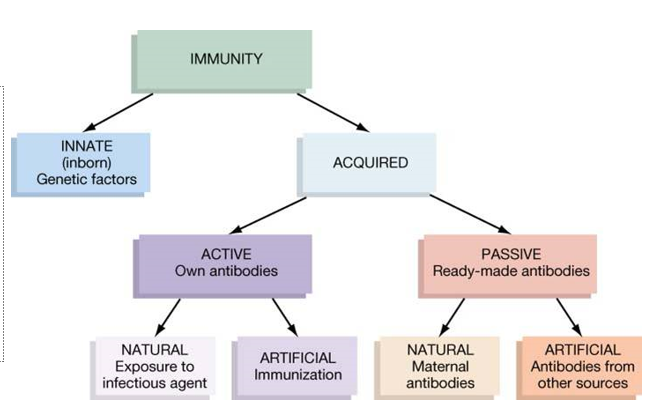
Passive immunity can be acquired as antibodies gained through the placenta, or antibody serum injections; active immunity can be acquired through natural exposure to the pathogen, or the use of vaccines.
Immunity: Immunity is resistance to infection by invading micro-organisms. Immunity to communicable disease depends on the presence of antibodies and memory cells. Immunity can be natural or artificial, passive or active.
Types of Immunity
Natural: occurs without human intervention
Artificial: results from giving people an antigen or an antibody (human intervention)
Passive: occurs when a person is given antibodies produced elsewhere
Active: results from exposure to the antigen causing the individual to produce its own antibodies.
Immunisation/Vaccination: The artificial introduction of antigens into the body so that the organism develops the ability to produce the appropriate antibodies and memory cells without having to suffer the disease.
Vaccine: The antigen preparation (attenuated antigen) used in immunisation
Primary antibody response: the antibody concentration rises gradually and peaks about 2 weeks after vaccination
Secondary antibody response: the antibody concentration rises quickly, and the response is more intense. The antibody concentration remains higher for longer.
Vaccinations are given as:
Injections
Orally
Nostril Sprays
Skin Patches
(Genetically Engineered Plants)
Types of Vaccines:
Live Attenuated
Created from: a micro-organism that has a reduced virulence (the disease-producing power of a micro-organism)
Mode of Action: The immunised person manufactures antibodies against the antigen
Example: polio, tuberculosis, rubella (German measles), measles, mumps and yellow fever
Inactivated (Dead micro-organisms)
Created from: dead micro-organisms
Example: cholera, typhoid and whooping cough
Toxoid
Created from: a pathogenic organism that has been altered so that it is no longer toxic
Example: diphtheria and tetanus
Subunit
Created from: a fragment of the organism
Mode of Action: provokes the immune response
Example: Hepatitis B and Gardasil (human papilloma virus)
Governments encourage and promote vaccination programmes. Widespread programmes protect vulnerable people and increase immunity of large population.
Herd Immunity = High proportion of population is immune to disease
Effective vaccination programmes mean that the incidence of the disease decreases. People often become complacent about diseases that they don’t see. Results in failure to vaccinate and loss of herd immunity.
Risks to Vaccination
Allergic reactions, usually to medium in which attenuated antigen is carried
Introduction of cross-species contamination
Dangerous chemicals used in manufacture
Ethical Concerns
Mainly centre on how the vaccine was manufactured, tested on animals, and its risk to health (negative side effects)
Cost of vaccines may not be affordable
Encourage vaccinated teenagers to be sexually active
Interests of commercial enterprise that manufacture the vaccine can affect its use
Right of the parent to vaccinate
Some religions oppose immunisations
Hygiene Hypothesis
Says that a child’s environment can be too clean and the lack of exposure to germs does not give the immune system a chance to develop resistance to diseases.
Affects immunity by less exposure to bacteria and viruses, no immune responses to pathogens have been triggered, decrease immunity for wide range of infections/no natural immunity/no memory cells present, increased chance of being infected and over-production of histamine leads to allergies
Antibiotics: Used to fight infections of micro-organisms (usually bacteria). Antibiotics work by blocking translation during protein synthesis of bacteria. Can work on a wide range of bacteria or on specific types. They are not effective against viruses.
Antibiotic Resistance: Researchers suggest that overuse of antibiotics in the community has caused the evolution of generations of multiple drug resistant bacteria.
Types of Antibodies
Bactericidal: Kills bacteria
Mode of Action: Changing or damaging the structure of their cell wall, allowing their contents to leak out
Bacteriostatic: Stops bacteria from reproducing
Mode of Action: blocks protein synthesis
Antivirals: Drugs which inhibit the action of viral pathogens. Can also enhance the body’s immune system to attack the virus.
Mode of Action: Target viral specific proteins and disable them or work by inhibiting the life cycle of the virus