5.2 Calorimetry
Heat Capacity
- Specific heat capacity (c): the quantity of thermal energy required to raise the temperature of 1g of a substance by 1 degrees Celsius.
- SI unit: J/(g*C)
Heat
- Thermal energy of a system is measured by the heat transferred to or from its surrounding as heat (q).
- We can measure the change in thermal energy indirectly by measuring the temperature change of the surroundings (a direct measure of the kinetic motion of the molecules).
Calorimetry
- <<Process of measuring energy changes during a physical or chemical change.<<
- Calorimeter: device used to measure thermal energy changes in a physical or chemical change. Designed to mimic an isolated system.
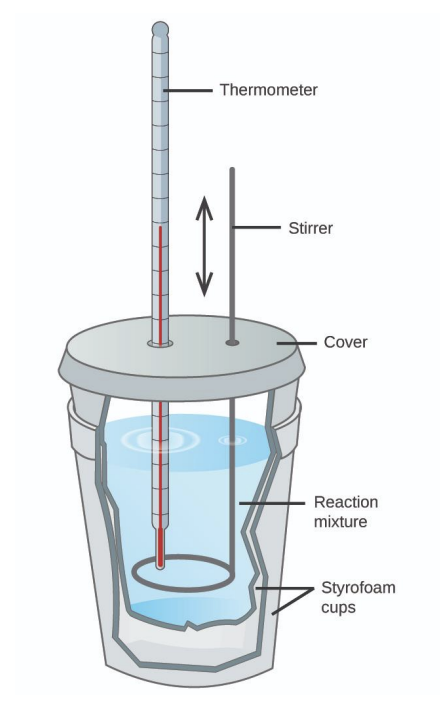
The 3 Assumptions of Calorimetric Calculations
- often sources of error in lab
- inflated/underreported
- Any thermal energy lost to the outside is negligible.
- Any energy absorbed by the calorimeter is negligible.
- All dilute solutions have the same density of water (1.0g/mL) and the same heat capacity as water (4.18 J/(g*C))
Calculating Heat Flow (q)
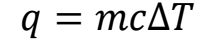
- Where,
- m = mass of the substance (mass of the water)
- c = specific heat capacity of the substance (heat capacity of the water)
- ΔT = temperature change experienced by the substance (temp of the water)
- ∆T = Tfinal − Tinitial
q has to parts
- Magnitude: the size of q, tells you how much energy is transferred
- Direction: the sing of q, tells you if energy is. absorbed (+) or released (-)
- In a system:
- If q is negative, the reaction is exothermic.
- If q is positive, the reaction is endothermic.
- In surroundings:
- If q is negative, the reaction is endothermic.
- If q is positive, the reaction exothermic.
Example
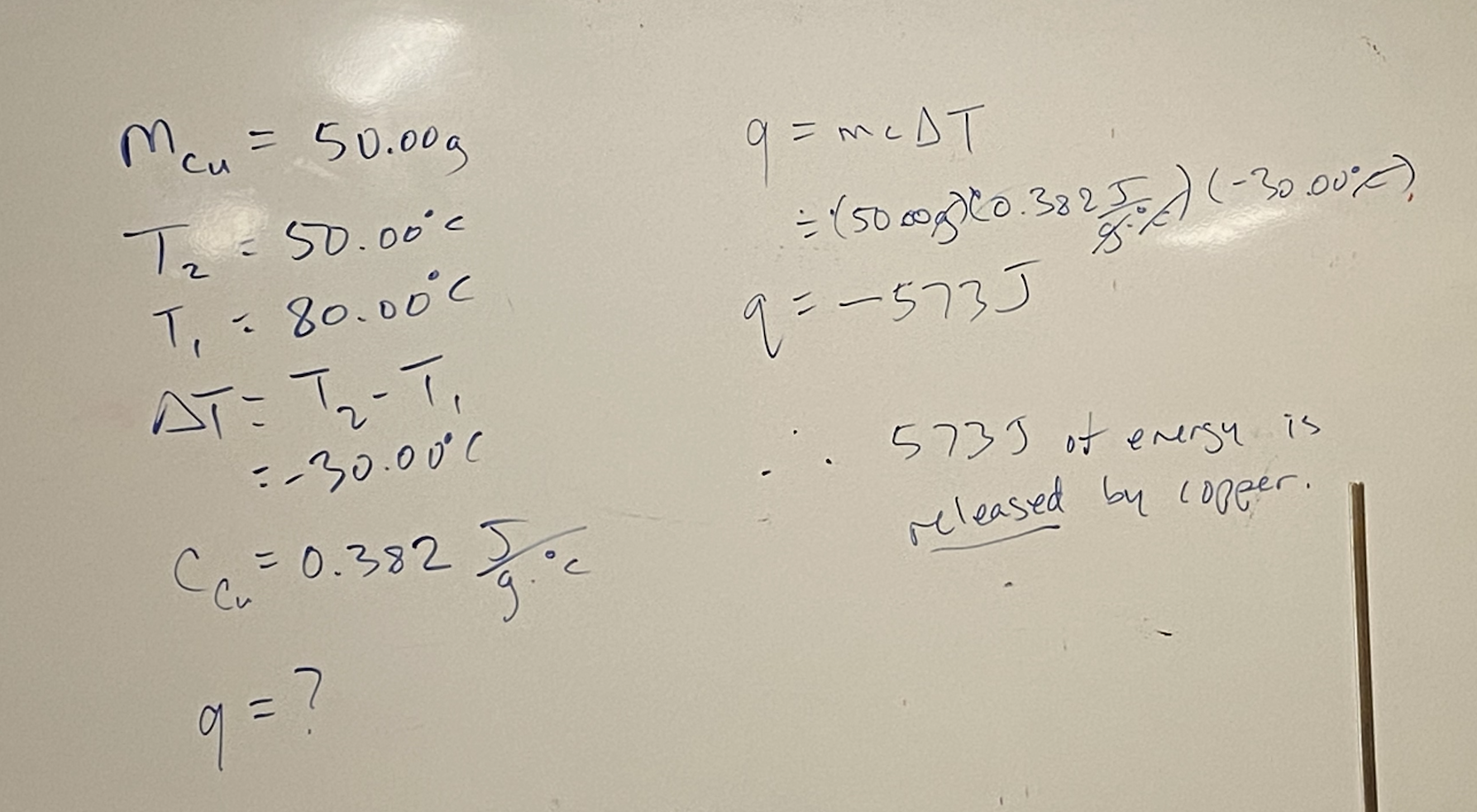
- How much heat is given off by a 50.00 g sample of copper when it cools from 80.00oC to 50.00oC. The specific heat of copper is 0.382 J/goC.