English
Information Disorder
Definition: Any disruption or corruption of information, characterized by the spread of harmful or misleading content.
Part 1: Descriptions
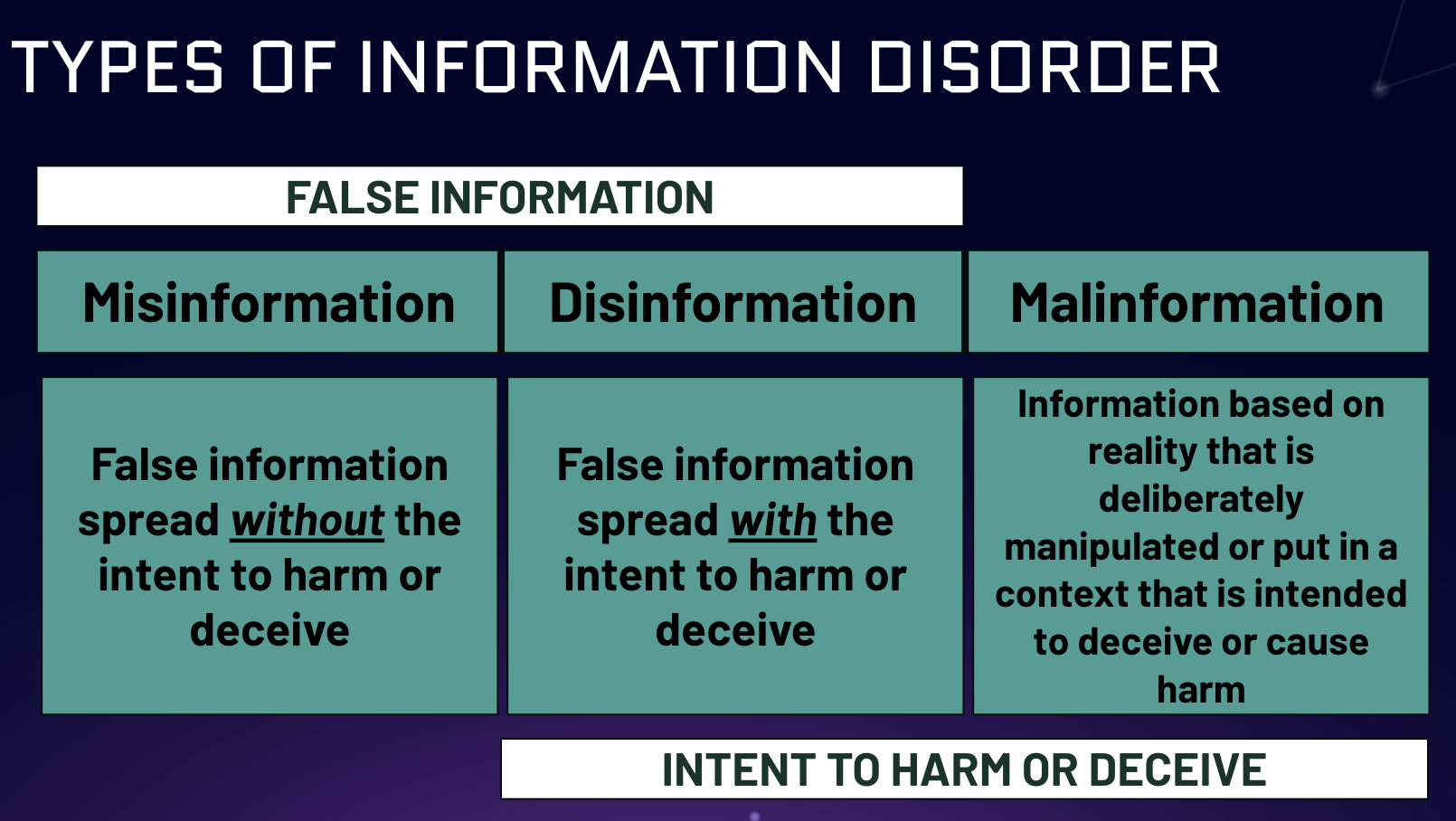
Types of Information Disorder
Misinformation: False information; no intention to harm/deceive
Disinformation: False information, with the intent to harm/deceive
Malinformation: Information that is intentionally altered (includes context) with the intent to harm/deceive.
Examples of Information Disorder:
Misinformation:
Sharing a wrong fact by accident.
Misinterpreting a statistic and spreading it.
A badly translated statement that changes the meaning unintentionally
Disinformation:
Deepfake videos created to ruin someone’s reputation.
Fake news made to influence an election.
Propaganda that deliberately lies.
Wicked: The Wizard and Madame Morrible deliberately spread false information about Elphaba.
Malinformation:
Releasing someone's private emails to ruin their career.
Using true statements in a way that portrays someone falsely.
Revealing someone’s personal address online (doxxing).
To Remember Easily:
Misinformation = Mistake
Disinformation = Deception
Malinformation = Malice with truth
Part 2: Identification Scenarios
When seeing a scenario, ask:
Is the info true or false?
Is there intent to harm/deceive?
Is true info being used as a weapon or out of context?
Use this formula: This example is [misinformation / disinformation / malinformation] because the information is [true/false], the person/group [does/does not] intend to harm or deceive, and [explain if it’s taken out of context or used as a weapon].
Scenario Examples:
(1). A woman shares a post on Instagram that says:
“Drinking hot lemon water cures COVID in 24 hours. Doctors don’t want you to know this!” She truly believes it works and wants to “help people,” but the claim is not supported by science.
This is misinformation because the information is false, but the person does not intend to harm anyone. She believes the claim is true and wants to help, so so there is no deliberate attempt to deceive. The problem is accuracy, not malicious intent.
(2). A political group creates fake news articles that claim their opponent is part of a criminal organization. They know this is not true, but they publish the lies anyway to make people hate the opponent and lose trust in them.
This is disinformation because the information is false and is created on purpose to deceive and damage the opponent’s reputation. The group clearly has an intent to harm by spreading lies, and the information is used strategically as a political weapon.
(3). A hacker leaks a politician’s private emails that reveal true but personal information about their family and health. The hacker posts them online right before an election to ruin the candidate’s chances.
This is malinformation because the information is true, but it is weaponized to harm the politician. There is a clear intent to damage their reputation by exposing private details that were not meant for the public.
(4). A student shares an old photo of a protest from 2010 but labels it:
“Look what happened in our city today! Things are out of control!”
The student thinks the image is current and doesn’t realize it’s from years ago.
This is misinformation because while the image is real, it is used with wrong context, and the student does not intend to deceive. The problem is that the info is inaccurate in time, but not shared with malicious purpose.
(5). A gossip website publishes a story that a celebrity cheated on their partner. It turns out to be true, and the site releases it in a way that humiliates the celebrity and destroys their public image.
This is malinformation because the story is true, but it is shared in a way that intentionally harms the celebrity. The truth is used as a tool to damage their reputation and create public scandal.
(6). A teenager shares a TikTok claiming that a certain vaccine is “full of poison” and will “shorten your life span.” The original video was made by someone who knows it’s false, but the teenager truly believes it.
The original creator: Disinformation
For the teen who believes it: Misinformation
Part 3: Real World Connections
Be able to explain in at least 8 sentences:
Example: “Information disorder has an impact on the public discourse because it creates confusion and increases polarization, as people start arguing based on different 'facts' and stop trusting those who disagree with them. In democratic processes, it can influence who people vote for, shaping opinions about candidates or policies based on lies or half-truths. This can create unfair elections by making them less fair and less informed. At a national and global event scale, it can affect decision-making towards real global issues such as climate change, public health, or war, which leads politicians, governments, and citizens to support harmful or ineffective actions. Moreover, it weakens institutions and the media, as people, when they see repeated lies, begin to believe that no source is reliable, leading to a lack of trust.
Misinformation and disinformation spread quickly through social media, where emotional and shocking content is shared more often than careful, accurate reporting. Algorithms on platforms like TikTok, Instagram, or YouTube tend to boost content that gets high engagement, even if it is misleading, which helps false or harmful information go viral. In the larger news ecosystem, some sites or channels may chase clicks and attention, sharing sensational content without fully checking its accuracy. Real-world examples include conspiracy theories about vaccines, misleading claims about election fraud, or manipulated videos of protests; these cases show how information disorder can move from online spaces into real life, influencing behavior, protests, and even violence.”
Information Inequality
Definition: Disparities in access to and distribution of information among individuals, organizations, and governments
Part 1: Matching
Five types of information inequality:
The digital divide: The gap between people who have access to digital technology and those who don’t.
Disinformation divides: The divides created by communities of indigenous people, people of color, and foreign language speakers being disproportionally targeted by political and health related disinformation.
Public Discourse divide: Marginalized groups (indigenous peoples, POC, etc) are less able to participate in the public discourse, assert their beliefs, and share their perspectives because of limited access to information.
News Production Divides: News content produces tailor information to appeal to predominantly white and affluent consumers.
Biasses in Algorithmic and AI Systems: Gaps and biases in algorithmic systems that reinforce existing institutional biases.
USE THE ACRONYM: D-D-P-N-A (“Digital Divides Produce News + Algorithms”)
Digital divide: who has devices + internet and who doesn’t.
Disinformation divides: marginalized groups get hit with more harmful disinfo.
Public discourse divide: marginalized groups can’t participate equally.
News production divide: news made for white, affluent audiences.
Algorithmic bias divide: AI systems repeat and amplify inequalities.
Flight Behavior
Part 1: Descriptions
Novel themes:
Chapter 1: Longing, motherhood, self-discovery, and the impact of the natural world.
Chapter 2: Transformation and Awakening
The entire passage centers on Dellarobia’s internal transformation. She moves from frustration, confinement, and emotional stagnation → toward a moment of clarity and awakening when she sees the butterflies. The butterflies symbolize renewal, possibility, and a break from the life that limits her. Her emotional shift becomes the chapter’s central thematic thread.
Chapter 3: Belonging, identity, connection, motherhood, marriage
Chapter 4:
Miracles and Consequences: The chapter highlights the juxtaposition between the wonder of the butterflies and the distress of those who have lost their homes. This theme suggests that beauty can emerge amidst tragedy and highlights the interconnectedness of lives impacted by environmental issues.
Identity and Reputation: Dellarobia’s struggle with her emerging identity as “Our Lady of the Butterflies” symbolizes the tension between personal narrative and public perception, revealing her discomfort with being thrust into the spotlight.
Family Dynamics: The various relationships depicted in the chapter expose the intricate ties that bind family members, with tension and warmth coexisting within the household.
Chapter 5: Awakening as she encounters new possibilities through Ovid Byron. He opens her eyes to knowledge, identity, and a world beyond her limited circumstances, symbolized by the monarch butterflies. This meeting intensifies her internal conflict between domestic duty and her longing for personal transformation.
Chapter 6: Environmental Change, domesticity, and self-discovery, illustrating Dellarobia’s journey towards agency and connection with the world, as she confronts the choices that shape her future.
Chapter 7: the tension between financial pressure and personal values, highlighting Dellarobia’s growing environmental awareness and desire for change as it clashes with the economic hardships, family expectations, and consumer-driven traditions that constrain her.
Symbols:
Monarch Butterflies: Transformation, awakening. and disruption
Dellarobia’s Boots: guilt and her complicated relationship with faith
The mountain: Stability vs. Exploitation - becomes a battleground for Dellarobia’s conscience as she struggles between family loyalty and ecological responsibility.
Fire/wildfire: In Chapter 1, Dellarobia’s vision of fire symbolizes her internal turmoil and the moment her life is jolted awake.
The Orange VW Beetle: New Possibilities and Outsider Perspective. Ovid Byron’s bright orange car symbolizes the arrival of the unfamiliar, the intellectual, and the global. It stands out in Dellarobia’s rural world, just as Ovid himself does.
Christmas Shopping: Consumerism and Emotional Strain. The stressful shopping trip symbolizes the pressures of poverty and the expectations of normalcy that weigh on Dellarobia.
Preston and Cordie: Responsibility, Legacy, and Fear of Repetition. Dellarobia’s children symbolize her fear of repeating cycles of hardship across generations.
Dellarobia’s Internal Conflicts:
Desire for change vs. feeling trapped
She yearns for a different, more meaningful life but feels confined by marriage, motherhood, and rural expectations.Intellectual curiosity vs. lack of opportunity
She feels intelligent and hungry for knowledge, yet her environment gives her no space to grow.Duty to family vs. desire for personal freedom
She loves her children, but the responsibilities and limitations of domestic life overwhelm her.Loyalty to her community vs. disagreement with its beliefs
She struggles with the community’s rigid religion, judgment, and refusal to question traditions.Emotional dissatisfaction vs. obligation to her marriage
Her marriage to Cub lacks passion and equality, causing resentment and isolation, but she feels guilty about wanting more.Environmental awareness vs. economic pressure
She recognizes the importance of protecting the land, yet her family relies on decisions (like logging) that harm the environment.Hope for transformation vs. fear of consequences
The butterflies awaken her sense of possibility, but she fears the changes that might follow and how they could disrupt her family.
The Turnbows’ Financial, Social, and Ideological Pressures
The Turnbows face constant financial strain, relying on unstable work and fearing the loss of their land. Socially, they feel trapped by community expectations, family judgment, and the pressure to conform to rural traditions. Ideologically, they are shaped by conservative values, skepticism of change, and a belief system that often clashes with Dellarobia’s growing awareness of environmental and scientific issues.
The Community’s Relationship to Science
The community views science with suspicion and discomfort, often dismissing scientific explanations in favor of familiar beliefs. Scientific outsiders like Ovid Byron challenge their worldview, which makes some residents defensive and unwilling to accept evidence that disrupts their sense of stability.
The Community’s Relationship to Religion
Religion provides moral structure and social identity, but it is often used to justify judgment, maintain hierarchy, and explain events in simplistic terms. Hester and others see blessings or misfortunes as signs from God, which reinforces a worldview that discourages questioning and resists evidence-based reasoning.
The Community’s Relationship to Outsiders
Outsiders are viewed with distrust and curiosity. People like Ovid Byron represent unfamiliar ideas, education, and social class, making the community wary of their intentions. Outsiders disrupt the community’s sense of control and highlight cultural and intellectual gaps.
Ovid Bryon’s Significance as a Character
Ovid Byron symbolizes knowledge, scientific truth, and the wider world beyond the rural community. He awakens Dellarobia’s intellectual curiosity, challenges the community’s narrow assumptions, and serves as a bridge between personal struggle and global environmental crisis. His presence pushes Dellarobia to question her life and recognize her own potential.
Major Themes
Climate Change:
The monarch butterflies’ displacement symbolizes ecological disruption and humanity’s impact on the planet, revealing how global issues reach even isolated communities.
Poverty:
Financial hardship shapes nearly every decision the Turnbows make, limiting their choices and reinforcing cycles of dependence and resignation.
Class Differences:
The contrast between rural families and educated outsiders highlights disparities in power, opportunity, worldview, and access to knowledge.
Education vs. Tradition:
Dellarobia’s awakening through science conflicts with her community’s reliance on tradition, showing the tension between learning and cultural resistance.
Moral Choice vs. Survival:
Characters often face choices between protecting the environment or protecting their income, revealing how economic insecurity can override ethical or ecological concerns.
Part 2: Written Responses
Information Inequality in Flight Behavior (Ch. 1–7)
Type of information inequality: Education Gap / Access to Knowledge Divide
Where it appears in the novel
From the moment Dellarobia discovers the monarch butterflies, it becomes clear that she and her rural community lack accurate scientific information and have limited access to education. Chapters 5–7 especially highlight this gap when Dellarobia meets Ovid Byron and realizes how little the community understands about climate change, biology, or the significance of the butterflies’ arrival.
Which Characters experience it
Dellarobia experiences it most strongly—she is intelligent and curious but has been denied educational opportunities and exposed only to local beliefs.
Cub also suffers from limited access to knowledge, relying on family tradition rather than scientific understanding.
Hester and the Turnbow family represent the older generation, who depend on religion and community rumor instead of verified information.
The broader community (neighbors, church members, local farmers) share the same educational limitations and mistrust of outsiders.
How it influences choices, misunderstanding, and access to knowledge
Dellarobia misinterprets the butterflies at first as a personal sign or miracle because she lacks the scientific context to understand their displacement.
The community misunderstands the butterflies as a religious event rather than an ecological crisis, shaping how they talk about and respond to the discovery.
Hester and others resist Ovid Byron’s scientific explanations because unfamiliar knowledge feels threatening to their worldview.
Dellarobia’s limited education restricts her choices, keeping her tied to farm labor, financial dependence, and traditional expectations.
Meanwhile, Ovid’s scientific literacy gives him power, authority, and clarity—highlighting the deep divide between those with knowledge and those without.
This inequality shapes Dellarobia’s internal awakening; she begins to realize how much of her life has been defined by what she never had the chance to learn.
Community and Social Influence: FB + “Very Old Man With Enormous Wings”
In both texts, communities react with suspicion, judgment, and superstition when faced with something unfamiliar. In Flight Behavior, the rural community relies on tradition and religion to explain the butterflies, while in García Márquez’s story, the townspeople project fear and curiosity onto the old man with wings. Societal norms shape behavior by encouraging conformity, shaping beliefs through rumor and tradition, and reinforcing morality based on what is familiar rather than what is true. Both communities mistreat outsiders—Dellarobia for questioning norms, and the angelic old man for not fitting expectations. The main contrast is tone: Flight Behavior critiques misinformation and poverty in a realistic setting, while Márquez uses magical realism to show how humans exploit or misunderstand the extraordinary.
Ovid Byron’s Role for Dellarobia
Ovid symbolizes intellectual possibility, curiosity, and a life beyond the limits of Feathertown. He challenges Dellarobia’s worldview by giving her scientific explanations that contradict local beliefs and by treating her intelligence with respect. He represents access to knowledge she never received, the possibility of a different future, and a sense of self-worth that her community rarely grants her. Through Ovid, Dellarobia glimpses a broader world where she can imagine becoming more than her circumstances.