orgo ch. 7
•Be able to identify nucleophiles, electrophiles, and leaving groups.
nucleophiles: species with a high electron density that can donate electrons to form a bond with electrophiles
electrophiles: species that are electron-deficient and can accept electrons to form a bond with nucleophiles
ex: alkyl halides; susceptible to nucleophilic attack
leaving groups: atoms or groups that can depart from the parent molecule during a reaction, facilitating the process of nucleophilic substitution or elimination
ex: halides
good leaving groups: conjugate bases of strong acids (conjugate base of an acid with pKa > 0)

•Be able to identify α and β carbons.
alpha carbons: the carbon atom connected directly to the halogen
beta carbons: the carbon atoms connected to the alpha carbon

•Know the difference between a 1°, 2° and 3° alkyl halides

•Know the mechanisms of SN1, SN2, E1 and E2 reactions
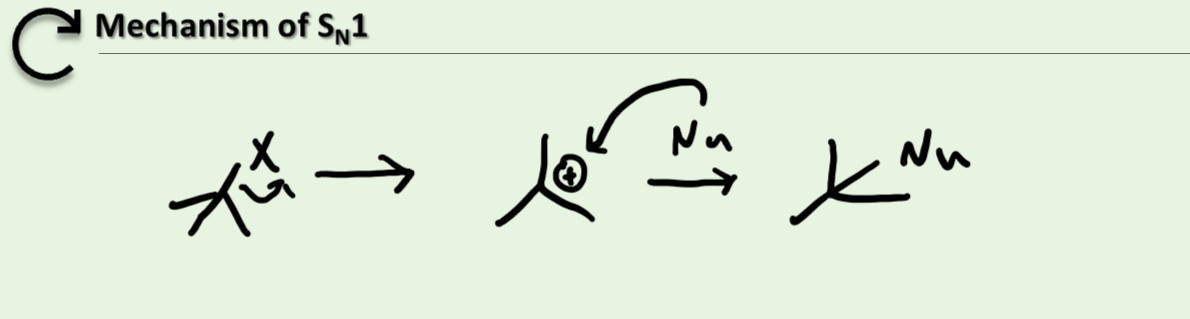
SN1: loss of leaving group, followed by nucleophilic attack —> form carbocation intermediate (neutral nucleophile) —> rearrangements are possible
highest energy transition state: formation of carbocation intermediate —> carbocation is rate-determining step
SN2: alkyl halide reacts with nucleophile —> loss of leaving group and nucleophilic attack occur in one step at the same time (concerted & bimolecular)
no intermediate; only a transition state where the new bond to the nucleophile is partially formed and the bond to the leaving group is partially broken
second order reaction kinetics— product formation depends on the concentration of both the nucleophile and the alkyl halide
stereospecific: the configuration of the product is directly related to the configuration of the starting alkyl halide, resulting in an inversion of stereochemistry in SN2 reactions (reagents with R configuration generally become S, vice versa)
inversion occurs due to a back-side attack: nucleophile attacks other side of carbon than where the leaving group is located —> R groups flip over, transition state where R groups and alpha carbon are in same plane (trigonal planar)
less sterically hindered electrophiles have a faster reaction rate under SN2 conditions
tertiary halides cannot react via SN2 mechanism; too sterically hindered

stronger nucleophiles react faster

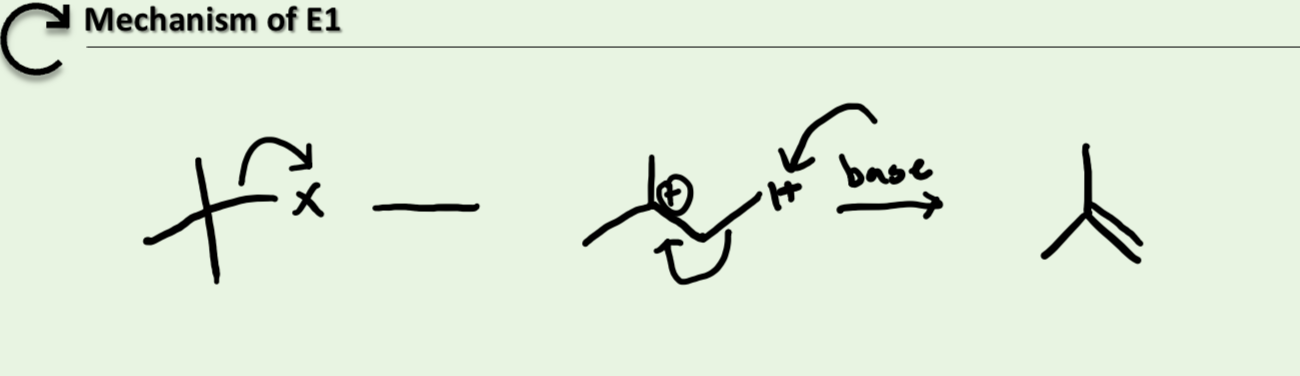
E1: loss of leaving group, followed by deprotonation of a beta proton —> form carbocation
rate-determining step: carbocation formation
will always give the most stable alkene as the major product: more substituted (Zaitsev product); if E/Z isomers are possible the least sterically hindered
regioselective and stereoselective (not regiospecific or stereospecific)
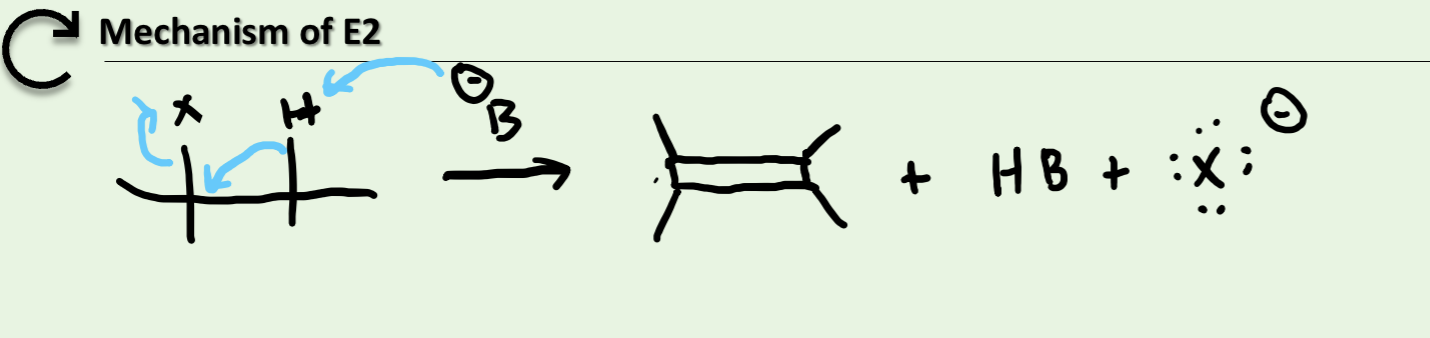
E2: alkyl halide reacts with Bronsted base —> abstraction of H on the beta carbon, loss of leaving group, and formation of a double bond at the same time (concerted); beta-elimination, dehydrohalogenation
bimolecular, second order reaction kinetics
no intermediate; only a transition state —> beta-hydrogen and leaving group should be in an anti-periplanar conformation (opposite sides; almost coplanar)
unimolecular reactions: SN1 & E1
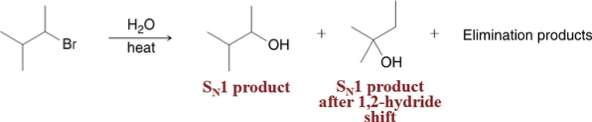
carbocation intermediate may rearrange from 1,2-hydride or 1,2-methide shifts —> form more stable carbocation
effects of substrate:
the nature of the leaving group: better leaving group = better reaction
the nature of the intermediate carbocation: reaction is better when the carbocation formed is more stable
tertiary carbocations/resonance stabilized cations readily undergo these reactions
primary/secondary carbocations are rarely formed, unless they can be re-arranged to a more stable one
carbocations on a sp2 carbon are not stable —> will not form

•Know the regio- and stereo-chemistry of SN1, SN2, E1 and E2 reactions, and how to apply it
regioselectivity: occurs when constitutional isomers are formed as the products of a reaction, with one as the major product
E2 reactions: regioselectivity can be controlled by carefully choosing the strong base used
under thermodynamic control: most stable alkene is formed (‘Zaitsev' product)
more substituted alkenes (more substituents) = more stable; hyperconjugation —> partial delocalization
under kinetic control: least substituted alkene is formed (‘Hofmann’ product)
sterically hindered base; reacts more quickly with the least sterically hindered proton of the alkyl halide
ex: sterically hindered bases

stereochemistry/stereoselectivity:
E2 reactions:
only 1 beta-hydrogen: reaction is stereospecific; only one possible anti-periplanar conformation, determines the stereochemistry of the alkene (only one possible isomer)
multiple beta-hydrogens: two possible anti-periplanar conformations = two possible stereomeric outcomes
reaction generally under thermodynamic control —> most stable alkene formed
trans alkenes are generally more stable than cis due to steric clash in cis conformation
cyclic structures: trans isomer not possible in rings with <7 atoms; possible but not stable in cycloheptanes; more stable for rings >8 atoms
SN1 reactions:
carbocations are planar; chirality is lost upon carbocation formation —> nucleophilic attack can occur on either side of carbocation —> form racemic mixture of compounds
inversion product is typically observed more; leaving group forms ion-pair with carbocation, making it more difficult for the nucleophile to attack from the same side
•Be able to predict the products of a given reaction, and decide which ones are major and minor
determine the function of the reagent:
SN2 = strong nucleophile | E2 = strong base |
SN1 = weak nucleophile | E1 = weak base |
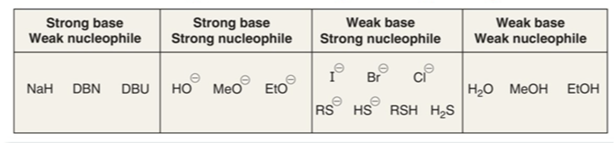
sterically hindered bases = generally weak nucleophiles
analyze the substrate and determine the expected mechanism(s):
primary, secondary, or tertiary?

consider the solvent:
protic or aprotic solvent? —> substitution reactions are very solvent dependent
SN2 reactions: faster in polar aprotic solvents (raise energy of nucleophile —> lower Ea)
protic solvents are detrimental; H bonds also stabilize nucleophile, making it less reactive
SN1 reactions: faster in polar protic solvents (stabilize carbocation intermediate —> lower Ea)
capable of H bonding/dipole interactions —> solvent can stabilize the carbocation and leaving group
fluoride: very strong nucleophile in an aprotic solvent, weak nucleophile in other solvents

consider regiochemical and stereochemical requirements:
draw all possible regio-/stereoisomers, then choose major product

•Be able to figure out the reagents to make a given product (retrosynthesis)
identify a bond in the target molecule that can be made using a known reaction
draw the substrates necessary for the reaction; may be multiple possiblities
verify that the reaction proposed is reasonable
draw the reaction in the forward direction; think of an approporiate solvent
•Know the difference between protic and aprotic solvents and how to affect substitution reactions
nomenclature: same rules as alkanes
common names:

