BIO349
Major themes and concepts
- Constant return to homeostasis
- Extracellular fluid: internal of body
- Outside of cell but in body
- Unicellular vs multicellular- ability to use cells for specific purposes (multi)
Boundary organ concept and homeostasis
- Feedback loops
- Positive and negative
- Feedforward mechanisms
- Anticipate change
WK Mechanics
- Concept packet
- Complete on your own to be prepared
- Application WK
- Work with group
- Available a week before due date
Cellular stuff
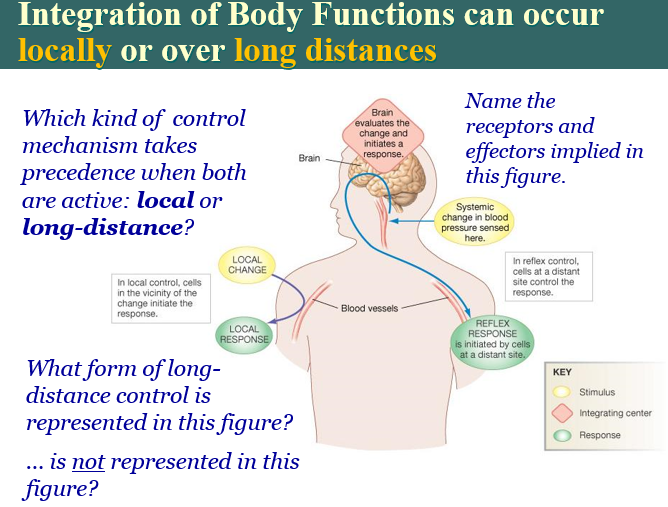
- Which kind of control mechanism takes precedence when both are active: local or long-distance
- Local to dilate, long-distance to vasoconstrict
- Local takes precedence over long-distance
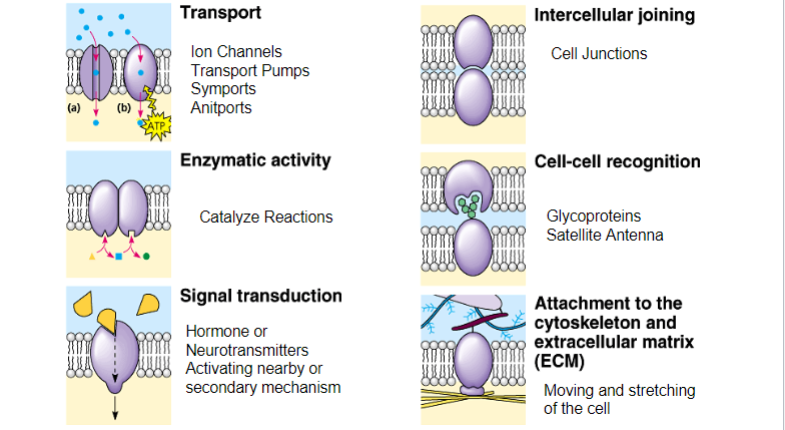
- Cell-cell: recognizes self and non-self
- Signal transduction: can be activated, secondary mechanism or an activator to continue
- Attachment: muscle cells prone to change shape
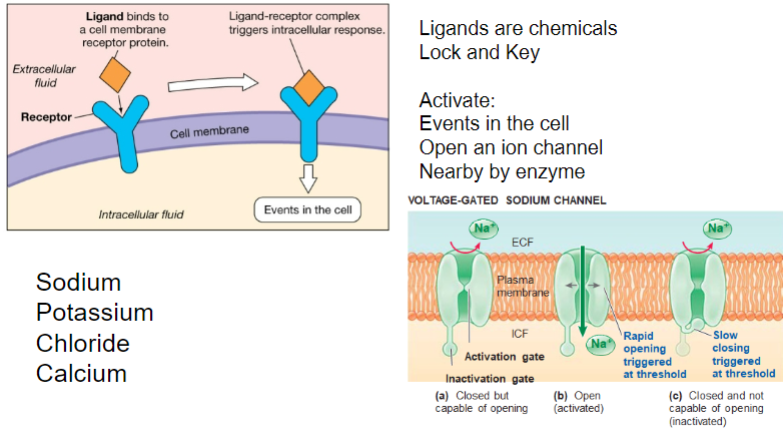
- When triggered, sodium will rush into cell (voltage gated channels)
- Potassium, chloride, and calcium also
- When triggered, sodium will rush into cell (voltage gated channels)
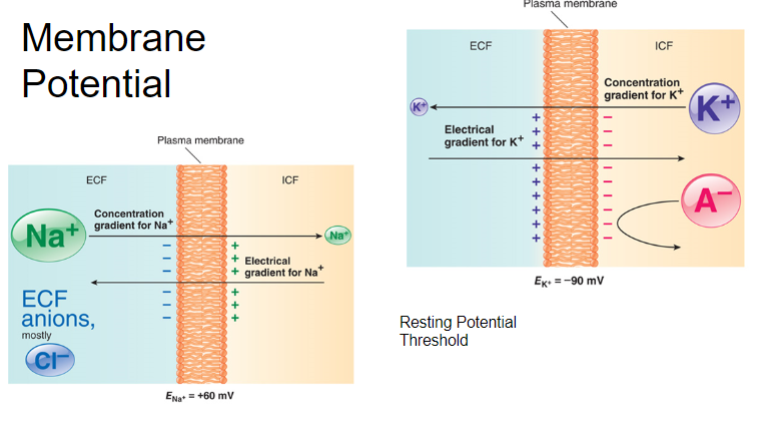
- Def: separation of opposite changes across membrane
Cell Membrane Function & Intercellular Communication
- Ficks law: info on diffusion through a singular membrane
- How molecules from areas of high concentration move to lower concentrations over time
- Transport
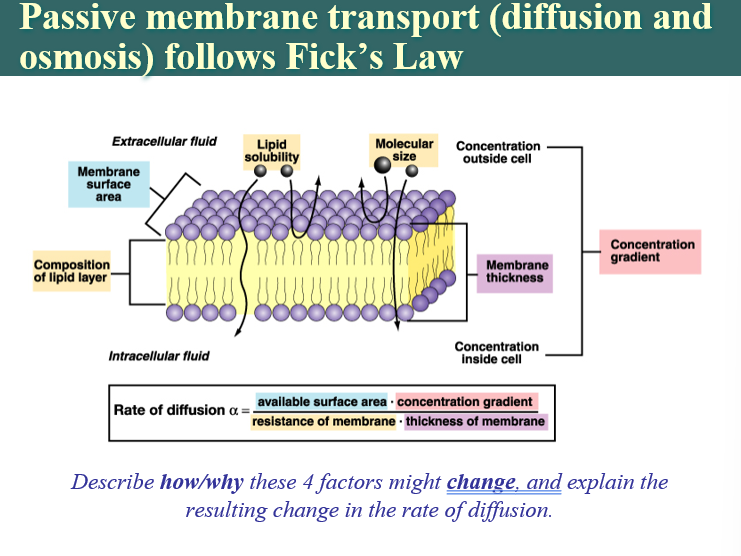
- Microvilli, conditions of membrane to increase surface area
- Resistance: solubility and size
- Thickness: doesn’t change self, other things can (mucus)
- Bigger the difference of concentrations, faster molecules move
- Surface area- larger area then more molecules can move through at once
- Thickness (thinner makes it easier for molecules to mvoe through)
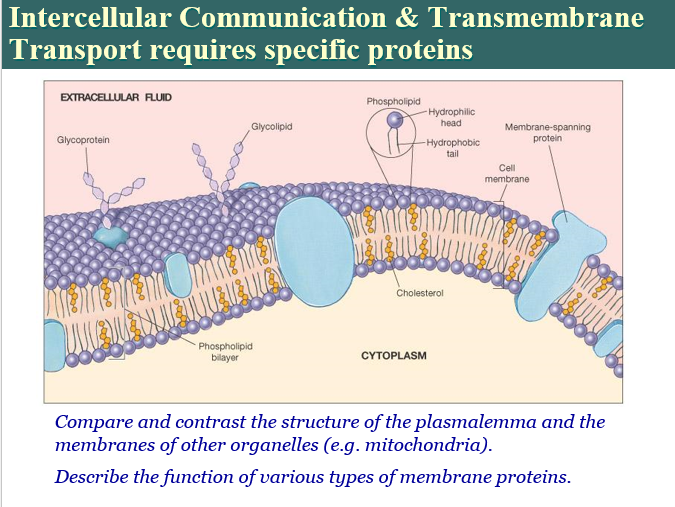
- Membrane proteins
- Transport
- Na/k pump
- Enzymatic activity
- Acetylcholinesterase
- Signal transduction
- Insulin receptors
- Intercellular joining
- Gap junctions, tight junctions, desmosomes
- Cell-cell recognition
- Blood group types, ABO
- Attachment to the cytoskeleton and extraceullular matric (ECM)
- Cadherins, intergins
- Transport
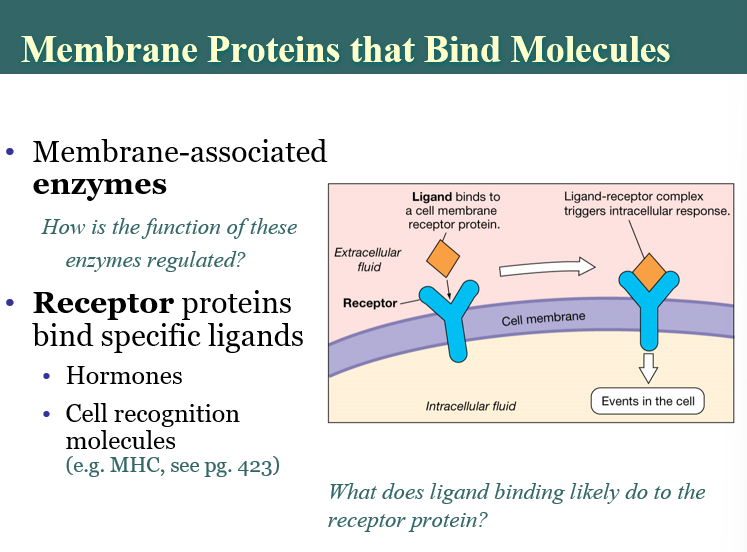
- CAM; major histocompatibility complex
- Through there interfacial surface, only take in molecules they were meant to take
- Creates a channel for ions to get through, can alter shape/properties and open lines of communication,
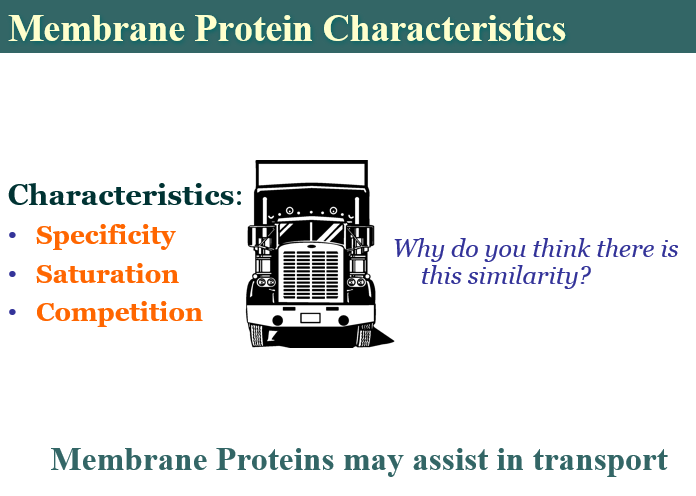
- Specific proteins
- More glucose than ligand, too saturated and can’t accept more
- 4 types of mediated transport
- Carrier- facilitated- channel
- Active transport- pumps
- Endocytosis
- Exocytosis
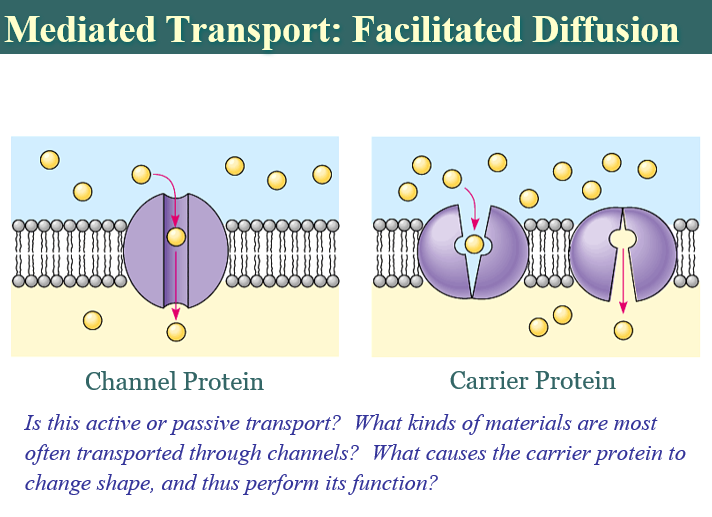
- Transport type: depends
- Carrier transport type: gradient would be passive, others may use ATP which would be active
- Ion channels are always passive, glucose symporter
- Carrier protein changes shape once it has binded to its specific protein to perform its function
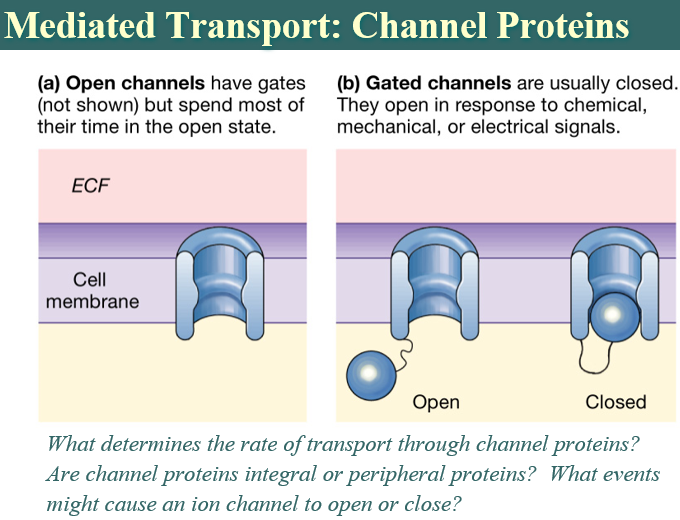
- Concentration gradient determines rate of transport
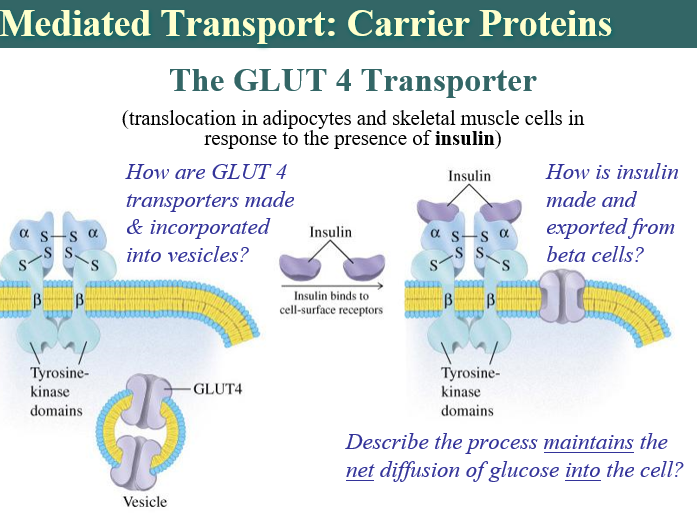
- Insulin dependent; only occurs at insulin binding receptors
- Skeletal muscle cells and adipocytes (found at)
- How are glut 4 transporters incorporated into the cell membrane: exocytosis
- Multiple carries to get through the plasma membrane
- Insulin made from beta cells in pancreas; endocrine function-released directly into blood. Secreted in response to elevated glucose level
- Facilitated diffusion for glucose; carrier protein at membrane binds to glucose and alters shape to make transfer easier, along gradient
- GLUT 1: blood brain barrier
- GLUT 2: kidneys to something
- GLUT 3: neurons
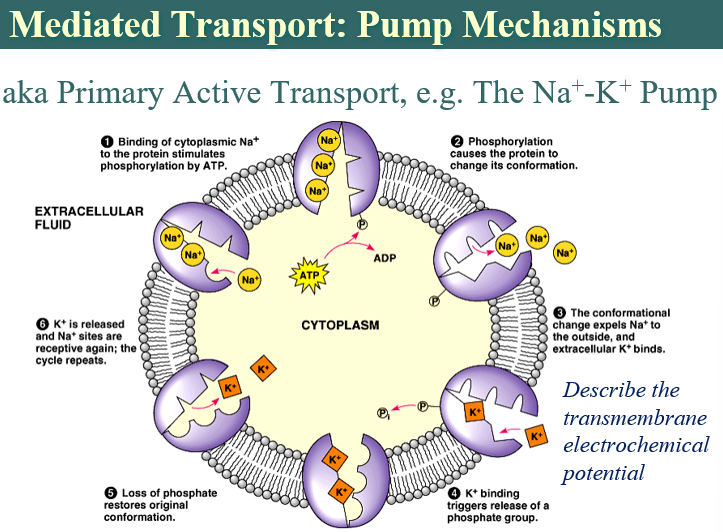
- Watch back lecture for what needs to be known*
- Charge and chemical concentration balance across a cell membrane
- Electrical potential: charge difference inside and outside of cell, negative outside creates the potential across the membrane
- Chemical: difference of ion or molecule concentration between the inside and outside of cell
- Together: energy gradient that affects how molecules move across cell membrane and impact processes like nerve signaling, contractions, nutrient transport
- Power activities while maintaining environment
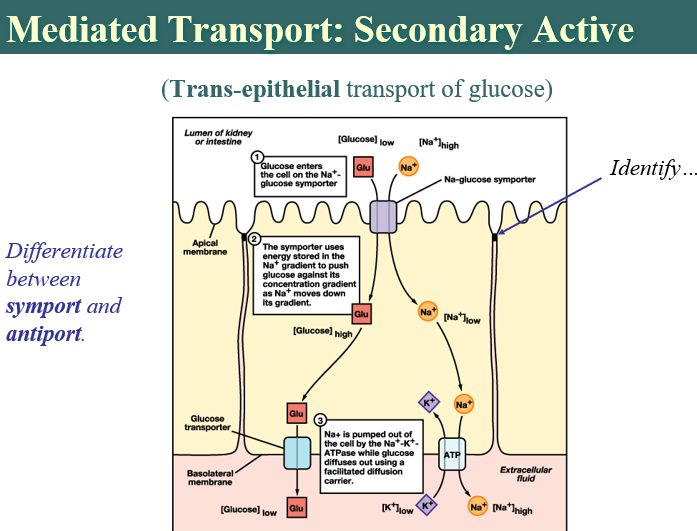
- Identify… tight junction; lining of cells; prevents inside and outside from leaking
- Move molecules across cell membrane
- Symport: two dif types of molecules or ions moves in same direction using energy from the movement of one molecule down its concentration gradient to power the movement of the other molecule; moving in same direction across membrane through a transport protein into cell or out of cell. Can be seen with sodium-glucose symporter which transports the ions into the cell lining of the intestine
- Antiport: molecules or ions transported across membrane in dif directions and movement of one powers the other. One moves out while the other moves in from a single transport. Sodium-potassium pump is an example that sodium comes out while potassium goes in
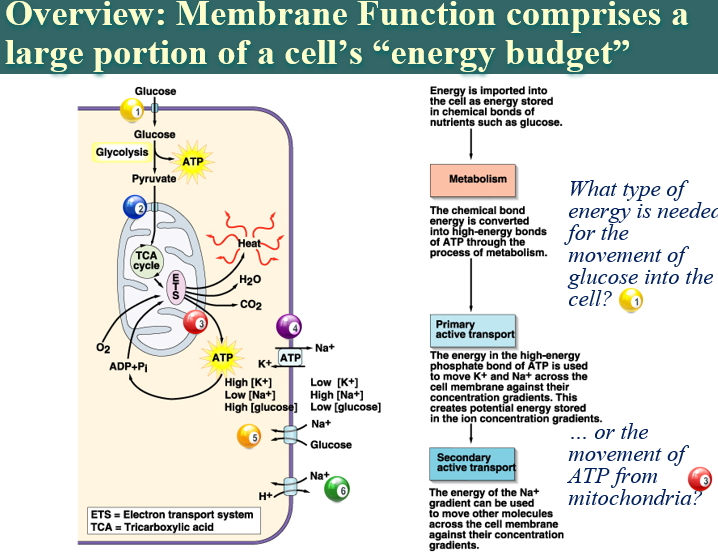
- What type of energy is needed for movement of glucose into the cell? Chemical potential energy
- Atp from mitochondria- facilitated
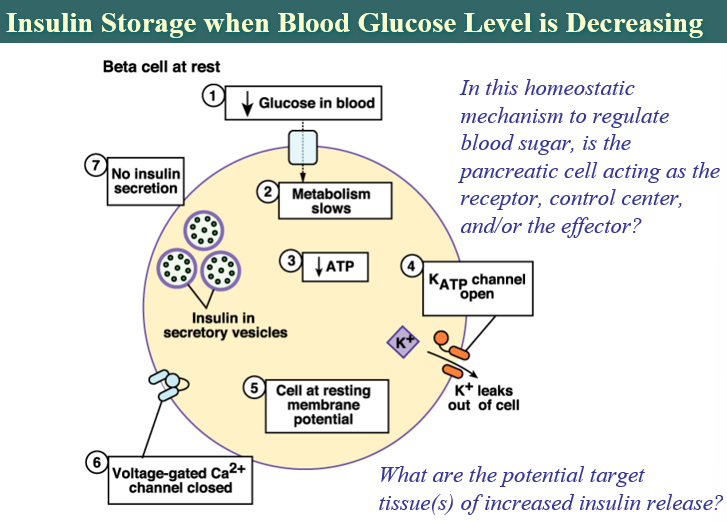
- Beta cell
- Glut 2 into beta cell passively
- Depolarizing cell to make more positive
- t/f glucose absorption into epithelial cells lining the intestine relies on normal function of Na-K pumps
- t/f rate of entry into adipose cells is discreetly proportional to the permeability of the plasma membrane
- t/f glucose absorption through the Na+-glucose symporter will increase indefinetly as glucose concentration increaes
- t/f glucose diffusion is often directly controlled by voltage-gated channels
4/11 Intercellular communication & Endocrine Function
-glucose entering beta cell: diffusion happens when gradient is kept then makes ATP
-tenicity: solute concentration in a solution and comparing to another
-osmolarity: diluteness of a solution based off addition of water
- Intercellular communication
- Direct communication
- Gap junctions
- Small molecules can pass between
- Contact dependent signals
- Cams (cell adhesion models)
- MHC (major histocompatibility)- cell recognizing self vs non-self
- Contact inhibition- can recognize each other after injury and healing that
- Gap junctions
- Indirect communication/contact
- Some sort of signal from point a to point b w/o direct contact with target cell (hormones, neurotransmitters)
- Short distance
- Autocrines
- Paracrines
- Long distance- into blood to be circulated through entire body
- Hormones
- Neurohormones
- *neurotransmitters can be argued either way
- Jaci: long distance
- Nervous signaling as whole is long distance
- Specific neurotransmitter is short distance cause its not that far outside cell
- Jaci: long distance
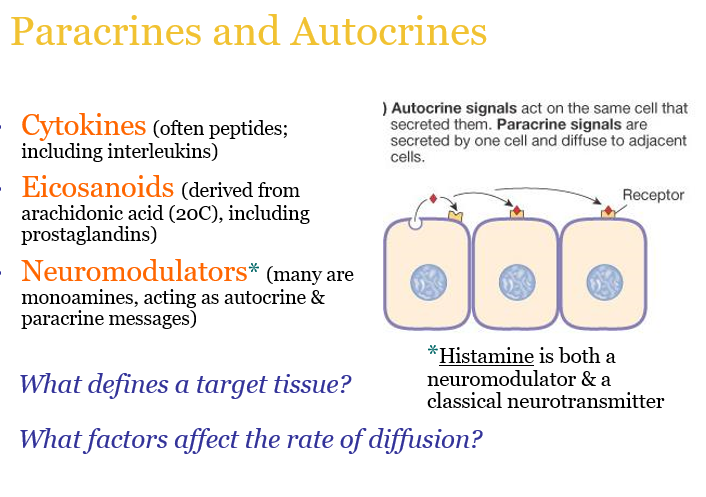
- Paracrine goes 1,2,maybe 3 cells away
- Hormone secreted into blood plasma (longer)
- Cytokines & eicosanoids are paracrines
- C- regulate immune function (ex. Macrophage release interlucins to helps with immune response to signal an outsider)
- E- lipid based: derived from arachidonic acid; prostaglandin
- N- autocrine or paracrine
- Direct communication
Momoamines
- Target tissue: review video
- Arachnoid acid:
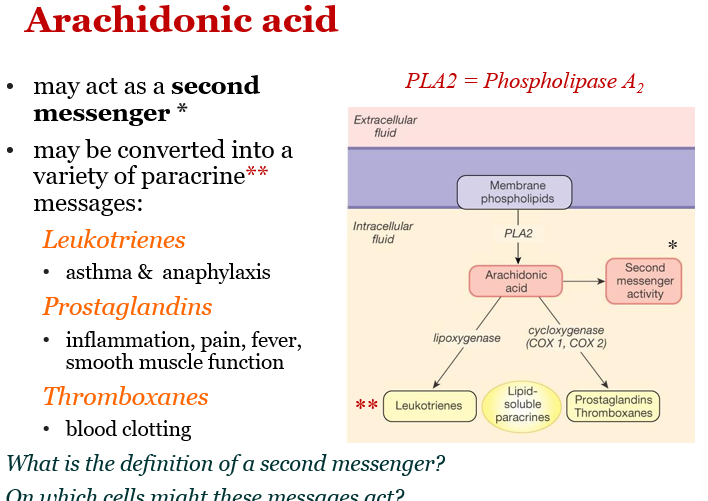
- Different pathways to be used as
- Leukotrienes
- Respiratory system
- Neurotransmitters
- Chemicals secreted by neurons that diffuse across a small gap to target cell. Neurons use electrical signals as well
- Travel short distance for long distance comm
- Long distance comm by NS is accomplished by conduction of action potentials
- Acetylcholine
- Norepinephrine
- Dopamine
- Serotonin
- Glutamate
- Gamma-aminobutyric acid (gaba)
- Glycine
- neurohormones**
- Neurosecretory cells send AP down the axon to release chemical message
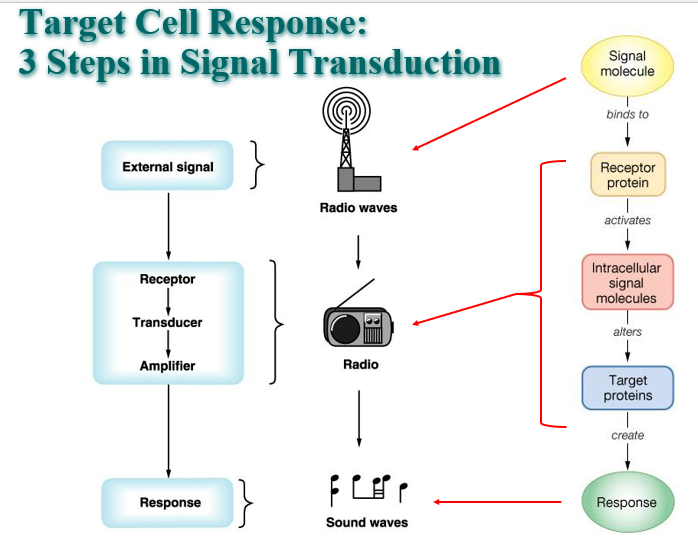
- Electrical signal to —---- receptor– transducer– amplifier—----- response
- Steps in signal transduction: target cell response
- Signal molecule binds to receptor protein activated intracellular signal molecules alters target proteins create response
- Metabolic response in cell or release of something into cell
- Reception-transduction-amplification
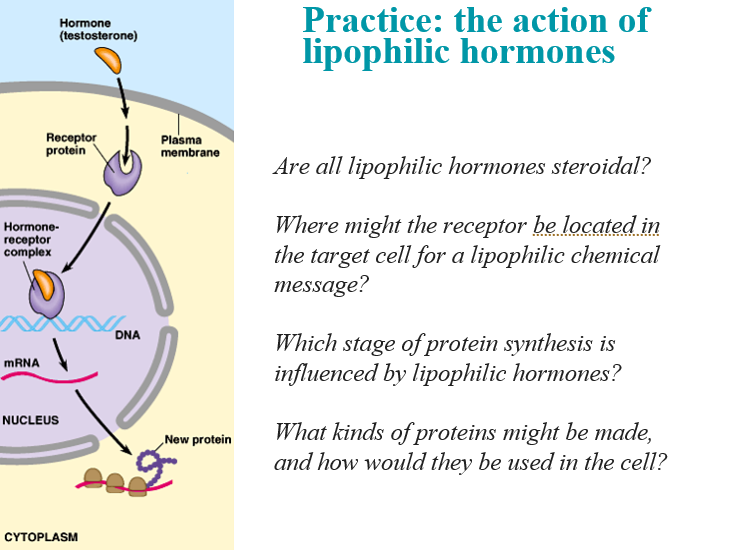
- Location for receptors: protein, nucleus
- Systolic or nuclear?
- Lipophilic message enters cell
- Often activates gene
- Slower response
- Cell membrane
- Lipophobic message cant enter cell
- Outer surface receptor
- Faster response
- 3 types of response when a signal binds to receptor
- open/close ion channel
- Receptor-enzyme comp
- G-protein complex
- practice/study questions
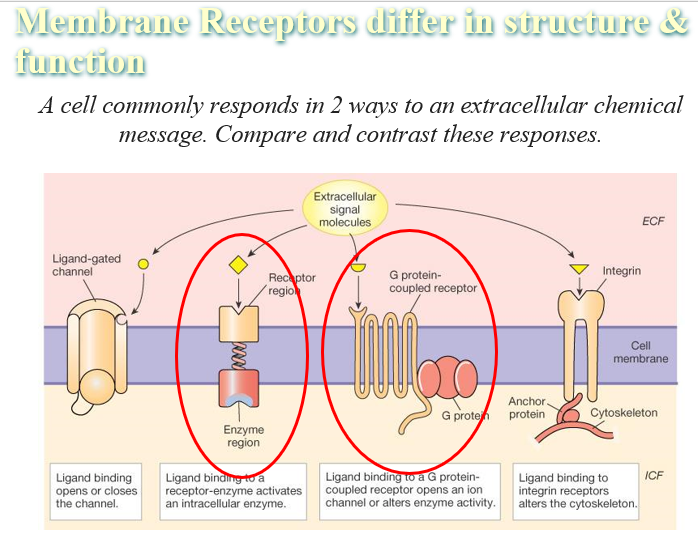
- Wiggly bit is receptor that ligand binds to
- Integrin (tooth shaped at right end): connects extracellular matrix to cytoskeleton
- Receptor binding can change shape of cell (important during embryonic development
- Growth hormone/other chemical signals change
- Platelet function and phagocytosis
- Receptor binding can change shape of cell (important during embryonic development
- Ligand binds to ion channel
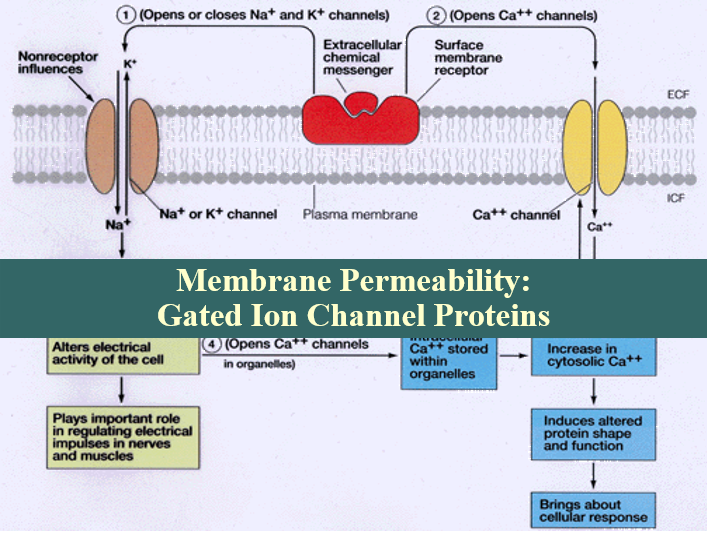
- Review lecture to understand what needs to be known
- Pattern in biological signal transduction is often to alter function of proteins
- Protein kinase- phospholarates: add or remove phosphate form a molecule**
- Calcium can be used as a molecule
- G protein-linked receptors function as a common metabolic switch
- cyclic-AMP (circle)
- 2nd messenger or activate protein kinase A
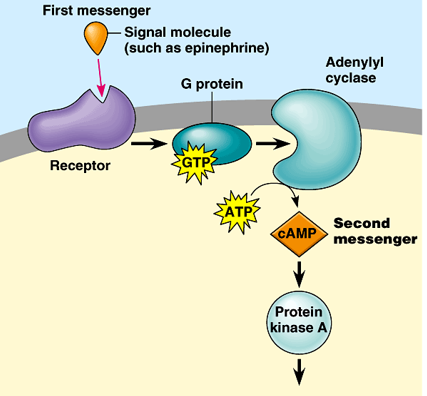
- cyclic-AMP (circle)
- Epinephrine acts at liver to aid in breakdown of glucose
- Binds at hipatocite
- Activates g protein
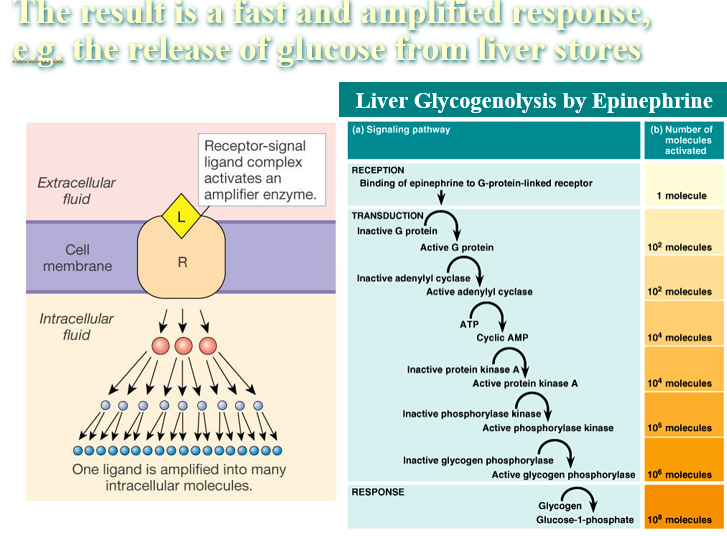
- Recognize the process- focus on vocab from previous figure’
- ANS
- SNS
- Inhibitory
- Reduce saliva production
- Inhibitory
- PNS
- Excitatory
- Produce more saliva (salivatory gland)
- Excitatory
Ca common intracellular messenger
- Enters cytosol
- Binds to protein
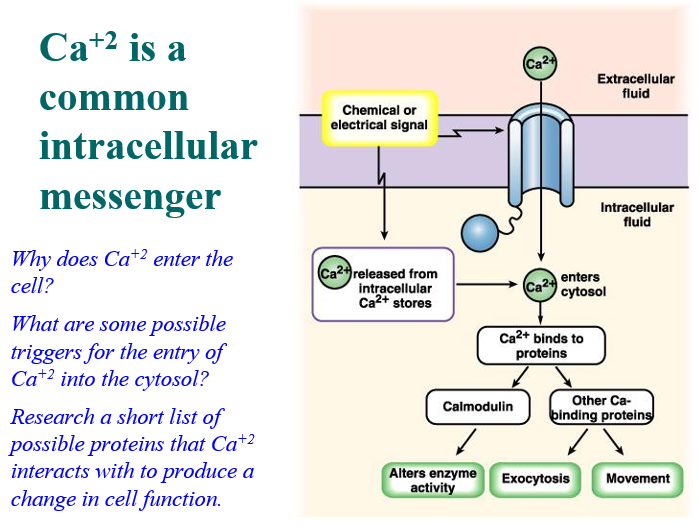
- Exocytosis, movement/muscle contraction
- Modulation of signals***
- Epinephrine at alpha receptor- vasoconstriction
- Beta receptors- dilate
- Epi comes form adrenal medulla
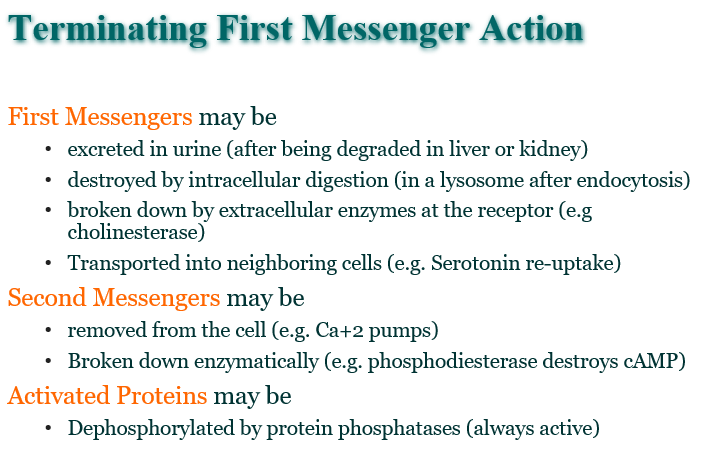
- Deactivating messengers
- 3 types of stress
- Metabolic
- Lack of nutrients cna stimulate response (ex.low glucose)
- Emotional
- Nerves, PNS
- exercise /physical stress
- Metabolic
4/16 Endocrine System
Functions
- Regulation of energy metabolism
- Water and electrolyte balance (integrated with CV and urinary systems
- Adaptation to various types of stress
- Control of growth and development
- Control of reproduction
- Regulation of RBC, WBC, platelet production
- Integrating digestive system functions (with ans)
3 mechanism for hormone secretion
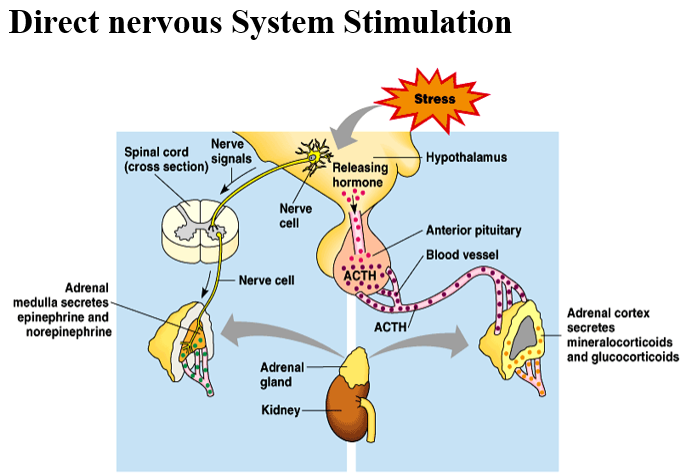
- Direct nervous system stimulation
- Neural
- Adrenal medulla
- Neural
- Negative feedback
- Humoral stimuli
- Parathyroid gland
- Humoral stimuli
- Hypothalamic control
- Hormonal stimuli
- Anterior pituitary gland
- Hormonal stimuli
Levels of integration
Hypothalamus (control/integration system of endocrine systems, releases or inhibits hormones)– pituitary (specific responses based of specific target cell)– endocrine gland
Releasing & inhibiting factors– tropic hormones– response in target cells
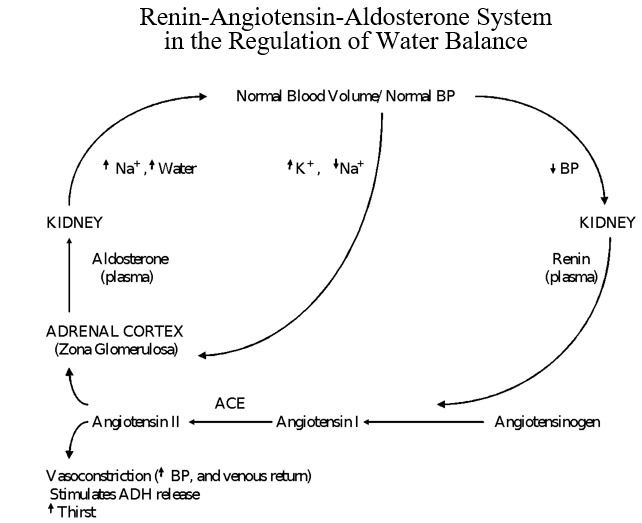
- Profusion, regular blood volume
- Kidney recognizes drops
- Angiotensin converting enzyme (angiotensin 1 into 2)
- Angiotensin 2 can increase thirst response
Glucose homeostasis
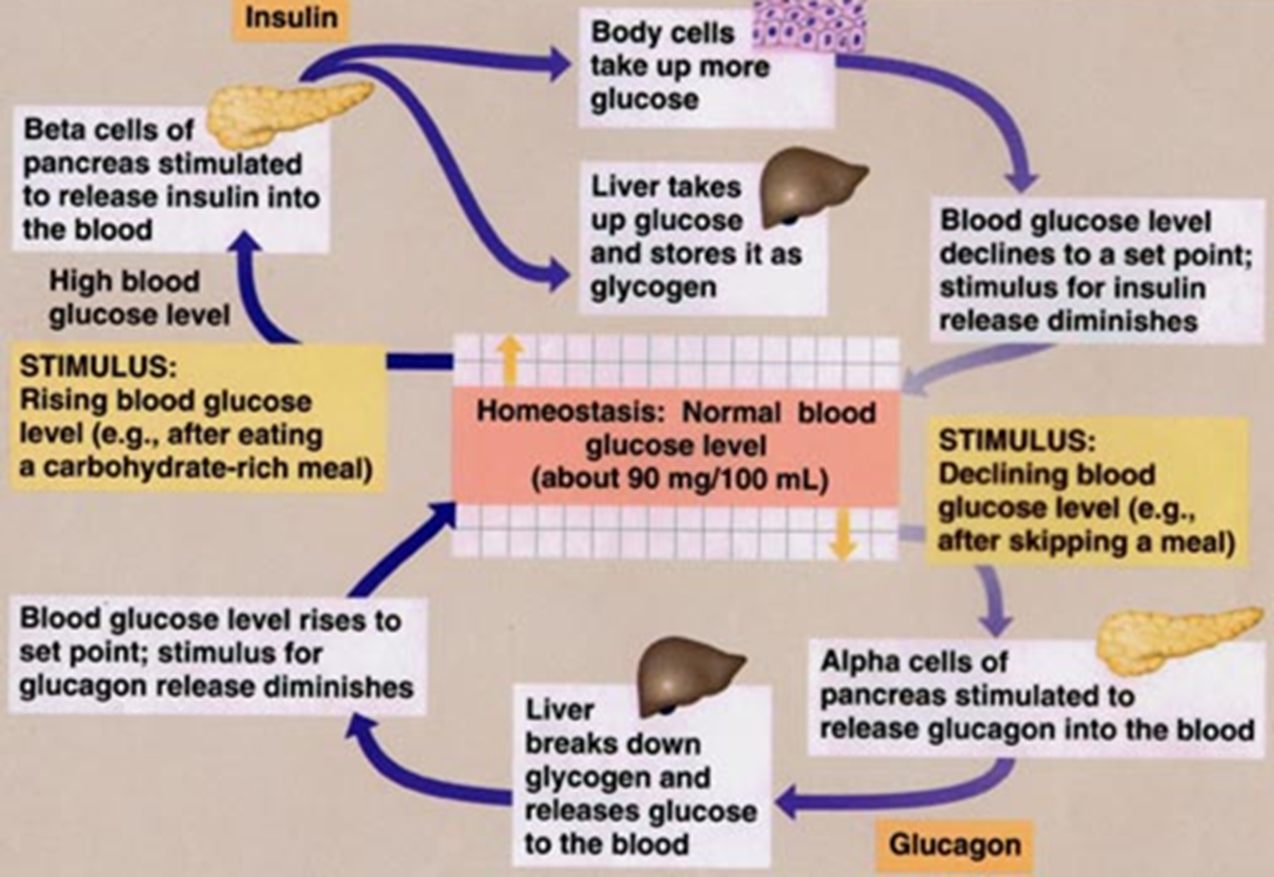
- Monitored for too high or too low
- Humoral
Hypothalamic control of pituitary

- Neural modulator
- Can come form other neurons or non-neuron cells
Hypothalamic regulation of blood glucose between meals

- Name the 4 hormones involved in glucose homeostasis
Chemical classification of cellular messages
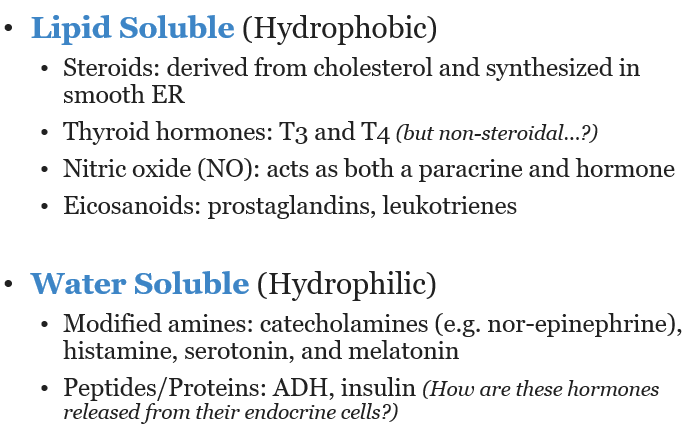
- LS: steroids
- Smooth ER
- Thyroid hormones: not steroids but soluble
- NO: endocrine message and something
- Eiocosanoids: prosto- from arachnodiacid
- peptides/proteins transported via exocytosis
Synthesis and release of lipophobic hormones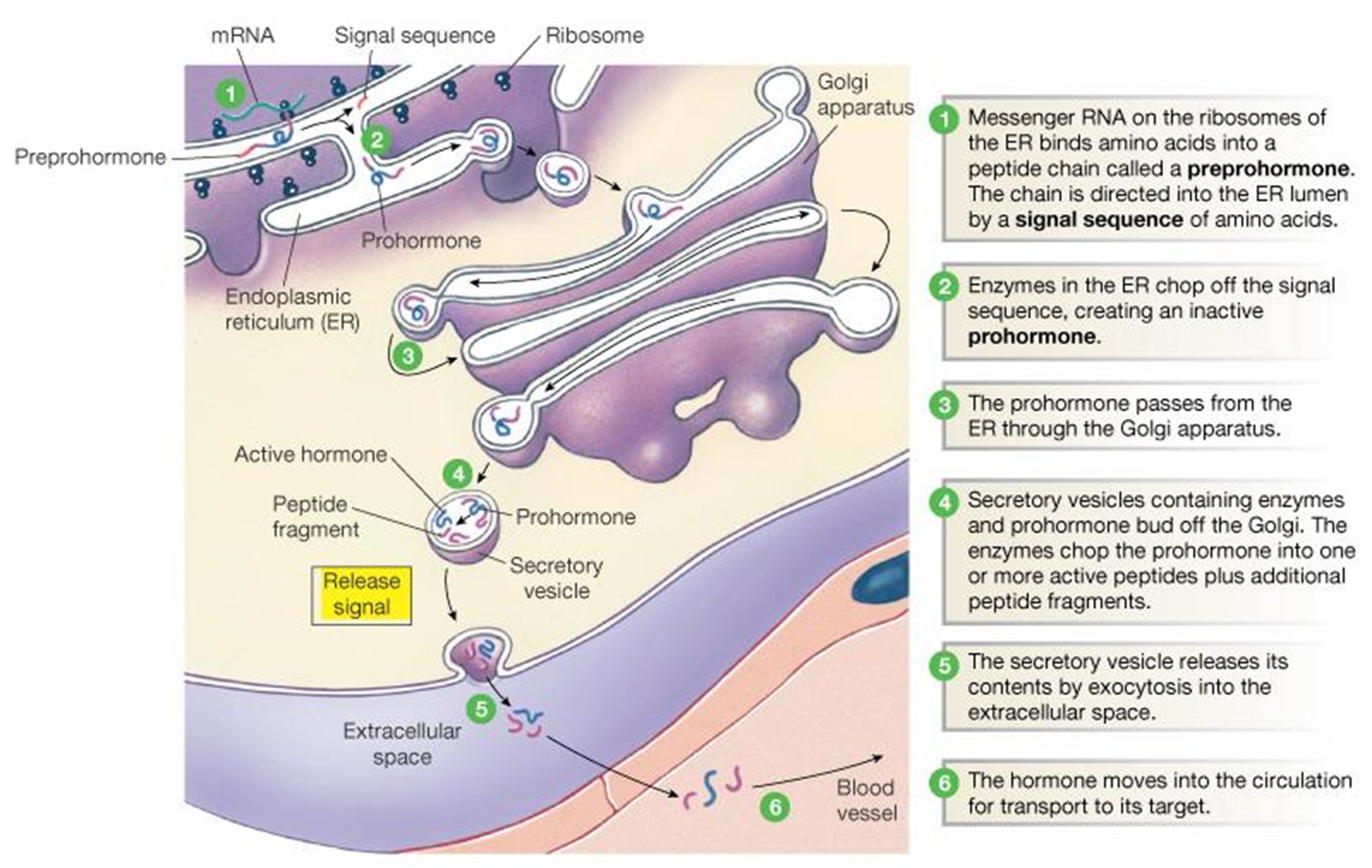
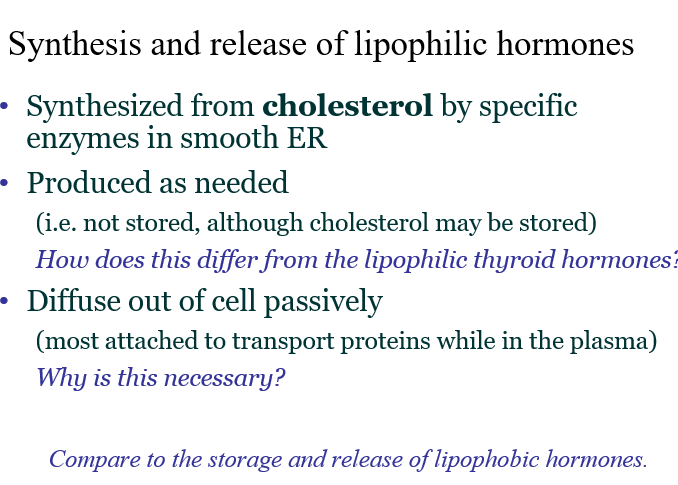
-How does solubility impact function etc
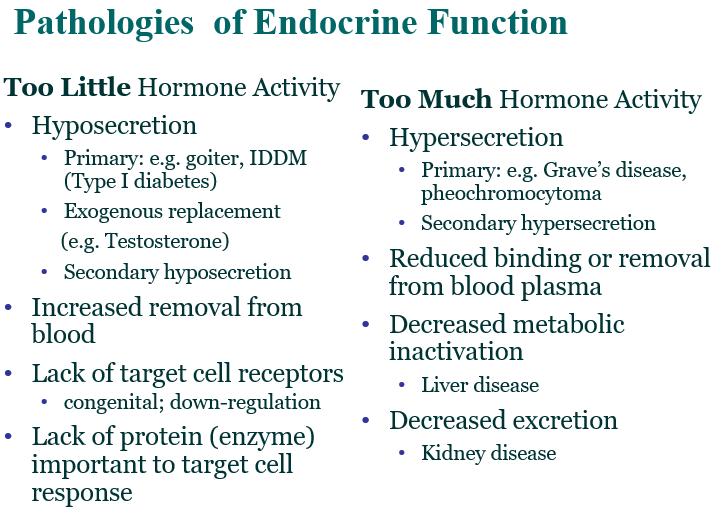
Stress Response
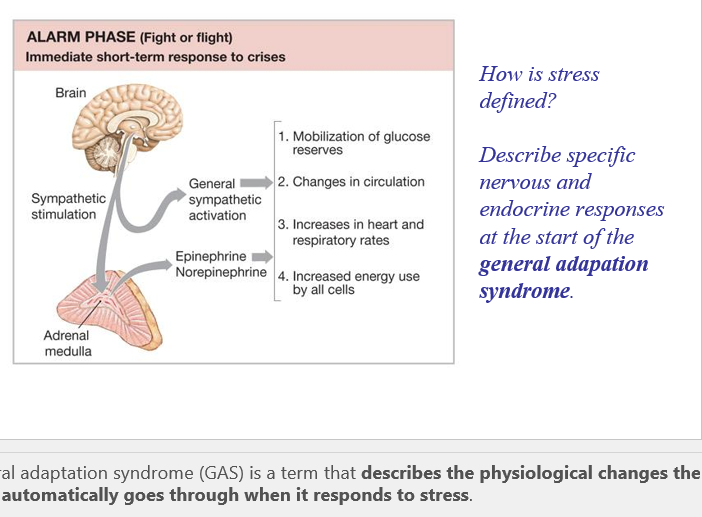
- Alarm
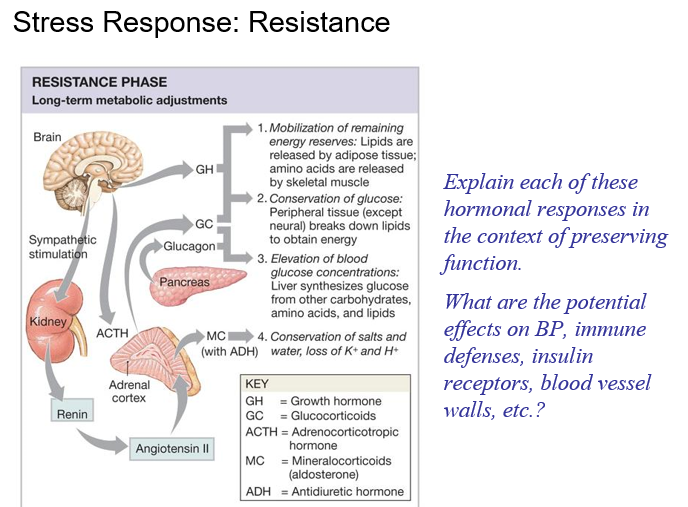
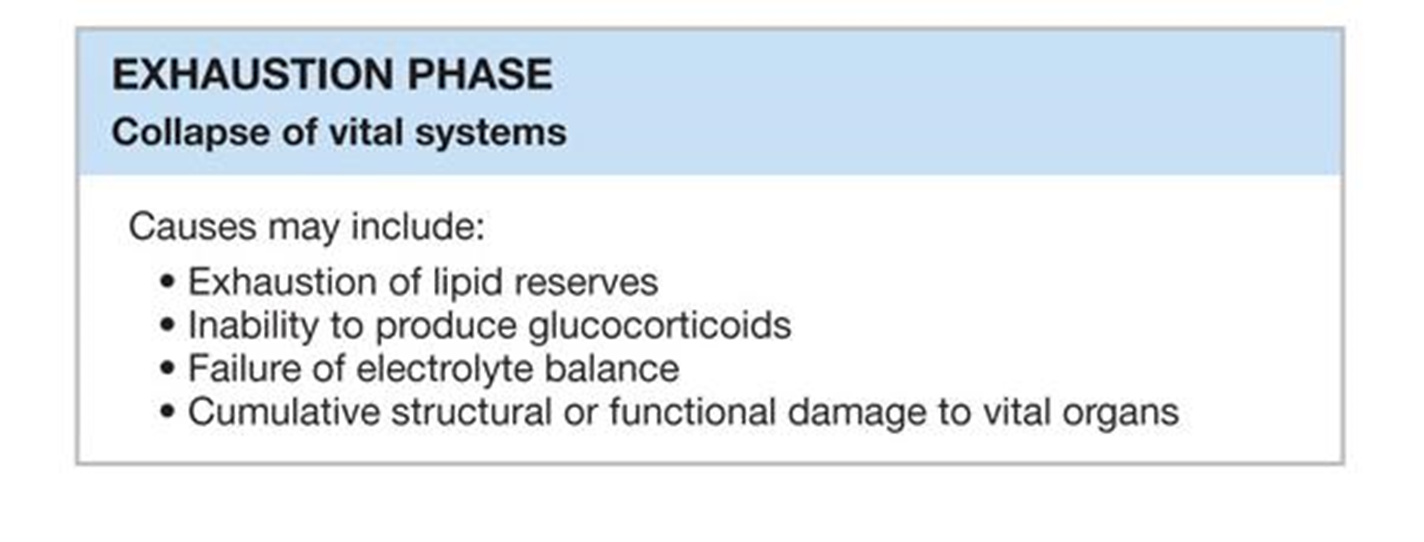
- Exhaustion: homeostatic collapse
- Can be minutes or extended but pretty short first response
- Next cna be days, weeks, months
- Final is based off individuals
4/18
Golgi apparatus gets glut 4 into vesicles
ELECTROCHEMICAL SIGNALING
- Organization of NS
- Split between locations and functions
- Central and peripheral, enteric
- Differentiate b/w the CNS, PNS, and ENS
- Define afferent and efferent
- Afferent- sensory pathway- incoming
- Efferent- motor pathway- outgoing
- Somatic and autonomic
- Somatic motor neurons-skeletal muscles- stretch only here, muscle stretch specific to its category
- Autonomic- sympathetic and parasympathetic
- Somatic and autonomic
- Should there be visceral afferents
- Compare the figure to the one on the next slide
- Typical neuron overview
- Electrical messages sent
- Multipolar neurons
- Branching of axon termines=
- Divergent: sending to two or more locations
- Convergent: messages coming in
- Metabolism and synthesis in a neuron
- Made in rough er and packaged by golgi apparatus
- Axonal transport
- Lisosomes eat and recycle old membrane to pop out new membrane (endocytosis)
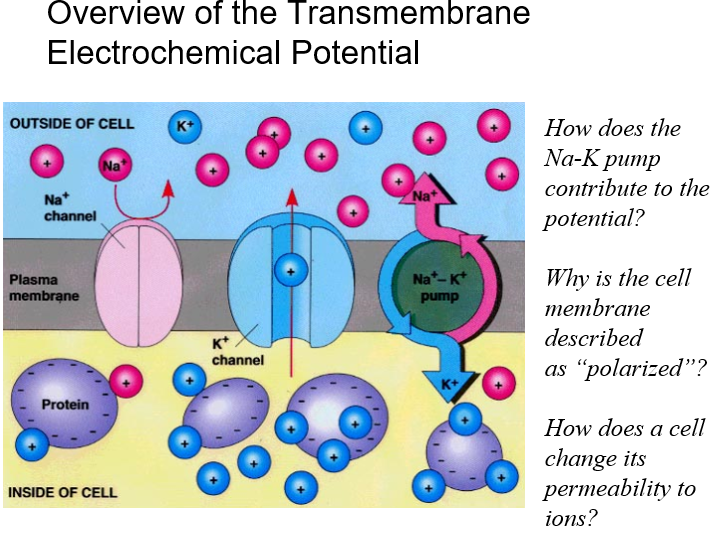
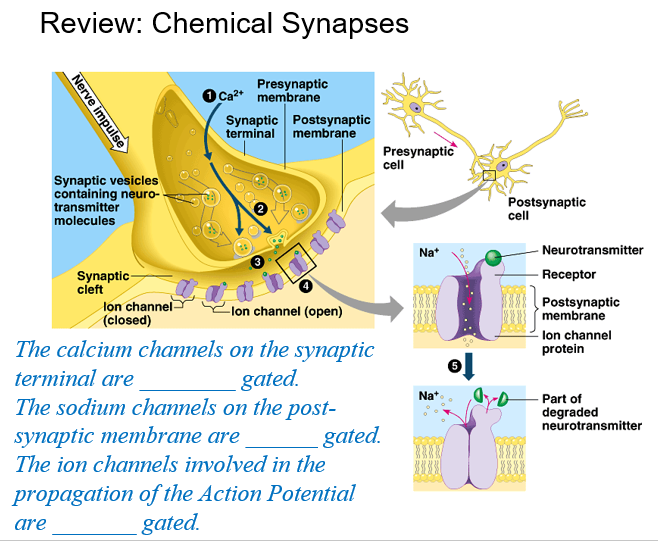
- Ligand gated
- Sodium-potassium channels, down their own gradients in/out of cell
- Nicotinic
- Create a change in potential, depolarization in this case
GRADED POTENTIALS- local
- Stronger stimulus=stronger graded potential
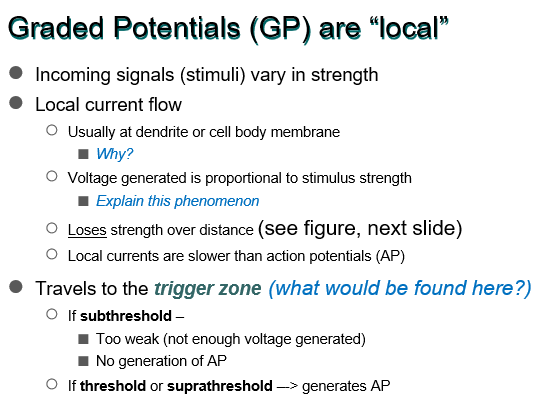
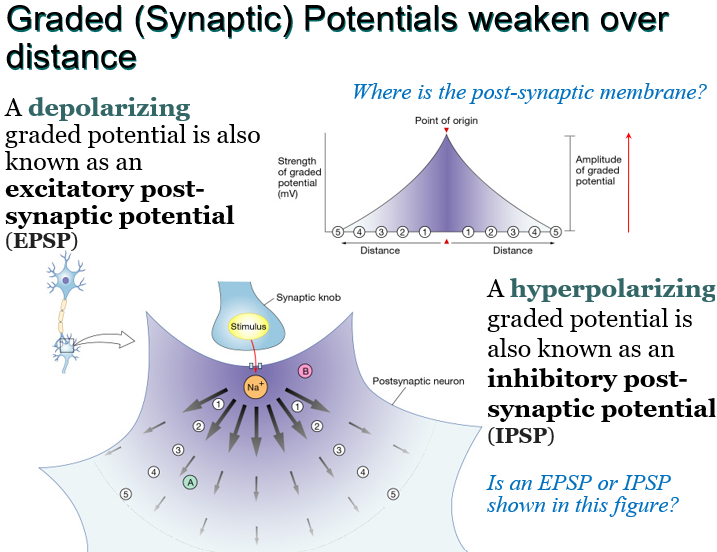
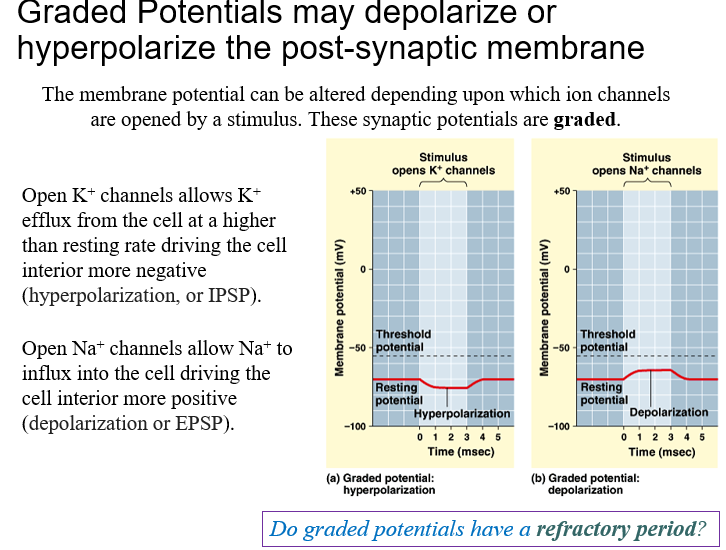
- Movement of different ions to cause different changes within the membrane (depolarization, more positive/ repolarizing, more negative/ hyperpolarization, brings further from threshold)
- Graded potentials (alone, singular) mostly dont reach threshold
- When it is met, action potential formed (all or nothing)
- Trigger zone is threshold
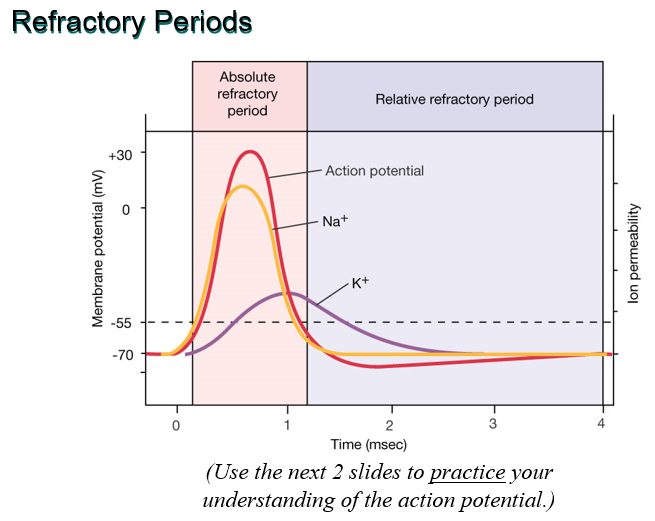
- refractory= stubborn
- Next two slides…
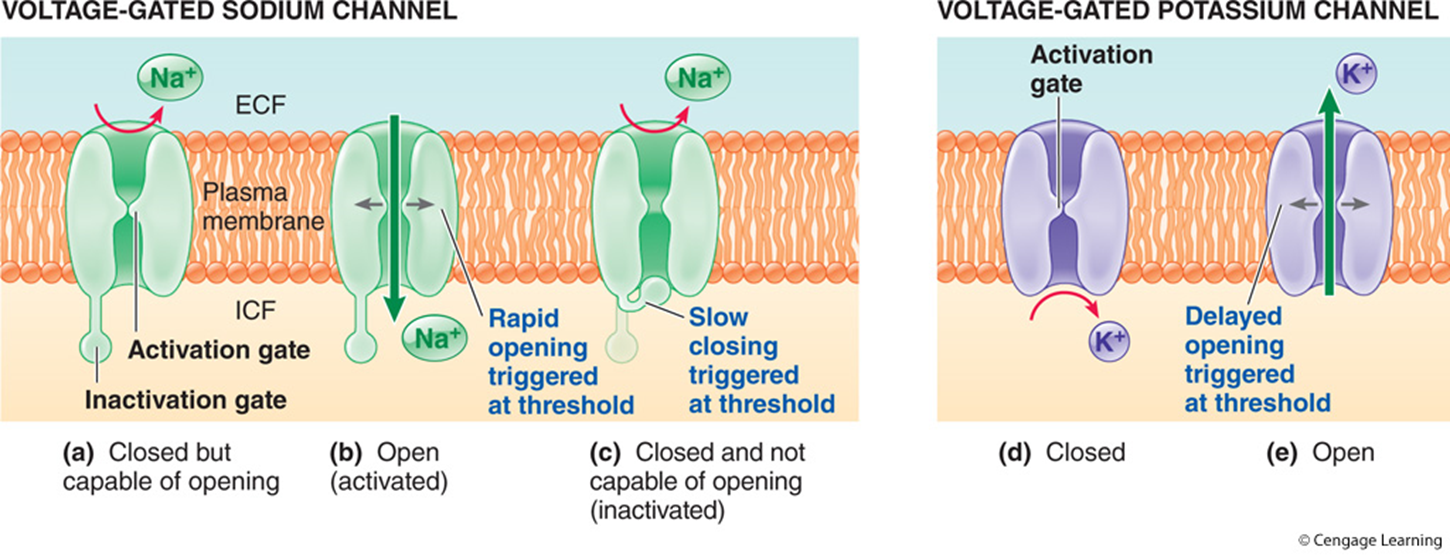
- Need voltage gated sodium and potassium channels
- Sodium channels has two gates, potassium has one
- Graded potentials (alone, singular) mostly dont reach threshold
- Movement of different ions to cause different changes within the membrane (depolarization, more positive/ repolarizing, more negative/ hyperpolarization, brings further from threshold)
Same channel has activation gates, opens and closes tunnels to allow for travel
Sodium- inactive gate, acts 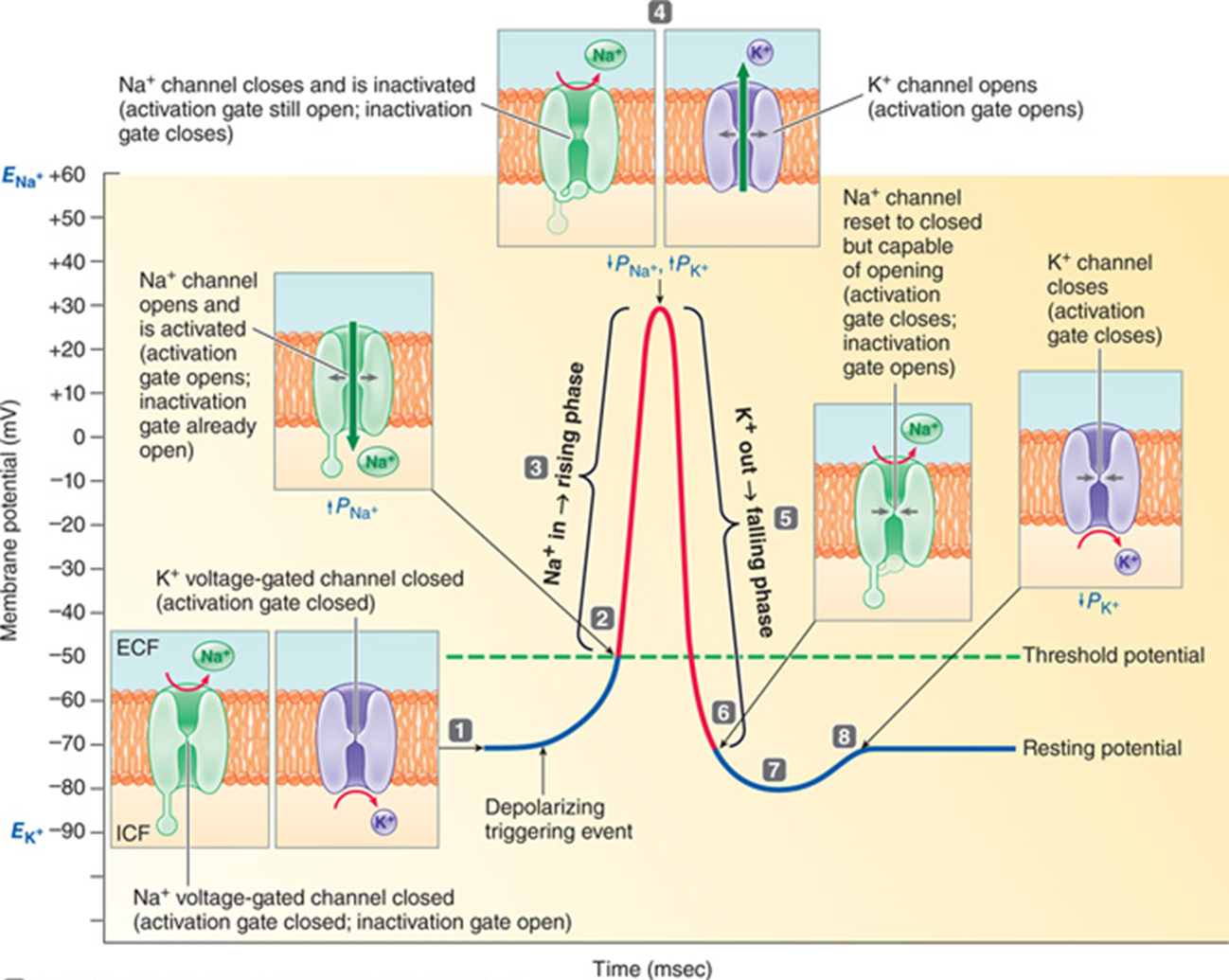
- At rest, not open
- 3 confirmation changes at threshold
- Sodium activation gate opens, potassium active and inactive gates slowly open/close (respetcively)- top of peak
- Once closed, cant open again in this phase
- However when falling it reaches a phase where its closed but has capability of opening (if activation is closed then it will keep inactive closed)
- Once closed, cant open again in this phase
- Sodium activation gate opens, potassium active and inactive gates slowly open/close (respetcively)- top of peak
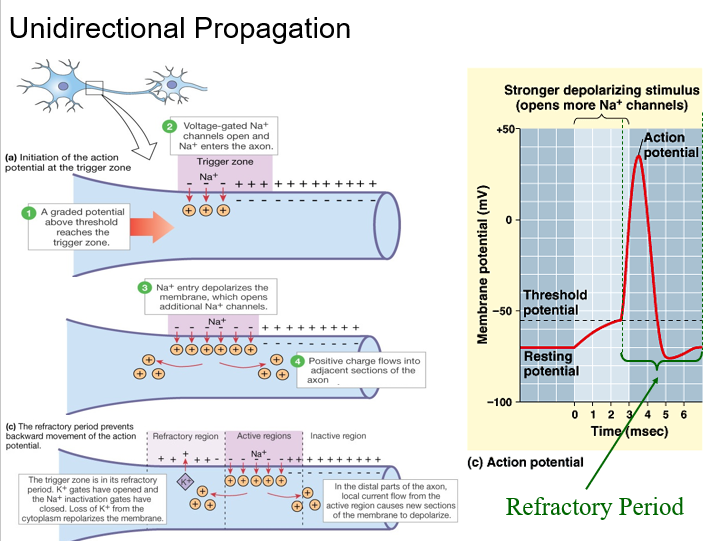
- Diffuses equally (middle port)
- Excitatory and inhibitory signals
- Grand post-synaptic potential (GPSP)
- Ultimate outcome of EPSP and IPSP
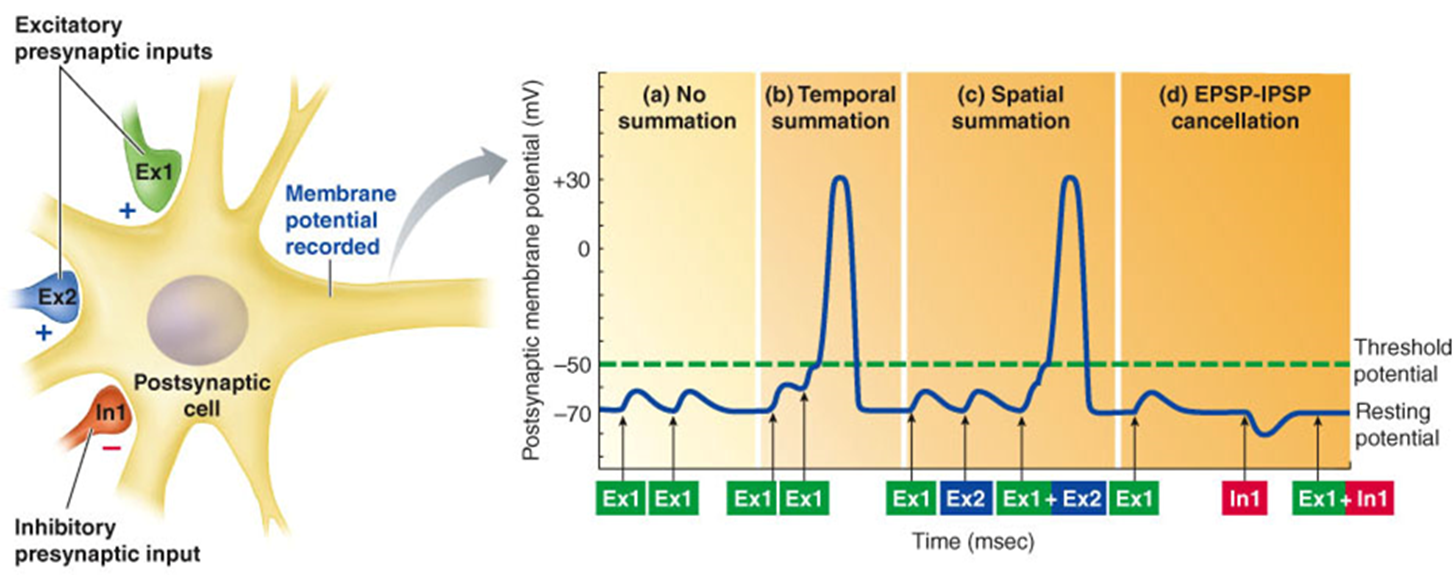
- Temporal- over time, faster frequency
- Spatial- multiple at same time
- Active at same time, rmeains at resting (cell body, dendrites
- Inhibition: pre-synaptic inhibition limits amount of neurotransmitter released
- Post vs pre, pre is not inhibited (WHAT)
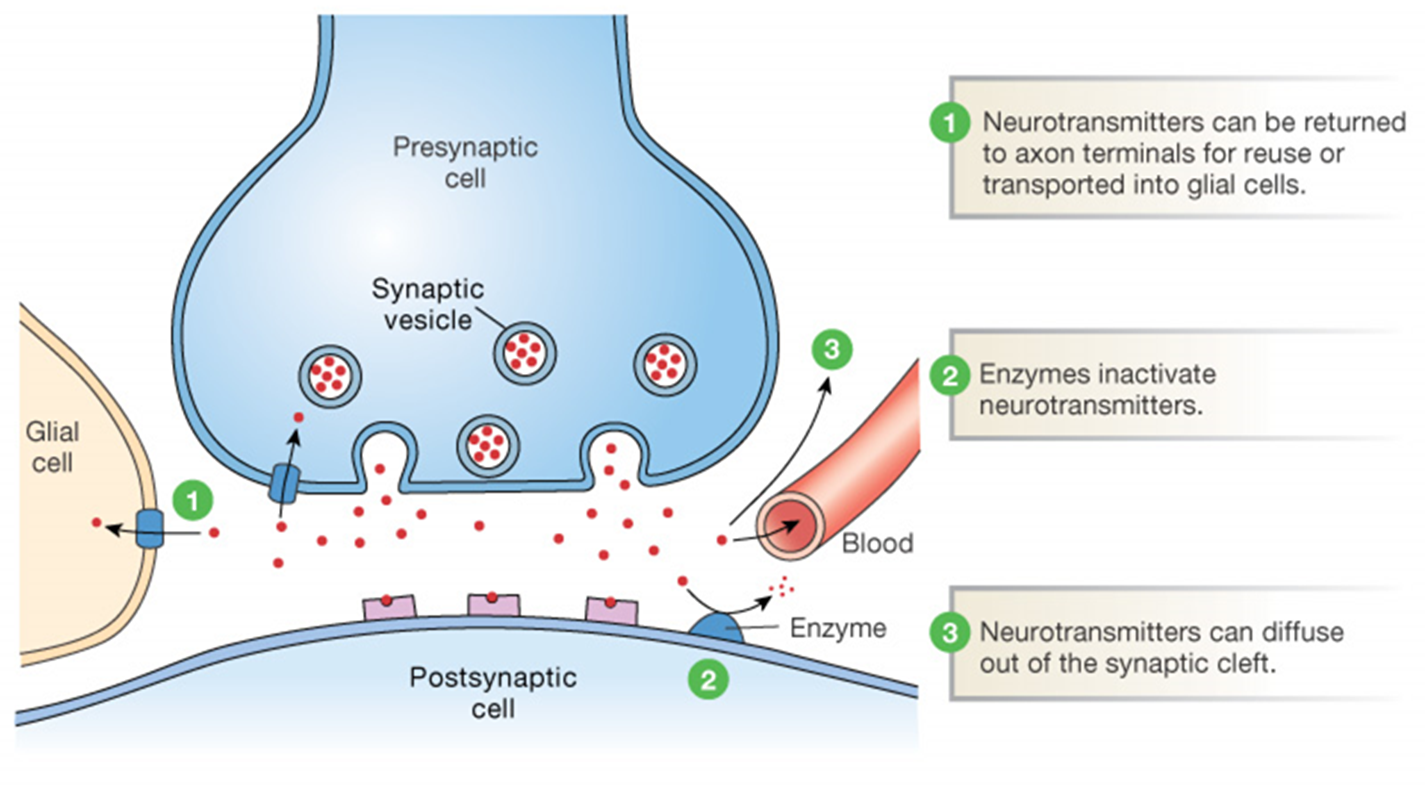
- Inactivation of neurotransmitters
- Acetylcholine broken down by acetocholinaphase
- Removed through urine, diffused into blood, recycled ‘’
4/23
List and describe sensory receptors
- Photo: eyes
- Mechano - baro - proprio: all over
- Osmo
- Themo: temp
- Noci: pain
- Chemo: chemo
Generator Potential
- Stimulus sensitive nonspecific cation channel
Review this lecture…
Exteroreceptors detect change outside the body: special senses
- Taste
- Scent
- Smell
- Touch
- Hearing
- Differentiate between exteroceptors and interoceptors
- Thalamus is relay section
Ascending pathways for somatosensory information often converge
NII
Somatosensory pathways synapse in the thalamus
Stimulated on left side of body but reaches right side of brain
Reaches an awareness, stimulated for action potentials and only then can brain perceive stimulus
Stops at thalamus
Perception of sensory information, several factors can change how we see those factors
- Sensory acuity
- Field size
- Amount of area at cortex, how much space can dedicate to receiving signals and pinpoint stimulus
- Stimulus intensity
- Frequency and population code
- How fast are AP being generated and sent
- How many neurons are stimulated that can converge
- Duration
- AP series- how long they are sent
- Sensory adaptation
- Tonic receptors
- Adapt very slowly
- Phasic receptors
- Tonic receptors
- Small receptive field size improves acuity
- Decreases with congrution
- Improved by lateral inhibition
- Decreases or stops AP
- Stimulus and intensity and duration is transmitted to the cortex in code
- Does sensory adaptation occur at all receptors? Tonic vs phasic receptors
- Mechanical signal receptor transduction and adaptation
PAIN
- ‘Fast pain’ conducted along a primary sensory pathway
- Stimulates a reflex
- What secondary pathways in the cerebrum might be stimulated by pain?
- List key nociceptor transmitters
- Nociceptor mechanical and thermal
4/25
Somatic
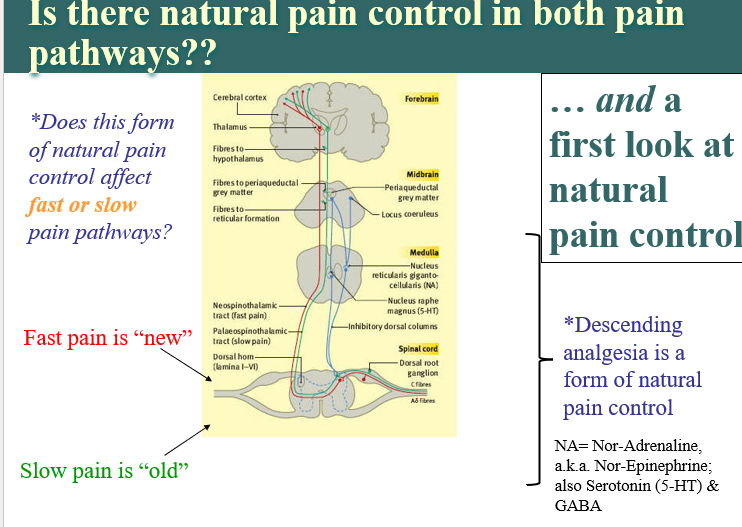
Two neurons that can inhibit pain that act at terminal of N1 and N2 (between)
Slow pain opens the gate, somatosensory pathway closes the gate
touch/non painful stimulus against painful stimulus will have an excitatory effect
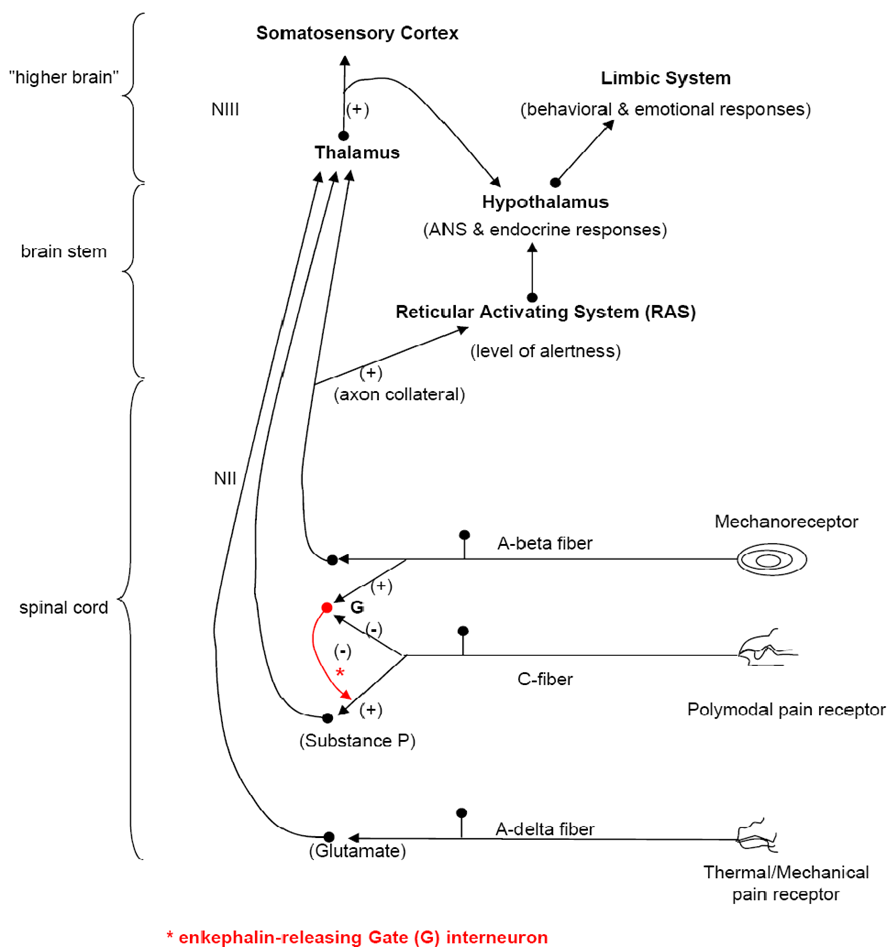
Recreate pathways***
Somatic vs autonomic
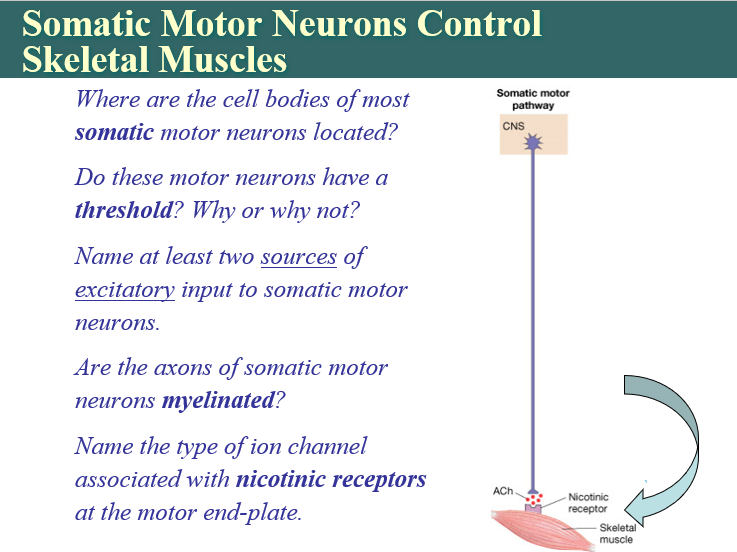

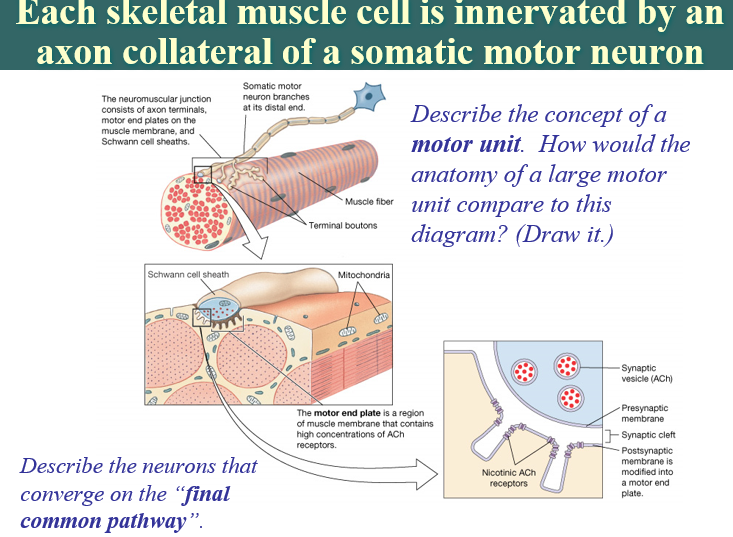
Motor neurons can aid in strength
Why is there a net effect of opening these non-specific monobalent cation channels (theres more sodium so there is depolarization, more sodium being moved than potassium)
Autonomic
What kind of nervous functions are regulated in the hypothalamus?
Sympathetic
Is the respiratory center in the medulla oblongata truly an autonomic control center?
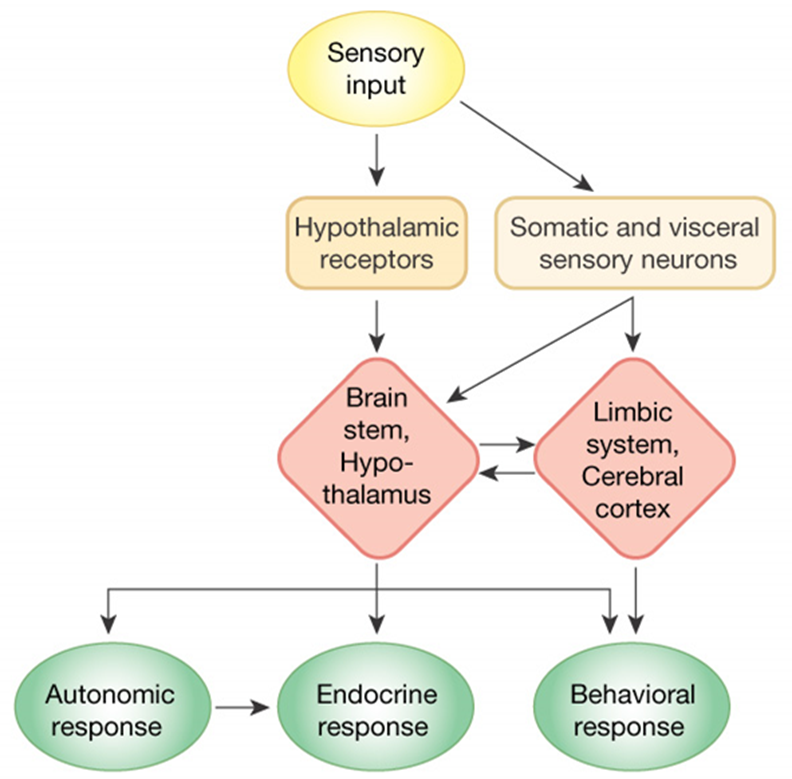
Stimulates to achieve appropriate responses
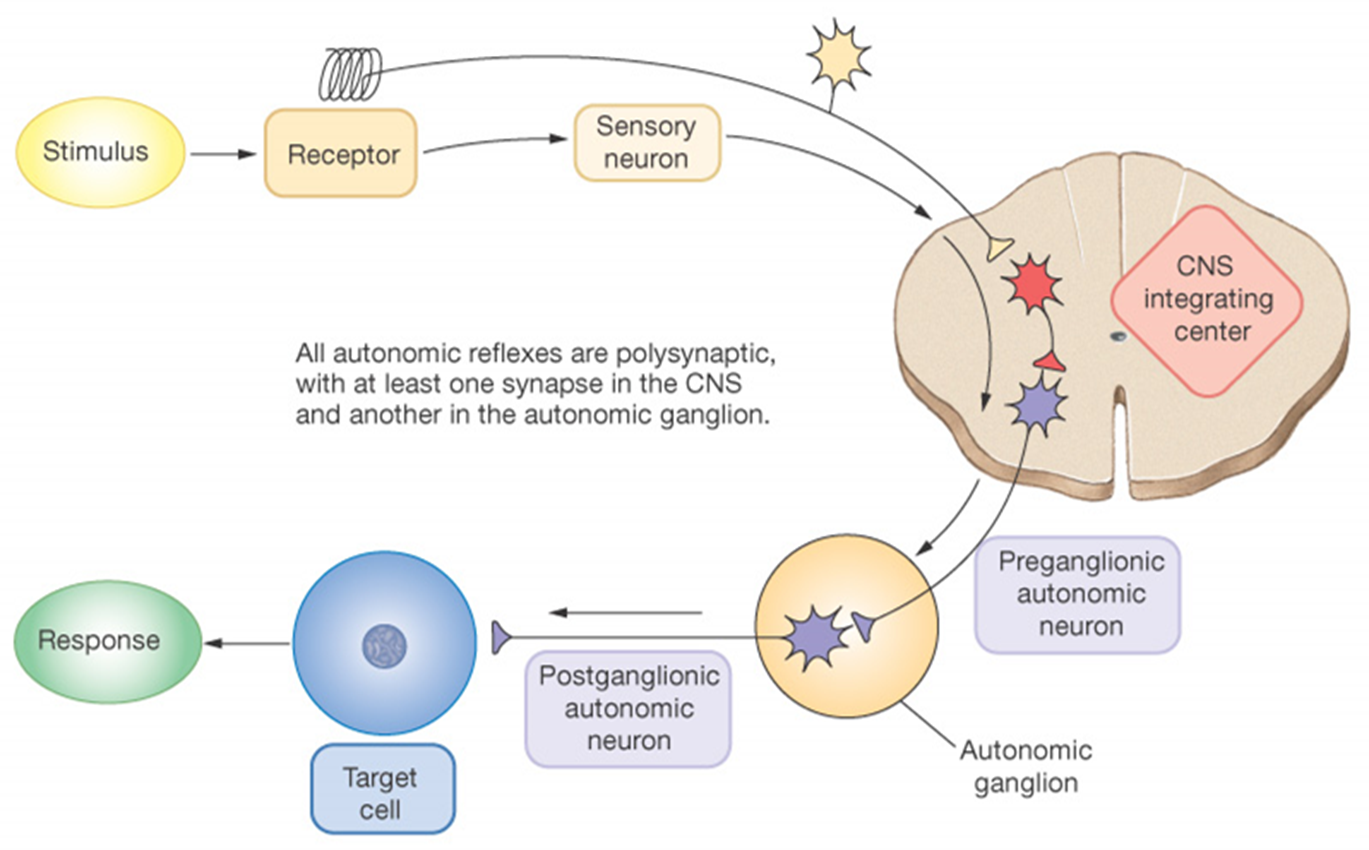
Autonomic reflexes are polysynaptic
-efferent pathway has two neuron: pre and post ganglionic neuron
Smooth muscle, cardiac muscle, glands- some importance within something
Autonomic neurotransmitters and receptors
Sympathetic (in sympathy wiht you durig stress, fith or flgiht) and parasympathetic (can be quieted, rest and digest)
-always in a dynamic balance
-volume control mechanism
Autonomic motor pathways: two efferent neurons
-all pre-ganglionic neurons release Ach onto nicotinic receptors
-most post-ganglionic sympathetic motor neurons release NE onto adrenergic receptors at visceral effectors
-most post-ganglionic parasympathetic motor neurons release Ach onto muscarinic (cholinergic) receptors are viscereal effectors
-most visceral organs receive dual innervation (antagonistic control)
Cholinergic- nicotinic and muscarinic
Ach at ganglia
4/30
Synapses at visceral effectors are structurally different
- Terminal ‘variocosities’
- Neurotransmitter released into ECF
- Impact
- Large area
- Slow acting
- Longer duration
- Subject modulation by local paracrine message (eg. histamine)
- Depends on location on reaction
- Not the absence of a ‘motor end-plate’ on these smooth muscle cells
- Slower acting, slight delay before smooth muscle has action, longer duration since neurotransmitter is hanging in ECF
- Subject to something from paracrine messages
The adrenal medulla is a modified sympathetic ganglion
- Contain neural cells that are modified post-ganglion neurons
- Releases both epi and norepi
- Epinephrine targets: heart, exocrine/endocrine glands- sweat glands
- How many motor neurons in this efferent pathway? Why?
- Organs that arent duel innervation will respond to epinephrine
- Adrenergic receptors
- Alpha 1
- Most common, respond to both epi and ne
- Alpha 2
- Digestive, respond strongly to both
- 1= general excitatory
- 2= inhibitory
- Digestive, respond strongly to both
- Beta 1
- Only in heart and kidney, respond strongly to both
- Beta 2
- Not directly innervated by sympathetic nerves
- Which catcholamine (epi or ne) would you expect these receptors to be most sensitive to? Epi
- Alpha 1
- Utilize g-proteins in signal transduction
- Caffeine inhibits the action of phosphodiesterase, the enzyme that destroys cAMP. How does this affect the effector cell?
- Inhibit a secondary messenger: turn it off fast, inhibit any transatctions to it
- Muscarinic receptors also use g-proteins i signal transduction
- Control k+ channels
- May activate second messenger systems
- TAKEA IN THE CHARt with BETA FISH and review this discussion
Reflex regulation of heart via autonomic dual innervation
5/2
Muscle physiology
(everything before today will be on midterm)
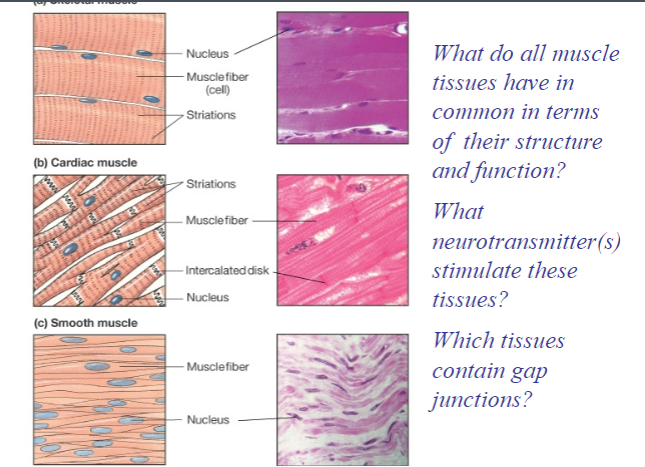
Very heavy on skeletal muscle rn
-skeletal and cardiac: striated
-smooth has dif arrangement of actin and myosin (no striation)
-cardiac cells held together with desmosomes and gap junctions
-smooth: not really intercellular junctions, most common tho is gap junction
Smooth muscle
-independent of each other
-multi-unit bc each muscle cell is a unit, multiple together provide function to entire muscle
-weave between cells
–or as a single unit,, when held together by gap junctions (digestive system- intestine)
-allows cytosol to be shared within unit, act as one larger cell
-when neurotransmitter released, travels via diffusion
***skeletal and paracrine have nicotinic, others have musirinic??
-smooth muscle well in shrinking a hollow organ
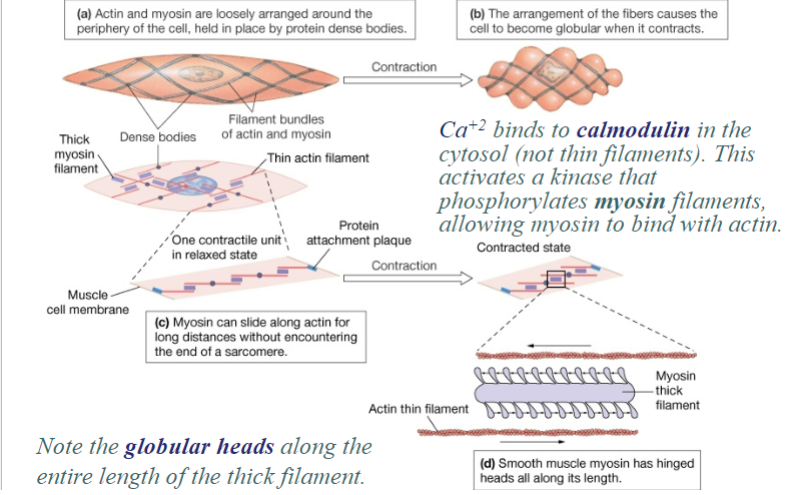
-long and spindly, actin and myosin arranged in criss-cross pattern, held together by dense bodies (protein connectors), contraction makes it globular (shorter/fatter)
-no sarcomeres w/strict boundaries or a ‘stop’ until filament runs out
-calcium binds to calmodulin in cytosol which activated kinase and phosphorylase the myosin cross bridge (myosin head, give energy to pull on actin)
Skeletal muscle
Muscle fibers bundled together
-fascicle (bindles of fibers) give striation, bound by connective tissue then whole skeletal muscle
Architecture of skeletal muscle fibers is complex bc of cell size
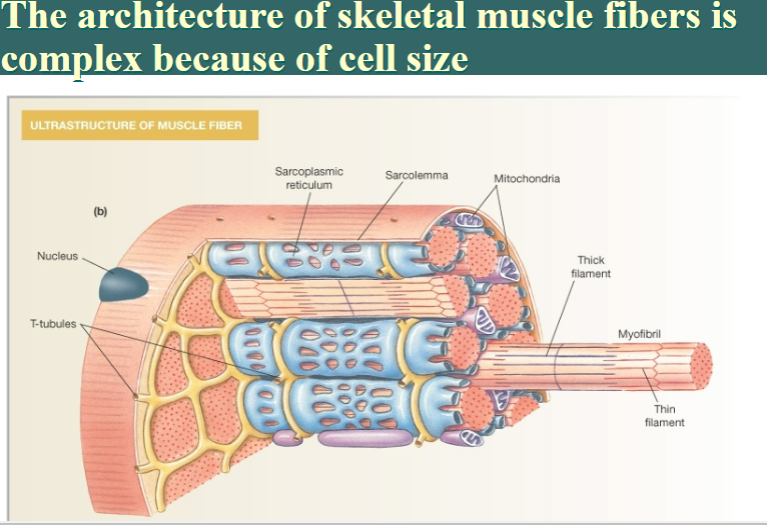
-sarcolemma= fleshy membrane
-sarcomere-functional unti of muscle cell
-sarcoplasmic reticulum and t-tubule
- 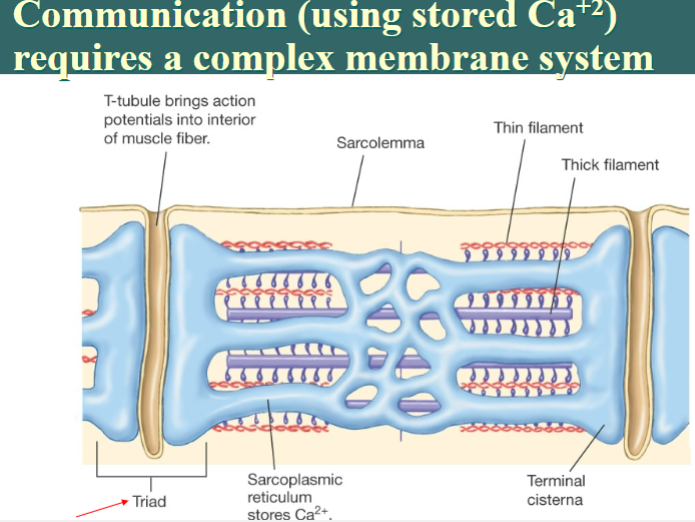
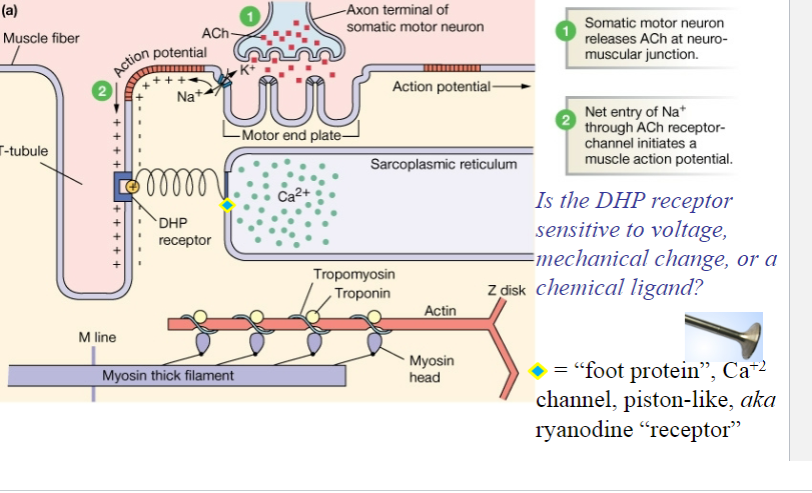
-mechanically gated (DHP receptor)
-calcium pumps, working constant as long as ATP is available
- need constant calcium being pumped and more transmitters, repeated AcH being released for new bindings and more action potentials
-protein complex around thin filament (actin); rotate, spin and change shape to get off binding sites of actin so myosin can bind to the sites’
-calcium binds to troponin and rotates etc
-why isnt muscle contraction jerky?
- myosin filaments have many heads to interact with actin: asynchronous binding and power-strokes, pulling on actin filaments (constant ish so not jerky cause always in movement)
-for every myosin there are 6 actin
-one myosin head per molecule, multiple make it thick as that ful structure
-actin chain, bound together in filament (thin)
-myosin hed stuck to actin until atp removes it so next one can bind
Midterm Practice Questions:
- Hormones in the hypothalamic-pituitary axis:
- include tropic hormones
- are regulated in a negative feedback fashion
- include epinephrine
- are influenced by internal body cues
- Pre-synaptic membrane at the neuromuscuarl junction has which of the following membrane proteins
- Na-K ATPase
- Voltage-gated calcium channels
- Voltage-gated K+ channels
- Convergence in neuronal pathways occurs
- At primary sensory neuron, as it receive input from several sensory receptor cells
- Review this question teehee
- Cadherins and integrins are examples of what type of membrane protein?
- Cell adhesion molecule
- How would a meal that includes mostly simple carbs impact glucose absoption form the intestine
- Rapid absorption
- Rapid rise in plasma glucose levels