Biology 1st exam
The Chemistry of Life
- matter - anything that takes up space.
- element- a substance that cannot be broken down by \n chemical reactions. ex. O
- compound - composed of two or more elements in a fixed ratio. ex. NaCl
- essential to human life → 25 of the known 92 elements.
- 4 make up 96% of living matter. C, O, N, and H.
- ex. C 6 H12 O6 as a product of photosynthesis.
- remaining 4% of the organism’s weight. P, S, Ca, K, and others.
- ex. calcium in muscle contraction.
- trace elements - only required in small quantities.
- ex. Iron (Fe) and Iodine (I).
- iodized salt has reduced goiter.
- atom- smallest unit of matter that still \n retains properties of an element.
- subatomic particles:
- neutrons
- protons
- electrons
- top number is mass
- bottom number is atomic number
- isotopes - atoms with more neutrons than other atoms of the same element. ex. 12C, 13C, and 14C.
- all have 6 protons in their nucleus.
- 12C and 13C are stable and tend to NOT lose particles
- 14C is an unstable, radioactive isotope.
- nucleus decays by giving off particles and energy.
- 14C decays to nitrogen.
- radioactive isotopes useful in: a) dating fossils, ex. carbon. b) medical dye, ex. cobalt.
- detected as tracers.
- also damages cellular molecules.
- stable-isotope use in ecological trophic analyses, ex. 13C and 15N.
- if the nucleus were the size of a golf ball… the electrons would be about 1 km away.
- electron potential energy occurs only in steps of fixed amounts.
- energy needed = difference in potential energy between levels.
- absorb to move out, ex. light energy.
- lose to move in, ex. heat.
- valence electrons - in the outermost shell or valence shell.
- atoms with incomplete valence shells interact with other atoms. → Chemical Bonds.
- Covalent Bonds - sharing a pair of valence electrons by two atoms, ex. hydrogen, oxygen, water, and methane.
- O2 has a double bond.
- H2O, polar covalent bond.
- oxygen is much more electronegative than hydrogen.
- electrons toward the nucleus.
- Ionic Bonds - result from the attraction between oppositely charged ions, ex. sodium and chlorine → NaCl.
- transfer of valence electrons.
- form ionic compounds or salts.
- other examples:
- magnesium chloride (MgCl2).
- ammonium chloride (NH4Cl).
- Hydrogen Bonds - hydrogen atom covalently bonded to one electronegative atom,
- is also attracted to another electronegative atom. ex. water and ammonia.
- nitrogen, negative.
- hydrogen, positive.
- van der Waals Interactions occur as even weaker bonds.
- due to ever-changing spots of positive and negative charges.
Properties of Water
- Only common substance to exist naturally in all three physical states.
- liquid, solid, and gas.
- 75% of the Earth’s surface.
- reason for Earth’s inhabitance.
- life began in water.
- most cells are 70-95% water.
- any water atom may have four other hydrogen-bonded to it.
Four Main properties:
- Hydrogen bonds tighten up water.
- surface tension - how difficult it is to stretch or break the surface of a liquid
- high in water, which appears like a film.
- top of a glass. some animal
- cohesion - water molecules collectively hold together.
- allows water to travel up plant vascular tissue.
- adhesion - clinging of one substance to another.
- plays a role in vertical transport.
- meniscus layer bends inside the airspace of a leaf.
- surface tension - how difficult it is to stretch or break the surface of a liquid
- Water Moderates Temperatures on Earth. \n ex. The Great Lakes.
- think back to all of those hydrogen bonds.
- heat has to break the bonds
- molecules move faster.
- single calorie of heat causes a small change in temperature.→ thus, water has a high specific heat.
- gradual cooling of water can warm the air.
- can absorb and store solar heat, and rise only a few degrees.
- milder climates near water and along coasts.
- think back to all of those hydrogen bonds.
- Water Expands When it Freezes
- less dense as a solid than a liquid, thus ice floats.
- back to hydrogen bonds again, they keep molecules at greater distances from each other.
- bonds break and reform when it’s a liquid thus, not as bonded.
- maximally bonded as ice, 10% less dense than as a liquid.
- if ice sank, lakes and oceans would freeze solid.
- only the top few inches would thaw each summer.
- floating ice insulates liquid water below.
- aquatic life thrives.
- Water is the Solvent of Life
- think back to the polarity of the water molecule. ex. salt in water.
- oxygen clings to sodium, and hydrogen clings to chloride.
- forms hydration shells, separating ions from each other.
- the water eventually dissolves all the ions.
- results in two solutes, sodium, and chloride mixed in water (solvent).
- ex. Xylem Sap, as a solution transported through plant tissue.
- Organic Chemistry - the study of carbon compounds.
- alchemists searched for the meaning of life in chemistry.
- in general, organic - carbon, inorganic - no carbon.
- carbon is the main building block in forming molecules.
- valence of 4 - in a shell that holds 8
- tends to form 4 covalent \n bonds with other atoms.
- intersection point for \n branching in 4 directions.
- double bond - enables two carbons to join.
- as well as others.
- notice how carbon acts like a backbone.
- and allows branching
- sone even arranged in rings
- hydrocarbons - contain only carbon and hydrogen
- Hydrophobic - does not habe an affinity for water
- non-ionic, nonpolar, and actually repel water
- Store lots of energy
- ex. hydrocarbon tails of fat molecules. \n
- Isomers - compounds that have the same chemical formula, but different structures.
- end up with different properties.
- three types:
- structural isomers - differ in the covalent arrangement of their structures
- may also differ in the location of double bonds.
- possibilities increase with carbon skeleton length.
- ex. C4 H10 both butane and isobutane, branching difference
- geometric isomer - same covalent structure, but differ in spatial arrangement.
- double bonds do not allow atoms to rotate about the axis.
- subtle but crucial difference.
- if you make the double bonds above single bonds, it will NOT be an isomer.
- enantiomers - mirror images of each other.
- involves an asymmetric carbon in the middle.
- like left-handed and right-handed versions.
- cells can distinguish them.
- usually, one is active and the other is inactive.
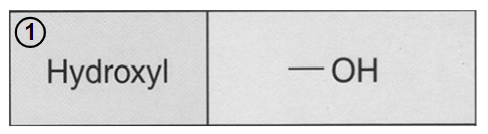
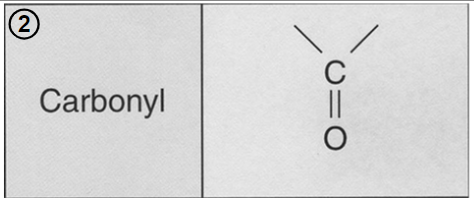
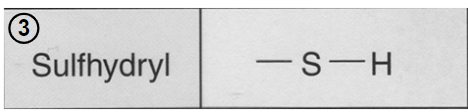
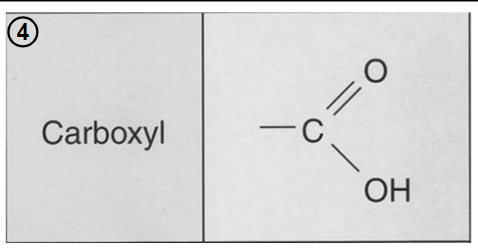
- Functional Groups - components of organic molecules that are commonly involved in chemical reactions.
- attachments in place of hydrogens along the carbon chain.
- some include the atoms on the carbon chain.
- 6 Main Groups:
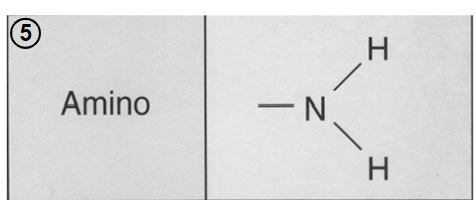
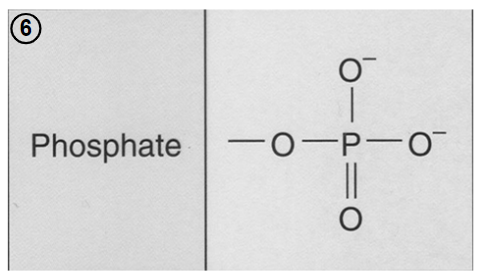
Macromolecules
- Monomers - repeating units as building blocks for polymers.
- many also have other functions.
- Polymers - long molecules composed of covalently-bonded monomers.
- include Carbohydrates, Proteins, and Nucleic Acids.
- Lipids are macromolecules but do not form polymers.
- Dehydration Reaction - condensation reaction, through the loss of a water molecule, builds polymers.
- connects two monomers, covalently bonded to each other.
- one drops a hydroxyl (OH).
- other drops a hydrogen (H) → out comes water (H2O).
- one reaction for each addition, a polymer chain results.
- Hydrolysis of a polymer - to break with water.
- bonds of monomers broken using a molecule of water.
- reverse of dehydration reaction.
- H added to one end, OH added to the other end.
- ex. digestion of food, polymers get broken up.
- Carbohydrate - sugars and their polymers.
- Monosaccharide - simplest sugar, molecular formula usually multiple of CH2O.
- ex. Glucose C6H12O6.
- one carbonyl group and many hydroxyls.
- fructose is a structural isomer of glucose.
- carbonyl on end = aldose, in middle = ketose.
- variation in the number of carbons in chain.
- Disaccharide - two monosaccharides joined by a glycosidic linkage, after a dehydration reaction.
- ex. glucose and fructose make Sucrose.
- table sugar.
- Xylem Sap
- Polysaccharide - few hundred to a few thousand monosaccharides joined by glycosidic linkages.
- for storage:
- starch - in plants, entirely of glucose monomers
- ex. - amylose - has 1-4 linkages, unbranched.
- ex. - amylopectin - has 1-6 linkages at branch points.
- glycogen - in animals, more branched than amylopectin.
- for structure:
- cellulose - tough component in cell walls.
- starch has the αglucose monomer, cellulose the β.
- β→ angles of the link bonds make every other glucose monomer upside down.
- thus, straight and not branched.
- Lipid - not include polymers, little or no affinity for water.
- fat - 1 glycerol (head) and 3 fatty acids (tails), bound together with an ester linkage.
- glycerol - alcohol with 3 carbons, each with a hydroxyl group.
- fatty acid - 16-18 carbon chain hydrocarbon, with a carboxyl group at the end
- hydrophobic.
- a) saturated fatty acid - no double bonds between the carbon atoms, it’s “saturated” with hydrogens.
- solid at room temperature, like butter.
- b) unsaturated fatty acid - one or more double bonds, formed by removal of hydrogen atoms, kinked structure.
- liquid at room temperature, like corn oil.
- Phospholipid - has 2 fatty acid tails rather than 3.
- third hydroxyl group of glycerol is joined to a phosphate group.
- electronegative end available for attachment.
- one end hydrophobic, other hydrophilic.
- make up cell membranes.
- Steroid - carbon skeleton with four fused rings.
- vary in their functional groups.
- ex. hormones.
- ex. steroids.
- Protein - polymers constructed from 20 possible amino acids in varying order and number.
- function in structural support, storage, transport, signaling, movement, and as enzymes.
- polymers form polypeptides, two or more make a protein.
- chain of amino acids forms a polypeptide.
- amino acid - amino group and a carboxyl group, with a carbon in the middle (H on one side, side chain on the other).
- different side chains allow for formation of 20 different amino acids.
- different types based on properties of the side chain.
- thousands of proteins result.
- 4 different types of amino acids: Nonolar Hydrophobic, Polar Hydrophilic, Charged Acidic, Charged Basic
- amino acids link together to form polymers.
- carboxyl group of one adjacent to amino group of another.
- enzyme allow them to join through a dehydration reaction.
- → peptide bonds result in a polypeptide chain.
- free carboxyl group on one end, amino group on other.
- each polypeptide is a linear sequence of amino acids.
- function as a protein after it takes on structural shape.
- 4 levels of protein structure:
- Primary Structure - sequence of amino acids in a polypeptide.
- Secondary Structure - bending and hydrogen bonding of polypeptide backbone to form patterns.
- α helix - every fourth amino acid, forming a coil.
- β pleated sheets - chains that sit parallel to each other, provides strength.
- Tertiary Structure - additional shaping due to interactions between side chains.
- also provides slight, but additional, strength.
- ex. disulfide bridge - where two sulfhydryl groups (--- SH) lie adjacent to each other, the two sulfurs will bond (S --- S).
- shown as yellow lines in previous model picture.
- Quaternary Structure - association between two or more polypeptides.
- two or more polypeptides → protein.
- Nucleic Acid - polymers of nucleotide monomers.
- composed of 3 parts:
- nitrogenous base.
- a) pyrimidine - six-member ring of carbon and nitrogen.
- cytosine, thymine, uracil.
- b) purine - six-member ring fused to a five-member ring.
- adenine and guanine.
- pentose, 5-carbon sugar.
- a) ribose - ribonucleic acid (RNA).
- b) deoxyribose - deoxyribonucleic acid (DNA).
- phosphate group - phosphate functional group.
- polynucelotide chain: \n a) RNA single strand (shown). \n b) DNA double strand.
Tour of the Cell
- Two types of cells.
Prokaryotic.
- small in size
- nucleoid
- no large organelles
Eukaryotic.
- large in size
- membrane-bound nucleus
- large organelles
- Plant Cells:
- cell wall
- chloroplasts
- central vacuole
- Animal Cells:
- Flagella, in general
- centrioles
- lysosomes
- Plant Cells:
- Nucleus - contains genes.
- bound by nuclear envelope, double membrane, each a bilipid layer.
- has pores that allow entrance into the nucleus, surrounded by a pore complex.
- lined by nuclear lamina, maintains shape of nucleus.
- Ribosomes - carry out protein synthesis.
- bound - outside of nuclear envelope and endoplasmic reticulum.
- free - in cytosol.
- Endoplasmic Reticulum - part of the endomembrane system (as well as the nuclear envelope).
- “little net within the cytoplasm”.
- cisternal space - between.
- cisternae - sacs and tubes.
- smooth ER - no ribosomes.
- contains enzymes that:
1. production of lipids. 2. hydrolysis of glycogen. 3. detoxify drugs and poisons.
- rough ER - with ribosomes.
1. moves secretory proteins. 2. membrane production.
- Golgi Apparatus - also part of the endomembrane system.
- receives vesicles from ER.
- products are modified, stored and then sent elsewhere.
- stack of cisternae and sacs.
- cis face receives vesicles.
- trans face pinches them off.
- products altered in transit through use of enzymes.
- makes macromolecules.
- functional groups act as molecular tags, help in sorting.
- departing vesicles even have“docking site” molecules on their membranes.
- Lysosomes - also part of the endomembrane system.
- membrane-bound sac of hydrolytic enzymes.
- used to digest macromolecules.
- low pH inside to function.
- isolated, like tiny stomachs.
- fuses with food vacuoles.
- products enter cytosol for use.
- autophagy - able to recycle cell’s own organic material.
1. engulf some cytosol, recycle, and release.
- programmed cell destruction.
- ex. tadpole tail.
- Central Vacuole - also part of the endomembrane system. (in plants)
- larger than vesicles.
- tonoplast - membrane that encloses it.
- transports solutes in the form of cell sap.
- reservoir for organic compounds.
- may take up to 80% or more of a mature cell.
- stores inorganic ions, potassium and chloride.
- other vacuoles → food vacuole and contractile vacuole.
- Mitochondria and Chloroplasts are NOT part of the
endomembrane system.
- their membrane proteins are not made in the ER.
- by free ribosomes and those within themselves.
- have own ribosomes.
- have own DNA →programs the production of proteins with their ribosomes.
- some proteins are imported from cytosol, programmed from nuclear DNA.
- semiautonomous - grow and reproduce within the cell.
- think back to the endosymbiotic theory of the origin or organelles.
- Mitochondria - site of cellular respiration.
1. found in nearly all eukaryotic cells. 2. plants, animals, protists, and fungi. 3. more metabolic activity, more mitochondria. 4. outer membrane smooth. 5. inner membrane with infoldings called cristae.
1. intermembrane space, within the cristae. 2. matrix, within inner membrane between cristae.
1. surface area, enzymes.
- Chloroplast - site of photosynthesis, in plants and algae.
1. usually in leaves, contains enzymes and pigments. 2. inner and outer membranes separated by narrow space. 3. within inner membrane:
1. stroma, fluid containing DNA, ribosomes, and enzymes. 2. granum, stacks of thylakoids (sacs). 3. thylakoid membrane, separates thylakoid space from stroma.
- Cytoskeleton - network of fibers throughout the cytoplasm.
1. organizes structures and activities. 2. structural support, balanced between opposing forces. 3. similar to geodesic dome. 4. disassemble, reassemble. 5. 3 types:
1. microtubules - cell shape.
1. movement: organelles, chromosomes, and flagella. 2. microfilaments - twisted double chain of actin subunits.
1. used in cytoplasmic streaming, and amoeboid movement. 2. interacts with myosin. 3. ntermediate filaments - supercoiled fibrous proteins.
1. composed of keratin, very strong. 2. maintains cell shape. 3. anchor for nucleus and organelles.
- Extracellular Matrix - substance in which animal tissue cells are embedded, with proteins and polysaccharides.
1. proteoglycans, formed by long polysaccharides. 2. collagen, glycoprotein, strong fibers. 3. fibronectins, attachment to membrane proteins. 4. integrins, receptor proteins built into plasma membrane.
Membrane Structure and Function
- amphipathic molecule, has hydrophobic and hydrophilic region.
- phospholipid bilayer, starting point to membranes.
- hydrophilic regions face the outside and the cytoplasm.
- hydrophobic regions face the inside of the bilayer.
- early experiments revealed lipids and proteins present.
- membrane proteins are also amphipathic.
- but still within the membrane.
- older view of proteins on the membrane, can’t \n be amphipathic.
- __fluid mosaic model,__with proteins incorporated as \n amphipathic.
- membranes are fluid, usually as fluid as salad oil.
- held together mainly by hydrophobic interactions.
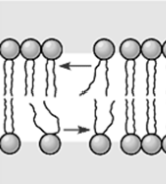
- lateral drift
- un saturated hydrocarbon tails
- move quick
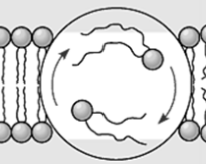
- flip-flop transversly
- rare, cross hydrophobic region
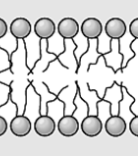
- pack less tightly due to unsaturated hydrocarbon tails
- more fluid
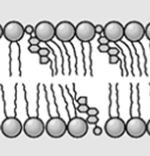
- cholesterol wedge, pack less tightly at low temps
- restrains movement at high temps
- must be fluid to work properly
- Mosaic Structure.
- a collage of different proteins embedded in the fluid matrix of a phospholipid bilayer.
- proteins determine membrane function.
- integral proteins, enter the hydrophobic core of the membrane.
- usually as coiled αhelices.
- hydrophilic parts stick out.
- peripheral proteins, not embedded in the
lipid bilayer.
- bound to integral proteins of membrane surface.
- some attached to cytoskeleton.
- carbohydrates, some are bound to the
membrane surface (forms a glycolipid).
- oligosaccharide = short polysaccharide.
- some oligosaccharides bond to proteins (forms a glycoprotein).
- used for cell to cell recognition:
- ex. provide variation for human A, B, O blood types.
- ex. - tissue transplan
- Selectively Permeable, some substances cross membranes more easily than others.
- cross at different rates.
- some (hydrophobic) dissolve in the lipid bilayer and cross it.
- ex. hydrocarbons, carbon dioxide, and oxygen.
- others (hydrophilic) cross through Transport Proteins.
- Passive Transport - diffusion of a substance across a
membrane, cell does not expend energy.
- driven by concentration gradient.
- osmosis - diffusion of water across a membrane.
- from hypotonic to hypertonic.
- diffusion (hydrophobic, small, and uncharged).
- facilitated diffusion -use of a protein.
- channels and bind andrelease.
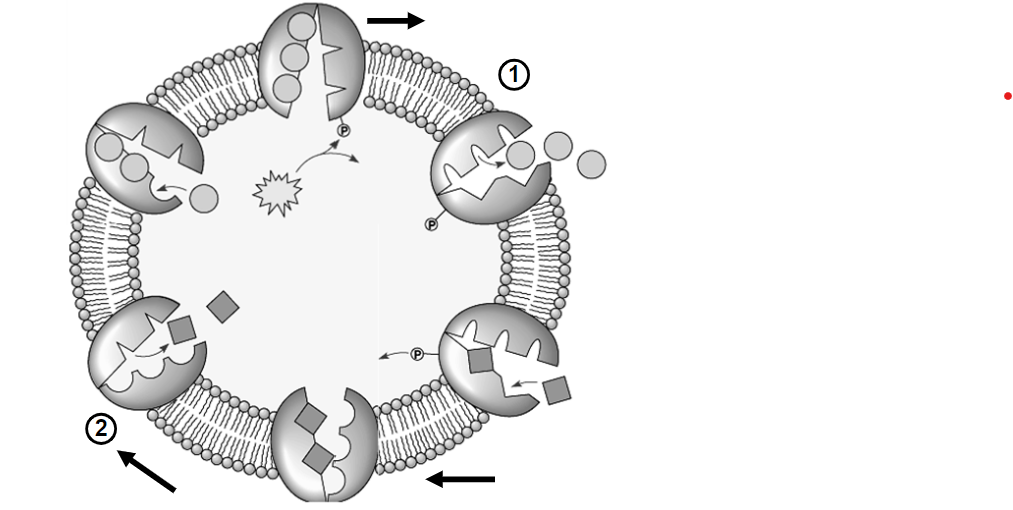
- Active Transport - pumping of solutes against their
gradients, use of a protein and cell expends metabolic energy.
- solute less concentrated → solute more concentrated.
- ATP gives up a phosphate group (phosphorylation) to the transport protein.
- protein changes conformation.
- results in a solute bond.
- solute gets moved across the membrane in bind and release.
- ex. Sodium-potassium Pump - two conformational states.
- a) 3 Na+ out of the cell.
- b) 2 K+ into the cell.
- environment high in Na+ (diffuses in), low in K+ (diffuses out).
- powered by phosphorylation of ATP.
- two forces drive diffusion of ions across membranes:
- i) chemical force - ion concentration gradient.
- ii) electrical force - effect of membrane potential on ion movement.
- membrane potential = voltage (electrical potential energy) across a membrane.
- range -50 to -200 millivolts inside cell due to anions.
- cations tend to get drawn into the cell.
- electrochemical gradient includes both forces on ions.
- ex. sodium-potassium pump → animal cells.
- ex. Proton Pump → plants, bacteria, and fungi.
- actively transports hydrogen ions (H+) out of the cell.
- powered by the phosphorylation of ATP.
- allows for the uptake of nutrients by yet another transport.
- ex. Cotransport - one ATP moves a solute with one pump, that can drive the transport of several other solutes through another protein (cotransporter).
- think of water being pumped uphill (proton pump).
- then performs work as it flows back down (cotransporter).
- plants use cotransporter proteins to actively transport amino acids and sugars, like sucrose.
- H+ keeps building up just outside the cell.
- sucrose rides the coattails of the H+ into the cell.
- How do large moleculescross membranes?
- exocytosis - vesicles fuse with the membrane and release them.
- endocytosis - takes in large molecules, forming a vesicle.
- a) phagocytosis - cellular eating.
- b) pinocytosis - cellular drinking.
- c) receptor-mediated endocytosis:
- receptor proteins.
- fuzzy layer of protein.
- coated pit.
Metabolism
- Metabolism - totality of an organism’s chemical reactions.
- three main kinds of work:
- mechanical work - flagella, cilia, and moving chromosomes.
- transport work - pumping substances across membranes.
- chemical work - synthesis of polymers and monomers.
- ATP - immediate source of energy that powers cellular work.
- adenosine triphosphate:
a) adenine, nitrogenous base.
b) bonded to a ribose.
c) chain of 3 phosphate groups (in contrast, RNA has 1).
- bonds between phosphate groups broken with hydrolysis.
- terminal phosphate bond broken → adenosine diphosphate (ADP) and molecule of inorganic phosphate P i
- yields energy, chemical change to a more stable condition.
- recipient of the phosphate group is phosphorylated.
- The ATP cycle - ADP can also become phosphorylated.
- energy from catabolism, breakdown reactions in the cell.
- occurs very quickly - 10 million molecules of ATP consumed and regenerated per second per cell.
- cellular respiration provides the energetic production of ATP.
Enzymes
- Catalyst- changes the rate of a reaction, without being \n consumed by the reaction.
- Enzyme - catalytic protein.
- ac__tivation energy__ - energy required to start a reaction.
- break the bonds of the reactants, usually heat.
- enzymes work by lowering the activation energy.
- think of climbing a hill to reach a state (absorb energy),
- then roll down (bonds break and new bonds form),
- products result (have less free energy than reactants).
- enzymes allow reactants to climb a smaller hill, → speed up reaction.
- Substrate = reactant.
- ex. - enzyme = sucrase, substrate= sucrose. \n -products = glucose and fructose.
- enzymes are substrate specific (sucrase not act on maltose).
- active site - where enzyme binds to the substrate.
- shape is everything, groove on surface of protein.
- induced fit - enzyme changes shape to fit snug.
- Enzyme cycle.
- water required to yield products.
- products = glucose and fructose.
- enzyme available for another molecule \n of substrate.
- Substrate held in active site by weak interactions:
- hydrogen bonds.
- ionic bonds.
- substrate → product - converted by side chains of only a few amino acids, then product leaves active site.
- enzyme ready for another substrate.
- cycle very fast, 1,000 substrate molecules per second.
- higher reaction rate:
- more substrate, to a point (saturation).
- more enzyme, to a point (saturation).
- Optimal temperature - allows greatest number of molecular collisions without denaturing.
- human enzyme - 35° to 40°, close to body temperature.
- bacteria in hot springs - over 70°.
- Optimal pH - usually pH of 6-8, but some conform to environment.
- pepsin in the human stomach at pH 2.
- trypsin in alkaline part of the intestine.
ex. catalase - found in most tissues to break down H2O2.
- catalase reacts with H2O2.
- H2O2 (substrate) can build up to toxic levels.
- products = water and O2.