L4 - Black Box and Glass Box Testing Summary
Black Box Testing Principles
Goal: Design strong test suites that cover core functionality and component integration, are easy to maintain, and provide reliable, deterministic feedback.
Methods: Equivalence Class Partitioning (ECP) and Boundary Value Analysis (BVA) are used together.
Equivalence Class Partitioning (ECP)
Purpose: Systematically cover the unbounded input/output space and reduce redundant tests.
Process:
Partition the set of possible inputs/outputs () into equivalence classes (, , ) that:
Characterize sets with something in common.
Cover ().
Are disjoint ().
Test one representative input from each class.
Input Partitioning Example (abs(x)): Classes for negative, zero, and positive numbers.
Output Partitioning: Requires identifying inputs that produce outputs in each defined output partition; sometimes better at finding bugs than input partitioning alone.
Boundary Value Analysis (BVA)
Purpose: Find common errors in edge cases, often caused by off-by-one errors (e.g.,
<vs._).Process: Test values on either side of each partition boundary (in-bound, on-bound, and out-of-bound values).
ECP and BVA Application
When to Apply: Most appropriate for fully-specified, client-facing functions.
Benefits: Easy to start, finds high-severity bugs (user perspective), less overfitting to implementation, parallelizes development and testing.
Drawbacks: Relies on well-defined specifications, assertion strength depends on input-output relationship, can make fault localization difficult.
Glass Box Testing
Purpose: Evaluate the effectiveness and completeness of a test suite against the implementation itself.
Contrast with Black Box: Black Box tests against specifications (prior to implementation), Glass Box tests against implementation (after implementation).
Measures:
Test Coverage: Quantifies how much code is exercised by tests.
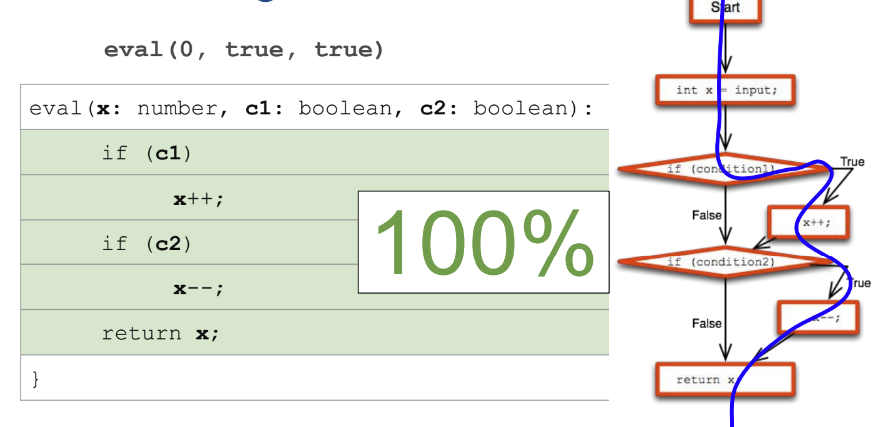
Line Coverage: Measures the percentage of lines executed.
Ex:
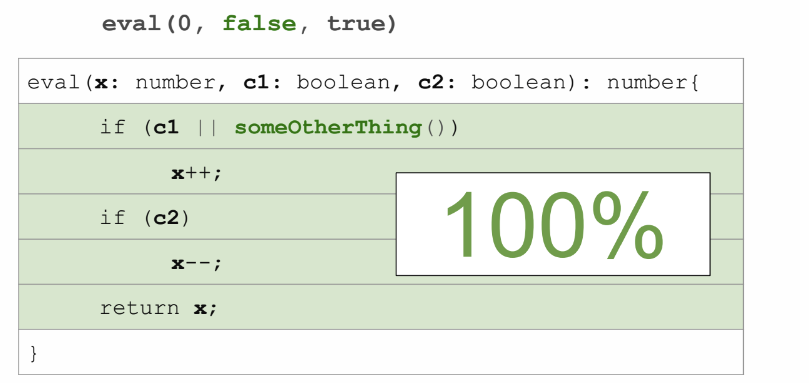
Statement Coverage: Assesses whether each statement was executed, ensuring critical paths are validated.
Ex:
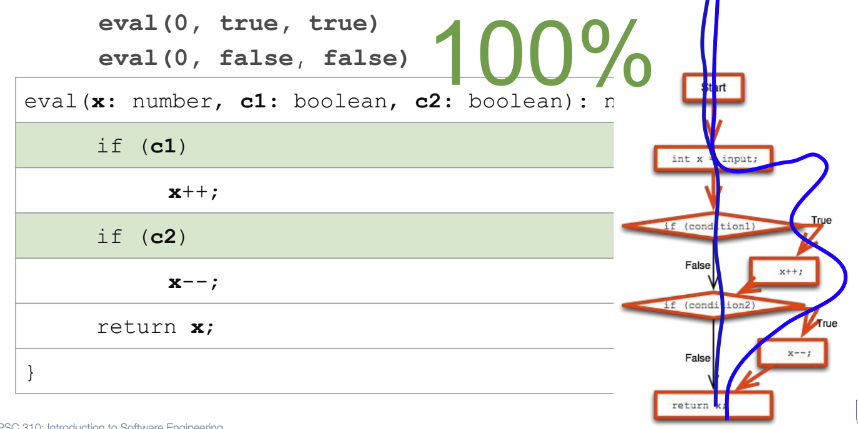
Branch Coverage: Measures if all branches (true/false paths of an
ifstatement) are executed. (if 2 if statements, doesn’t have to be both true and false to get 100%)
Ex:
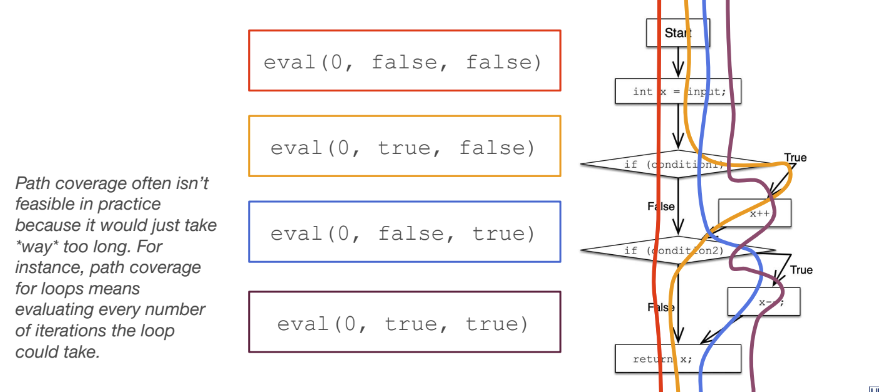
Path Coverage: Measures if all possible paths through the code are executed; often infeasible due to complexity.
Ex:
Mutation Testing: Assesses if tests can detect small, randomly inserted code changes (typos).