Meat Tenderness and Tenderization
Meat Quality
fresh meat must first look good, then meet visual expectation by tasting good
Color and texture affect visual preference
Palatability: Tenderness, flavor, and juiciness affect taste preference
It has been recognized for a long time that muscles within and between carcasses vary in tenderness.
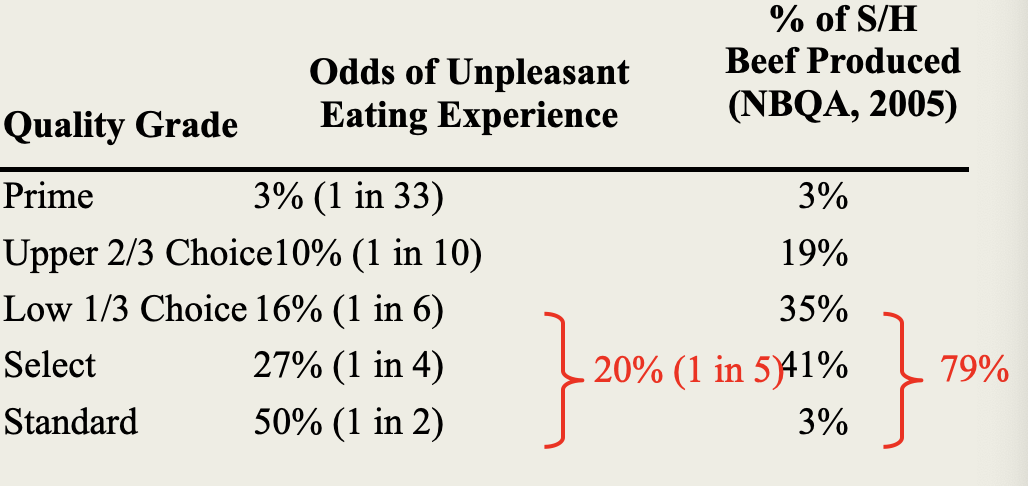
Tenderness is a palatability trait that has the greatest influence on consumer satisfaction and is therefore an economically important trait; thus it is important to know what factors affect meat tenderness and how to manage those factors.
Differences in tenderness among muscles can be attributed to one or more of these effects:
Actomyosin (muscle fiber) effect
sarcomere length: shorter sarcomere = tougher
Muscle fiber diameter: larger fibers = tougher
White fibers
Number of Sarcomeres and Fragmentation: more fragmentation = more tender
Background (connective tissue) effect
stromal protein concentration
EX: collagen, elastin, reticulin
Solubility of collagen (insoluble): decreases tenderness
Size of elastin fibrils
Bulk density and Lubrication (marbling) effect
Connective Tissue Review
connective tissues in meat are affected by the age (maturity) of the animal hormones and muscle function
Maturity and Hormones cause:
Cross-linking between collagen fibers, which decreases meat tenderness
A decrease in the heat solubility of collagen, which also decrease meat tenderness
Muscle Function and Connective Tissues (CT):
Muscles used for locomotion have more CT than muscles used for skeletal support; therefore, muscle associated with the limbs (leg, shoulder, chuck, round) have more CT and are generally more tough than muscles found in other parts of the carcass.
The bulk density/lubrication effect, also known as the marbling effect, is estimated by:
amount of marbling
distribution of marbling
Marbling
Density: fat is less dense, and therefore more tender than muscle and connective tissue
Lubrication: Fat melts during cooking and the oil lubricated the bite during chewing, allowing muscle bundles to slide down during chewing, which is perceived as tender
Juiciness: improves perception of tenderness; water and lipid contribute to cooked meat juiciness, thus, more fat = oil/lipid after cooking
Meat Tenderization
Methods to improve meat tenderness must:
cause post-rigor mortis sarcomeres to be longer (prevent shortening during rigor mortis development)
Cold Shortening: is a cold induced shortening of the sarcomere during carcass chilling
Can be prevented by accelerated glycolysis or slower chill rates early postmortem
Ways to make sarcomeres longer:
Holding carcasses at high temperatures immediately after slaughter (accelerates glycolysis)
Electrical stimulation of hot carcasses at slaughter to deplete ATP (accelerates glycolysis)
Feeding live animals to deposit excess subcutaneous fat (slows chill rate)
Stretching or the maintenance of tension on sarcomeres during rigor mortis onset will prevent or decrease sarcomere shortening
Hung by the H bone so the weight of the leg helps release tension
drawback is less space
Disrupt the integrity of the myofibrils
Endongenous Enzymes: naturally present in meat and cause the proteolysis of meat during aging, which improves meat tenderness.
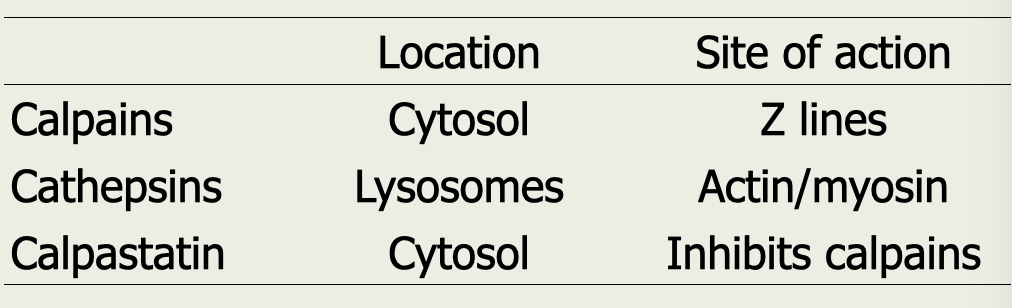
Higher cowpastatin level differences: bos indicus vs. taurus
Endogenous enzyme activity can be enhanced by:
Cooler aging
1 to 6 weeks at 0 to 3 ∞C
Holding/storing meat at high temperatures (postrigor)
20 ∞C for 24 h
Holding/storing carcasses at high temperatures (prerigor)
16 ∞C for 16 h
High voltage electrical stimulation of carcasses
disrupts lysosome causing the release of cathepsin
Calcium chloride solution infusion into meat pre- or post-rigor
consumers are apprehensive towards “injecting meat”
Heat activated – activated during cooking
Examples: Swifts Pro-Ten and Adolf’s Meat Tenderizer
Usually added during marination as an ingredient
Most common enzymes used are derived from tropical plants:
Papain – from papaya
Bromalin – from pineapple
Ficin – from figs
Rhozymes – fungal enzymes with proteolytic activity can be added to meat to improve meat tenderness
Consumers are less apprehensive towards “natural injections”
High Voltage Electrical Stimulation will tear or sever myofibrils, causing an increase in tenderness.
Mechanical severance can come from equipment designed to sever
Blade tenderization
Cubing (more severe)
Disrupt the integrity of the connective tissues