State board screenshot break down
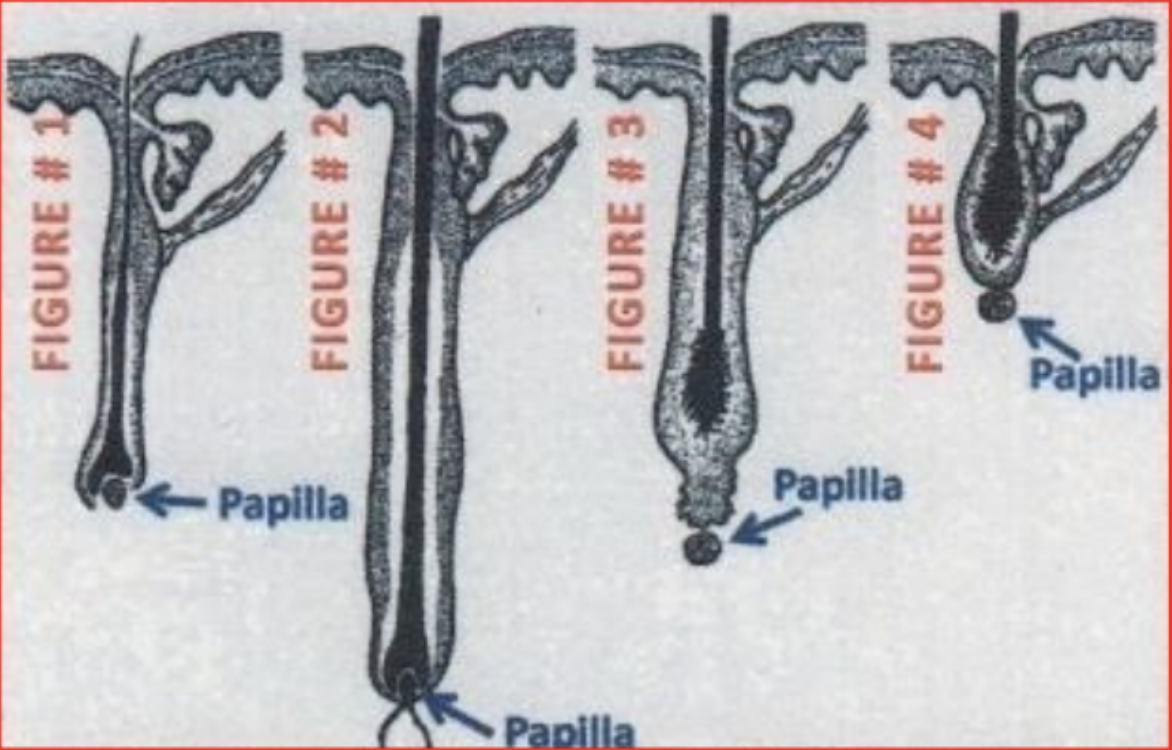
Biology of the hair- anagen→ catagen → telogen → exogen
Anagen phase or active growth period, the hair follicle is at its deepest. It can be divided into two segments: the reconstruction of the hair bulb and the growth of the hair.
The early phase is signaled by mitotic activity of the germ hair, mitotic activity is the continuous process of cell division.
The bulb is the thickest part of the follicle and consists of the lower third of the follicle. The widest diameter of the dermal papilla is the “critical level” and the bulb is separated into two regions, the lower part consisting of the matrix and the upper part of the bulb. the matrix or intercellular material of a tissue, is the basic substance from which all living organisms are made.
Milotic activity of the matrix is diving cells every 13 hours. In the upper part of the bulb, melanocytes supply the cells of the cortex and medulla with melanin granules to give the hair its color. During the anagen phase, it continues to grow until its reached full length, the duration differs according to the location on the body. Typical length of areas in anagen stage in most parts of the body are 4-8 weeks.
Catagen phase or the transitional, regression and the involution phase, is the shortest hair growth phase. Its when the anagen phase is completely done and catagen begins. It begins with the process of melanin production of the melanocytes in the upper part of the bulb. The tip of the dermal papilla shortens, next, the papilla shrinks and the formation of the inner root sheath comes to an end before the mitotic activity stops. No new cells are formed.
The last step in catagen is building the hair club which is anchored into the germ sac. The germ sac or the epithelial is described as two or three layers of germ cells which surround the club, The cells of the germ sac are the seeds for the next generation of hair and are the most important part of the telogen phase.
Telogen phase or the resting and shedding phase, is when the hair follicle is only about one-half to one-third of the length of a growing follicle. The characteristics structures of a follicle in telogen are the club and the hair germ. After resting, a new hair root is regenerated from the hair germ (also called the secondary germ) and with increased mitotic activity grows downward and the whole cycle begins again with the anagen phase.
Exogen phase is considered the return to anagen phase. Considered to be a fourth stage of hair growth. The actual shedding of the hair shaft (club hair) at the end of the telogen phase.
Layers of the hair
Cuticle
Cortex
Medulla
The cuticle is the outermost of the hair layers, it is composed of transparent cells that overlap like scales. The purpose of the cuticle is to protect the inner layers of the hair
The cortex lies below the cuticle, and is the middle layer made up of elongated cells of fibrous tissue, where the pigment (melanin) is. The cortex is also the layer that gives hair its strength and elasticity.
The medulla also known as the “pith or marrow” it is the innermost layer of the hair. It is made out of round cells. Fine hair lacks a medulla. The curlier the hair the stronger the medulla.
Types of hair
Lanugo
Vellus
Terminal
Lanugo hair also called “fetal hair” because it is on infants at birth, is soft, and downy hair. Lanugo hair often sheds a few weeks after birth.
Vellus hair often called “peach fuzz” is fine and short. It is present through adulthood and vellus hair often has no pigment or medulla.
Terminal hair is longer, coarser and pigmented hair that covers the scalp, and is found on the arms, legs and the groin and axillary.
Laser cooling → post cooling, parallel cooling, pre cooling
Pre cooling is cooling the skin before the treatment to reduce pain and minimize thermal damage to the epidermis.
Methods: Ice packs, cooling gels, chilled air devices, or contact cooling systems.
Parallel cooling is cooling applied simultaneously during the treatment process.
Methods: Contact cooling (cooling plates or sapphire tips), cryogen spray, or cooling air systems integrated with the treatment device.
Post cooling is cooling applied immediately after the treatment to alleviate pain, reduce inflammation, and promote comfort.
Methods: Ice packs, cooling gels, aloe vera, or cooling creams.
There are 4 types of epidermal cooling:
clear gel - usually chilled (bulk cooling)
contact cooling - through a window cooled by circulating water, most efficient (sapphire)
cryogen spray - applied immediately before and sometimes after the laser pulse
air cooling - (zimmer cooler) forced cold hair at -34 degrees C, best for tattoo removal
UVA and UVB
UVB Rays
290 to 320 nm
penetrates the epidermis
causes redness of sunburn
most intense between 10 and 4 pm April to October
does not significantly penetrate glass
can cause skin cancer
____________________________________________
UVA Rays
320 to 400 nm
penetrate deeper into the subcutaneous layer
causes lasting skin damage
always present during daylight hours
can penetrate clouds and glass
tanning booths emit UVA 12 times that of the sun
can cause skin cancer
TRT → thermal relaxation time
TRT is the time necessary for a target tissue to cool down by 50 % through transfer of heat to surrounding tissue via thermal diffusion.
Selective destruction is possible if the TRT of the target is longer than the duration of the laser pulse.
Effects of African american skin
hypopigmentation, hyperpigmentation, scarring, keloids, burns and texture change
Anaphoresis and Cataphoresis
Anaphoresis- the use of the negative electrode to force substances into the skin.
anaphoresis → negative pole → vascodialtion→blood circulation→ redness→ erythema →blood circulation→ redness → erythema.
Cataphoresis- an excellent tool for helping the skin gets back to normal (after a galvanic or blend treatment by neutralizing the sodium hydroxide produced in the follicles)
cataphoresis → positive pole→ calms skin → great for after treatment→
pushes product in reticular layer → dense collagen
Anode, cathode, galvanic, thermolysis and the different names for it
Galvanic electrolysis is with a direct current, and destroys the follicle through chemical decomposition. The first person to use electrolysis for hair removal was Dr. Charles E. Micheal, in 1875 for an ingrown eyelash. Paul kree in 1916 for the multiple needle method, using up to 16 needles.
FDA CONSIDERS THIS AS THE ONLY PERMANENT HAIR REMOVAL
Anode is positive and Cathode is negative
Positive pole hydrochloric acid (HCL) and chlorine gas (CI) is made
Negative pole sodium hydroxide (lye / NaOH) and hydrogen gas
The anode (indifferent electrode, buddy bar) is held by the client during treatment.
galvanic names: direct current, galvanic electrolysis
______________________________________________________________________
Thermolysis was created by Dr. Henri Border in 1924, Used with an alternating current, it raises the temperature in the tissue, and destroys the follicle with electrocoagulation and electrodesiccation. The working point is only term used for thermolysis.
Thermolysis names: alternating current, heat, radio frequency (weak) , radio wave, high frequency, short wave, diathermy and flash method.
_______________________________________________________________________
Blend is also called dual action, blend both galvanic and high frequency currents. When heated lye becomes more caustic, the surrounding tissue becomes more porous. Do not perform electrolysis on the abdomen or breast during the last trimester (3 months) of the pregnancy. Do NOT work on the abdomen during the entire pregnancy; but you can work on the lower bikini line during the last 2 trimesters (first 6 months). The blend was created in 1945 by Henri St. Pierre, and Arthur Hinkel. Especially useful in wavy, curly and overly curly hair.
Diabetes
Diabetes Type 1- an autoimmune disease, produces little to no insulin
Also called- juvenile onset diabetes, insulin dependent
Diabetes Type 2- the most common type of diabetes, producing enough insulin but for an unknown reason and this is where we get insulin resistance
Also called- non - insulin dependant diabetes and or adult onset diabetes
Diabetes Gestational- is a form of glucose intolerance that is diagnosed in some women during pregnancy, and more common among obese women and women with a family of diabetes
Symptoms of diabetes:
frequent urination
excessive thirst
unexplained weight loss
extreme hunger
sudden vision loss
tingling or numbness in hands or feet
very dry skin
sores that are slow to heal
more infections than usual
Critical→ Semi-critical→ non critical
Critical items- instruments or objects that come in direct contact with the blood stream or other normally sterile areas of the body. MUST be pre-sterilized, single use, and disposable or subjected to sterilization before use
Semi critical items- items that may come in contact with mucous membranes and non intact skin but do not ordinarily penetrate body surfaces
Non critical items- instruments or environmental surfaces that will come in contact only with intact skin
Skin cancers
Basal cell carcinoma is s slow growing form of skin cancer, but can be very disfiguring. It is the most common of all skin cancers, with the lowest mortality rate.
Appears as:
pearly or waxy
white or light pink
flesh colored or brown
in some cases the skin may be just slightly raised or even flat
Squamous cell carcinoma is the second most common type of skin cancer develops from small, sandpaper like lesions called actinic keratoses, which also are caused by exposure to sun’s UV rays. Develops in the squamous cell of the epidermis. Appearing on sun exposed areas such as the head, neck, ears, trunk, lips.
Appears as:
red
crusted
scaly patch on the skin
a non healing ulcer
firm red nodule
Malignant melanoma has the highest mortality (death) rate of the skin cancers. It is a cancer of the pigment producing cells in the skin also known as melanocytes. Melanoma occurs when melanocytes become cancerous grow and invade other tissues. It usually arises from previous existent mole and involves the pigment cells (melanocytes). if not treated early it can spread (metastasize) throughout the body. Only a physician can determine the nature of an abnormal growth whether it is benign or cancer.
Appears as:
asymmetrical
varied colors
irregular borders
Merkel cell carcinoma is a rare and aggressive cancer that affects the merkel cells in our skin, caused by sun exposure and weak immune systems or by the merkel cell virus. Spreads very early and often affects our lymph nodes.
Appears as:
firm shiny
red or purple nodules
Kaposi’s sarcoma is a rare cancer linked to our blood vessels in our skin. Commonly seen in patients who have HIV and AIDS.
Appears as:
red, purple or brown patches
open wounds
(A)symmetry- when half of the mole does not match the other half
(B)order- when the border (edges) of the mole are ragged or irregular
(C)olor- when the color of the mole varies throughout
(D)iameter- if the moles diameter is larger than a pencil eraser
(E)levated- if the mole is raised
Lasers
Ruby → 694.3 nm
The shortest wavelength system used for LHR. First cleared for use by the FDA. melanin has the greatest affinity for the ruby of all LHR devices. ONLY BE USED ON VERY WHITE SKIN. Use a red marker.
Alexandrite → 755 nm
Used on fitzpatrick skin type 1-4 (I-IV)
Use a red marker.
Diode → 800 - 810 nm
Used on fitzpatrick skin types 4-6 (IV-VI)
Use a white marker.
YAG →1064 mm
Capable of treating all the skin types
Use a white marker
IPL- Intense pulsed light → 400 - 1400 nm
IPL machines emit light which is polychromatic, non-collimated, and non-coherent.
Use a white marker
Corpuscles
Ruffini end organ responsible for heat, also detects the skin stretching and deformation, located in the dermis
End bulb or Krause responsible for cold, located in the epidermis and dermis
Meissner’s corpuscles responsible for touch, also can sense low frequency and vibrations to the central nervous system, located in the dermal papillae of the hairless skin
Merkel’s discs is responsible for very soft (light) touch, also texture, located in the basal layer of the epidermis
Pacinian corpuscle is responsible for pressure, also high frequency vibrations, located in the dermis and subcutis
Free nerve endings is responsible for pain, located in the epidermis and dermis
Perifollicular nerve endings is responsible for sensitivity of our hair moving, located in the dermis but inside the papillae
Measurements of electricity
ohm → resistance
watt → power
ampere → strength
volt → pressure
Autoclaves and Dry Claves
Both regulated by the FDA
Autoclaves (steam heat) used for sterilization, uses steam, under pressure, to transfer heat to instruments, killing all bacteria. BIOLOGICAL INDICATORS
Unpackaged items → 15 mins 250°F
Packaged → 15 -20 mins 250° F
Dry clave (dry heat) is used for sterilization, used like an electric oven.
CHEMICAL INDICATORS
Dry heat for 60 minutes at 340°F (170°C)
Dry heat 120 minutes at 320°F (160°C)
Eye safety
Ultraviolet - 315 to 390 nm are absorbed by the lens. (invisible to the human eye)
Far-infrared - 1400 nm to 1mm affects the cornea
Mid-ultraviolet - 180 to 315 nm affects the cornea
Visible - 400 to 700 nm are absorbed primarily within the retina
Class 1- considered to be incapable of producing damaging radiation levels during normal operation.
Class 1M - incapable of producing hazardous exposure conditions during normal operations unless the beam is viewed with an optical instrument, such as an eye-loupe (diverging beam) or a telescope (collimated beam).
Class 2 - emits in the visible portion of the spectrum (400-700 nm) and eye protection is normally afforded by the aversion response. Aversion response is closing the eyes, movement of the head to avoid the bright light.
Class 2M - emits in the visible portion of the spectrum (400-700 nm) and eye protection is normally afforded by the human aversion response for unaided viewing. Potentially hazourdous if viewed with certain optical aids.
Class 3R - potentially hazourdous under some direct and specular reflection (mirror).
Class 3B - may be hazourdous under direct and specular viewing conditions, but is normally not a diffuse reflection or fire hazard.
Class 4 - hazard to the eye and skin from the direct beam, and may produce a diffuse reflection or fire hazard, may also produce laser generated airborne contaminants and hazourdous plasma radiation.
Endocrine disorders
Acromegaly is caused when the anterior pituitary gland secretes too much growth hormone after the normal growth years, causes enlargement of the bones of the hands, feet, jaws and cheeks.
Gigantism is caused by hypersecretion of growth hormone during the early years of life
Dwarfism is caused by hyposecretion
Addison’s disease is caused by a deficaiincy or hyposecretion of adrenal cortex hormones. Cause a loss of appetite, weight loss, muscle weakness, reduced blood sugar and nausea.
Cushing’s syndrome is caused by excessive cortisol levels in the body. features of this syndrome include moon face and buffalo hump. They also have elevated blood sugar levels and suffer frequent infections. Surgical removal of a glucocorticoid producing tumor may result in improvement
Graves disease is an autoimmune endocrine disorder that directly affects the thyroid gland and leads to hyperthyroidism. symptoms of this cause increased heart rate, weight loss, bulging eyes.
Hyperthyroidism or OVERSECRETION of the thyroid hormones, dramatically increases the metabolic rate. people who suffer from this condition lose weight, are irritable, increased appetite and often have protruding eyeballs.
Hypothyroidism or UNDERSECRETION of the thyroid hormone, can be caused by different condition.
Goiter low dietary intake of iodine causes a painless enlargement of the thyroid gland.
Diabetes type 1, type 2 and gestational diabetes.
Causes of hirsutism
Hirsutism is hair in women in a male pattern distribution, commonly on the face, chest, back, and abdomen, due to an increased level of androgens or heightened hair follicle sensitivity to androgens.
Exogenous the use of male hormones and medications with androgen effects will stimulate hair growth
Ovarian: androgen producing tumors; hirsutism progresses rapidly and left untreated leads to masculinization
Mixed gonadal dysgenesis which is a rare condition of genetic origin in which either remnants of testicular tissue are found in an ovary, or testicular and ovarian tissue consists within one gonad; or there is an ovary on one side and testes on the other.
PCOS/Stein-leventhal syndrome or polycystic ovarian disease
Luteinizing hormone (LH)
Cushing syndrome consequence of an excess production of corticosteroids in the adrenal gland, moon face, hump back, fat neck and trunk, diabetes, these individuals also have elevated blood sugar levels and suffer infections
Enzymes Deficiency : Adrenal hyperplasia
Local / Intrafollicular or Idiopathic
Visible light + Ionizing and Non-Ionizing
Visible light is in the spectrum of 400-700 nm and is absorbed primarily by the retina. KTP and Argon lasers are typical visible medical lasers.