Week 3 Readings: Western Civilizations
Europe in the Atlantic World 1550-1660 (pp. 474-484)
Introduction
16th Century Atlantic world became an arena of cultural and economic exchange
brought new diseases
gunpower: the introduction of gunpowder weapons transformed warfare and power dynamics among European nations and indigenous populations.
religious divide
production of items such as chocolate, sugar, tobacco and silver
industry of human trafficking
nearly 11 million enslave Africans
Roman Catholic Church tried to influence the Americas and Asia
Catholic Habsburg Monarchy
tried to enforce religious uniformity which led to the Thirty Years’ War
one of the longest and bloodiest conflicts in history
Tension grew between monarchies and landowning elites
disputed the rights of rulers
The Emergence of the Atlantic World
Mid-16th century - Spanish and Portuguese ventures into Africa, the Caribbean, and South America provoked other European Kingdoms to seek their new colonies
John Cabot
hired by the English Crown to explore the St. Lawrence River
led to the discovery of parts of North America and laid the groundwork for future English claims in the region.
Walter Raleigh
attempted to start an English colony just north of Spanish Florida in 1585, ultimately failing due to a lack of supplies and support from England.
Christopher Newport
Expedition to the Chesapeake Bay in 1606 funded by the Virginia Company (a joint-stock company from London)
“gentleman planters”
A term used to describe the early English settlers in Virginia who were motivated by the prospect of land ownership and wealth, typically coming from the gentry class and often lacking practical farming skills.
goal was to provide agricultural goods for the European market
reserved the right to “subdue” any Indigenous peoples who did not cohere to his terms and demands
Some Native American peoples tried to take advantage of these contacts to trade for goods otherwise unavailable to them
The Columbian Exchange and its Environmental Impacts
fundamental turning point in both human and ecological history
new agricultural products
introduced new species of domesticated animals
encouraged the spread of diseases and invasive plant and animal species (accidentally)
wiped out peoples by force, resettlement, or diseases
90% of the pre-Columbian population of the Americas died of said diseases
smallpox, Cholera, influenza, typhoid, measles, malaria and bubonic plague
brought from Europe
revolutionized the diets of local populations
most typical ingredients used today are from the “Old World”
pre-colonization
Products
Old World → New World
Wheat
Sugar
Bananas
Rice
Wine Grapes
Horses
Pigs
Chickens
Sheep
Cattle
Smallpox
Measles
Typhus
New World → Old World
Corn
Potatoes
Beans
Squash
Pumpkins
Tomatoes
Avocados
Chili Peppers
Pineapples
Cocoa Tobacco
Early Colonial Populations Compared
7 million Africans forced to labor and die on plantations across the Atlantic
only about 1.5 million Europeans that immigrated to the Americas in the 16th and 17th centuries
most of which were men
subject to high mortality rates
1570 - in Spanish colonies, 150,000 settlers were recorded
the owners of plantations lived in cities rather than at the plantation and had foremen to manage the plantations
those who were granted encomiendas (“to entrust” in Spanish) lived on the lands
this system stems from the earlier Reconquista of Spain which was originally made to manage Muslim populations
These lands technically were owned by native peoples but settlers exploited the lands anyway for their profit
treated native workers like serfs (a laborer bound by legalities)
English colonies in New England and the Chesapeake Bay grew quickly
1700 - settlers were estimated to be about 250,000
due to overpopulation in the British Isles
due to the persecution of radical Protestant groups
colonies in Virginia offered additional incentives by granting 100 acres to each settler
due to indentured servitude that brought thousands of “free” European laborers across the Atlantic under terms that made them temporarily enslaved
indenture: the contract that bound a servant to a master for a set period
80% of the people who arrived in the Chesapeake colony were indentured servants, and nearly a quarter of those were women
New Social Hierarchies in New Spain
Viceroyalties: administrative divisions in Spanish colonies, each governed by a viceroy appointed by the Spanish crown, who was the king's representative.
built on the administrative structures of Indigenous governments, these viceroyalties allowed for the integration of local customs and practices, while simultaneously enforcing Spanish laws and culture.
Spanish governments worked closely with local elites to maintain order
Encomienda system was effective because it only built on these established structures and didn’t attempt to uproot existing societies
co-opted the Inca’s system of mandatory service on public work projects
colonists used this to control and exploit native labor
ex., aggressive mining operations
Spanish worked to convert people to Catholicism but didn’t try to change basic patterns of life
led to widespread cultural assimilation
“Pure-blooded” refers to individuals of Spanish descent born in the Americas, often associated with notions of racial hierarchy and social privilege during the colonial period.
These emerging racial categories correspond to class distinctions
Sugar, Slavery, and the Transatlantic Triangle
shortage of labor
Indigenous labor force was decimated by disease
Europe couldn’t offer any workforce either
this led to the capture and trafficking of people from West Africa
The wealth that was sought was not gold or silver, but sugar
Sugar was the center of the triangular trade
Investors in Amsterdam, London, and Lisbon financed the salve ships
Insurance brokers negotiated complex formulas for protecting investments in humans
Bankers offered a range of credit options to new slave traders
Everyone who bought or used products of the slave trade was ultimately implicated
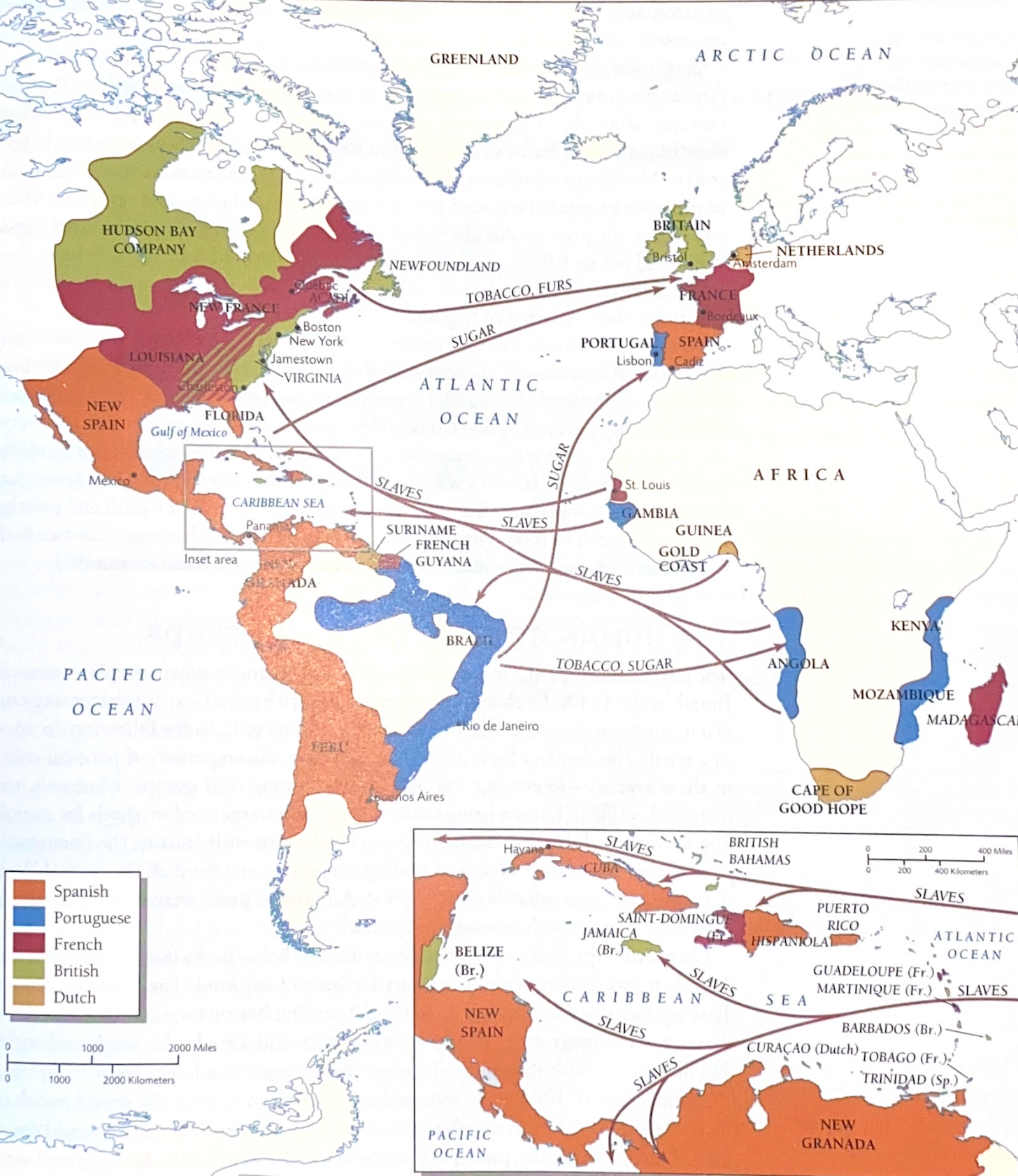
The Human Cost of the Slave Trade
Portuguese were the first to bring enslaved Africans to sugarcane plantations in Brazil in the 1540s
Increased human trafficking called for more systematized methods for corralling, sorting, and shipping
This led to the establishment of fortified trading posts along the African coast, where enslaved individuals were held before being transported across the Atlantic.
Enslaved humans were shackled below decks in small spaces with no sanitary facilities
The mortality rate was low but only because those who were chosen were healthy, to begin with or had already dealt with health issues that they’ve overcome; about 10%
In actuality, after you really look at the process, the mortality rate is closer to 60%
Enslaved individuals began to revolt
led to draconian regimes of violence and punishment which consisted of severe physical beatings, executions, and the implementation of strict laws designed to suppress any further dissent.
sought to liberate themselves
one community formed in 1603 in the hinterlands of Brazil, persisted for over a century, and had about 20,000 inhabitants, this group was known as the Quilombo dos Palmares, which became a symbol of resistance against slavery and colonial oppression.
European Monarchies and Asboluteism 1660-1725 (pp. 522-524)
French Colonialism under Louis XIV
Jean-Baptiste Colbert
due to his policies on trade, France emerged as a major colonial power
encouraged the development of sugar-producing colonies in the West Indies
Saint-Domingue (known as Haiti)
became wealthy due to its lucrative sugar plantations
Sugar became a popular luxury item
Enslavement of Indigenous peoples demonstrated that the profits to be made from slave labor could not satisfy the demand for more workers
led to the kidnapping and sale of African men and women as laborers
the physical differences between the African and European people were enough justification for enslavement
intermarriage and migration still occurred and produced diversity
whites and free people of color
Louis XIV
1685 - established a legal premise for slavery
Code Noir (Black Code)
prohibited non-Catholics from owning enslaved people
banned slave markets and labor on Sundays
prohibited enslaved people from engaging in economic acitivity independently
1700 - France dominated
established and administered as direct crown enterprises
french colonial settlements in North America served as outposts and trading centers
Fishing and fur trades relied on cooperation between all indigenous groups and French settlers, fostering alliances that were crucial for the success of these economic activities.
1750 - enslaved Africans in Saint-Domingue produced 40% of the worlds sugar and 50% of the worlds coffee
1 million of the 25 million people in France lived off the money that came through the trade system
thus the slave colonies in the Caribbean very powerful
added to the prestige of France’s absolutist government
War and Balance of Power 1661-1715 (pp. 529-530)
Tutorial Notes
Approx. 2 months to travel
some missionaries and/or Quakers protested that there is no way to convert the enslaved peoples to Christianity
Antislavery Arguments
Lay
“What, I pray and beseech you, dear Friends, by the tender mercies of our God, to consider, can be greater hypocrisy and plainer contradiction, than for us as a I .2 people, to refuse to bear arms, or to pay them that do, and yet purchase the plunder the captives, for slaves at a very great price, thereby justifying their selling of them, and the war, by which they were or are obtained; nor doth this satisfy, but their children also are kept in slavery, ad infinitum; is not this plainly and substantially trampling the most blessed and glorious testimony that ever was or ever will be in the world, under our feet. . . . Is this the way to convince the poor slaves, or our children or neighbours or the world?” (Lay, 1758)
Equiano
“Does not slavery itself depress the mind, and extinguish all its fire and every noble sentiment? But, above all, what advantages do not a refined people possess over those who are rude and uncultivated. Let the polished and haughty European recollect that his ancestors were once, like the Africans, uncivilized, and even barbarous. Did Nature make them inferior to their sons? and should they too have been made slaves? Every rational mind answers, No. Let such reflections as these melt the pride of their superiority into sympathy for the wants and miseries of their sable brethren, and compel them to acknowledge, that understanding is not confined to feature or colour. If, when they look round the world, they feel exultation, let it be tempered with benevolence to others, and gratitude to God, "who hath made of one blood all nations of men for to dwell on all the face of the earth; and whose wisdom is not our wisdom, neither are our ways his ways."
Wheatly
“No more, America, in mournful strain Of wrongs, and grievance unredress’d complain, No longer shall thou dread the iron chain, Which wanton Tyranny with lawless hand Had made, and with it meant t’enslave the land.”
Rebellion in Jamaica
preceded by the Jamaican maroon revolt in 1733
defeated in 1761 by a counter-attack by white planters
Questions
In the Jamaican rebellion of 1760-61, what did enslaved peoples do to challenge the institution of slavery?
How does the “Description of a Slave Ship” document support the abolition of the slave trade?
In what ways did overseas expansion & slavery influence state formation in Europe?