12.4 - Principles 6 & 7 - Angular Motion
Principles Related to Angular Motion
Two biomechanical principles are related to angular (or rotational) motion: • Principle 6 “Production of Angular Motion (Torque),” and • Principle 7 “The Conservation of Angular Momentum”
Principle 6
PRODUCTION OF ANGULAR MOTION (TORQUE) “Angular motion is produced by the application of a force acting at some distance from an axis; that is, by torque.”
Interpreting Principle 6
If an eccentric (or “off-centre”) force is applied to a body, the force tends to make the body rotate about its axis. • This “turning effect” is known as torque. • The magnitude (size) of the torque depends on three factors.
Factors That Affect the Amount of Torque
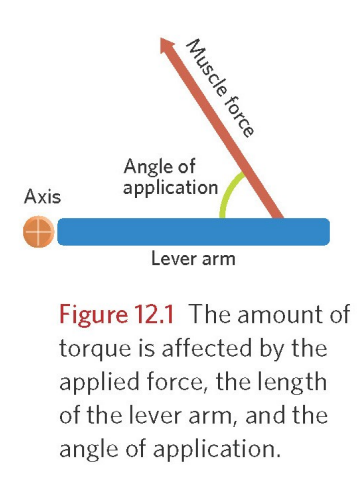
The amount of toque that is generated is affected by three factors: • The applied force, • The length of the lever arm, and • The angle of application of the force, as shown in the diagram.
Example of Principle 6 in Action
In the generation of torque, the length of the lever arm and the angle at which the force is applied are very important. • As might be expected, it is easiest to initiate rotation when the force is applied as far away as possible from the axis. • It is also easiest to initiate rotation when the force is applied perpendicularly to the lever arm (e.g., when unfastening a bolt with a socket wrench).
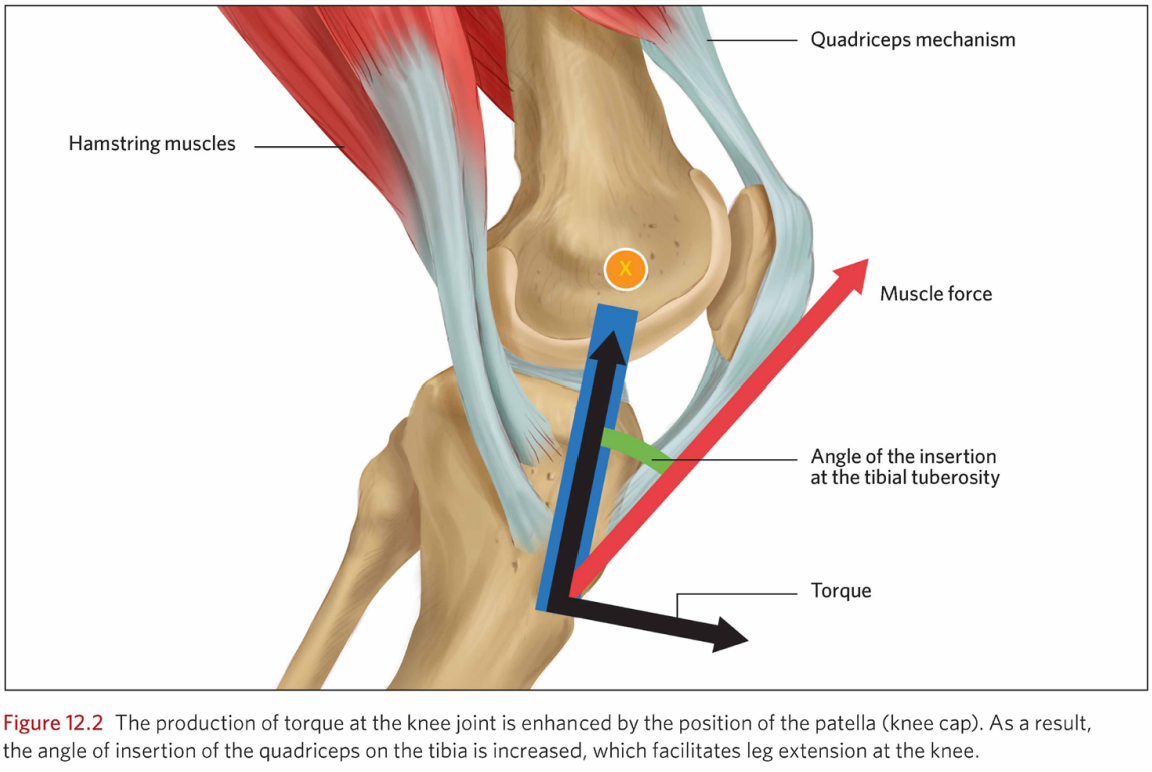
Generation of Torque at Human Joints
Principle 7
THE CONSERVATION OF ANGULAR MOMENTUM “Angular momentum is constant when an individual or object is free in the air.” (Angular momentum is the quantity of motion contained within an object or a body.)
Interpreting Principle 7
Many physical activities—trampoline, gymnastics, tumbling, aerial skiing, aerial snowboarding, and diving—require individuals to be airborne and in a state of free fall. • Angular momentum is the product of the rate at which the athlete is rotating—or her angular velocity—and the extent to which her body resists angular motion. • This resistance to angular motion is known as the “moment of inertia.” • The farther a body’s distribution of mass from the axis of rotation, the greater is the body’s moment of inertia.
Adjusting the Moment of Inertia
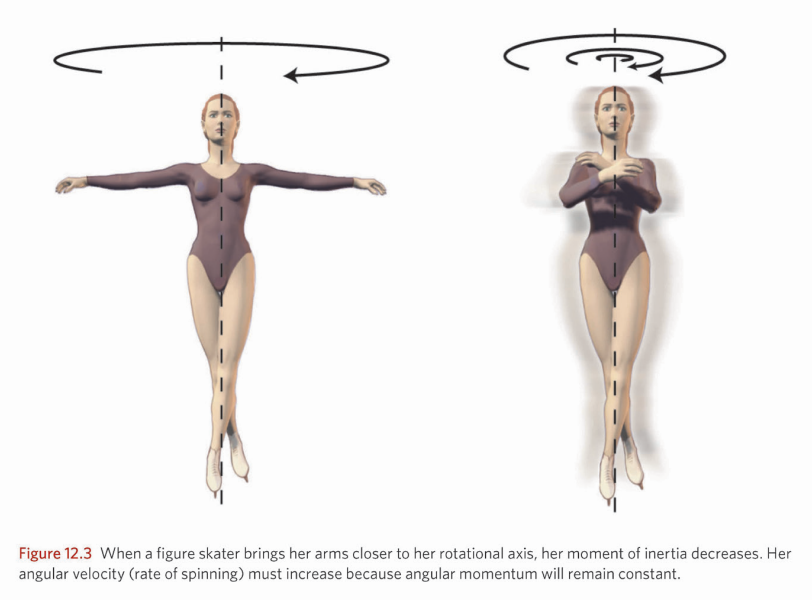
Successful rotational maneuvers in many sports involve adjusting (i.e., either minimizing or increasing) the moment of inertia. • The moment of inertia is minimized, for example, when a trampolinist’s arms and legs are brought close to the athlete’s axis of rotation in what is commonly referred to as a tuck position. • In this position, the trampolinist rotates rapidly. • To slow the rate of rotation, she simply needs to extend her arms and legs away from her axis of rotation. • In other words, she can adjust her moment of inertia by controlling how far her mass is distributed from her axis of rotation.
Examples of Principle 7 in Action
A high diver and a figure skater can adjust her moment of inertia by controlling how far her mass is distributed from her axis of rotation. • By pulling her arms and legs close to her body, the diver can decrease her moment of inertia. • As the moment of inertia changes, angular velocity also changes—by speeding up. • As the diver approaches the water, she straightens out, which reduces the rate of rotation just before entry into the water. • The same angular forces are at play in the case of a figure skater’s spin.
The Law of Conservation of Angular Momentum
The principle underlying the angular forces at play in a diver’s rotation or a figure skater’s spin is known as the law of conservation of angular momentum. This law states: “THE TOTAL ANGULAR MOMENTUM OF A ROTATING BODY REMAINS CONSTANT IF THE NET TORQUE ACTING ON IT IS ZERO.” • A rigid spinning object continues to spin at a constant rate and with a fixed orientation unless influenced by the application of an external torque.
Example of the Law of Conservation of Angular Momentum