Lecture 8: Cognitive Dissonance Theory
Cognitive Dissonance
A state of discomfort that arises from holding two different beliefs or values
A feeling of mental tension
State of uneasiness
Motivational drive to reduce inconsistency
“Concerned with how perception and cognition influence and are influenced by motivation and emotion.”
Leon Festinger
Known for cognitive dissonance theory and social comparison theory
Other contributions: group behavior, self-evaluation, and attitude change
Definition of Terms
Cognition
Belief, attitude, or knowledge about oneself or the environment
Cognitive Dissonance
Conflict between related but inconsistent beliefs or behaviors
Leads to psychological discomfort
Example:
A person reminds others that “smoking is harmful”, while they smoke regularly
Animal cruelty is wrong…but also so delicious
Core Assumptions
Inconsistency —> psychological discomfort
People are motivated to reduce discomfort
People avoid information that increases dissonance
Magnitude of Dissonance
Not all conflicts feel the same
Depends on:
Number of conflicting beliefs
Importance of those beliefs
More important conflict = stronger discomfort
Stronger dissonance = faster response
Festinger’s Reduction Strategies
How to reduce dissonance?
Changing behaviors - Removing dissonant cognitions
Changing beliefs - Change dissonant cognition
Adding justification - Add consonant cognitions
Reducing importance - Reduce importance of dissonant cognitions
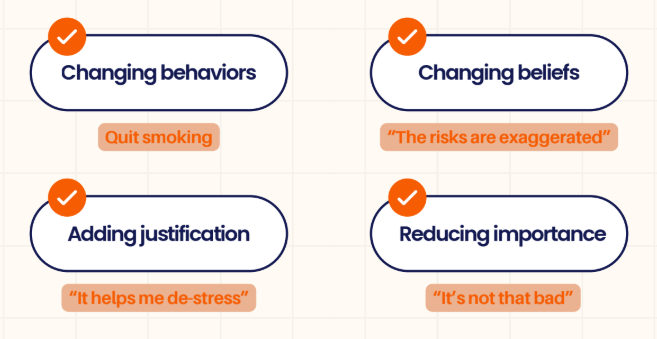
Other Observed Strategies
Specific Ways that Festinger’s Four Methods are Applied
Attitude change
“Smoking isn’t that harmful”
Trivialisation
“The risks aren’t that serious”
Self-affirmation
“At least I’m healthy in other ways.”
Denial of responsibiltiy
“I was influenced by my friends.”
Distraction
Avoid thinking about smoking risks
Rationalisation
“Smoking helps me deal with stress.”
Cognitive Dissonance as a Persuasive Tool
Discomfort motivates change through:
Change in beliefs
Change in behavior
Justify actions
Cognitive Dissonance & Aristotle
Aristotle’s Means of Persuasion
Logos (Logic)
Shows Contradiction
Ethos
Makes it uncomfortable
Pathos
Audience accepts the message
Four Phases
Cognitive Discrepancy
Dissonance
Motivation
Discrepancy Reduction
Summary:
Think of cognitive dissonance as that uncomfortable feeling you get when your actions don’t match your beliefs. For example, if someone says “smoking is harmful” but still smokes, or believes animal cruelty is wrong but enjoys eating meat, they experience a kind of mental tension. This idea was developed by Leon Festinger, who explained that our thoughts (called cognitions—beliefs, attitudes, or knowledge) are supposed to be consistent. When they’re not, we feel uneasy, and that discomfort actually pushes us to fix the inconsistency.
Not all dissonance feels the same—the more important the belief and the more conflicts involved, the stronger the discomfort. Because people naturally want to reduce this tension, they respond in different ways. They might change their behavior (quit smoking), change their belief (“maybe it’s not that harmful”), justify their actions (“it helps me deal with stress”), or downplay the issue (“the risks aren’t that serious”). Other common reactions include denial, distraction, or self-affirmation—basically anything that helps them feel less conflicted.
In communication and public speaking, cognitive dissonance becomes a powerful persuasive tool. A speaker can intentionally point out contradictions in the audience’s beliefs or actions (this uses logic or logos), make the audience aware of the inconsistency (which creates discomfort tied to ethos, or credibility), and then guide them emotionally (pathos) toward accepting a new idea or behavior. The process usually follows four steps: first, the audience notices a discrepancy; then they feel dissonance or discomfort; this creates motivation to resolve it; and finally, they take action to reduce the inconsistency.
So, in simple terms, cognitive dissonance explains why people change: when we feel that inner conflict, we are driven to resolve it—and skilled speakers can use that feeling to influence beliefs and actions.