Cognitive Development
Vocabulary:
Classical conditioning: A form of learning that consists of associating a neutral stimulus with a stimulus that always evokes a particular response. Can be used to help an infant suck/feed when a breast is present
Neural Stimulus (NS): Stimulus that evokes no reflexive response
Unconditioned Stimulus (UCS): Stimulus that evokes a reflexive response
Unconditioned Response (UCR): Reflexive response elicited by the UCS
Conditioned Stimulus (CS): Stimulus repeatedly paired with with UCS to elicit a CR
Conditioned Response (CR): Originally reflexive response (UCR) that cones to be elicited by the CS
Instrumental conditioning: A form of learning that consists of associating consequences of behavior, involves reinforcement and punishment
Reinforcement: Increases probability of behavior occurring again, presents a desirable stimulus
Punishment: Reduces the probability of a behavior occurring again, presents an unpleasant stimulus or removes something desirable
Positive (operant): A stimulus that adds something, can apply to positive or negative, example candy or extra chores
Negative (operant): A stimulus that removes something, can apply to positive or negative, example taking away a phone or making loud noises to be embarrassing
Positive punishment: Used in operant conditioning, though shown to be the least effective
Imitation: Learning through observation of others’ behavior, infants are born with the ability to imitate facial expressions and finger gestures. This is cross-cultural, and demonstrated in some species of apes. Harder to induce in older infants, leading to the thought that it might be a reflex. Starts with simple movements, but capacity improves with age to learn instrumental skills and social conventions
Mirror neurons: Fire in the brain when an action is seen and when it is performed, could be an explanation for imitation in infancy
Constructivism: Reinforcement isn’t required, kids are able to naturally construct knowledge through interactions with their environment
Scheme: An organized was of making sense of experiences, build through adaptation
Adaptation: Different ways to interact with the environment and learn
Assimilation: Uses current schemes to interpret the external world, happens during equilibrium, part of adaptation
Accommodation: Creates new schemes to adjust old ones to better fit the environment, happens during disequilibrium, part of adaptation
Organization: The process of rearranging and linking schemes, part of adaptation
A-not-B error: When an infant sees an object hidden behind another, and then sees the object moved to a new location, and still believes the object is in the initial location
Object permanence: The understanding that an object continues to exist when out of sight, develops during the sensorimotor stage though infants will display the A-not-B error while this develops
Deferred imitation: When a behavior is copied after it is seen as a tool to learn about the world around them, the copying occurs later after observed. For example, going to a restaurant and then pretending to be a server at home
Symbolic representation: The perception of an object as both an object and a symbol, for example a US puzzle as a puzzle (object) and a representation of a larger idea (country), develops around 3 years
Egocentrism: The inability to distinguish others’ viewpoints from one’s own, the false belief that one’s thoughts are everyone’s, tested via 3-mountains task
Three mountains task: There is a 3D representation of mountains with different objects that are perceived from different angles around the table. Asks a child what they see and what another angle (represented by a doll) might see
Animistic thinking: The belief that an inanimate object has lifelike qualities, may apply to dolls and stuffed animals
Conservation: The idea that an object’s properties remain the same despite changes in appearance. For example, two identical containers with water that the child recognizes are identical, then when one container is poured into another container so that the amount of water is the same but the water level is different (thinner glass), the child will incorrectly identify that the new container has more (it has the same amount). There is a lack of backward thinking
Class inclusion: The struggle to organize and group objects into classes and subclasses based on differenced. For example, if there are 4 blue flowers and 12 red, if asked if there are more red flowers or flowers, they will say red flowers (red flowers is a subclass of flowers)
Seriation: The ability to order items along a quantitative dimension, efficient at 6-7
Transitive inference: the ability to seriate mentally, appears around 7
Spatial reasoning: The ability to mentally move oneself to another physical perspective, use mental rotations and directions
Hypotheticodeductive reasoning: A hypothesis is developed and then tested through a combination of variables and isolation, uses logic and testable inferences
Propositional thought: Evaluation of logic of verbal statements without referring to real-world information, hypotheticals without accompanying real world examples
Continuum of acquisition: The idea that the mastering of concrete operational tasks is gradual, goes against the ideas of Piaget
Sociocultural theory: Proposed by Lev Vygotsky, how cognitive development is based on social interactactions and rapid language acquisition, growth in language leads to changes in thinking
Guided participation: Part of sociocultural theory, includes things like scaffolding. More knowledgeable individuals for a task help those who are less knowledgeable (infants) to succeed at a given task. For example, learning to ride a bike an older sibling who is a pro will help a younger sibling to learn to ride the bike. Helps with skills in the zone of proximal development
Zone of proximal development: Where a skill isn’t mastered when done on it’s own, but can be achieved with help from someone with more knowledge. This is where learning occurs
Scaffolding: A form of guided participation, where the amount of support is tailored to the progressive skill level of the learner, used a lot in education. First, a lot of help may be required, but as learning continues less may be required
Private speech: Talking to oneself, thought to be important by Vygotsky for self-guidance, as a foundation for higher cognitive processes. Piaget viewed it as egocentric speech. As development grows, this is lowered, done more internally
Information-processing theories: Theories about how the brain develops and processes information. Emphasizes the brain, the brain gets inputs in the form of sensory information that are processed in the brain, which outputs behavioral responses. The mind is a manipulating system. There is a large focus on brain structures and the function of cognitive systems. Says development is gradual and over time (continuous)
Capacity: How much information the brain can store at once, tied to processing speed in informational-processing approaches, grows during development
Processing speed: How fast the brain can carry out functions, grows during development
Executive function: Higher order cognitive abilities, like organization, planning, inhibition of distracting information, regulating attention. Grows during development
Sustained attention: The ability to fixate attention on one thing, happens with voluntary information processing. Necessary for goal-directed behavior. Can be seen in infants based on decelerated heart rates (low HR when attention is being sustained), though as growth continues this is less of an indicator. For infants, this is when information is being encoded and there is more demonstration of things previously recognized, they are more resistant to distractors. With ageing, ability to maintain this increases (with frontal lobe development). Experiences have a large impact, more complex play helps develop this. Scaffolding can help redirect this once distracted to a task. Tied to selective attention gains
Selective attention: The ability to decide on what part of an environment should occupy attention, relevant to task completion (as they require attention). Improves with age, best with no distractions
Adaptable attention: The ability to inhibit distracting information. Distracting stimuli can be internal or external, for example thoughts or someone nearby tapping a pencil. This can be used as a predictor of future success, ability in kindergarten is linked to reading/math achievement in high school. Can be tested via the Wisconsin Card Sorting Task (simplified for children) where children succeed at around 5
Planning: A higher cognitive function that improves with age, the ability to think out a sequence of actions and allocate attention to reach goals. By the age of 5 things like getting groceries from a list can be done. Training helps with this (the use of tools and patterns for things like legos). Exposure to things like recipes also help develop ability to follow steps in a certain order
Memory span: The amount of things that can be remembered in succession, increases over time from 2 items at 2 years old, first graders can remember 4 and adults can remember more like 6. This is also improved when told to remember them consciously (attentive intention) and there are no distractions
Recognition: Develops early in infancy, the ability to notice a stimulus that is identical/similar to one previously experienced, shown via habituation (familiarity preferences indicate this has occurred, novelty preferences also indicate this as they can tell the difference). This ability is fully developed by pre-school
Recall: The mental representation of absent stimuli, generating memories of things, first present at 6-12 months and can be tested with Piaget’s object permanence task though otherwise really hard to test, development lags behind the growth of recognition, improvement is also tied to language development as things are easier to tie into ideas presented in language
Language: Helps organize information, gives ideas labels. As this develops, so does recall memory
Episodic memory: The recall of personally experienced events
Script: Episodic memory of repeated events that is in a causal order, such as hygiene tasks, things that repeat. There is a sense of order, certain things happen at specific times. Helps organize events, predict what might happen next, recall how things are generally done, guide pretending, and plan future events under a set guideline
Autobiographical memory: A kind of episodic memory that contains information about the self, for personally meaningful one-time events. To form, this requires self-image and the ability to integrate events into time-organized life stories
Self-image: The idea that self is unique and difference from others, develops around the age of 2, required for autobiographical memory
Infantile amnesia: Describes how few of us can remember things from before 3 years of age. Can be caused by lack of brain development (as the frontal lobe and hippocampal connections haven’t formed yet). Could also be caused by lack of language development, as memories are retrieved based on language organization
Suggestibility: The ability to influence memory and potentially create false memories, more severe under power dynamics or kids trying to please adults
Core knowledge theories: A collection of theoretical perspectives that share core ideas about how development takes place, ideas include how we are all born with innate knowledge systems that allow for early and rapid knowledge acquisition. Babies are ‘too quick’ to acquire all of the knowledge after birth, so there must be cognitive systems present at birth to help interpret information accurately and allow for engagement in enhanced cognitive processes. Development is also domain specific, there are multiple knowledge systems in order to properly interpret information early in life.
Physical knowledge domain: Understanding of objects and impact on other objects (two objects moving towards another will bounce, not pass through each other)
Numerical knowledge domain: Objects can be kept track of, basic addition and subtraction
Linguistic knowledge domain: They can quickly learn language importance and have the ability to use it
Psychological domain of knowledge: Others are unique being with different mental states and ways of thinking
Biological domain of knowledge: The difference between living and non-living, along with biological processes like the need to eat food
Violation-of-expectation method: Uses to test infant knowledge, an infant will look longer at an event it perceives as “impossible” or “surprising”. One example is a carrot passing behind a wall with a window, but the window is false and shows no carrot. Some studies have one impossible event and one realistic one, they will show a reaction to the impossible one
Piaget stages: Provide a general theory of development, invariant, go in a specific order and are universal and apply everywhere in the world
Sensorimotor stage: Birth to 2 years, kids learn via circular reactions and lead to new scheme development, substages
Circular reaction: Something is attempted to be recreated, to create a new scheme around it. For example, if an infant drops something accidentally and it is handed back to them, they will them intentionally drop it
Reflexive schemes: Birth to one month, learning via reflexes
Primary circular reactions: 1-4 months, early motor control and integrates reflexes, behaviors are motivated by basic needs, centered around their own body
Secondary Circular reactions: 4-8 months, direct behavior outwards
Coordination of secondary circular reactions: 8-12 months, complex actions and goal-directed behavior, master object permanence, A not B error is present
Tertiary circular reactions: Overcoming of A-not-B error, 12-18 months, objects explored through novel actions, correlates with frontal lobe cortex
Mental representations: 18-24 months, developing internal depictions of objects and places they interact with, deferred imitation, more make believe play
Pre-operational stage: 2-7 years, there is a very large increase in the amount of information they can mentally represent, exponential growth of knowledge including things like speech and language. Previous sensorimotor activity leads to internal images, which then get word labels applied that help with language acquisition and mental images of the world around them. Make believe play takes off, which allows for the practice and strengthening of schemes. Over time, play is less self-centered (rather connecting with peers) and more detached from life. There is symbolic representation, which can be aided by adults. Limitations in this stage include egocentrism, animistic thinking, conservation, class inclusion
Concrete operational stage: Ages 7-11, thought is more logical, flexible, and organized. Real world information is relied on along with things that can be interacted with, passing of conservation stages as evidence of operations (decentration, reversibility), seriation develops and so does spatial reasoning
Formal operational stage: Ages over 11, abstract, systematic, and scientific thought. Includes hypotheticodeductive reasoning and propositional thought
People:
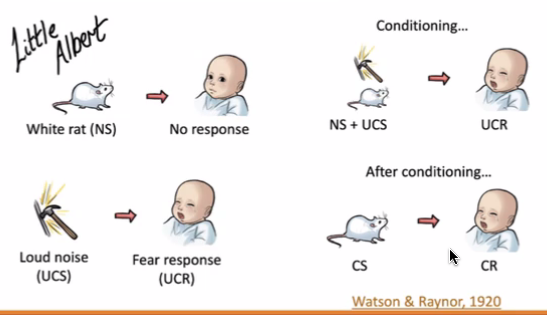
Little Albert: Was taught to fear white rabbits via classical conditioning. Was shown prior to have no fears of any animals. A steel bar was struck by a hammer whenever he reached for a white rat, and after 6 times he was thought it fear them. He demonstrated this, and then it was demonstrated that he had generalized this fear, to white animals in general. White rat starts as a neutral stimulus (NS), the loud noise is the unconditioned stimulus (US)
Watson: Carried out the Little Albert study, a behaviorist
Rovee-Collier + Bhatt (1993): A baby kicks and makes a mobile move, shows that kicking increases as it is positively reinforced. This was also remembered, as 3 month olds remembered after 1 week and 6 month olds remembered after 2 weeks
Alfred Binet: Created a test to determine ‘mental age’ to reflect current cognitive ability, if age was less than actual the child needed additional help. Tested many different categories.
Jean Piaget: Created a framework for cognitive development, went against behaviorism, constructivist, believed in adaptation, created states of development. Believed in discontinuous development, though recognized continuous aspects. Very influential past and today, though weaknesses include his vagueness about mechanisms that produce cognitive growth, and his underestimation of kid’s ability to contribute to the social world. He also exaggerated egocentrism and animistic thinking. Evidence against him includes things like the roles of culture and schooling on task performance. Believed in the importance of make-believe play
DeLoache (1987): Did studies around Piaget, showed symbolic representation development by 3 in the pre-operational stage. In a model room, a mini-snoopy is hidden behind a pillow and shown to a child. In a large room that looks exactly the same, the 2.5 year old cannot find the big-snoopy in the same location, but the 3 year old can
Lev Vygotsky: Proposed sociocultural theory, died early but very influential. Focused on how social interactions were the primary force in cognitive development (parents, teachers, friends, family). He said language was a very important tool to support cognitive development. Believed things like guided participation could help with the zone of proximal development and scaffolding. Thought that make-believe play was important (as a zone of proximal development where skills were self-advanced based on ideas), and helped learn social norms/expectations, thinking before acting, and other social developments. He thought that toddlers weren’t interested in make-believe play without encouragement from someone older (parent, sibling). He thought private speech was important. His theories help to explain cultural diversity and the role of teaching in development, but weaknesses include. Weaknesses include how he doesn’t explain the impact of biology, and the vague explanation of change and what drives it, what helps a child be ready to acquire knowledge.
Simcock & Hayne (2003): Did an experiment with a “magic shrinking machine” where kids would play with a toy and them it would be put into this “machine” where the same toy would be found by much smaller. This is a new and novel experiment. Tested the next day, kids would be asked what happened the day before and then they would pull out the machine and be asked to show the researchers how to use it. For kids under 3, it was difficult to describe how to use the machine, with this sharply increase between 3 and 4 years
Finnila et al. (2003): Did a study where 4/5 and 6/7 year olds were read a story and asked to recall it a week later. They used either low/high pressure situations, both times implying abuse to suggest an answer (“He took of your clothes, didn’t he?) despite knowing that it didn’t actually happen. In high pressure (“All your friends said this happened”), found that suggestibility was present across all ages, and higher under high pressure situations.
A child may be at equilibrium but comes across a dog (Unknown), they go through accommodation to create a new scheme for a dog. Next time they see another dog, this dog is assimilated into the scheme. Then there is a first encounter with the cat, this could be attempted to be assimilated, though the scheme doesn’t match it so accommodation creates a new scheme
The Violation of expectation method is used to show object permanence as early as 3.5 months (drawbridge experiment). With numerical knowledge, a mouse is shown → screen up → mouse added → screen drops → two objects/one object. One object is “impossible” event. Infants can count/distinguish up to 3 in a ratio manner (1 v 2 v 3 or 2 v 4 v 6).
Weaknesses of core knowledge systems are hotly debated, based on the fact it could all just be a mind that is able to process the environment and all of the information in early months does everything that all core knowledge systems explain. It says that nature and nurture interact, but not how, and widely takes from nature. The language used is also controversial, like instead of “surprised” it could just be the baby just being interested instead of shocked. There is also no aspect on how other individuals might impact learning, such as a parent or teacher (nurture).
Capacity for information increases over time, more things can be remembered. Information processing as a whole becomes faster, as cognitive development progresses
Due to infantile amnesia, kids cannot be used as eyewitnesses in courts. They are likely to form false memories and repeat them, which is why if they are used it has to be immediate. They are better at reporting on distinctive and personally relevant events. Accuracy can be improved with training (in-court schools, with practice interviews to get comfortable with the setting, encourages “I don’t know” when they don’t know to avoid giving false information just to please adults
Researchers are progessively getting better at distinguishing parts of cognitive development (different kinds of memory), and when these are developed. This is also really hard to pool together all of the knowledge gained from information processing theories to get an idea of cognitive development and how it impacts development. Age/skill are distinguished, but the distinguishments between nature/nurture aren’t made.