biomes
1.2: Terrestrial Biomes
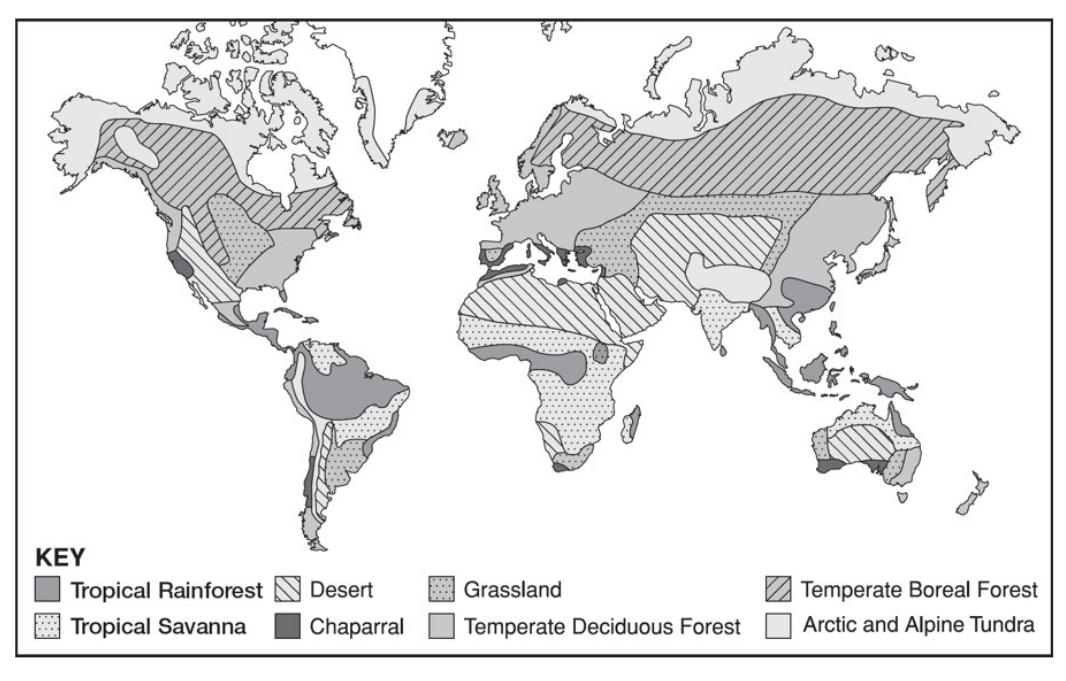
Biomes: These are major regional or global biotic communities characterized by dominant forms of plant life and the prevailing climates
Temperature and precipitation are the most important determinants of biomes.
Many places on Earth share similar climatic conditions despite being located in different areas.
Most terrestrial biomes are identified by the plant life primarily found within them.
The geographical distribution of the various terrestrial biomes is controlled primarily by the average air temperature and the amount of rainfall the biome receives.
Deserts
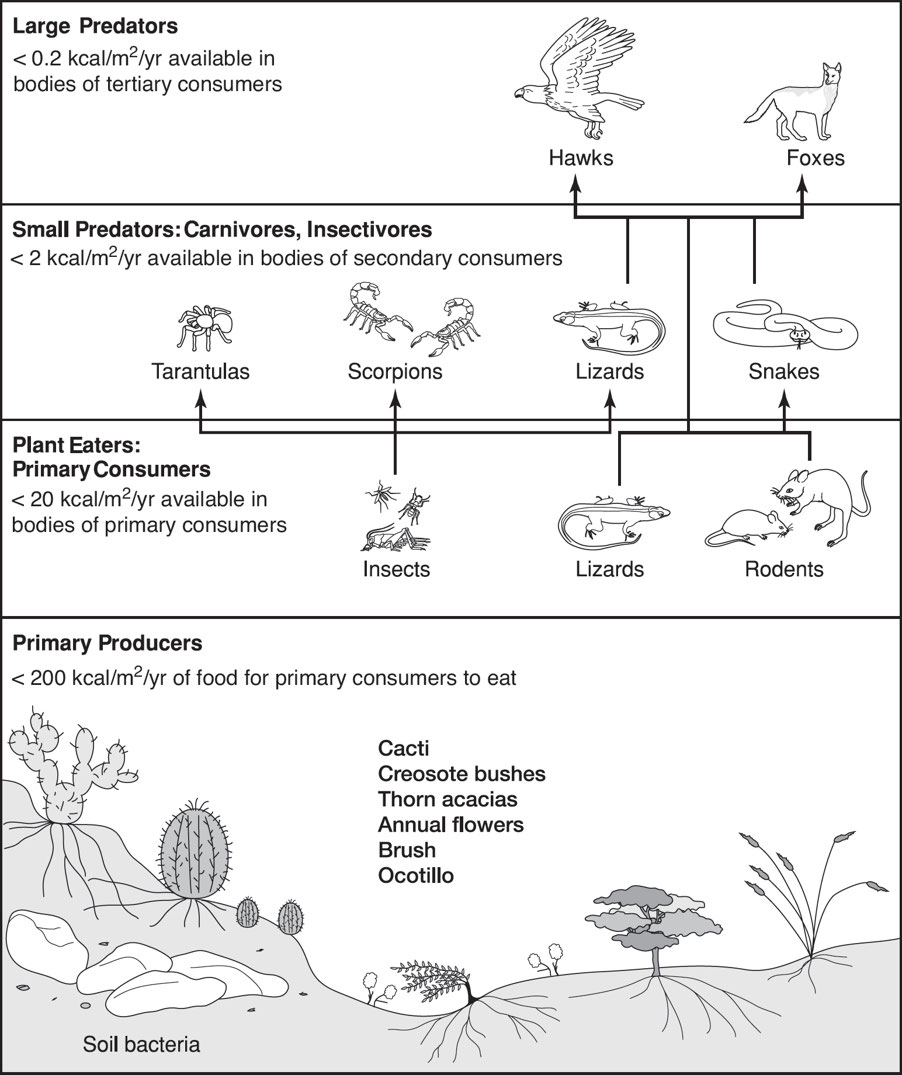
Deserts: Defined in terms of the amount of rainfall they receive, not temperature.
They cover about 20% of Earth’s surface and occur where rainfall is less than 20 inches (50 cm) per year.
Daily extremes in temperature result from exceptionally low humidity as water vapor tends to block solar radiation.
Most deserts are located between 15° and 35° north and south latitudes.
Arctic tundra is a cold desert due to the low amount of rainfall it receives yearly.
Succulents
Plants that have fleshy leaves or stems that store water.
They have:
deep roots to tap groundwater;
open stomata at night;
shallow roots to collect and store water after short rainfalls;
small surface areas exposed to sunlight;
vertical orientation to minimize exposure to the sun; and
waxy leaves to minimize transpiration.
Cactus
They have sharp spines that create shade, reduce drying airflow, discourage herbivores and reflect sunlight.
They also secrete toxins into the soil to prevent interspecific completion.
Wildflowers
They are are dependent on water for germination;
They have short life spans;
They perform their entire life cycle from seed to flower to seed within a single growing season; and
They store biomass in seeds.
Desert animals:
They are generally small.
They are often nocturnal.
They have small surface areas.
They spend time in underground burrows where it is cold.
Aestivation: A summer hibernation.
Forests
Forests cover about one-third of Earth's land surface, mostly in North America, the Russian Federation, and South America, and account for 75% of gross primary productivity and plant biomass.
Ecozones like boreal forests near the poles and tropical forests near the equator are formed by forests at different latitudes and elevations.
Forest Layers
Closed canopy: Tree crowns cover more than 20% of the ground’s surface.
The majority (80%) of the forest biome.
Open canopy: Tree crowns cover less than 20% of the ground surface.
Tropical Rainforests
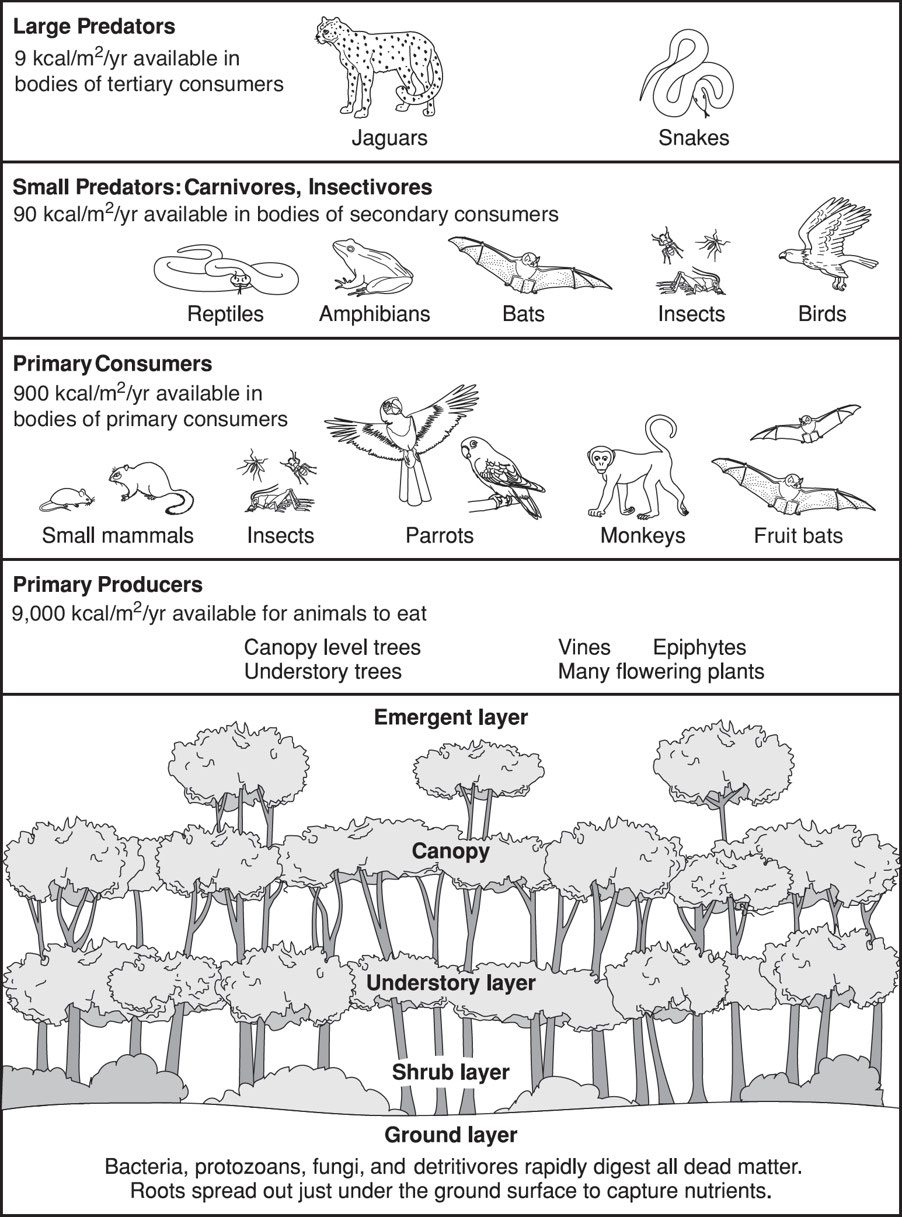
Animals include numerous birds, bats, small mammals, and insects.
Decomposition is rapid and soils are subject to heavy leaching.
Distinct seasonality where winter is absent and only two seasons are present.
The length of daylight is 12 hours and varies a little year-round
Large diversity of species.
Occur near the equator.
Annual rainfall exceeds 80 inches (200 cm) and is evenly distributed.
Plants are highly diverse.
Most nutrients are rapidly assimilated and stored in plant tissue, leaving soil nutrient-poor.
Temperature is warm to hot and varies little throughout the year.
Tree canopy is multilayered and continuous, allowing little light penetration.
Trees have buttressed trunks, shallow roots, and large, dark green leaves.
Temperate Deciduous Forests
Occur in eastern North America, northeastern Asia, and western and central Europe.
Have a distinct winter, moderate climate, and a 140–200-day growing season during four to six frost-free months.
Temperature varies from –20°F to 85°F (–30°C to 30°C).
Precipitation averages 30–60 inches (75–150 cm) per year.
Fertile soil is enriched by decaying leaf litter.
The tree canopy allows light to penetrate, resulting in well-developed and diverse understory vegetation and animal stratification.
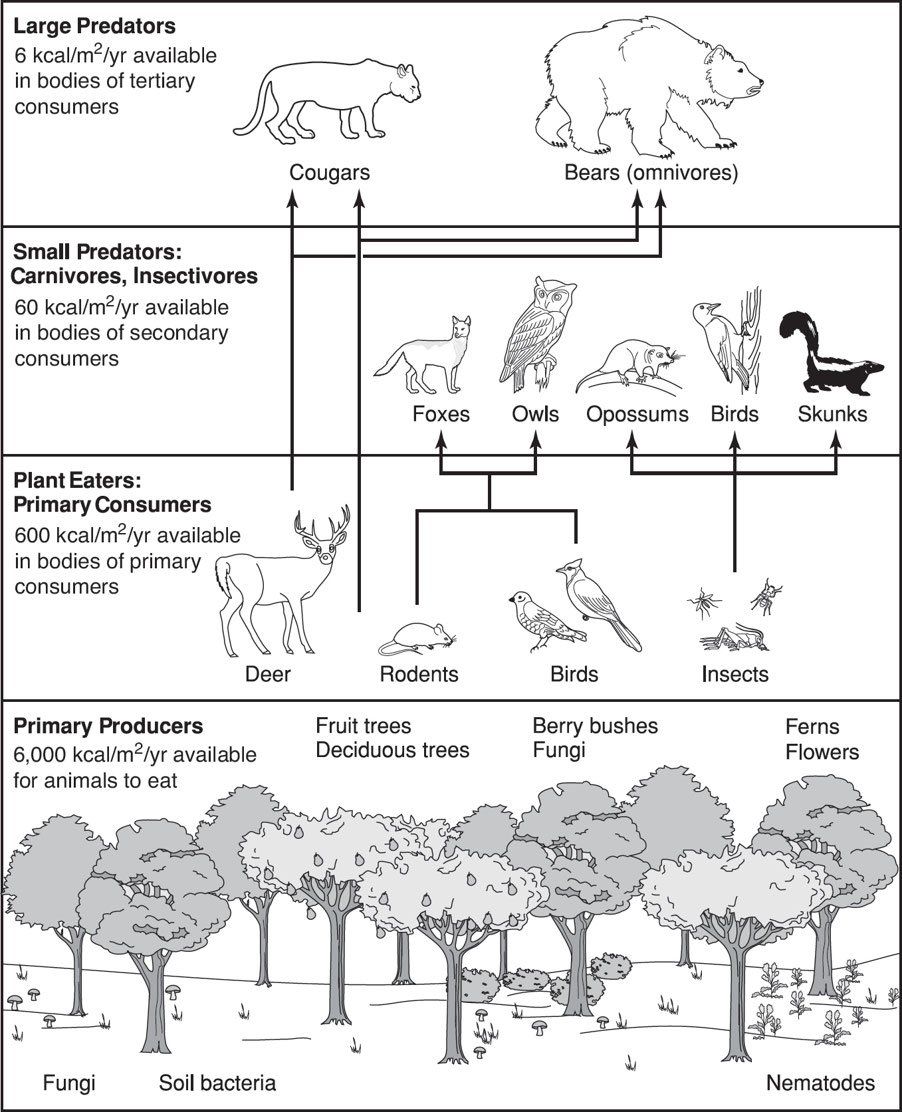
Oaks, hickories, beeches, hemlocks, maples, cottonwoods, elms, willows, and spring-flowering herbs are deciduous trees.
Birds, squirrels, rabbits, skunks, deer, mountain lions, bobcats, timber wolves, foxes, and black bears live there.
Development, land clearing, and timbering have left few temperate forests.
Temperate Coniferous Forest
Found in temperate regions with warm summers, cool winters, and enough rainfall to support forests.
Common in coastal areas with mild winters and heavy rainfall, or inland in drier climates or mountains.
These forests have cedar, cypress, fir, juniper, pine, redwood, and spruce.
These forests have two layers:
Overstory: The uppermost trees in a forest.
Understory: Layer made up of young trees, short species of trees, shrubs, and soft-stemmed plants.
Some forests have a shrub layer.
Grassy understories in pine forests often burn in ecologically important wildfires.
The understory has many herbaceous and shrub species.
Conical trees shed snow and protect branches.
Dark green needles absorb more light for photosynthesis.
As temperatures rise, trees can start photosynthesis with their year-round needles.
Needles have thick waxy coatings, waterproof cuticles, and sunken stomates.
Needles reduce transpiration by reducing surface area.
In winter, when food is scarce, many animals hibernate to conserve energy and build fat in summer.
Birds have feathers and many animals have thick fur to protect them from cold weather.
Some animals migrate to warmer climates during the winter months.
Taiga
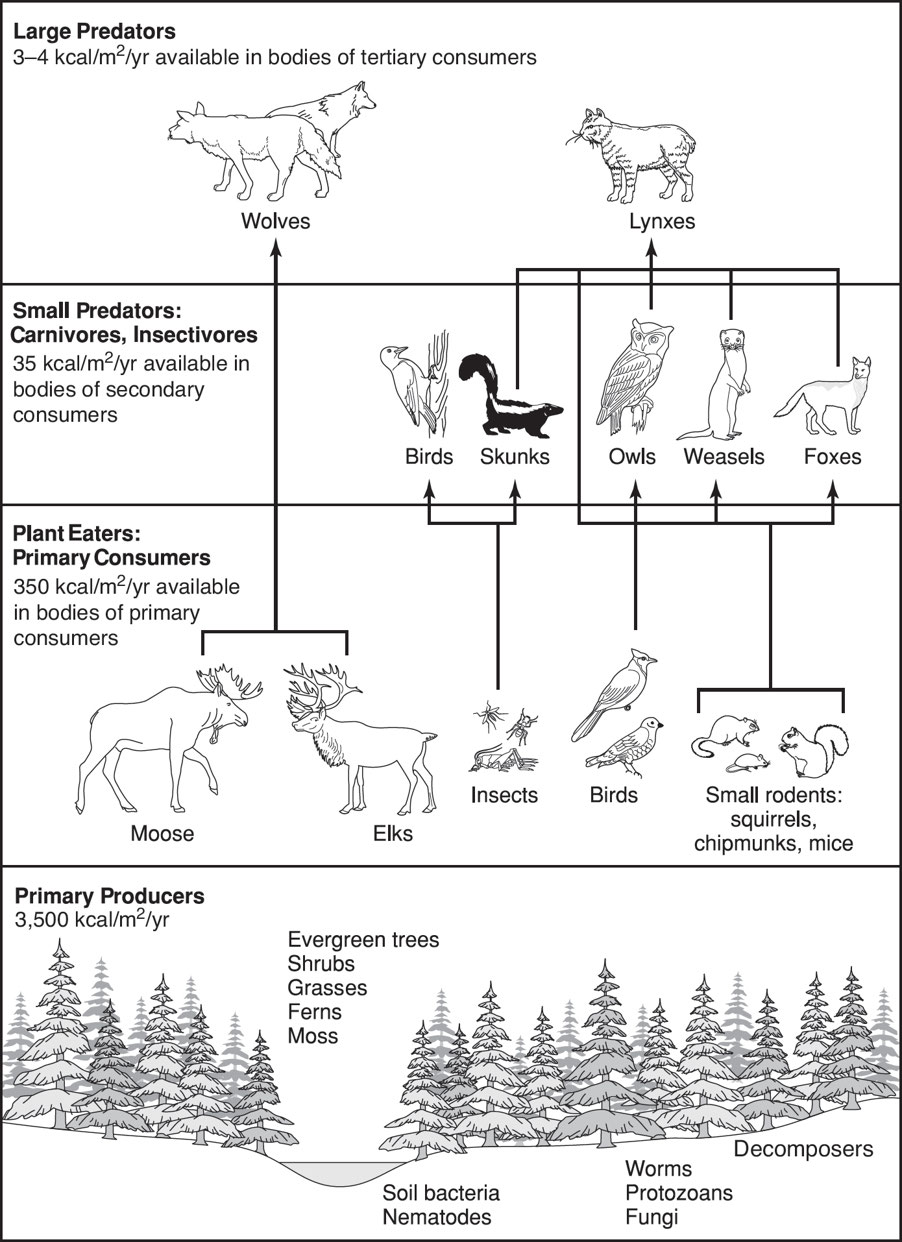
Taiga: Largest terrestrial biome; found in northern Eurasia, North America, Scandinavia, and two-thirds of Siberia.
Southern Taiga: Also known as boreal forest, consists primarily of cold-tolerant evergreen conifers with needle-like leaves, such as pines, spruces, and larches.
Northern Taiga: It is more barren as it approaches the tree line and the tundra biome.
The harsh climate in the taiga limits both productivity and resilience.
Cold temperatures, wet soil during the growing season, and needle and moss acids slow organic matter decay.
Seasons are divided into:
Short, moist, moderately warm summers
Long, dry, freezing winters.
Soil is thin, nutrient-poor, and acidic.
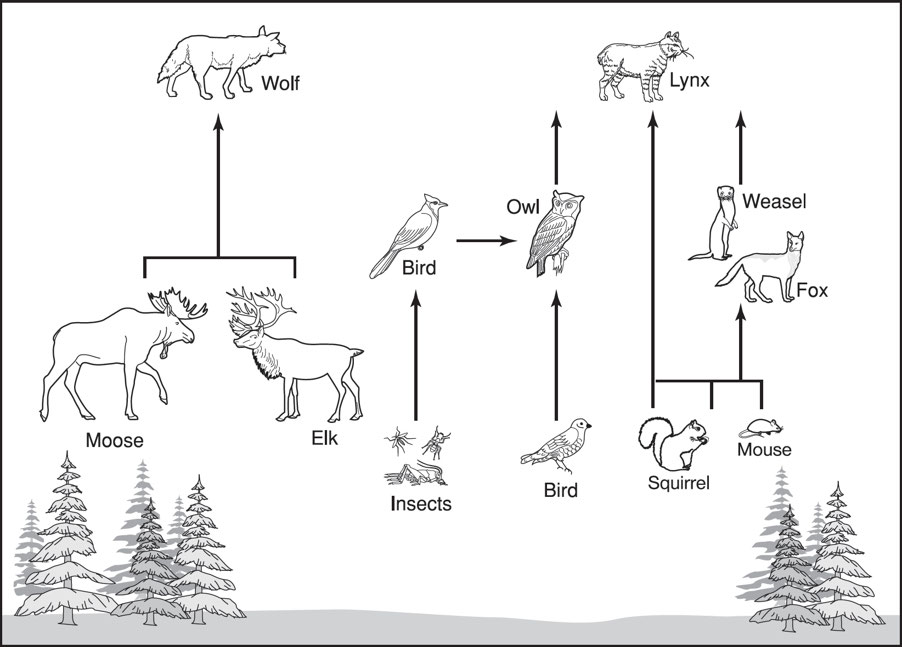
Animals include woodpeckers, hawks, moose, bears, weasels, lynxes, deer, hares, chipmunks, shrews, and bats.
Grasslands
Grasslands are characterized as lands dominated by grasses rather than by large shrubs or trees.
There are two main divisions of grasslands:
savannas or tropical grasslands; and
temperate grasslands.
Savannas
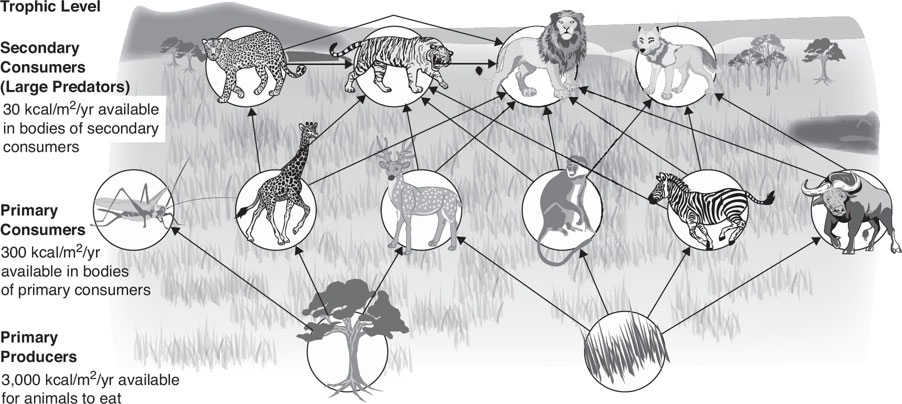
Savannas: These are grasslands with scattered individual trees and cover almost half the surface of Africa and large areas of Australia, South America, and India.
Savannas are found in warm or hot climates with an annual rainfall of 20 to 50 inches (50–130 cm) concentrated in six to eight months, followed by a long drought when fires can occur.
Savanna soil drains quickly and has a thin layer of humus to nourish vegetation.
Grass and small broad-leafed plants dominate.
Deciduous trees and shrubs are scattered across the open landscape.
Seasonal fires help savannas' biodiversity during dry and rainy seasons.
Animals include buffaloes, elephants, giraffes, ground squirrels, hyenas, kangaroos, leopards, lions, mice, snakes, termites, and zebras.
Temperate Grassland
Temperate Grasslands: Here grasses are the dominant vegetation, while trees and large shrubs are absent.
Examples of temperate grasslands include
the veldts of South Africa,
the pampas of Argentina,
the steppes of Russia, and
the plains and prairies of central North America.
Climate is characterized by hot summers and cold winters, and rainfall is moderate.
Taller grasses grow in wetter areas.
Drought and fires affect biodiversity in the savanna.
Deep, multi-branched grass roots grow and decay in the dark, fertile soil, enriching it.
Rotted roots bind to soil and feed plants.
Seasonal drought, fires, and large mammal grazing prevent woody shrubs and trees from establishing.
In river valleys, cottonwoods, oaks, and willows grow, along with some flowers.
Animals include gazelles, zebras, rhinoceroses, lions, wolves, prairie dogs, rabbits, deer, mice, coyotes, foxes, skunks, badgers, blackbirds, grouses, meadowlarks, quails, sparrows, hawks, owls, snakes, grasshoppers, and spiders.
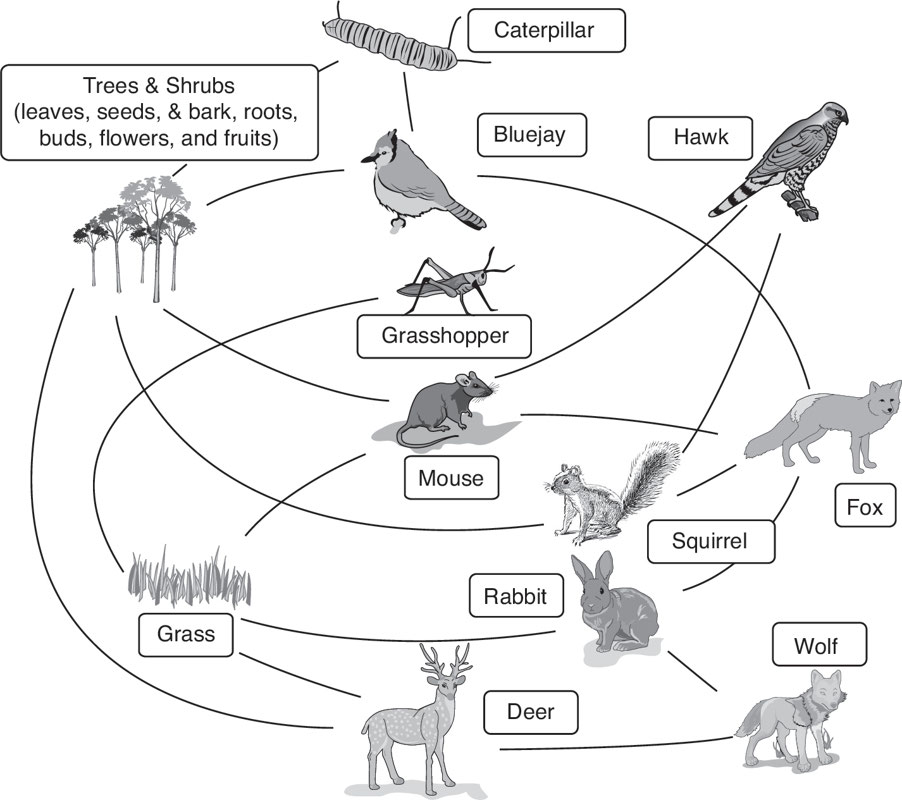
Tundra
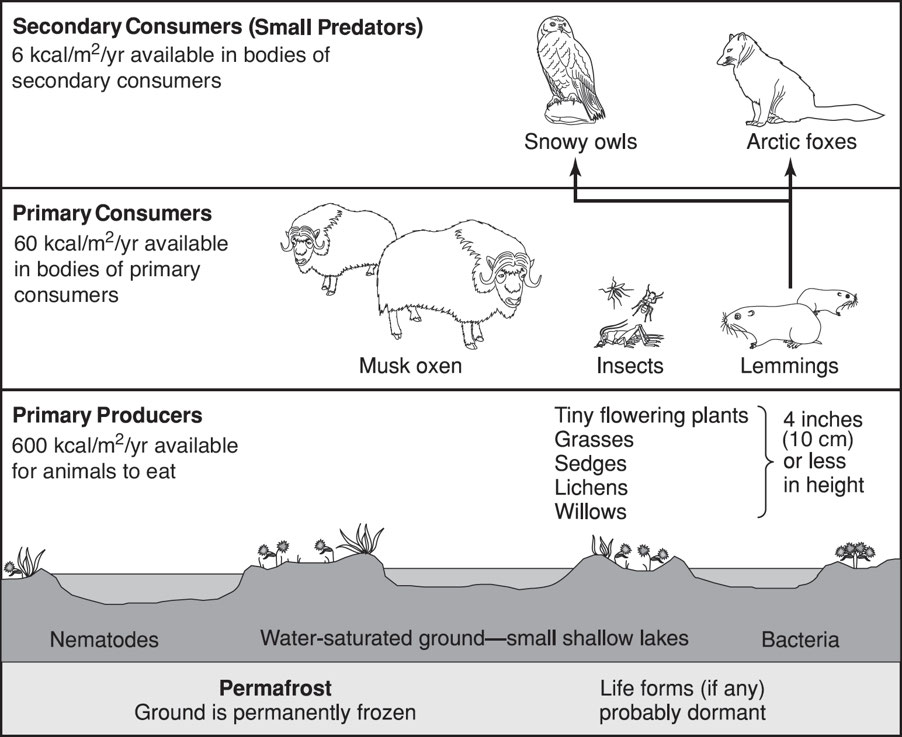
Tundra: It has extremely low temperatures, large repetitive population changes, limited soil nutrients, little precipitation, low biotic diversity, poor drainage, short growing and reproductive seasons, and simple vegetation structure.
Due to the Arctic tundra's unique conditions, the biota is highly specialized and sensitive to environmental change.
Dead organic material functions as a nutrient pool in the tundra.
Arctic Tundra
Arctic tundra: It circles the North Pole and extends south to the taiga, is cold, dry, and desert-like.
Organic matter and pollutants decompose slowly in cold, dry conditions.
The very short growing season averages around 50 days per year.
This biome survives because summer temperatures range from 37°F to 54°F (3°C to 12°C) and winter temperatures average –30°F (–34°C).
Yearly precipitation, including melting snow, is 6 to 10 inches (15 to 25 cm).
The thin, shallow, easily compacted, nutrient-poor soil forms slowly.
Permafrost: A layer of permanently frozen subsoil.
Bogs and ponds form when water saturates the upper surface, providing moisture for cold-resistant plants like low shrubs, mosses, grasses, approximately 400 flower varieties, and lichen.
All plants are adapted to sweeping winds and disturbances of the soil.
Short, clumped plants survive winter snowfall.
They can photosynthesize in low light and temperatures.
Most plants reproduce by budding and division, not by flowering.
Food webs are simple and characterized by low biodiversity.
Animals are highly specialized for long, cold winters and quick breeding and raising young in summer.
Mammals and birds also have additional insulation from fat.
Due to the scarcity of food in the winter, a lot of animals hibernate or move south.
Animals:
Herbivorous mammals include lemmings, caribou, Arctic hares, and squirrels.
Carnivorous animals include Arctic foxes, wolves, and polar bears.
Migratory birds include ravens, falcons, terns, snowbirds, and various species of gull. Insects include mosquitoes, flies, moths, grasshoppers, and bees.
Reptiles and amphibians are few or absent.
Fish include cod, salmon, and trout.
Alpine Tundra
Alpine tundra: It is located on mountains throughout the world at high altitudes where trees cannot grow.
The growing season is approximately 180 days, with nighttime temperatures usually falling below freezing.
The soil in the alpine tundra is well-drained.
Plants are very similar to those of the Arctic tundra and include grasses, dwarf trees, and small-leafed shrubs.
Animals living in the alpine tundra include mountain goats, sheep, elk, birds, beetles, grasshoppers, and butterflies.