FW 404: Managing for Game Birds (Upland and Migratory), 11/25
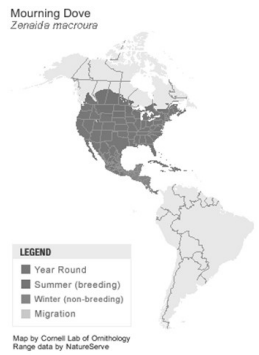
Mourning Dove
Widespread and abundant
~70 million harvested/yr
Over 500 million in US
Migratory/resident
Benefit from:
Land clearing
Agriculture
Bird feeders
High annual mortality rate
Lay 2-egg clutches 5-6 times/year
Males larger and more colorful than females
Seed-eaters (99%)
sparsely vegetated ground
Eat grasses, croton, sunflowers, ragweed, pokeweed, smartweed, pines, cereal grains, soybeans
Nest in trees, shrubs, vines up to 50 ft, usually lower
feed crop milk to young
Habitat Requirements
Nest in open woodlands, young forest, along edges
Agricultural and urban landscapes
Roost in mid-succession vegetation
Stage next to feeding areas, often in snags
Feed in cropland & disturbed areas w/ bare ground
Move 3-11 miles/day to find new food sources
Management for Doves
Avoid clean farming, closed canopy plantations, and large, contiguous even-aged forest
70% agricultural crops, old fields, early succession
28% forest, mostly with open canopy
Use repeated prescribed fire
2% free-standing water - banks w/ sparse veg.
Maintain snags as congregation sites
Field Management (>5 acres)
Sunflowers, grain sorghum, millet
Planted in strips with fallow between
Clean-row middles or burned (bare ground)
Mow, push down, or burn existing crops/weeds
Where doves want to be (H2O, snags, high spots)
20-50 acres and away from humans is ideal
Follow normal agricultural practice
Top sowing sunflowers not allowed
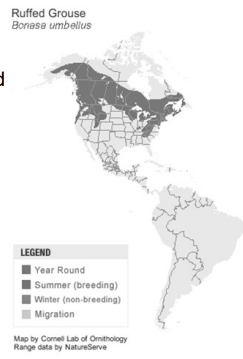
Ruffed Grouse
Past - logging, abandoned farms
Today – mature forests, fire suppression
Pop. decline since 1970s
Silver-gray to red-brown (aspen, birch, maple vs. oak camouflage)
>1500 ft elevations in SE
Males drum logs to attract mates (>10” dbh)
Nest on ground at base of tree or log
7-16 eggs/clutch
Diet – herbaceous vegetation, soft mast (grape, greenbrier, dogwood), hard mast, insects (4-6 weeks old), evergreen vegetation/buds in winter
Habitat Requirements
5-15 yr old forest w/ high woody stem density
drumming logs >10 ft long, large diameter (>10”)
drumming sites near top or base of ridge
Mature forests w/dense understory shrubs
Nest in mid-aged/mature stands w/ CWD, herbs
Brood in herbaceous vegetation adjacent to cover
Thermal protection in conifers, evergreen shrubs
Habitat Management
Intersperse mid-successional forest patches (5-30 acres) to provide cover/forage
Clearcut (retain hard mast producers)
2-aged stand, < 20ft2/acre retained
Retain downed wood
Brood cover:
Small timber harvest openings
Old fields, roadsides/logging decks
Burned areas
Mesic coves/bottoms with herbs
American Woodcock
Forest shorebird
Migratory
Past – logging and old fields
Today – mature forest
1968-2014: -1%/yr

Females: larger, outer 3 primaries ≥ 0.5 in. wide
Males: outer 3 primaries <0.5 in, shorter bill
Diet – mostly earthworms (ants, beetles,seeds)
Male courtship display
Nest in shallow depressions
Usually 4-egg clutches
Habitat Requirements
Feed in soils w/ high pH, moisture (earthworms)
Bottomlands, organic soils in uplands
Sparse vegetation within 1 foot of ground
Diurnal – young forest and mature bottomlands with shrubs or switchcane
Nocturnal – fallow fields, croplands, pastures, young forest
Usually, w/in 1.25 miles of each other
Nest in early- to mid-successional vegetation
Brood: open ground with moist soils
Habitat Management
Soybean, especially no-till with ridge and furrow
Logging decks for singing grounds
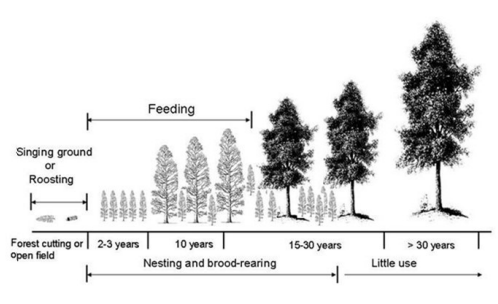
Promote early-succession vegetation (stages 2/3)
Clearcut ≥ 10 acres (or other timber harvests)
Widely spaced planted pines
PCT or commercial thin to maintain open canopy
Small harvest openings in riparian areas (group selection)
Prescribed burns in old fields and forests
Key Summary Points
Game birds are disturbance-dependent
Timber harvest, fire, disking
Doves require bare ground and eat seeds
Grouse/woodcock require high stem density
Habitat requirements change seasonally
Landscape diversity required