BIOPSYCHOLOGY
CENTRAL NERVOUS SYSTEM
Where all complex processing of information is done/ where decisions are made.
Contains the brain and spinal cord.
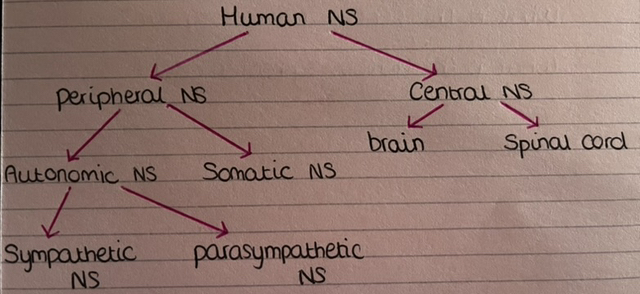
PERIPHERAL NERVOUS SYSTEM
Brings information from sense to the CNS and transmits it to the muscles and glands.
Somatic NS: receives information from the sense and transmits it to the CNS and then to the muscles.
Automatic NS: responsible for vital functions (eg. Heartbeat, breathing, digestion).
→ Sympathetic NS: stimulates functions.
→ Parasympathetic NS: slows functions.
The sympathetic and parasympathetic NS work together to maintain the body at an optimum even of functioning, Homeostasis.
Both are involved in the ‘flight of fight’ response.
THE BRAIN
Cerebrum: (largest part)
Split down the idle into two halves called Cerebral Hemispheres.
Each hemisphere is specialized for particular behaviour and have to communicate thought the Corpus Callosum.
→ Frontal lobe- thought and production of speech
→ Occipital lobe- processes visual images
Cerebellum: (sits beneath back of cerebrum)
Controls motor skills/ balance, coordinating muscles to allow precise movements.
Problems can result in epilepsy.
Diencephalon: (sits beneath cerebrum/ on top of brain stem)
Controls hormone releases from pituitary gland.
→ Thalmus- nerve impulse relay station from sense.
→ Hypothalmus- regulates body temperature, hunger and thirst.
THE SPINAL CORD
Relays information between brain and the body.
Connected to different parts of the body by pairs of spinal nerves, which connect to specific muscles and glands.
Contains a circuit of nerve cells that enable us to perform some simple reflexes without direct involvement from the brain.
If damaged, areas supplied by spinal nerves will be cut off from the brain and stops functioning.
TYPES OF NEURONS
Sensory: carry’s signals from receptors to spinal cord and brain.
Relay: carry’s signals from one part of the CNS to the other.
Motor: carry’s signals from CNS to effectors (muscles and glands).
SYNAPTIC TRANSMISSION
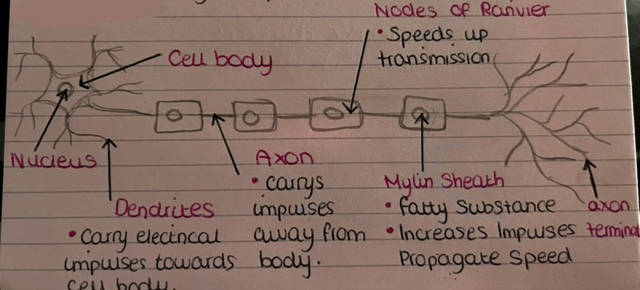
Electrical impulses travel along axon or transmitting neuron, which triggers the nerve-ending of the pre-synaptic neuron to release neurotransmitters.
Chemicals diffuse across the synapse and bind with receptor molecules on the membrane of the next neuron, which stimulates the second neuron to transmit electrical impulses.
Neurotransmitters are reabsorbed in the vesicles of the pre-synaptic neuron after it has performed its function of transmitting a neural impulse.
THE ENDOCRINE SYSTEM
Network of glands that manufactures and excretes hormones.
Works with the nervous system
In charge of body processes that happen slowly (eg. Cell growth).
GLAND: HORMONE RELEASED: EFFECTS:
Pituitary - Adrenocortical trophic and oxytocin - Stimulates adrenal cortex and uterus contractions
Pineal - Melatonin - Responsible for biological rhythms
Adrenal - Medulla (Adrenaline) and coristol - Stimulates release of glucose whilst suppressing immune system
Ovaries - Oestrogen - Regulates reproductive system
Testies - Testosterone - Develops muscle growth and Male sex characteristics
FIGHT OR FLIGHT RESPONSE
A person enters a stressful/ dangerous situation, the amygdala is activated and sends a distress signal to the hypothalmus.
The hypothalamus triggers activity in the sympathetic branch of the automatic nervous system. The ANS goes from resting state to physiologically aroused sympathetic state.
Sympathetic nervous system stimulates the adrenal medulla in the adrenal gland.
The adrenal medulla secretes stress hormones, adrenaline and noradrenaline into the bloodstream.
Adrenaline then causes psychological changes to prepare the body for fight or flight.