Lecture 2: values of biodiversity: Direct & Indirect economic values
Why bother with Biodiversity?
Scientific: biodiversity is inherently interesting
Citizen: biodiversity is important for lots of reasons - biological, aesthetic, political, ethical
Arguments for the protection of biodiversity
Intrinsic value: biodiversity is important in living systems - conservation of ecologically equivalent species; redundancy is allowed
Anthropocentric: humans benefit because biodiversity supports ecosystem services - conservation of ecologically non-equivalent species; redundancy is avoided
Biodiversity is the ‘total and irreducible complexity of life’
‘complexity’ includes all aspects of living systems, not just species richness
single objective ‘measurements’ of biodiversity are impossible or useless
contextual values have to be used - this is determined by usage (who/what its for)
Valuing biodiversity occurs at levels:
genetic diversity: raw material for adaptation
Species diversity: raw material for population growth
ecosystem diversity: the matrix within which species and genes operate
Direct use of Values 1 and 2
these values are obtained via harvesting or destroying a resource
one of the consumptive use values applied to this form of obtaining resources is replacement cost approach
this means that resources are consumed locally for subsistence and are generally not traded
the second value is Productive use value
this means that the resources obtained are traded in national and global markets for first or last sale value. the final value is measured by the raw materials, labour, transport, energy and cost of other materials etc…
Indirect use values
These are non-consumptive values
ecosystem productivity
protection of water and soil resources
climate regulation
waste treatment and nutrient retention
species relationships
environmental monitors
recreation and ecotourism
educational and scientific value
How do we assign economic value?
for example we can look at the asian wild gaur and the possible uses and values it may have
meat harvested from wild populations would be an example of Direct Use
Seeing them via Nature tourism is an example of Indirect Use
Asking if they have a future potential in domestic cattle breeding programs is an example of Option Value
And lastly the Existence Value relies on the Asian Wild Gaurs Intrinsic/Cultural/Aesthetic Value
Costs of maintaining biodiversity
Maintaining biodiversity costs a lot, whether that’s in management or collateral.
management costs include: Equipment, Wages, Infrastructure and Monitoring
While collateral costs considers: Income foregone, Displaced Communities, Other areas that are affected and Civil Unrest
To value biodiversity economically it is important to consider if it is owned by everyone or no-one. The common property resources (‘global commons’) is also involved in this
Economic Discounting
the value of resources will be lower in the future due to harvesting many resources now causing us to aquire greater wealth now. However there is an uncertainty that these resources may not be there later
resources in developing countries tend to have high discount rates which encourages unsustainable resource use.
Environmental/Ecological Economics
there is an effort being made to integrate economics, environmental science, ecology and public policy into economics
We have to factor full costs into market for long term
It is difficult to asses and assign and may come with Ethical Issues
to factor true costs into economic activities we use COST-BENEFIT ANALYSIS which compares values gained against costs
we can do an environmental impact assessment to consider present and future effects on environment against the reduction of potential for future activities/restoration costs - This is a Precautionary Principle
Direct Use Values: Externalities
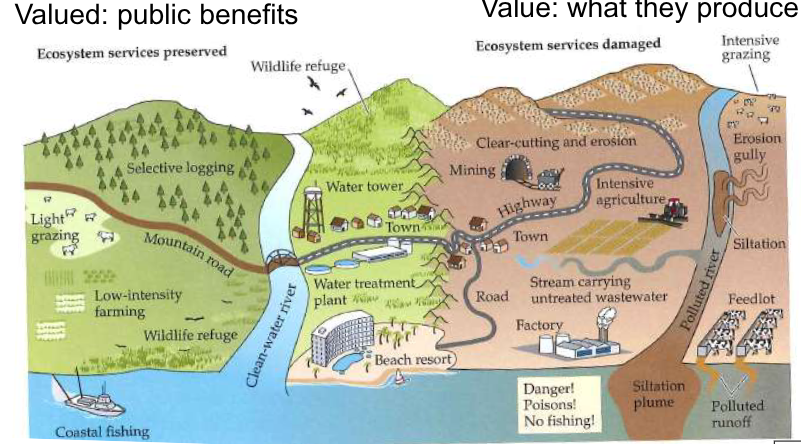
The REAL value of what we produce
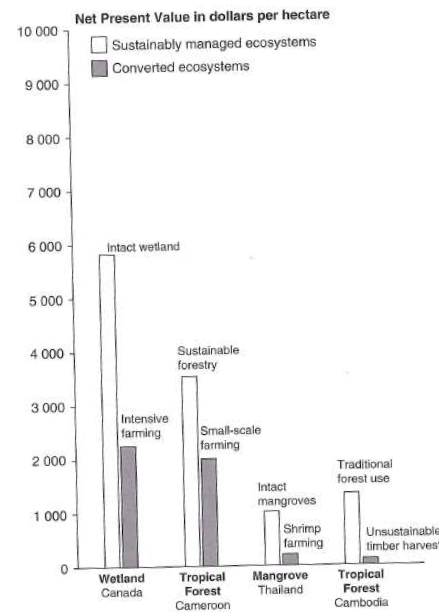
when looking at statistics comparing the net present value in dollars per hectare between sustainably managed ecosystems and converted ecosystems, you can see that ecosystems that are sustainably managed are far more profitable than those that have been converted. the difference is averaging an over half profitability.
The Problems with economic valuing systems for biodiversity
Implicit acceptance of the modern economic system
Not all species or communities can be assigned an economic value
There’s a difficulty assigning even option values
what about the species that are economically undesirable
this relies on ‘perfect knowledge’ in order to make a decision, which is difficult/impossible
Further Problems
as resources become scarce → they become more expensive
what do we do if it becomes uneconomical to conserve biodiversity