Lecture 7 - Privatisation
Definition
Privatisation is the transfer of ownership and/or control of a state-owned enterprise (SOE) to the private sector.
It can involve:
Full sale of assets
Partial sale (share flotation)
Contracting out
Public–private partnerships
Major UK programme: 1980s–1990s under Margaret Thatcher.
2. Why Governments Privatise (Arguments For)
A. Productive Efficiency
Private firms:
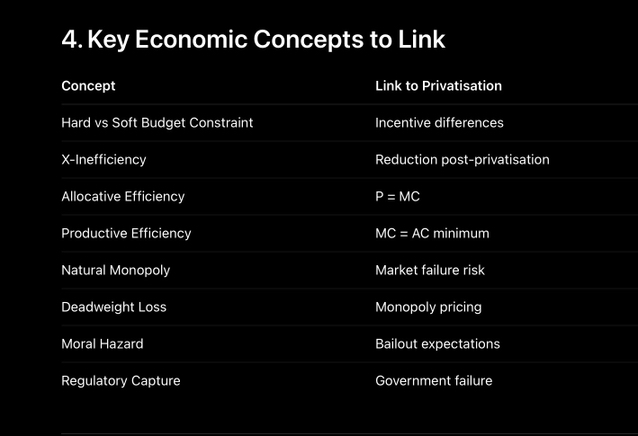
Face hard budget constraints
Must minimise costs to survive
Risk bankruptcy if inefficient
State firms may face soft budget constraints (concept by János Kornai).
Result: Lower average costs, reduced X-inefficiency.
B. Profit Incentives & Managerial Discipline
Privatisation introduces:
Shareholder monitoring
Performance-based incentives
Corporate governance mechanisms
Reduces:
Overstaffing
Political interference
Bureaucratic slack
C. Dynamic Efficiency (Innovation)
Competition + profit motive →
Investment in R&D
Technological improvement
Quality enhancement
Example: British Telecom experienced increased competition and expansion after privatisation.
D. Fiscal Benefits
Government gains:
Immediate revenue from asset sale
Reduced borrowing requirement
Lower public sector debt (short-term)
E. Increased Competition
If combined with deregulation:
Entry increases
Prices fall
Output rises
Potential movement toward:
P ≈ MC (allocative efficiency)
F. Wider Share Ownership
Privatisation programmes sometimes aim to:
Develop capital markets
Encourage household investment
Promote “shareholder capitalism”
3. Arguments Against Privatisation
A. Natural Monopoly Risk
Industries with:
High fixed costs
Large economies of scale
Privatisation may simply replace:
Public monopoly → Private monopoly
Private monopolist:
Restricts output
Raises price
Creates deadweight loss
Example: Rail infrastructure under Railtrack, later replaced by Network Rail.
B. Higher Prices
Private firms maximise profit, not welfare.
Can lead to:
Price increases
Reduced cross-subsidisation
Lower affordability
Example: Energy sector criticism of British Gas.
C. Equity Concerns
State firms may:
Protect employment
Provide universal access
Support rural regions
Privatised firms may:
Cut unprofitable services
Focus on high-income areas
→ Increased inequality.
D. Under-Provision of Merit Goods
Where:
Social Benefit > Private Benefit
Private market underprovides:
Transport
Water
Infrastructure
E. Short-Termism
Private firms may:
Prioritise dividends
Underinvest in long-term infrastructure
Focus on quarterly performance
Particularly risky in capital-intensive sectors.
F. Regulatory Failure
Privatisation often requires:
Price caps
Competition authorities
Industry regulators
Risk of:
Regulatory capture
High monitoring costs
Government failure
6. Evaluation Framework (High-Level Analysis)
Privatisation works best when:
Market is competitive
Entry barriers are low
Demand is elastic
Externalities are minimal
Strong independent regulation exists
Privatisation works worst when:
Industry is a natural monopoly
Service is a merit good
Equity concerns are significant
Information asymmetry is high
Regulation is weak