Firms in Global Business: MNE & The Global Factory
For international managers, theories of the international firm help to identify the critical considerations in cross-border operations and to abstract from the vast detail that characterizes their work. Theories based on microeconomic reasoning, such as those evaluated in this chapter, also contribute to the formulation of logical management decision-making.
●The ‘global factory’ concept encompasses both ‘theories of the multinational firm’ and the analysis of global value chains . This synthesis enables an understanding of the current problems (trade-offs, decisions, uncertainties) facing managers of internationally oriented companies
Why do we have MNE’s?
Ownership advantages: Firms have valuable, firm-specific assets (technology, brands, know-how) that can be used profitably in multiple countries.
Internalization advantages: It is often more efficient to keep control of these assets within the firm than to license or contract them out, due to weak enforcement and contract problems.
Location advantages: Certain countries offer benefits such as lower production costs, access to resources, large markets, or proximity to customers.
Avoiding trade costs: Producing abroad can bypass tariffs, quotas, transport costs, and other barriers to exporting.
Efficiency and coordination: Internal control across borders improves coordination of production, quality, and supply chains.
Market access and adaptation: Local affiliates allow firms to better tailor products and services to local consumer preferences.
what the theories of the international firm explain
Why some firms are international (and some are not).
Why some industries/sectors are more internationalised than others.
Why some countries are net outward investors and others are mainly host countries for inward investment.
How firms choose locations and modes of operation.
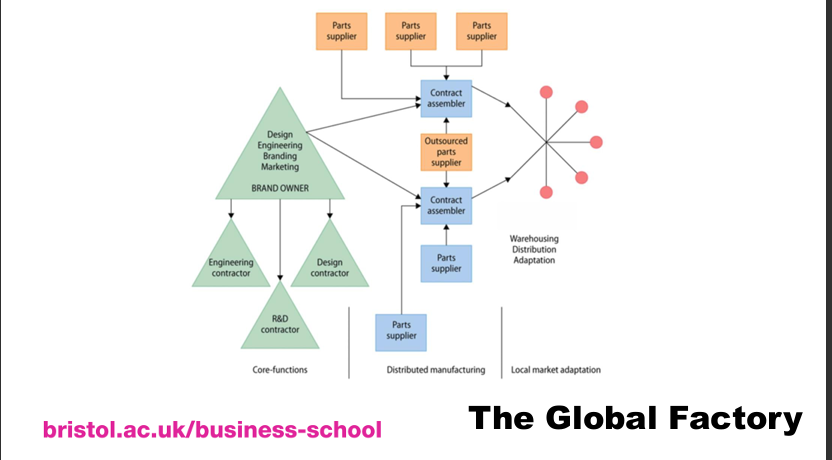
the Global Factory (GF) concept
The locational configuration of the GF is based on the least cost location.
The control configuration combines both internalised activities (such as Foreign Direct Investment) and externalised activities (such as outsourced suppliers) governed by contracts.
The ‘focal firm’ orchestrates the global factory by controlling information and choosing the optimal set of location and internalised/externalised activities
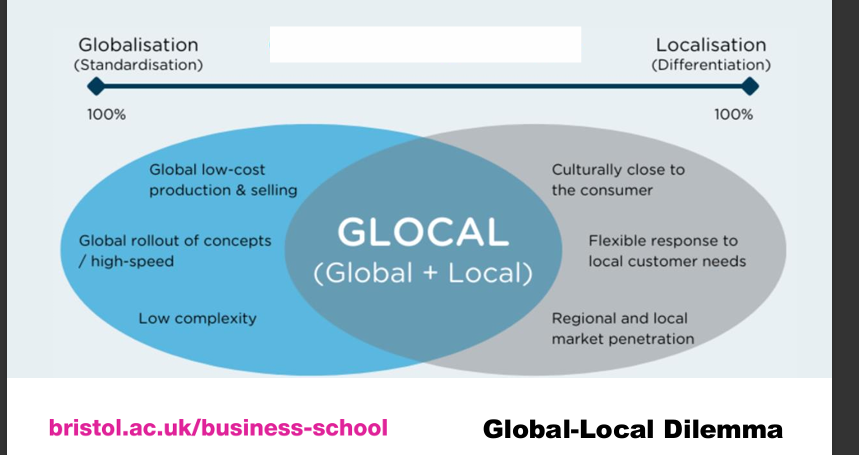
global-local dilemma
Multinational firms have to reconcile pressures to be globally efficient with the need to be locally responsive.
The efficiency imperative dictates standardization, economies of scale, and uniformity of product and process.
The localization motive mandates adaptation, differentiation, and close liaison with customers.
These pressures have to be accommodated and the global factory is the ideal structure with which to do so
The ‘glocal’ strategy seeks the best compromise for each element of the marketing mix as the balance of global and local pressures dictates across different national markets. This glocalized strategy is well suited to being combined with the ‘fine-slicing’ of activities across the complex set of processes in the whole network of the global factory.
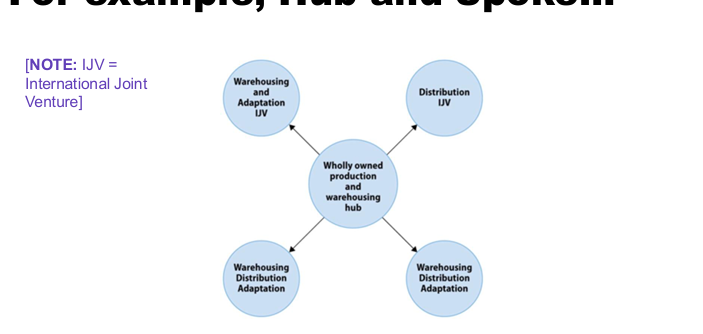
Hub and Spoke model
Much of the strategy of the multinational firm can be explained by the attempts of management to reconcile these pressures (Devinney, Midgley, and Venaik, 2000).
Over time, firms have (been advised) to switch their organization so as to balance these pressures
However, pressures in different industries push firms towards a strategic imperative (scale in electronics, local demand differences in consumer goods) and different functions (finance, production, sales functions) require different balances of global/local orientation.
The ‘hub and spoke’ model is a key method of attempting to reconcile these conflicts
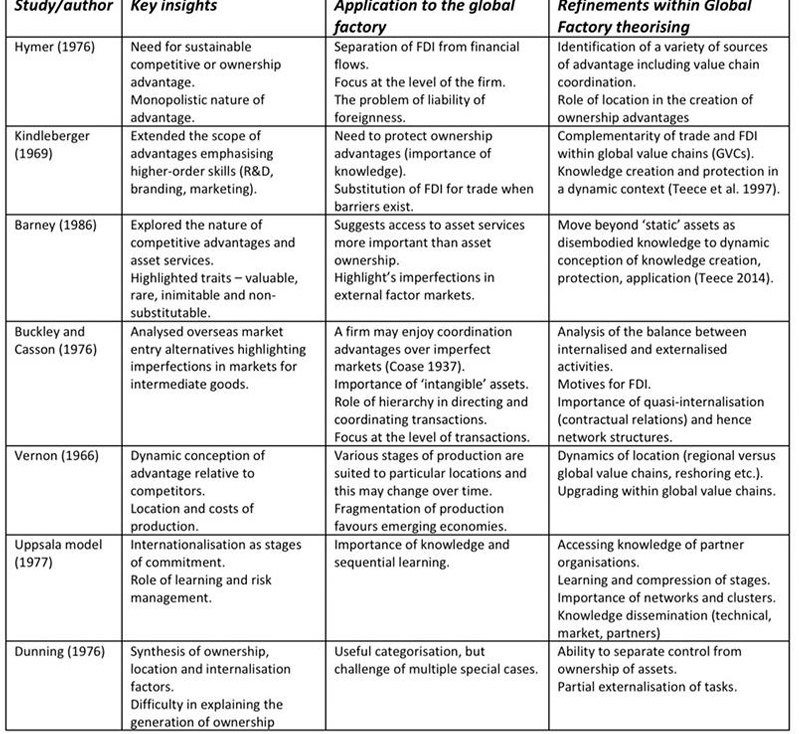
Evolution of thinking on the global factory
the theory of the global factory draws upon a considerable body of literature designed to explain the activities of international firms.
Advantages of Global Factory
Flexibility: Flexibility is a response to increasing volatility arising from globalization and from opposition to monopoly, including internal monopoly. Firms can respond to changes more quickly and smoothly
Resilience: in a globalized world, shocks from any part of the global economy are rapidly transmitted around the world. Competition within the global factory, multiple alternative sources of supply of key inputs, access to many national markets and supply sources, intelligent use of forecasting, and internal transfer of knowledge are all sources of built-in resilience for the global factory.
Coordination and control: the information structure of the global factory is a major source of its strength, allowing information to be obtained and to be disseminated to those decision-makers best placed to use it. The use of increasingly complex structures involving both internalized and externalized activities requires that externalized activities be carefully monitored.
internal entrepeneurship: A feature of many global markets is the use of regional production and distribution hubs, from which location several neighbouring countries can be serviced. The hub provides gains from diversification. These are real gains that only the firm can achieve, as opposed to the financial gains from unrelated product diversification, which have proved disappointing in the past because they are best exploited through the diversification of individual share portfolios instead.
Evolving GFs
the global factory represents an evolution of international business strategies and structures adapting to the changing nature of the global operating environment. Such changes—technological, economic, political and social—are ongoing and mean that the global factory will need to further adapt as new challenges emerge. The following sections highlight some of the current and emerging challenges that they face:
Development in technology
VUCA (Volatility, Uncertainty, Complexity, and Ambiguity)
Growing responsibility and sustainability concerns
Fractures in the world economy
Growing regionalisation