Renaissance
1450-1650
Renaissance = French word for "rebirth"
• Man should be the subject of study, not God.
Considered as the era of cultural revival and poetic evolution
The era in which the modern sense of English poetry begins
Lyrical spirit
Poetry = natural language of people
Full, free, and spontaneous
Tudor dynasty
1485-1603
• Instrumental in shaping the cultural, political, and religious landscape of England
Promotion of humanism
Church of England reformation
Legal and political developments
Henry VII
1509-1547
Strong central monarchy: undivided rule or absolute sovereignty by a single person (King)
Elizabeth I
1558-1603
Political stability and the beginnings of modern bureaucracy
Renaissance Period
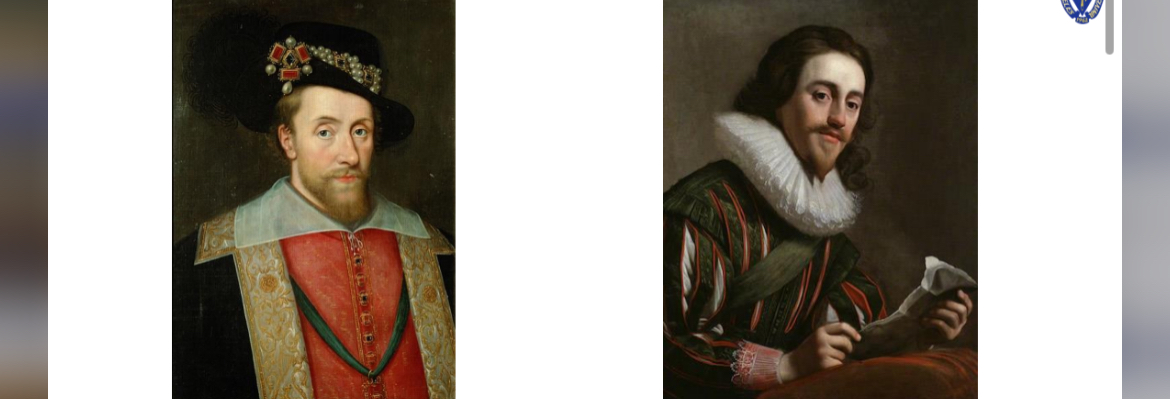
King James |. King Charles I
(1603-1625). (1603-1625)
What happened?
Political tensions
Religious rifts
(Catholics vs. Protestants)
Civil war
(Parliamentarians and Royalists)
Monarchy restored
Execution of Charles |
Lengthy discussions = restoration of the monarchy in1660
Renaissance Period (Significant contributions in the world of English)
Drama
Playwrights created masterpieces blending tragedy, comedy, and history in innovative ways
Major themes
Love and physical beauty
"Fair" = a sign of beauty
Printing press
All books were handwritten before
Invented by Johannes Gutenberg (1455) and was introduced by William Caxton (1476)
The Renaissance Period (Writers)
Famous writers emerged
Remarkable literary achievements
Geoffrey Chaucer
The Canterbury Tales
collection of stories and poems, each told by a group of pilgrims on their way to the Canterbury Cathedral
Thomas More
1480-1535
Author of "Utopia"
about an imaginary island where everything is perfect
Nicholas Machiavelli
Published a book titled "The Prince" in 1513
Contains theories about how a ruler should govern
King James I
Ordered 47 scholars to produce a translation of the Bible in 1604 King James Bible
RENAISSANCE "REBIRTH"
• began in Italy, especially in architecture and art
Other significant events:
1492-discovery of America by Columbus
Copernicus and Galileo-discovered stars and planets
Ferdinand Magellan-sailed across the world
HUMANISM
intellectual movement that greatly influenced Renaissance thinkers, writers, artists
The humanists
revived old Greek and
Latin classicsexplored questions such as "What is a good life?"
made history, literature, and philosophy popular again
The Renaissance world was a Christian world.
What objections might some people have raised to the revived interest in ancient Greek and Latin texts?
People might say that these old texts were heathen and couldn't be any good for Christians to read.
Others are worried that the texts would lead people astray from church teachings.
How do you think Renaissance scholars overcame this objection?
They also studied the Bible, and looked for Christian ideas in the ancient texts.
They used the ancient texts to support Christian teachings and to show that questions of morality and virtue were important to people.
How might reading ancient texts (philosophy, ethics, and virtue) expand people's understanding of the world?
These texts would offer people a different perspective about the world.
One that wasn't tied to Christian beliefs (still dealt with issues of right and wrong and proper behavior) would also gain a better understanding.
HUMANISM
Printing Press Plays Part in Spreading Humanist Ideas | |
Around 1455... | printing press invented by Johannes Gutenberg |
In 1476. • • | press set up in England by William Caxton |
By 1500 .. • | books widely available throughout western Europe |
HUMANISM
Two Humanists
Sir Thomas More
English lawyer
wrote Utopia
Lord Chancellor
beheaded by order of
Desiderius Erasmus
Dutch monk
traveled throughout
Europetaught Greek
Henry VIll
Both wrote in Latin; loved life, laughter, and classical learning; were dedicated to the church.
HENRY VIII BREAKS WITH THE CHURCH
Henry VIlI
"Renaissance man"— poet, musician, athlete
had 6 wives (Catherine of Aragon, Anne Boleyn, Jane Seymour, Anne of Cleves, Catherine Howard, and Catherine Parr)
1533
Pope refuses Henry VIll's request for annulment (Catherine of Aragon)
Henry appoints new archbishop of Canterbury, who grants annulment
1534
• Henry declares himself head of the Church of England
Annulment
It cancels or puts an end to a marriage. The children of an annulled couple become illegitimate.
Divorce was not allowed, so Henry was looking for a loophole.
He asked Pope Clement VI to annul his marriage, that is, declare that he was not properly married to Catherine of Aragon.
Protestant Reformation
Henry closes monasteries
Protestantism begins in England
Some people want to
get rid of "popish" things
make religion solely a matter between the individual and God
Heirs of Henry VIII
Edward VI (1547-1553)
son of Jane Seymour
rules in name only
Elizabeth I (1558-1603)
daughter of Anne Boleyn
the "virgin queen"
Elizabeth I-literary connoisseur; beloved symbol of peace, security, prosperity
restores law and order
reestablishes Church of England;
rejects pope's authority
never marries
Survives numerous assassination plots
Mary Stuart, Queen of Scots
Elizabeth's cousin, heir to English throne
returned to Scotland in 1560 to reclaim the throne
initiates several plots to kill Elizabeth In 1587 ..•
after enduring Mary and her plots for 20 years, Elizabeth sends her to the chopping block
THE DEFEAT OF THE SPANISH ARMADA
1588
Warships from Spain (Spanish Armada) sent to invade England
England's smaller ships defeated the Armada
Elizabeth's finest moment
Assures England's independence from Catholic countries of the Mediterranean
Mary Tudor (1553-1558)
a brilliant,
"Bloody Mary"
successful monarch
restores pope's power
hunts down and executes Protestants
DECLINE OF THE RENAISSANCE
James I (1603-1625)
patron of the arts
benevolent but uninspiring ruler
1649-1660
England ruled by Parliament
by the Puritan dictator Oliver Cromwell
Charles I (1625-1649)
remote, autocratic, self-destructive
beheaded by powerful
During this time ..
Renaissance values gradually destroyed.
Renaissance energies gradually gave out.