Topic: Phylogeny - Basic Rules of Cladistics
Approaches to Phylogenetics
The study of evolutionary relationships among organisms through various methods and data sources.
Derived and Ancestral Character Traits:
Characters that indicate evolutionary change; include apomorphies (derived traits) and plesiomorphies (ancestral traits).
Ingroup and Outgroup:
The ingroup consists of species being studied, while the outgroup is a species or group that is closely related but does not share derived traits.
Cladogram Construction:
Creating a visual representation of evolutionary relationships based on shared derived characteristics allows researchers to hypothesize the genealogical relationships among taxa, facilitating the identification of common ancestors and the evolution of traits.
Traditional Approach
Morphological Systematics:
Focus on physical traits of organisms to determine relationships.
Issues:
Convergent evolution: When unrelated species evolve similar traits.
Parallel evolution: Similar traits evolve independently in related species.
Difficulty in defining what constitutes a good character trait.
Example groups: Reptilia and Aves.
Cladistic Approach
Cladistic or Phylogenetic Systematics:
Incorporates morphological, genetic, and fossil data.
Based on the identification of characters that best reveal evolutionary relationships.
Example groupings: Reptilia, Lepidosauromorpha, Archelosauromorpha.
Derived Character Traits
Different traits provide varied information about evolutionary history.
Apomorphy:
A new derived character trait that signifies evolutionary change.
Often indicates an evolutionary advantage or point of change.
Synapomorphies:
Shared derived character states important for constructing phylogenies.
Phylogeny:
An evolutionary history derived from a series of synapomorphies.
Ideally should integrate a wide range of data including morphological, molecular, and fossil evidence.
Character Definitions
Apomorphy:
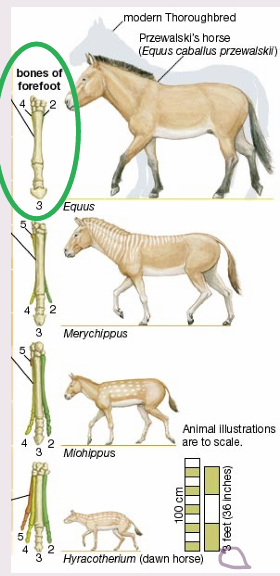
A novel character trait arising from an ancestral trait, marking a significant evolutionary alteration.
Illustrate with example: horse hoof.
Plesiomorphy:
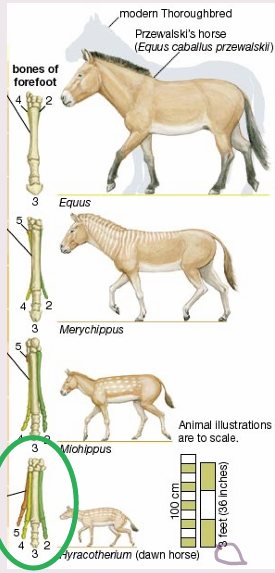
An older, ancestral trait shared among multiple groups (taxa), often referred to as primitive traits.
Not useful for differentiation within a group.
Example: Pentadactyl limb (five-digit limb structure) compared to horse hoof (apomorphy).
Evolutionary Relationships
Visual Representation:
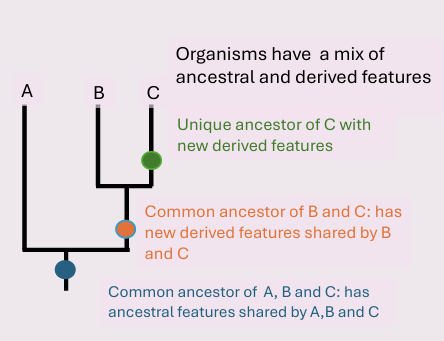
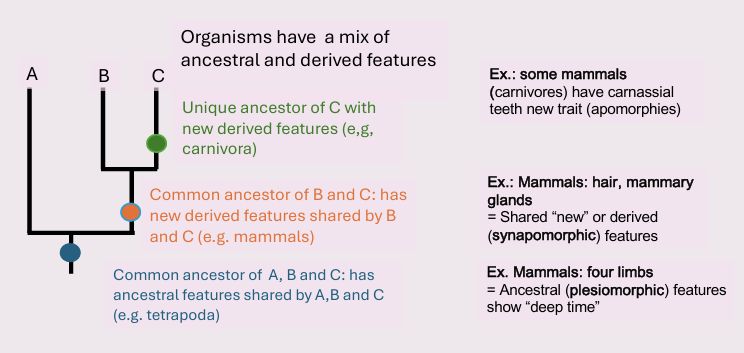
Organisms exhibit a combination of ancestral (plesiomorphic) and derived (apomorphic) features.
Example:
Unique ancestor of C with new features, common ancestor of B and C with shared derived features, common ancestor of A, B, and C with shared ancestral features.
Example Analysis:
Mammals:
Ancestral features include four limbs (plesiomorphic characteristics).
Derived features include hair and mammary glands (synapomorphic).
Carnivorous mammals exhibit advanced traits like carnassial teeth (apomorphy).
Cladistics Fundamentals
The goal of cladistics is to group organisms according to their evolutionary history (creating a cladogram) in monophyletic groups.
A monophyletic group (clade):
Includes all species that share the most recent common ancestor.
Example: all horses belong in the Equus genus, including zebras as part of the ingroup.
Ingroup and Outgroup Relations
Ingroup:
The group of species being studied.
Compared against the outgroup, which is closely related but lacks shared derived traits.
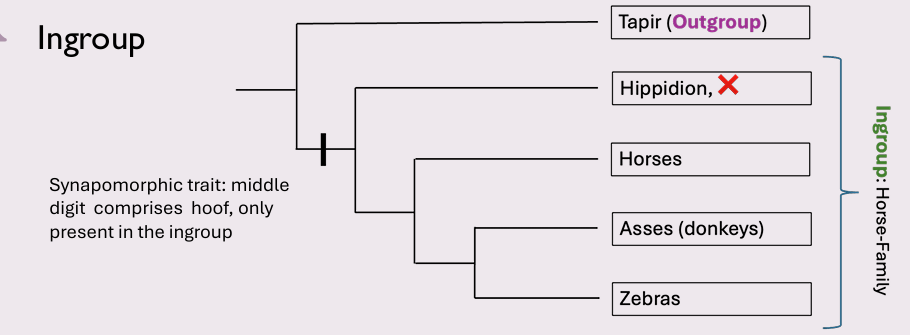
Synapomorphic Trait:
Character unique to the ingroup, exemplified by the hoof structure in horses.
Homologies:
Features shared by both ingroup and outgroup are considered ancestral and not useful for differentiating among ingroup species, such as odd-toed hoofed animals.

Cladogram Construction: Principles
Maximum Parsimony:
The principle assuming the tree with the fewest evolutionary events, or changes in derived characters, is most likely to represent true evolutionary relationships.
Maximum Likelihood:
Based on specific rules regarding DNA changes over time, it seeks the tree that best reflects the most likely sequence of evolutionary events.
Example Character Matrix
TAXA:
Lancelet (outgroup), Lamprey, Tuna, Salamander, Turtle, Leopard.
Characters:
Vertebral column (backbone), Hinged jaws, Four walking legs, Amniotic (shelled) egg, Hair.
Character Data Table:
Represents presence (1) or absence (0) of characters across species, aiding in cladogram creation.
Phylogenetic Tree Visualization:
Shows relationships among groups based on their character data.
Example:
Salamander, Leopard, Turtle, Lamprey, Tuna with Lancelet as the outgroup.