Medical Terminology: Suffixes Signifying Medical Conditions
Fundamentals of Medical Terminology in CSSD Operations
Core Learning Outcomes:
- Deconstruct complex clinical terms to accurately isolate suffixes signifying medical conditions.
- Differentiate distinct pathological states based entirely on diagnostic and structural suffix definitions.
- Correlate surgical instrumentation requirements to localized patient medical conditions and tissue states.
- Execute error-free sterile processing workflows by verifying pathologically specific procedural records.
- Understand the fundamental importance of precise medical terminology in healthcare environments.
- Identify and differentiate the four basic word parts: prefixes, roots, suffixes, and combining forms.
- Analyze complex medical terms by breaking them down into their structural components.
- Apply foundational Latin and Greek roots, prefixes, and suffixes to interpret medical and surgical terms.
Clinical Significance of Medical Terms:
- Medical Conditions: Encompass structural anomalies, functional disorders, disruptions, or injuries that directly impact human health.
- The Diagnostic Engine: Suffixes serve as the core diagnostic engine of medical terminology, shifting a general anatomical root word into a concrete, highly specific medical disease or condition.
- Central Sterile Supply Department (CSSD) Impact: Understanding clinical conditions dictates instrument kit provisioning, device parameters, and strict contamination guidelines based on the exact condition listed in surgical schedules.
Precision vs. Ambiguity:
- Casual terms like "gut" or "cut" introduce critical clinical errors.
- "Gut" can refer ambiguously to the stomach, small intestine, or large intestine, whereas the combining form
gastr/ospecifically isolates the stomach. - "Cut" can mean a simple surgical incision or an entire organ amputation.
- CSSD professionals must communicate with absolute accuracy to safeguard patient safety and maintain structured operational workflows.
Etymological Foundation:
- Approximately of English words—and nearly all medical terms—are derived from Latin and Greek origins.
Structural Components of Medical Vocabulary
The Four Basic Word Parts:
- Word Roots: The core foundation of a medical term; nearly every medical word contains one or more roots (e.g.,
card/ifor heart). - Prefixes: Elements added to the beginning of a word to alter its meaning, modifying position, direction, or time (e.g.,
peri-,post-). - Suffixes: Elements attached to the end of a word to denote a clinical condition, symptom, or specialized practice (e.g.,
-itis,-algia). - Combining Forms: A root plus a connecting vowel (usually 'o') used to make structural pronunciation fluent and seamless (e.g.,
psycho-,cardi/o).
- Word Roots: The core foundation of a medical term; nearly every medical word contains one or more roots (e.g.,
Structural Word Part Decomposition:
cardialgia:- Root:
cardi(heart) - Suffix:
-algia(pain) - Meaning: Pain in the heart; also refers to heartburn (a digestive disorder).
- Root:
cardiology:- Root/Combining Form:
cardio(heart) - Suffix:
-logy(study of) - Meaning: Study of the heart and its disorders.
- Root/Combining Form:
carditis:- Root:
card(heart) - Suffix:
-itis(inflammation) - Meaning: Inflammation of the heart.
- Root:
diagnosis:- Prefix:
dia-(across; through) - Root:
gnosis(knowledge) - Meaning: Discovery of the cause of signs and symptoms.
- Prefix:
iatrogenic disease:- Roots:
iatro(physician);gen(origin, cause) - Suffix:
-ic(adjective suffix) - Meaning: Disease caused by health care (worker, institution, or system).
- Roots:
psychopath:- Roots:
psycho(mind);path(disease) - Meaning: Person with a (serious) mental disease.
- Roots:
- Derived Word Parts:
ger/o(old age) /geroitic: Derived terms such as geriatrics.ped/o/ped/ia(child): Derived terms such as pediatrician.- Practitioner Suffixes:
-ist/-ician(practitioner).

Foundational Word Roots, Prefixes, and Fundamental Suffixes
- Foundational Word Roots:
arthr/o: jointcard/i/o: heartderm/o/ato: skingen/o: origin, cause, formationger/o/onto: old agehem/a/ato: bloodiatr/o: physicianmuscul/o: musclenatal: birth; bornneur/o: nerveos/teo: bonepath/o: diseaseped/ia: childphren/o: diaphragm, mindpsych/o: mindskelet/o: skeletontend/o,ten/o: tendon

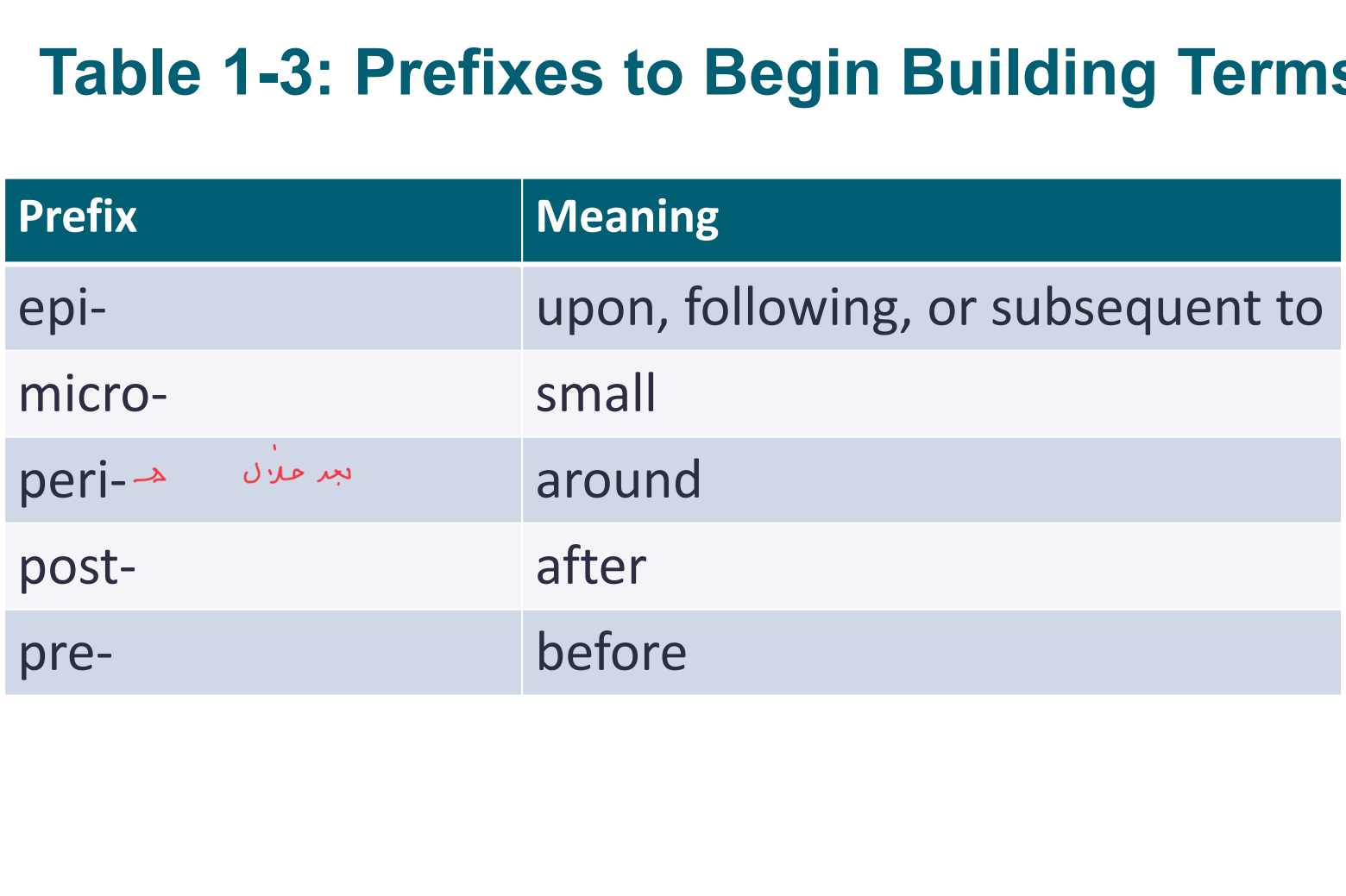
- Foundational Prefixes:
epi-: upon, following, or subsequent tomicro-: smallperi-: aroundpost-: afterpre-: before
- Fundamental Building Suffixes:
-al: adjective suffix-algia: pain-dynia: pain-gen,-genesis: origin, cause, formation-ic: adjective suffix denoting of-itis: inflammation-logy: study of-pathy: disease-scope: viewing, an instrument used for viewing

Comprehensive Directory of Pathological and Diagnostic Suffixes
- Medical Condition Suffixes (Part 1):
-algia,-dynia: pain | Example:arthralgia,arthrodynia(pain in a joint)-cele: protrusion, hernia | Example:rectocele(hernia of the rectum)-cyte: cell | Example:leukocyte(white blood cell)-ectasis,-ectasia: expansion or dilation | Example:angiectasis(dilation of a vessel / blood vessel specifically)-edema: excessive fluid buildup causing swelling | Example:angioedema(fluid buildup causing swelling under skin)-emesis: vomiting | Example:hematemesis(vomiting of blood)

- Medical Condition Suffixes (Part 2):
-emia: blood condition | Example:uremia(urea in the blood)-iasis: condition or state | Example:cholelithiasis(stones in the gallbladder or bile ducts)-ism: a condition of, a process, or a state of | Example:hypothyroidism(condition characterized by thyroid hormone deficiency)-itis: inflammation | Example:appendicitis(inflammation of the appendix)-lith: stone, calculus, calcification | Example:pneumolith(a stone in the lung)-lysis: disintegration, breaking down | Example:hemolysis(rupture of red blood cells)

- Medical Condition Suffixes (Part 3):
-malacia: softening | Example:osteomalacia(softening of the bones; common in older individuals)-megaly: enlargement | Example:gastromegaly(enlargement of the stomach)-oid: resembling or like | Example:opioid(substance that resembles opium; drug that can lead to addiction over time like morphine)-oma: tumor | Example:gastroma(tumor of the stomach)-osis: abnormal condition | Example:osteoporosis(condition of porous bones; common in elderly populations)-pathy: disease | Example:myopathy(disease of the muscle)

- Medical Condition Suffixes (Part 4):
-penia: reduction of size or quantity | Example:leukopenia(low number of white blood cells)-phobia: fear | Example:carcinophobia(fear of cancer)-plasia: abnormal formation | Example:neoplastic(abnormal growth of cells)-plegia: paralysis | Example:hemiplegia(paralysis on one side of the body)-pnea: breathing | Example:tachypnea(rapid breathing; contrast withorthopnea: inability to breathe unless sitting or standing erect)-poiesis: producing | Example:erythropoiesis(production of red blood cells)

- Medical Condition Suffixes (Part 5):
-porosis: porous condition | Example:osteoporosis(porous state of bones)-ptosis: downward displacement | Example:nephroptosis(downward displacement of a kidney)-rrhage: flowing forth | Example:hemorrhage(significant discharge / heavy flowing forth of blood from blood vessels)-rrhea: discharge | Example:rhinorrhea(discharge from the nose / runny nose)-rrhexis: rupture | Example:hysterorrhexis(rupture of the uterus)-sclerosis: hardness | Example:atherosclerosis(hardening of the arteries)

- Medical Condition Suffixes (Part 6):
-spasm: muscular contraction | Example:angiospasm(muscular contraction of a vessel)-stasis: level, unchanging | Example:thermostasis(a constant, consistent internal body temperature)-stenosis: a narrowing | Example:arteriostenosis(narrowed arteries)

Applied Case Cart Provisioning Audits and Clinical Scenarios
Interactive Activity 1: Case Cart Provisioning Audit:
- Scenario Outline: A CSSD professional is auditing emergency case carts for the evening shift. Cart A contains a vascular tray prepped for a patient exhibiting localized angioedema and severe angiospasm. Cart B is staged for an emergency orthopedic intervention to repair bone damage caused by severe osteomalacia. Meanwhile, the decontamination area receives a specialized scope from an active case where the surgical record notes the immediate occurrence of a severe hemorrhage alongside sudden tachypnea in the patient.
- Pathology and Suffix Analysis:
angioedema: Suffix-edema(excessive fluid buildup causing swelling). Pathology: Excessive fluid buildup causing swelling under the skin or vascular tissue.angiospasm: Suffix-spasm(muscular contraction). Pathology: Involuntary muscular contraction of a blood vessel.osteomalacia: Suffix-malacia(softening). Pathology: Abnormal softening of the bone tissue.hemorrhage: Suffix-rrhage(flowing forth). Pathology: Significant discharge or heavy flowing forth of blood from vessels.tachypnea: Suffix-pnea(breathing). Pathology: Abnormally rapid rate of breathing.
Interactive Activity 2: Decontamination & Urology Suite Case:
- Scenario Outline: A CSSD technician is processing a high-priority flexible cystoscope return in the decontamination suite. The accompanying surgical chart indicates the patient was admitted with severe cholelithiasis and chronic uremia. During the intraoperative phase, the surgeon documented a localized rectocele and a secondary diagnosis of appendicitis. Due to these complex clinical findings, the patient also experienced post-procedural muscle weakness categorized as an acute myopathy, necessitating specialized instrument configurations.
- Pathology and Suffix Analysis:
cholelithiasis: Suffix-iasis(condition or state) containing root-lith(stone). Pathology: Formation or presence of stones in the gallbladder or bile ducts.uremia: Suffix-emia(blood condition). Pathology: Abnormal blood condition marked by excessive urea in the blood.rectocele: Suffix-cele(protrusion, hernia). Pathology: Herniation or protrusion of the rectum.appendicitis: Suffix-itis(inflammation). Pathology: Acute or chronic inflammation of the appendix.myopathy: Suffix-pathy(disease). Pathology: Pathological disease affecting muscle tissue.
Interactive Review & Clinical Self-Assessment
Question 1: Word Roots
- Prompt: Which of the following combining forms refers specifically to the heart, an organ whose associated surgical trays are frequently processed in the CSSD?
- Options:
- A)
gastr/o - B)
cardi/o - C)
nephr/o - D)
arthr/o
- A)
- Correct Answer: B)
cardi/o - Explanation:
cardi/ospecifically designates the heart.gastr/orefers to the stomach,nephr/oto the kidney, andarthr/oto joints.
Question 2: Suffixes
- Prompt: An orthopedic instrument tray is processed for joint conditions. If a chart lists "arthralgia", what does the suffix
-algiasignify? - Options:
- A) Inflammation
- B) Surgical removal
- C) Pain
- D) Puncture to withdraw fluid
- Correct Answer: C) Pain
- Explanation: The suffix
-algia(along with-dynia) denotes pain.arthralgiarepresents joint pain. Inflammation is indicated by-itis.
- Prompt: An orthopedic instrument tray is processed for joint conditions. If a chart lists "arthralgia", what does the suffix
Question 3: Prefixes
- Prompt: In medical contexts, a clear distinction is made between postoperative and perioperative care. What does the prefix
peri-mean? - Options:
- A) After or following
- B) Before or in front of
- C) Within or inside
- D) Surrounding or around
- Correct Answer: D) Surrounding or around
- Explanation: The prefix
peri-means surrounding or around (e.g., pericardium, perioperative).post-signifies after/following, whilepre-signifies before.
- Prompt: In medical contexts, a clear distinction is made between postoperative and perioperative care. What does the prefix
Question 4: Clinical Distinctions
- Prompt: What is the precise clinical distinction between the combining form
gastr/oand the general term "gut"? - Options:
- A)
Gastr/ospecifically refers to the stomach, whereas gut is a broader term for the whole tract. - B)
Gastr/orefers exclusively to the small intestine, while gut refers to the stomach. - C) There is no clinical distinction; both terms are used interchangeably.
- D) Gut refers strictly to the esophagus, whereas
gastr/orefers to the large intestine.
- A)
- Correct Answer: A)
Gastr/ospecifically refers to the stomach, whereas gut is a broader term for the whole tract. - Explanation: Imprecise terms like "gut" create clinical ambiguity because they can imply any part of the gastrointestinal tract (stomach, small intestine, large intestine), whereas
gastr/ostrictly isolates the stomach.
- Prompt: What is the precise clinical distinction between the combining form
Question 5: Compound Medical Terms
- Prompt: Based on analyzing word parts:
peri-(surrounding) +cardi(heart) +-itis(inflammation), what doespericarditismean? - Options:
- A) Surgical removal of the heart muscle
- B) Inflammation of the sac surrounding the heart
- C) Chronic pain originating within the heart valves
- D) Abnormal enlargement of the heart chambers
- Correct Answer: B) Inflammation of the sac surrounding the heart
- Explanation: Synthesizing the components yields
peri-(surrounding) +cardi(heart) +-itis(inflammation) = inflammation of the pericardium (the sac surrounding the heart).
- Prompt: Based on analyzing word parts: