Unit 1 - Single and Double Replacement
#4d3800
#cbe2c4
#04453c
Single Replacement
A single replacement reaction, sometimes called a single displacement reaction, is a reaction in which one element is substituted for another element in a compound. The starting materials are always pure elements, such as pure zinc metal or hydrogen gas, plus an aqueous compound. When a replacement reaction occurs, a new aqueous compound and a different pure element will be generated as products. The general pattern of a single replacement reaction is shown below.
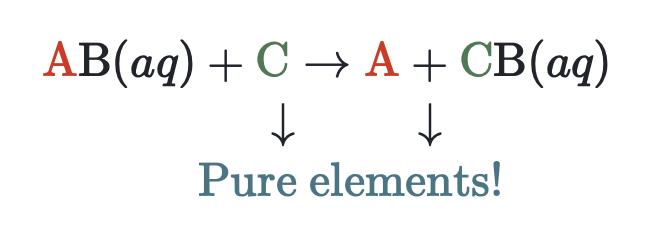
We can see that A is replaced by C in compound AB to make a new compound CB and elemental A. Another thing you might notice is that A starts as an ion in solution but appears in its elemental form on the product side. The reactant C does the opposite: it starts out in its elemental form on the reactant side, but it ends up as an ion in aqueous solution as part of the compound CB(aq).

Double Replacement
Double replacement reactions—also called double displacement, exchange, or metathesis reactions—occur when parts of two ionic compounds are exchanged, making two new compounds. The overall pattern of a double replacement reaction looks like this:

You can think of the reaction as swapping the cations or the anions, but not swapping both since you would end up with the same substances you started with. The solvent for a double replacement reaction is usually water, and the reactants and products are usually ionic compounds—but they can also be acids or bases.
Here is an example of a double replacement reaction:

In this example, the cations are Ba2+ and Na+, and the anions are Cl-and SO42-. If we swap the anions, or cations, we get as our products BaSO4 and NaCl.
Don’t forget stoichiometry:
Once we swap the anion/cation partners to get the products, we also need to make sure that the product compounds are neutral since the reactant compounds are neutral. This means checking that the charges for the anion(s) and cation(s) cancel out within a compound. Also, we have to check that the subscripts in the products are the lowest possible integer values.