Chain of Infection
What is it?
The chain of infection is an infection or communicable disease model.
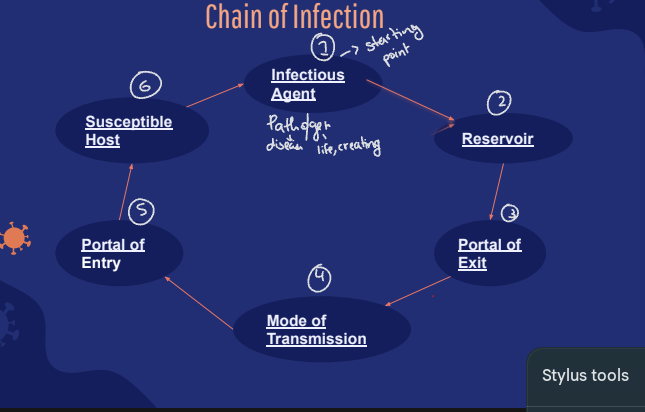
Pathogen / Infection agents
Bacteria
Virus
Parasite
Fungi
Reservoir
Something that holds bacteria.
Fomite: hard, inanimate, surface or object that holds bacteria.
Example for reservoirs:-
Humans
Environment
Rodents (aka vector)
Birds
Water
Equipment
Portal of exit
Open wounds/skin
Splatter or body fluids
Aerosols (eg: Bacteria that are sprayed when you are coughing)
Mode of TRANSMISSION (don’t confuse transportation!!!)
Transmission from host to host
Direct or indirect contact
Ingestion
Inhalation
Portal of entry
Broken skin/incisions
Respiratory tract
Mucous Membranes
Catheters/tubes/IV
Susceptible Host
Young (5 years or younger)
Elderly population
Immunosuppressed
Anyone (depends on the pathogen)
Medical Asepsis
A/sep/sis - A means without ; Sep means poison, rot or infection ; sis means condition
Helps to contain infectious organisms and to maintain an environment free from contamination.
Sterilize vs Disinfect: Sterilize is to rid of bacteria while disinfect completely is to just kill off basic bacteria.
Hand washing
Gowns, Masks, Gloves (PPE)
Basic Hygiene
Clean Linens
Autoclave : Sterilization of instruments
Standard Precautions
Treating everything as it is infected. This widens the focus of protective tactics.
PREVENTION
1. Pathogen : antibiotic, antifungal, antiviral, pasteurization, chlorination (these are just examples)
2. Reservoir: isolation, surveillance, vector control (rat/pest control)
3. Portal of exit: PPE (masks, face shields), proper bandaging/wound care,
4. Mode of transmission: Sterilizing, disinfecting, PPE, hand hygiene
5. Portal of entry: PPE, first aid, hand hygiene
6. Susceptible Host: Good nutrition, treatments, immunizations, patient education