PS201 - T1W5 - Interpersonal Relationships
Slides 4–5: Individual Differences & Interpersonal Attraction
Key claims / arguments
Interpersonal attraction is influenced by stable individual differences
There are three components to consider when looking at attraction
Personality variables (e.g. bog 5 traits), cognitive variables (E.g. Evaluative Strategies), and psychosocial variables (e.g. Similarity in looks or SES, age dynamics) etc jointly determine attraction
Individual differences help explain why some relationships form and succeed while others do not
Key theories / models
Three-component framework of attraction:
Personality variables (e.g., Big Five traits)
Cognitive variables (e.g., evaluative strategies)
Psychosocial factors (e.g., similarity)
Key studies
Kreuger & Caspi (1993) - Proposed multiple hypotheses explaining interpersonal attraction.
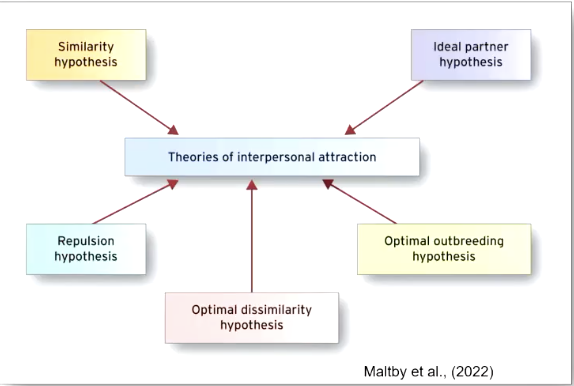
Similarity - someone who sees the world the same way as you is likely to be attracted to you
Repulsion hypothesis - opposite of similarity. Someone who is opposite to what you are as a person (e.g. personality, beliefs, world views, physical attraction) will not be someone who you are attracted to.
Optimal dissimilarity - idea that someone is aligned enough to who you are as a person to the point that you are not pushed away from them, but different enough so that you are intrigued by them.
Ideal Partner - idealising a romantic/sexual partner. Categorising characteristics around this ideal.
Optimal Outbreeding - similar to optimal dissimilarity, but in the context of breeding. Considering whether someone is different enough from you to have optimal biological conditions for breeding.
Maltby et al. (2022)
Integrated personality and social factors in attraction theories.
One-line essay use
Can be used to frame relationship success as partly driven by individual personality differences rather than chance.
Slides 5–7: Hypotheses of Interpersonal Attraction
Key claims / arguments
People are attracted to others who resemble themselves
Ideal characteristics influence partner choice
Extreme dissimilarity is generally unattractive
Key theories / models
Similarity hypothesis
Ideal partner hypothesis
Repulsion hypothesis
Optimal dissimilarity hypothesis
Optimal outbreeding hypothesis
Key studies
Kreuger & Caspi (1993) - Found evidence for similarity, repulsion, and ideal partner hypotheses, but not for optimal dissimilarity or outbreeding.
Shown women computer generated profiles - shown men with similar and dissimilar personality
Asked to rate how they would feel when on a date with that person.
Found that it was a combination of
Similarity to own personality and possession of ideal characteristics
Lacking in evidence → optimal dissimilarity and optimal outbreeding.
One-line essay use
Useful for explaining why similarity in traits promotes relationship stability and success.
Slide 8: Fatal Attraction
Key claims / arguments
Traits that initially attract partners can later cause relationship conflict and breakup
Relationship breakdown often reflects reinterpretation of traits, not personality change in the partner.
Key theories / models
Fatal attraction hypothesis
Key studies
Felmlee (1995) - Showed that positive partner traits can become sources of dissatisfaction over time.
Those who were nice → were now passive
Those as strong → now stubborn
Funny → now flaky
Outgoing → over the top/too much
Caring → clingy
One-line essay use
Useful for evaluation, showing how individual differences can both promote and undermine relationship success.
Slides 13–16: Love Styles – Sternberg’s Triangular Theory
Key claims / arguments
Individuals differ in how they experience and express love
Different combinations of love components predict relationship outcomes
Love has a place in Maslow’s hierarchy of needs - safety, esteem and belongingness
No agreed definition - no consensus on whether love is experienced in the same way universally
Key theories / models
Sternberg’s Triangular Theory of Love
Passion
Intimacy
Commitment
Seven types of love (e.g., romantic, companionate, consummate)
Key studies
Sternberg (1986a; 1998) - Proposed that love consists of three interacting components.
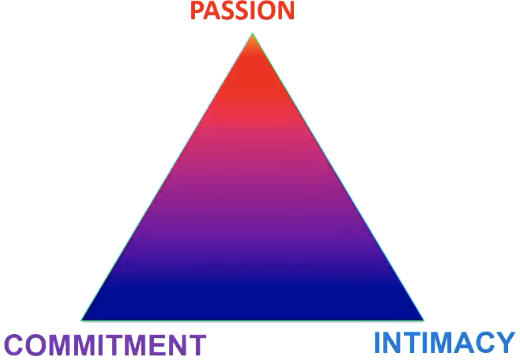
Passion (sex), commitment and intimacy (emotional not physical).
They are combined systematically to make different kinds of love.
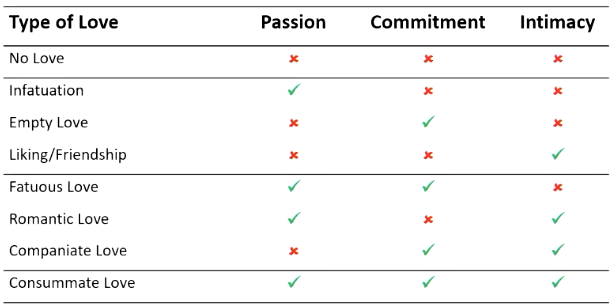
Consummate love is the most difficult to achieve and maintain as it requires all things constantly.
Regan (2003)
Supported the model’s relevance for explaining relationship differences.
One-line essay use
Can be used to explain individual differences in relationship satisfaction and longevity.
Slides 18–20: Lee’s Colours of Love
Key claims / arguments
Individuals adopt different love styles that shape relationship behaviour
Love styles are linked to personality traits
Key theories / models
Lee’s six love styles:
Eros, Ludus, Storge, Mania, Pragma, Agape
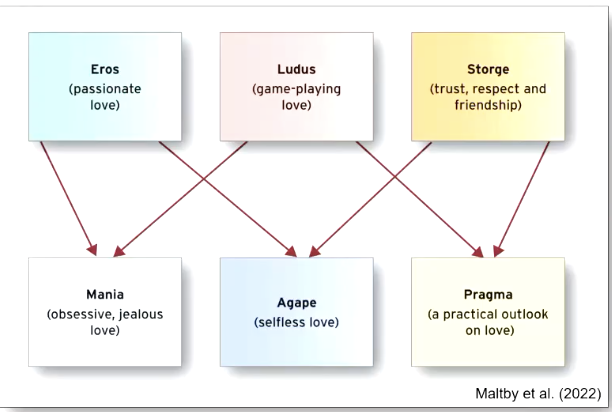
Eros (most sexual form), ludus (most strategic/amnipulative form)
Mania - combination of eros and ludus - very intense and not always healthy
Agape - combo of eros and storge - can also be known as altruism
Pragma - combo of Ludus and Storge - pragmatic/practical look on love.
Love Attitude Scale (LAS) - Hendrick & Hendrick, 1986
Men → Ludic and Manic Lovers
Women → storge and pragma
Key studies
Lee (1976; 1988)
Identified distinct love styles.Hendrick & Hendrick (1986; 1995)
Developed measures of love styles and found gender differences.Davis (1996) - Linked love styles to personality traits (e.g., extraversion, neuroticism).
Positive association with extraversion with Ludus/Eros styles
Neuroticism has a positve association with Mania, yet negative association with Pragma
Psychoticism has a positive association with Ludus, yet negatively associated with Storge and Agape.
One-line essay use
Strong evidence that personality traits influence relational success via love styles.
Slides 21–26: Attachment Theory
Key claims / arguments
Definition of Attachment - relationship between primary caregiver (usually the mother) and infant
Attachment styles reflect stable individual differences
Early attachment patterns influence adult romantic relationships
Secure attachment is associated with healthier, more successful relationships
Key theories / models
Attachment theory (secure, anxious-resistant, anxious-avoidant)
Models of self and other (positive vs negative)
Key studies
Bowlby (1969)
Proposed attachment as a biologically based system.Ainsworth et al. (1978) - Identified attachment styles.
Secure Attachment → Where the infant is distressed from the caregiver, is initially distressed but easily soothed
Insecure/Anxious - Resistant attachment → distressed initially and then hard to soothe, but then pushes away yet clings to the caregiver
Insecure/Anxious - Avoidant attachment → may not have even realised that the caregiver is gone child does not use caregiver as an anchor/secure base to explore new environments
Hazan & Shaver (1987) - Linked childhood attachment to adult romantic relationships.
Similar behavioural patterns with romantic partners based on the attachment type during infancy
Securely attached children tend to have the best outcomes with romantic relationships (or other outcomes in life, whereas there are some faults when having insecure attachment styles.
Secure attachment → more trust - tendency for long-term relationships - generous and supportive when partner is under stress - Positive, optimistic, constructive
Insecure/Anxious Resistant → more eager to be close - fear of abandonment - high breakup rate followed by intense grieving and unstable self-esteem - jealous and untrusting
Insecure/Anxious Avoidant → Less investment to relationships - not comfortable being close to the partner - withdraws from partner under stress - finds social interaction boring/irrelevant - prefers solitude
Baeckstroem & Holmes (2001); Gallo et al. (2003) - Linked attachment styles to Big Five traits.
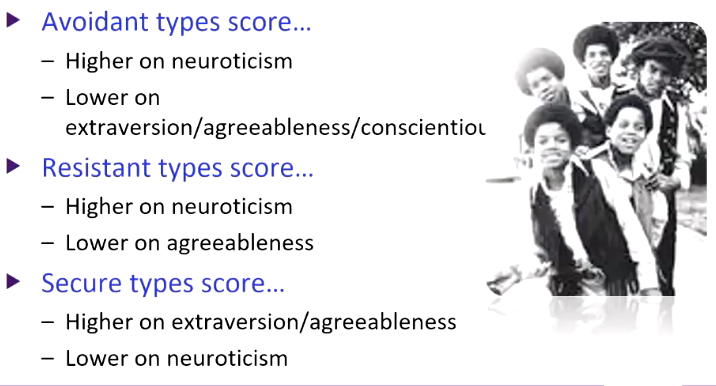
Shaver & Fraley (2004) - Proposed dimensional models of attachment - Individual differences in attachment styles
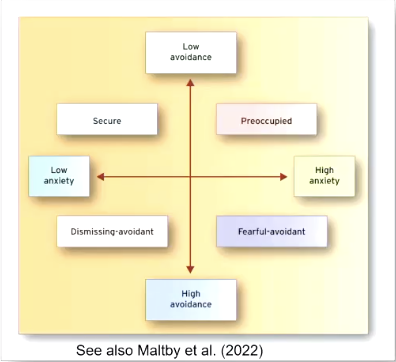
Shows the attachment to other people along two dimensions
Avoidance and anxiety → interaction between these to are shown in 4 quadrants
Low avoidance → tend to have positive mode of other - vice versa for high avoidance
Low anxiety → tend to have positive mode of self - vice versa for high anxiety
One-line essay use
Central evidence for arguing that individual differences predict relationship success and stability.
Slides 27–31: The Investment Model
Key claims / arguments
Commitment determines relationship persistence/longevity
Individuals differ in how they respond to relationship problems
High investment promotes constructive coping - represents psychological attachment to relationship and partner and motivation to continue it.
Key theories / models
Rusbult’s Investment Model
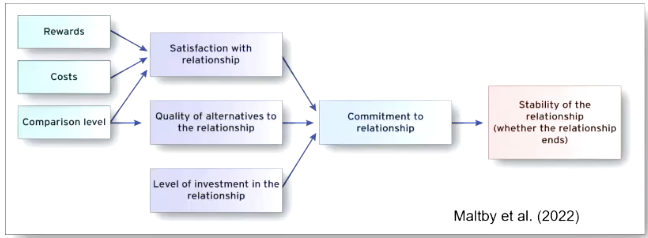
Satisfaction → costs vs rewards/comparison level (comparing the relationship you have to others you may have seen, the concept of what an ideal relationship may look like to you, what it would be like to be by yourself)
Quality of alternatives → can be things such as life by yourself or life in another relationship.
Investment size - can be tangible and intangible things e.g. memories, children, mortgages, physical possessions that are tied to the relationship
Once all these things have been quantified, this then determines whether one deems it worth it to stay or leave the relationship.
Exit, voice, loyalty, neglect strategies
Key studies
Rusbult (1983)
Developed the investment model of commitment.Rusbult & Zembrodt (1983); Rusbult et al. (1986) - Identified individual differences in breakup strategies/response categories for how individuals initiate the end of a relationship
Exit strategy → things aren’t going well, wanting instant divorce/separation.
Voice strategy → things aren’t going well, talk between each other and try to talk things out between one another
Loyalty strategy → things aren’t going well, stay because person is committed to the relationship, desires to see it overcome this
Neglect strategy → things are not going well, do nothing and observe
Two main dimensions for strategies
Constructiveness → Voice strat and Loyalty strat vs Destructiveness→ Exit strat and Neglect strat
Activity → Exit strat and Voice strat vs Passivity → Loyalty strat vs Neglect strat
One-line essay use
Explains why some individuals maintain relationships despite difficulties, indicating relational success.
Slides 32–33: Personality, Attachment & Response to Relationship Dissolution
Key claims / arguments
Personality traits influence coping with relationship breakdown
Attachment style predicts emotional responses to dissolution
Key theories / models
Attachment-based coping styles
Trait-based differences in emotional recovery
Key studies
Davis, Shaver & Vernon (2003) - Attachment styles predict distress and coping strategies.
Resistant attachment → devastated, preoccupied with relationships breakdown, distress and anger and dysfunctional coping strategies, reluctance to let go
Avoidant Attachment → less distress, more avoidance of teh situation as a whole, rely on self-reliant strategies.
Secure attachment → rely on the support of family and friends and functional coping strategies, willing to let go, less distress, views former partner with respect
Chung et al. (2002); Furnham & Heaven (1999); White et al. (2004) - Neuroticism, extraversion, and psychoticism predict recovery patterns.
High neuroticism → take longer to get over break up
High psychoticism → takes less time to recover from break up.
High extraversion → more likely to use family and friends as support after relationship breakdown.
One-line essay use
Useful for showing how individual differences affect resilience and long-term relational success.