5.2.2 Respiration- Oxidative Phosphorylation using TM
Takes place on the Cristae and inter membrane space, all hydrogen acceptors such as NADH (10) and FADH (2). This stage creates 38 ATP
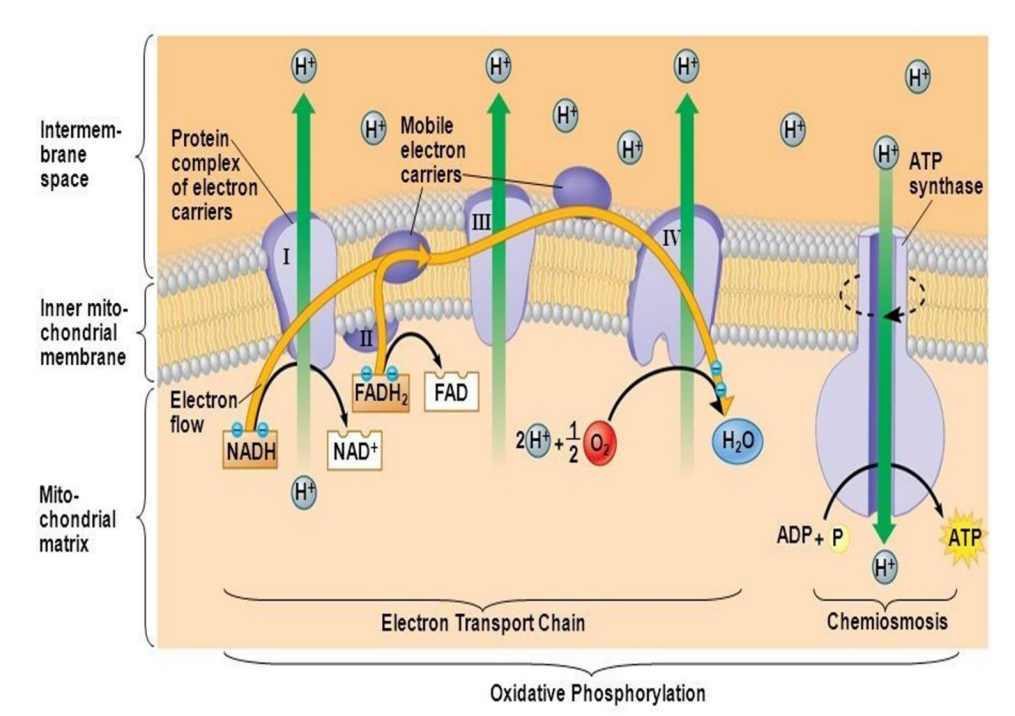 Reduced NADH and FADH are oxidised and the hydrogens are released into the matrix to maintain the proton gradient and electrons which move down the electron transfer chain and move along by redox reactions providing energy for protons to be actively transported to the intermembrane space.
There is then a higher concentration in the intermembrane space so they hydrogens move back by ATP synthase into the matrix this creates 38 ATP this is known as chemiosmosis.
Once electrons reach the last electron carrier it is accepted by O2 as the last electron acceptor to form water. If there is no oxygen the electron will not transfer so it will stop the electron transfer chain
Per glucose molecule:
Glucose- 2 NADH
Link reaction- 2 NADH
Krebs cycle- 6 NADH, 2 FADH
so overall 32 ATP now adding 6 ATP for Oxidative phosphorylation so its 38 ATP