East Asia
Figure 10.1 will be on Week 1 Map Quiz
Indetifying the Boundaries
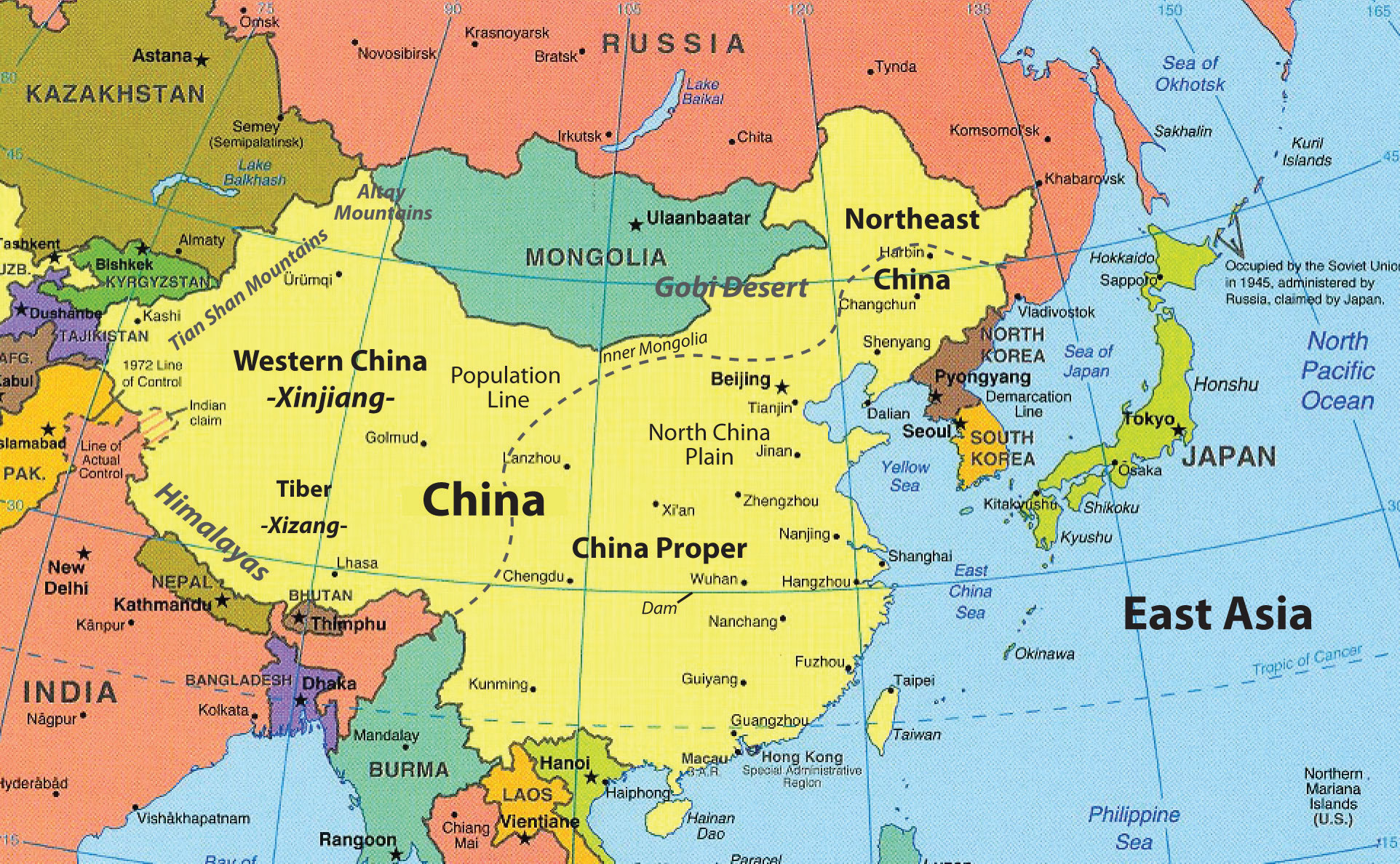
East Asia is a large expanse of territory with China as its largest country.
Mongolia, North & South Korea, and Japan are China’s neighbors.
Taiwan is off the eastern coast of China and has been an independent government that has been seperated from mainland China since the end of WWII
Southern coast of China is Hong Kong — form British possession
under the agreement of autonomy, Hong Kong and its port were turned over to the Chinese government in 1997
West of Hong Kong is Macau — former Portuguese colony
Western China is the autonomous region of Tibet, Xizang ( Chinese Name )
controlled by Communist China since 1949 shortly after the People’s Republic of China was declared a country
Tibetan independence has not been successful
recently become more integrated with the country of China due to immigration of Chinese people to the region
Japan has emerged as the economic dragon of East Asia.
have a high standard of living
been an industrial and financial engine for the Pacific Rim ( coastal lands bordering the Pacific Ocean )
Economic Tigers — quickly emerging economic centers in Asia which includes:
South Korea
Taiwan
Hong Kong
Singapore
balancing out the advantages of the economic tigers and Japan is the extensive labor base of the Chinese people which catapulted the Chinese economy to its position as a major player in the global economy.
North Korea — isolated iteself behind an authoritarian dictatorship since World War II
countries that were former enemies in WWII are now trading partners like China and Japan
cultural and political differences between these countries still remain
East Asia is home to one-fifth of the human population
Japan, South Korea, and Taiwan creates an industrial environment that has awakened the human entrepreneurial spirit of the realm.
manufacturing has fueled the high-tech engines of the Pacific Rim economies which have recently taken advantage of the massive labor pool of the Chinese heartland.
across the Pacific from East Asia are the superpower of the US and its North American Free Trade Agreement (NAFTA) partners — both competing against and trading with the East Asian Community (EAC)
Russian realm to the north of East Asia — port of Vladivostok continues to actively engage the East Asian nations.
10.1 Introducing the Realm
Physical Geography
surrounded by a series of mountain ranges in the west
Russia in the north
Southeast Asia to the south
Himalayas border Tibet and Nepal
among the highest mountain ranges in the world and Mt. Everest is the planet’s tallest peak
Karakoram Ranges, Pamirs, and the Tian Shan Mountains shadow Central Asia
Altay Mountains next to Russia
dry arid conditions of type B climates dominate western China
desert conditions rises to a large uninhabitable region in its center
many mountains ranges are home to earthquakes and tremors
Indian tectonic plate is still pushing northward into the Eurasian plate forcing the Himalayan rangers upward
the Tibetan Plateau is the largest plateau region of the world with high elevations of fifteen thousand feet
sparsely populated and the only places with human habitation are the river valleys
Lhasa is the largest city of the sparsely populated region
sometimes called “the Roof of the World”
small amount of rain that occurs often comes in the form of hailstorms mixed with wind
landscape generally rocky and barren
vast arid regions extend into the Gobi Desert between Mongolia and China
colder type D climates dominate Mogoalian steppe and northern China
eastern coast of Asia is home to islands and peninsulas
Taiwan
produces warmer tropical type A climate
Japan
prone to earthquakes
type C climate is dominant in Japan but the north has a colder type D climate
North and South Korea
North Korea type D climates are similar tothe northern tier of the United States ( North Dakota )
most of China’s population lives in its eastern region called China Proper
type C climates
fresh water
good soils
dense population clusters that correspond to the areas of type C climates that extend south from Shanghai to Hong Kong
to the south temperatures are warmer, with hot and humid summers and dry and warm winters
North China Plain at the mouth of the Yellow River (Huang He River) has rich farmland and is the most densly populated region in China
Northwest of Beijing is Inner Mongolia at the Gobi Desert
arid type B climates dominate all the way to the southern half of Mongolia
northern half is colder with continental type D climates
higher elevations of the highlands in western Mongolia is type H highland climates
climate and location indentify Mongolia as a landlock country in the Northern latitudes with low level of precipitation
areas of type D climate extend north from Beijing through Northeast China at times receive more precipitation than northern Mongolia
North of the Great Wall and encompassing Inner Mongolia is the Mongolian Steppe
broad flat grasslands that extend north into the highlands
North China includes:
Yellow River Basin
superb agricultural lands
loess — extremely fine silt or windblown soil that is yellow
municipalities of Beijing and Tianjin
Deciduous forests
Great Wall of China
Most of western China is arid with type B climate
has large regions like Takla Makan Desert which is uninhabited because of hot summers and long cold winters
Uyghur language, the name Takla Makan means “You will go in but you will not go out”
Far west are high mountains bordering Central Asia that restrict travel and trade
Northwestern China is mountainous with glaciers, deserts, and basins
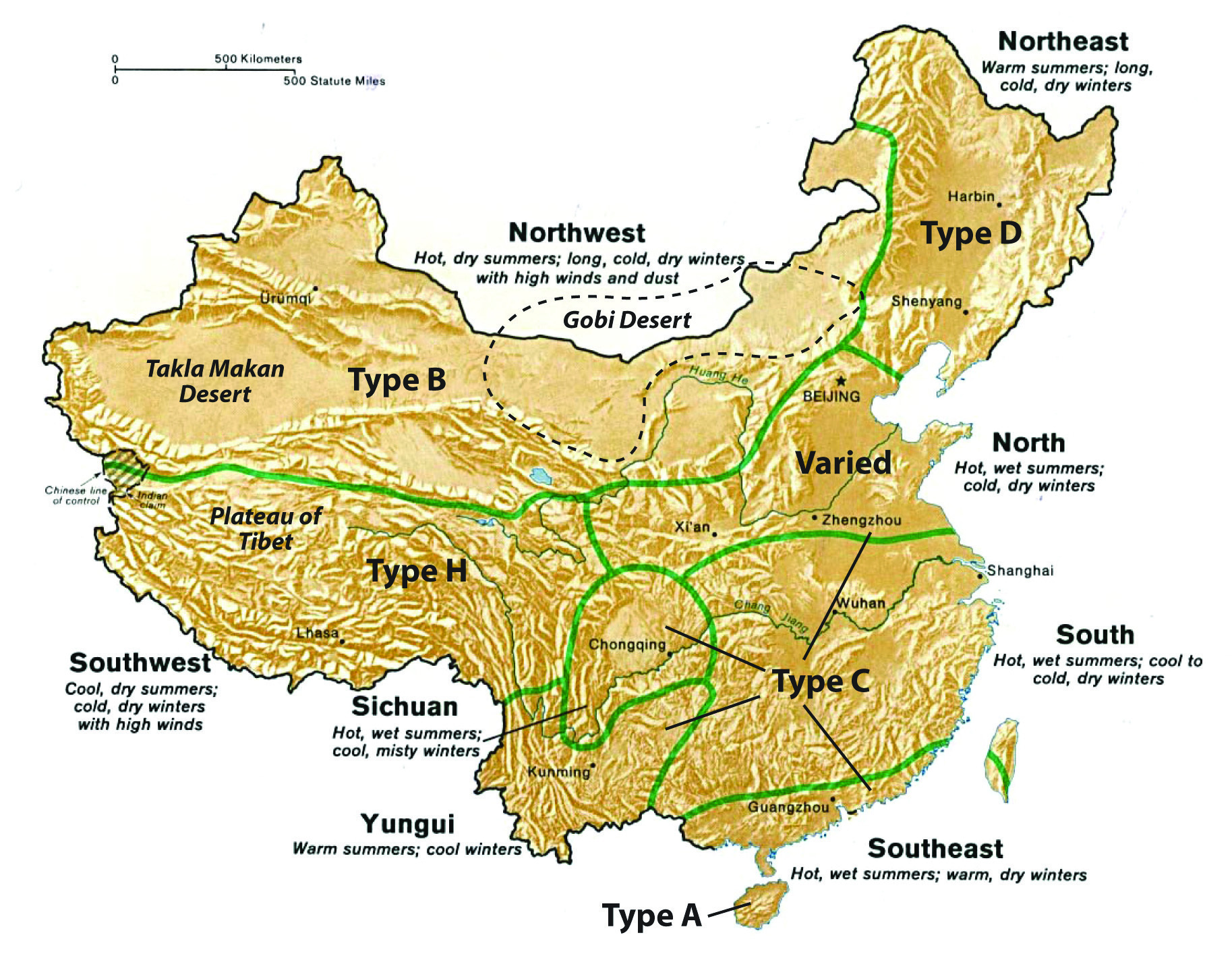
Central China Proper is subtropical
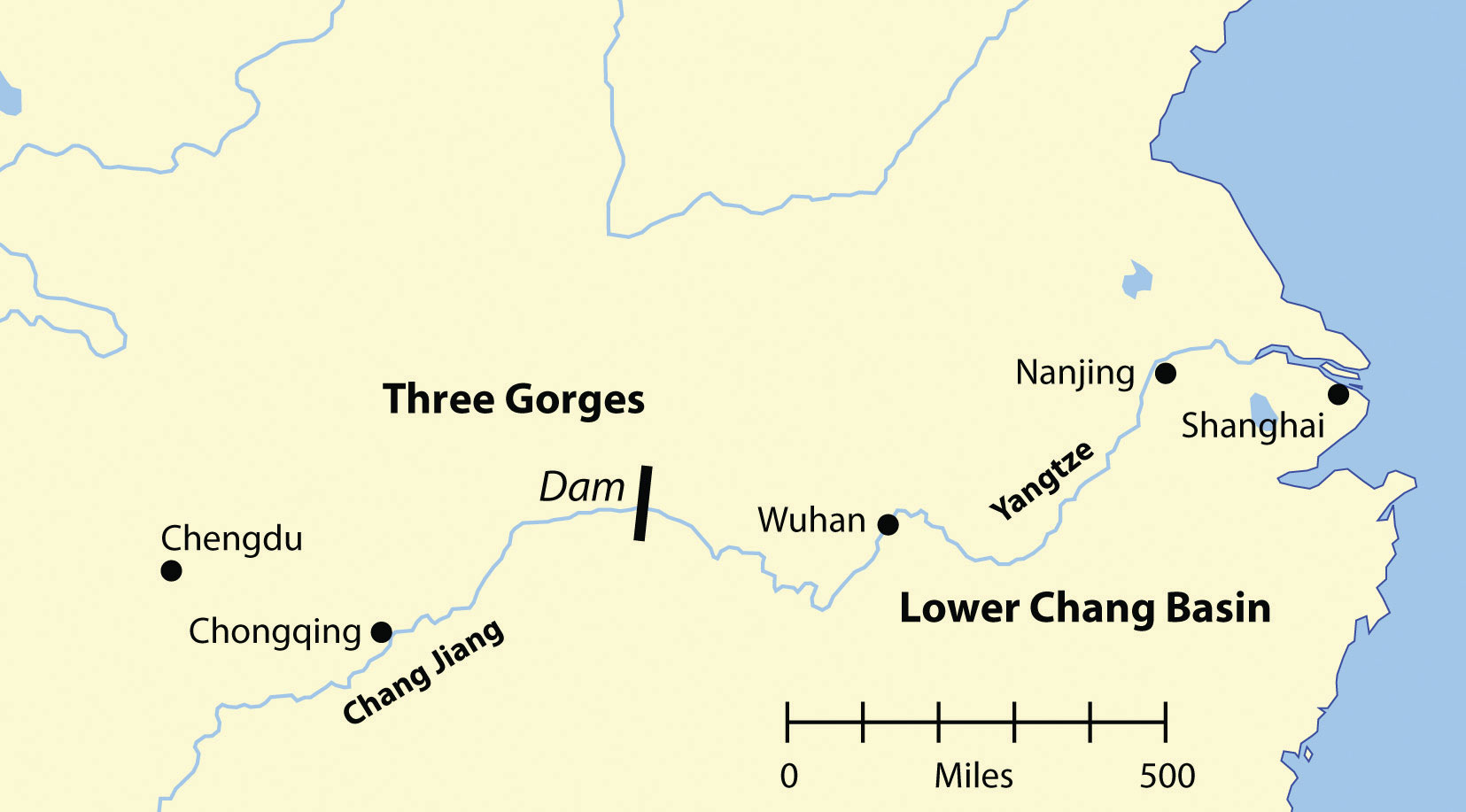
includes the Yangtze River (Chang Jiang River)
Shanghai
Chongqing
climates are warm and humid in the summers with mild winters
monsoons create summery rainy seasons
Tropical China is extreme south and includes Hainan Island with small islands neighboring it
temperatures are higher than in subtropical and rainfall amounts brought by the summer monsoons are very substantial
low mountains and hills
River Basins of China
Major River Systems in Central China
Yellow River (Huang He)
named for light-colored silt
flows from Tibetan highlands to Yellow Sea
supports extensive agriculture via
dams
irrigation
common crops include:
wheat
sorghum
corn
soybeans
vegetables
fruit
tobacco in smaller plots
North China Plain has high population density (1,000 people/sq mile)
typically does not produce food surplus due to high demand
Beijing borders the plain; Tianjin is the nearest port and economic center
key industrial crop is cotton
Yangtze River (Chang Jiang)
flows from Tibetan Plateau through Sichuan and Three Gorges into East China Sea
extensive rice and wheat farming in this region
Major cities include
Wuhan
Chongqing
Nanjing
Shanghai
home to the Three Gorges Dam, world’s largest dam which provides significant electricity
navigation for oceangoing ships to Wuhan and Chongqing via locks
vital transportation corridor for goods between urban centers
Sichuan is a top province by population, reliant on the Yangtze River
Northeast China (formerly Manchuria)
two river basins:
lower Liao River Basin
Songhua River Basin
industrial centers:
Harbin
Shenyang
known as Northeast China Plain with extensive farming and industrial activities
significant mineral wealth and iron ore deposits — leading to environmental pollution
once the main steel production area; now a rustbelt due to shifts in manufacturing
Southernmost Region (Pearl River Basin)
important agricultural and commerical district
includes rivers:
Xi River
Pearl River
tributaries
third-longest river system; second-highest water flow volume
major cities:
Guangzhou
Macau
Hong Kong
Shenzhen
former colonial histories
Macau — Portuguese
Hong Kong — British
hubs for international trade and commerce
Cantonese heritage significantly influences local culture
Three Gorges Dam ( The New China Dam )
located on the Yangtze River
third longest river globally ( after Nile and Amazon )
largest hydroelectric production system in the world
controls flooding along the Yangtze River
produce hydroelectric power
increase shipping capacity on the river
concept dates back to the period after the last dynasty fell
plans and development initiated in the decades leading up to 1994
construction of the dam began in 1994
Information on Dam
Dam length | 7,661 feet |
Dam height | 610 feet |
Dam width ( at base ) | 377 feet |
Physical construction began | December 14, 1994 |
Construction cost | est. 39 billion USD |
Estimated surface area of reservoir | 403 square miles |
Estimated length of reservoir | 375 miles |
Capacity | 32 generators totaling 22,500 MW (equal to about 20 nuclear power plants the size of the Watts Bar 1 — newest US nuclear reactor ) |
flooding along the Yangtze resulted in thousands of deaths and billions in damage
1954 flood caused:
over 33,000 deaths
displaced 18 million people
City of Wuhan flooded for 3 months
1998 flood caused:
billions in damage and flooded thousands of acres of farmland
1,526 deaths and displaced over 2.3 million people
in 2009, the dam was tested during a massive flood
successfully contained excess water and controlled downstream flow
saved many lives and prevent billions in potential damages
projected savings in lives and economic damages to exceed construction cost within a few decades
dam supplies most electricity for the lower Yangtze Basin, including Shanghai
after 5 years of operation, covered about 1/3 of construction costs ( equal to burning 150 million tons of coal )
reduces emissions of
CO2
sulfur
nitrogen oxides
aids air quality and climate change mitigation
high freight traffic on the Yangtze existed before the dam’s construction
increased frieght traffic capacity along the river
positive attributes of the Three Gorges Dam have fueled China’s economic development
nation’s engineering and technological capabilities
by 2008, 1.24 million people forced to relocate dur to reservoir flooding
historic villages and hundreds of archaeological sites submerged
thousands of farmers relocated to areas with less productive soil
compensation for relocation often lost to corruption and fraud
scenic beauty of the river basin largely submerged
critically endangered Siberian Cranes lost winter habitat
Yangtze River Dolphin is facing extinction due to dam impacts and increased river activity
Dam restricts flushing of water pollution
increased risk of landslides long the banks
potential for silting in the reservoir and clogging of turbines
situated on a fault zone, raising concern about earthquakes triggered by the reservoir’s weight
large development projects have significant impacts on local people and environment.
The Three Gorges Dam has sparked controversy with strong arguments on both sides
Additional large dam projects proposed or underway along the Yangtze River complicate the situation.
Chinese Dynasties and Colonialism
Earliest dynasty dates to around 2200 BCE in North China Plain
established political systems and facilitated the transfer of power, ideas, and culture across generations
The Han Dynasty ( 206 - 220 BCE ) defined Chinese identity ; became known as Han Chinese
The Qin (Manchu) Dynasty ruled from 1644 - 1911, claiming control over China, Mongolia, Southeast Asia, and Korea
Dynastic rule in China ended in 1911
European colonialism emerged during the Qing Dynasty
China been industrialized long before European powers with advanced concepts in clean water, transportation, and technology
paper, gunpowder, and printing were developed in China centuries before reach Europe
Silk Road served as the main trade link between China and Europe
European powers faced strong resistance in China and were initally kept at bay
Industrial Revolution in Europe provided an advantage in mass production over Chinese goods
British exported opium from South Asia to China causing social problems and weakening Chinese culture
First Opium War (1839 - 1842) resulted in British dominance and control over central China
European powers sought territoral gains like
Portugal acquired Macau
Germany took control of parts of the North China Plain
France claimed regions in southern China and Southeast Asia
Russia claimed northern section of China
Japan controlled Korea and Taiwan
European powers often conflicted with each other while claiming parts of China
China lacked military weapons compared to Europe hindering defense against invasions
Chinese culture which thrived for thousands of years, faced erosion from foreign intrusion
Boxer Rebellion around 1900 marked organized resistance against foreign influence
Qing Dynasty dissolved in 1911 signaling the end of dynastic rule
european colonialism persisted in various forms within China
Three-Way Split in China
European colonialism in China slowed after 1911 revolution
WW1 weakened European powers
Japanese colonizers continued to advance in China easily resupplying their troops
Dr. Sun Yat-Sen advocated for an independent Chinese Republic free from dynastic, Japanese, and European control
nationalist and communist worked towards establishing the republic
Dr. Sun Yat-Sen died in 1925
Nationalist, led by Chiang Kai-shek, defeated the Communists and formed a national government
foreigners were expelled, and the Communists were marginalized politcally
a three-way conflict ensued among Nationalists, Communists, and Japanese forces
Japan occupied parts of Northeast China (Manchuria) and advanced among the eastern coast
Nationalists pushed Communists into rural areas while Chinese citizens supported cooperation to defeat Japan
The Long March (1934) was a 6000 mile retreat by Communist pursued by Nationalists aided by rural populations
Japan’s defeat in 1945 by the US ended its control over territories in China, Taiwan, Korea, Southeast Asia, and the Pacific
by 1948, well-organized Communists began defeating Nationalists
Chiang Kai-shek fled to Formosa (Taiwan) with supporters and treasures declaring it the Republic of China
Communist established control over mainland China leading Mao Zedong to declare the People’s Republic of China in 1949, with Beijing as its capital
Japan was devasted by US bombing during WWII, losing colonies and facing a lengthy rebuilding process
Korea was liberated from Chinese dynasties and Japanese Colonialism but experienced internal divisions
political structures in East Asia changed significantly in the latter half of the 20th century compared to the beginning of the century
10.2 Emerging China
The Emergence of Modern China
China is the world’s largest Communist country
isolated from Europeans and Central Asians by the Himalayas and other mountain ranges
rich in history, culture, and traditions that have endured for thousands of years
land size similar to the US but slightly smaller; has only an eastern coast
heavily populated regions correlate with climate types
Mao Zedong’s communism differed from the Soviet Union
various communist experiments led to disastrous outcomes
Great Leap forward (1958):
communes established ; peasants worked the land
citizens donated pots and pans for scrap metal production
intended to boost industrial ouput but resulted in mass starvation
Great Proletarian Cultural Revolution (1966 - 1976)
purged traditional culture and promoted total loyalty to the Communist Party
indocrinated students reported dissenters; schools closed, intellectuals persecuted
est. 30 million lives lost due to purges, starvation and conflict
travel into and out of China restricted during early Communist decades
US supported Chiang Kai-shek in Taiwan and did not recognize Communist China
China lagged behind in industralization while the west advanced technologically
Nixon’s 1972 visited open diplomatic relations, countering Soviet influence
the Chinese Communist Party implemented a “planned economy” or command economy
government controls all economic aspects, including production, distribution, and pricing
businesses are nationalized
the 1980s marked a shift towards a more market-oriented economy
economic collapse of the Soviet Union in the early 1990s coincided with China’s opening to trade
in 1992, China announced a transition to a socialist market economy, combining elements of both systems
focus on increasing national wealth and improving citizens’ quality of life
rapid economic growth in the following decade
by the early 200s, China ranked among the top 5 largest trading nations
despite economic growth, most of the population does not have a high standard of living
Political Units
China can be divided based on various criteria: political, economic, natural, and climatic regions
the People’s Republic of China (PRC) consists of:
Twenty-Two Provinces — including the island province of Hainan
Taiwan — considered the twenty-third province by China but governed by the Republic of China
Five Autonomous Regions — Tibet, Guangxi, Xinjiang, Inner Mongolia, and Ningxia; each designated for a specific minority group
Four Municipalities — Beijing, Tianjin, Shanghai, and Chongqing which gave governance structures similar to provinces
Two Special Administrative Regions (SARs): Hong Kong and Macau, which have considerable autonomy
designed as a compromise for regions desiring indepedence with large ethnic minority populations
limited legal ability to self-govern, they have less autonomy than provinces
directly controlled cities with governance similar to provinces
encompass large geographic areas beyond city limits, including towns and rural areas
Special Administrative Regions (SARs)
Hong Kong
formerly a British colony, governance reverted to China in 1997
operates under “one country, two systems” arrangment
Macau
similar governance structure and autonomy as Hong Kong
both regions have autonomy for at least 50 years post-transfer
China handles defense and some foreign affairs for the SARs
Hong Kong and Macau manage most internal matters
legal systems
law enforcement
immigration
custom policies
China’s Communist government is controlled by the Chinese Communist Party
considered an authoritarian state complete with heavy restrictions on the Internet, press, freedom of assembly, reproductive rights, and freedom of religion
economic trade with the West has created more openness with travel and business which begun to challenge or erode the hard-line politics of decades past
The People
Population
China has a rich cultural heritage spanning four thousand years
as of 2010, China had approx. 1.33 billion people, the largest population in the world
most of the population resides in China Proper, particularly in the eastern regions, which have the best agricultural lands and moderate climates
China has over one billion more people than the US
during Mao’s era, there was little concern about population growth ; recent decades have seen increased focus on managing it
One-Child Policy
implemented in 1978 to control population growth and address environmental, economic, and social issues
limits families to one child, with certain exemptions for rural couples and ethnic minorities
Peripheral regions like Macau and Hong Kong are exempt from the policy
policy has reportedly reducted the potential population by hundreds of millions but has faced implementation challenges
concerns about negative societal effects, including female infanticide and increased abortions
approx. 75% of the population supports the one-child policy, according to independent surveys
families faced economic pressures to comply with the policy, losing government benefits if they have more than one child
enforcement is variable , provincial authorities managing implementation
preference for male children has led to a significant gender imbalance
created cultural challenges, particularly with a surplus of unmarried men and insufficient marriage opportunities
over 50% of China’s population lives in rural areas, leading to potential high levels of rural-to urban migration
core industrial cities attract migrants in a periphery-to-core migration pattern
urbanization rose from 17% in 1978 to 47% in 2010, marking one of the largest rural-to-urban shifts in history
many workers alternate between temporary urban jobs and returning to their rural families
Ethnic Groups
Ethnic Groups in China
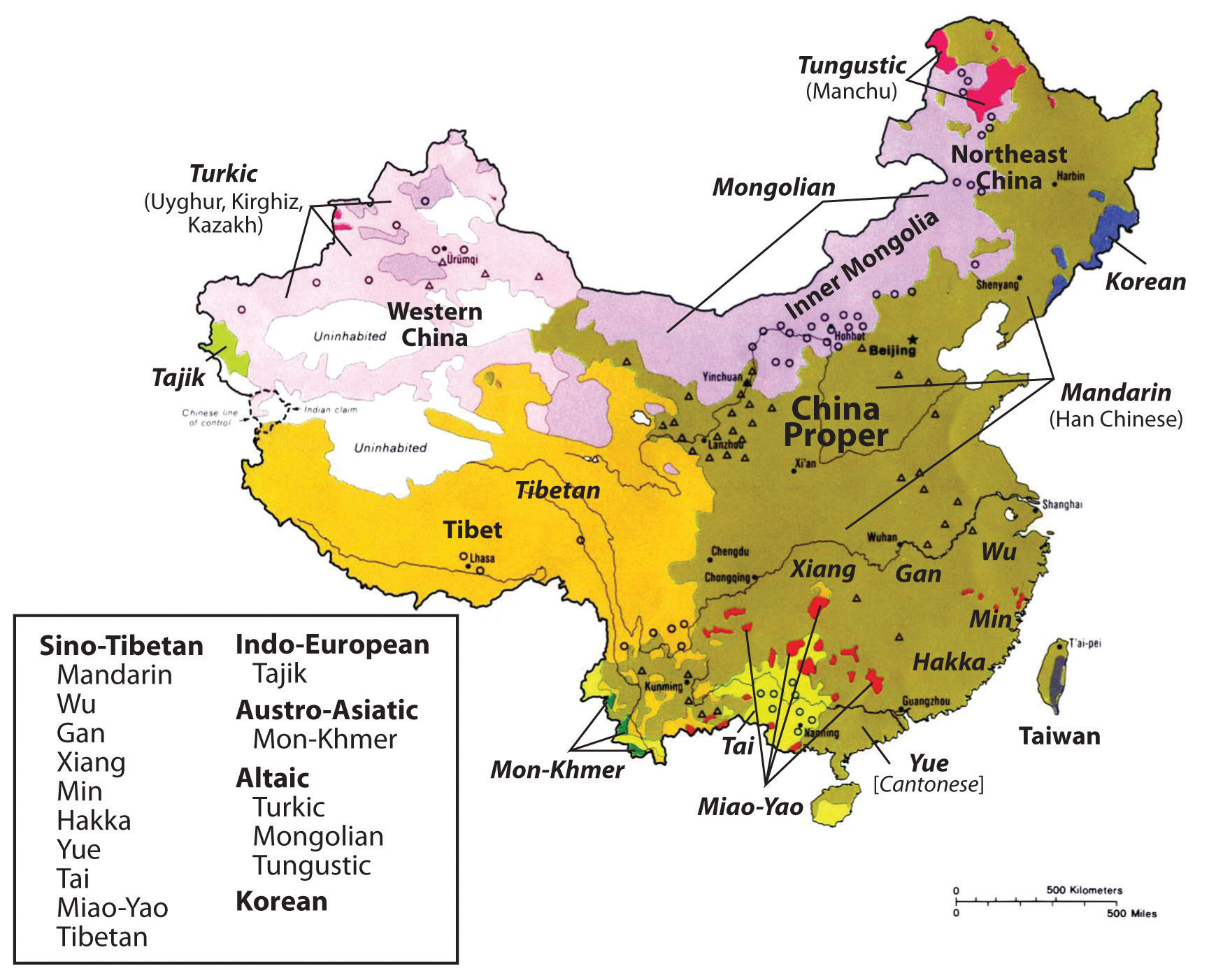
Han Chinese are the largest ethnic groups, making up about 90% of the population
Significant minority groups include:
Zhuang (Tai) in the south
Manchu in the northeast
Mongolian in the north-central region
Uyghur in Western China
Tibetan in Tibet
over 290 languages are spoken, corresponding roughly to the number of ethnic groups
Uyghur and Other Minorities
in Western China, predominantly Muslim and constitute a large portion of the population
other Muslim ethnic groups include Kazakhs, Kyrgyz, and Tajiks
estimates in Muslims in China vary, goverment reports about 21 million while other sources estimate up to three times that number
Uyghurs and other minorities often face discrimination and marginalization from the Chinese government
China is officially atheist with no religion endorsed by the government
before Communism, Buddhism was widely practiced along with Taoism and Confucian teachings
Christianity exists but practicing it is illegal, Christian population estimates to be 3-4% (39-52 million people )
Falun Gong — group blending elements of Buddhism and Taoism, emerged in the 1990s and claims to be more of a science than a religion
Chinese government banned Falun Gong in 1999 following a large protest resulting in arrests and harsh penalties
remains officially prohibited in China
Economic Summary
shift from a closed centrally planned economy to a more open, market-oriented economy over the past two decades
increase involvement in private enterprise and international investment
agricultural and economic reforms phased out collective farms, boosting agricultural production
opened up free enterprise and international trade
rapid economic growth in urban areas
global intergration enhanced engagement with global community, improving information and communication technology
increased computer and internet use
created more job opportunites
Special Economic Zone ( SEZs) promoted urban and economic growth especially in coastal cities
contributed to rural-to-urban population shifts
negative consequences of growth included:
Resources exploitation leading to soil erosion and air pollution
decline of water tables due to high demand on water supply
loss of arable land due to erosion and poor land-use practices
rural areas receive fewer resources compared to coastal cities, leaving many in poverty
high unemployment among migrant workers
goverment issues included:
corruption in government and state-run offices
authoritarian state, free speech, freedom of religion, and freedom of press
no minimum wage law, factory workers worked long hours without benefits
fewer safety requirements and government regulations for security in workplaces
China aims for a blend of authoritarian efficiency and market-driven capitalism
possesses the largest standing army, positioning itself as a global superpower
potential for cultural conflict with the US over economic, political, and human issues
emphasis on the need for mutual understanding between the US and China to foster cooperation
Growth of Enterprise and Industry
following Mao Zedong’s death, Deng Xiaoping recognized the need for economic change
aimed to open China’s economy while preserving the Communist system
Bamboo Curtain limitation on the movement of goods and people began to diminish
SEZs set up along the coast in strategic port cities to attract international business
international corps were drawn to China due to cheap manufacturing costs
China’s large population provided both a labor pool and a consumer market
modernization efforts led to increased world trade and a significant rise in US - China trade
expanded manufacturing capacity resulted in signifcant profits for China around 2002
coastal cities and SEZs became core industrial centers, attracting many poor agricultural workers
factory jobs became sought-after employment opportunites
unprecendented urban growth as people move to cities for work, mirroring global trends
SEZs encouraged multinational corps to relocate to China for lower costs
objectives of SEZs include
tax incentives for foreign companies
focus on exporting market-driven manufactured products
joint partnerships
four main cities and Hainan Island province designated as SEZs and development areas for industrial expansion
in 2006, China president urged a focus on innovative economic activities
increased funding for research in genetics, computer software, semiconductors, and alternative energy technologies
growing demand for energy spurred expansion into wind and solar power for domestic and commerical use
China’s industrial sector aimed to compete globally
challenged established high-tech economies in Japan, Western Europe and US
Geopolitics
China’s politcial environment is closely linked to its geography
large land area with core region (China Proper) primarily populated by Han Chinese
surrounding periphery includes
autonomous regions
minority populations (Tibet and Inner Mongolia)
Tibet serves as a buffer between China and India with high mountains providing natural barriers
Nepal, Bhutan, and Kashmir also acts as buffers of South Asia
Inner Mongolia and Mongolia buffers China from Russia — actual border is remote
Northeast China (Manchuria) is home to the non-Han Manchu population
North Korea serves as a buffer against US influence via South Korea
Southeast Asia’s mountainous terrain limits access
Coastal China is accessible and historically targeted by foreign powers
Taiwan poses a geopolitcal challenge with its independent goverment
the coastal region is considered China’s most vulnerable area
SEZs attracts foreign corps to coastal cities and facilitate economic growth and ties with global marketplace
extensive coastal development benefits all parties
China operates under three main premises
secure a buffer zone in peripheral regions
maintain unity within the Han Chinese majority
protect the vulnerable coastal region from outside influence
disparities in living standards have emerged between wealthy coastal cities and poorer rural areas
factory workers earn more than agricultural workers , challenging the distribution of wealth
shift to a more open capitalist economy raises questions about equality
China relies heavily on export manufactoring for wealth
insufficient agricultural resources to support its vast population necessitate strong international relations
the eastern coast has yielded economic gains
disappearance of the Bamboo Curtain marks China’s integration into the global economy
economic development has increased dependence on foreign resources, technology and markets
multinational corps rely on China for low-cost manufactured goods, enhancing China’s global economic integration
10.3 China’s Periphery
Hong Kong and Shenzhen
Hong Kong is a former British colony located southern of China’s coast and consists of several islands
feat. Victoria — one of Asia’s best deepwater ports protected from the sea
new territories leased from China by Britian in 1897 for 99 years , borders rapidly growing Shenzhen
Hong Kong served as a major entry point for British expansion into China
trade relationship disrupted during the Korean War (1950s) as Britain and China sided with opposing forces
closed border with China led Hong Kong’s business community to utilize its port to establish a world trade center
ships import raw material for processing and manufactoring
Hong Kong focused on low-level goods using cheap labor
progressed to higher-value goods like electronics to boost incomes and transform into a global business center
strong financial network emerged and enhanced the free market system
Deng Xiaoping viewed Hong Kong as a crucial access point for trade and commerce with China
in the 1990s, Hong Kong facilitated about ¼ of China’s imports and exports
1997 handover agreement allowed Hong Kong to remain non-Communist with autonomy for 50 years
Shenzhen became a rapidly growing SEZ capitalizing on Hong Kong
population soared from 350,000 in the 1980s to over 10 million by 2010
major manufactoring hub, producing goods for companies like Walmart
over 95% of Hong Kong’s 7 million residents are ethnically Chinese, valuing their unique economic and political status
major financial and banking center in Asia — offers private banking services for Chinese citizens
high real estate prices , limited land
Hong Kong attracts millions of tourist annually as a gateway to southern China
known for shopping and a safe modern environment
Cantonese is the official language with widespread English use
Macau follows a similar agreement with China as Hong Kong, automonous for 50 years
smaller territory than Hong Kong with about half a million residents
Taiwan (ROC)
Taiwan is separated from mainland China by the Taiwan Strait
compared in size to Maryland, have a population of 22 million in 2010
island is mountainous with rugged national parks; most people live in coastal cities
Taiwan emphasizes education and technical skills, resulting in high incomes and a developed economy
after WWII, the US severed trade with communist China but maintained trade with Taiwan
tensions between China and Taiwan root in Taiwan’s complex history and the “One Child” Policy
in 1972, US president Nixon visited China to strengthen ties against Soviet Union
US moved its embassy from Taipei to Beijing, acknowledging Beijing as the official Chinese government
US officials and Taiwan’s diplomats face restrictions on official visits due to the One China Policy
to have relations with China, countries can’t recognize Taiwan
UN shifted recognition to Beijing in 1971, ending Taiwan’s representation in the UN
Taiwan’s global status remains ambiguous
in 2000, Taiwan announced intensions to seek international recognition and possible independence
China responded with threats and military exercises
US has historically supported Taiwan including with military aid
Taiwan evolved from textile to high-tech industries, achieving a high-standard of living
Taiwanese industries shifted production to China’s SEZs due to lower labor cost, increasing unemployment in Taiwan
Taiwan’s recent focus has been on trade rather than independence
in 2008, Taiwan elected a government committed to strengthening economic ties with China
Taiwan joined WTO in 2001 as “Chinese Taipei” facilitating cross-strait trade
despite unresolved political tensions, Taiwan competes in global events including Olympics as Chinese Taipei
Autonomous Region of Tibet
Tibet is located in mountainous southwestern China
one of China’s autonomous regions though it has limited self-governance
historically, was an independent Buddhist theocracy with the Dalai Lama as the head of state and religous leader
an independent kingdom with its own form of Buddhism and a system of Lamaism
during the 13th century, became a part of the Mongol Empire
15th century, the Dalai Lama gained significant authority
Tibet fell under Qing control but after China’s imperial period ended in 1911 Tibet sought independence
China’s intentions to control all of Tibet were met with resistance from Tibetans
in 1949, China allowed the Dalai Lama control over domestic affairs but gradually reduced his power
the Chinese government destroyed monasteries, religious symbols, and suppressed Buddhism which Tibetans perceived as an invasion
Tibetans revolted in 1956 with US support, but China crushed the revolt in 1959 leaving thousands dead or imprisoned
the Dalai Lama and thousands of Tibetans fled to India, establishing a governement in exile
in the 1980s, China proposed leniency if the Dalai Lama renounced independence claims which he refused
tensions escalated after the controversial death of the Panchen Lama and disputes over selecting his successor
during the 2008 olympics, a peaceful Tibetan protest led by monks turned violent, pormpting a harsh crackdown by Chinese authorities
global attention on China’s human rights violations against Tibet was limited during the Olympics
Tibet’s population is about 3 million, mostly mountains valleys with Lhasa as its capital
China has relocated thousands of Chinese people to Tibet, altering the ethnic balance and a rail line now links Beijing to Lhasa
China see Tibet as a buffer state between India and China’s heartland
Tibet’s mountains hold natural resources critical to supporting China’s manufactoring economy for global exports.
China seeks economic integration of Tibet despite cultural differences
Who is the Dalai Lama
The Dalai Lama is both the spiritual and political leader of all Tibetans
considered the reincarnation of past Buddhist Masters or Tulkus
believes to be reborn by choice to guide humanity
traditionally serves as the head of state for Tibet with Lhasa as the capital
Tenzin Gyatso is the current, 14th Dalai Lama
believed to be reincarnated
Tenzin Gyatso became the 14th Dalai Lama on November 17, 1950 at the age of 15, shortly after China’s invasion of Tibet
under Chinese military pressure he initially ratified the 1951 Seventeen Point Agreement
in 1959, the Dalai Lama fled Tibet and went into exile in India following China’s crackdown on Tibet resistance
while in India, established the Tibetan government in exile, striving to preserve Tibetan culture for the refugees who joined him
Mongolia
Mongolia is the world’s 19th largest country by land area and 2nd largest landlocked country after Kazakhstan
with a land area similiar to Alaska or Iran, it is least populated globally with about 3 million people
Mongolia’s landscape includes mountains, high plains, and grassy steppe with limited annual precipitation , mostly snow
The Gobi Desert, stretching from southern Mongolia to northern China, recieves less precipitation
Ulan Bator, Mongolia’s modern capital, houses about 1/3 of the country’s population and is the coldest world capital on average
historically known for the Mongol Empire, established by Genghis Khan in the 13th century
20th century, the Soviet Union used Mongolia as a buffer state with China and Communist influence remained strong until the Soviet collapse
Tibetan Buddhism is practiced by about 50% of Mongolians; around 40% indentify as nonreligous due to the Soviet influence
most Mongolians are of Mongol ethnicity, 30% remain seminomadic living in mobile yurts and migrating seasonally for livestock grazing
Mongolia’s cultural heritage is rooted in rural agrarian traditions, with popular sports like archery, wrestling, and equestrian events
Mongolia’s economy has traditionally focused on agriculture but now relies heavily on mining like coal, molybdenum, copper, gold, tin, and tungsten
being landlocked limits Mongolia’s access to the global economy but mineral reserves are in demand by industrial areas offering potential for economic growth
China has become a significant trading partner, drawing Mongolia’s trade focus from its former ally, Russia, and expanding its business presence in Mongolia
10.4 Japan and Korea (North and South)
Japan
Japan is an archipelago along the Pacific Rim, east of China and across from the Korean Peninsula with over 3000 islands
four main islands make up most of Japan
Shikoku
Kyushu
Hokkaido
Honshu
land area is about the size of the US state of Montana, with mountainous terrain from volcanic activity
many volcanos remain active including Mount Fuji
Japan spans two climate zones
Majority has a temperate climate (type C)
northern Hokkaido has colder climate (type D)
Tokyo is the world’s largest verified metropolitan area with a population of about 26.7 million located on the Kanto Plain including Yokohama and Kawasaki
second-largest urban area, the Kansai District includes
Kobe
Osaka
Kyoto
Japan’s population was approx. 126 million in 2010 with 67% living in urbanized coastal areas from Tokyo to Nagasaki
Japan’s tectonic location, at the convergence of the Eurasian, Phillipine, and Pacific Plates makes it highly prone to earthquakes
Significant earthquakes include
1923: Tokyo-area, killed around 143,000 people
1995: Kobe, killed about 5,500 people and injured 26,000
2011: 9.0 earthquake off northern Japan’s coast cause severed destruction on Honshu and triggered a tsunami over 130 feet high
the 2011 disaster resulted in 15,500 deaths, widespread damage, and missing persons
tsunami damaged coastal nuclear power plants, leading to meltdowns in three reactors and releasing nuclear material — marking the worst nuclear disaster since Chernobyl
remains at high risk for future earthquakes due to its tectonic activity
Japan’s Development
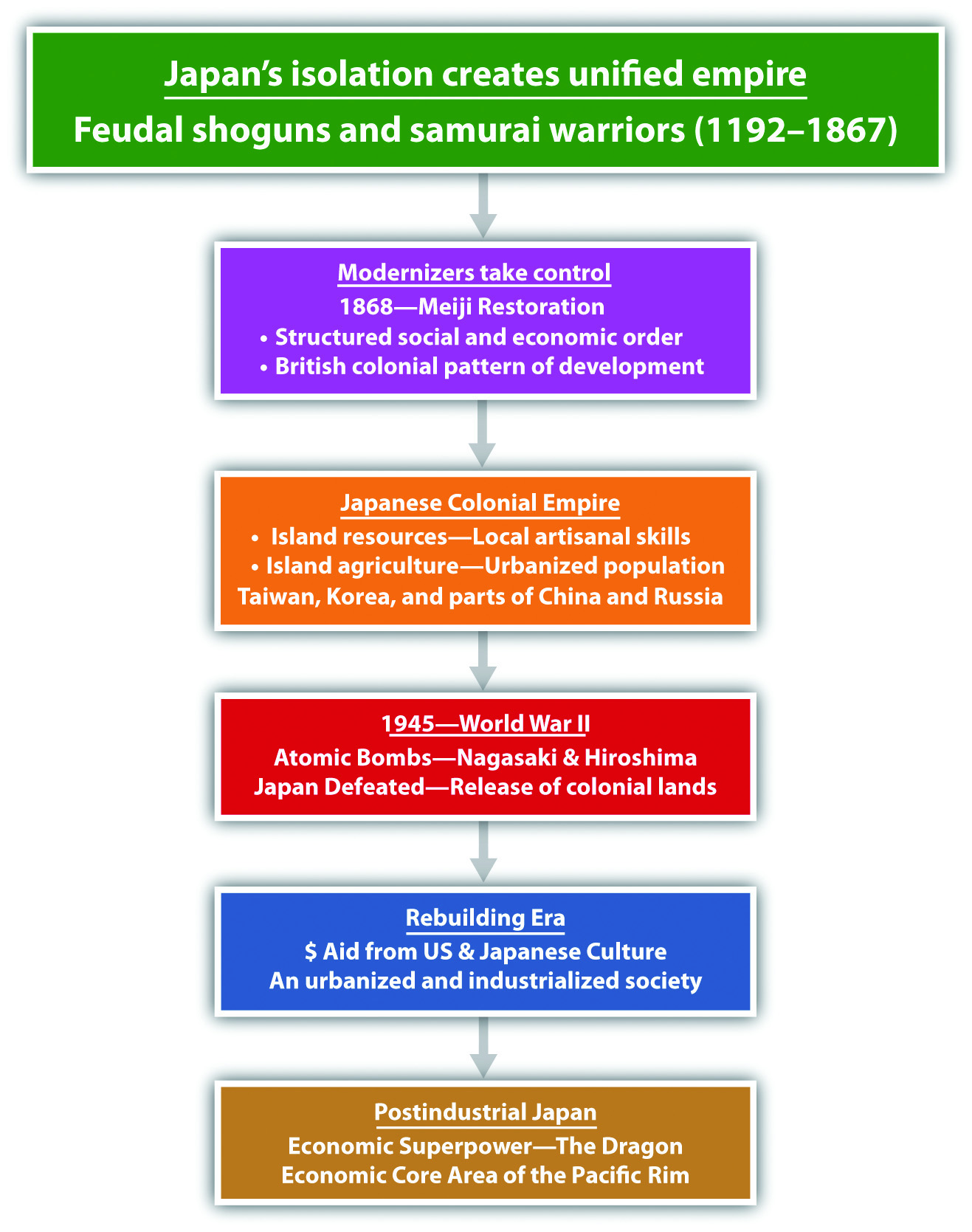
Japan was historically ruled by Shogun lords and Samurai with a highly organized and structured society
Japan’s mountainous terrain led to semiurban coastal community, limiting the rural-to-urban shift
encounters with EU ships in the colonial era encouraged Japan to consider industrialization to protect its sovereignty
Japan saw similarities between its island geography and Britain’s and aspired to develop a comparable level of power
The Meiji Restoration (1868) marked Japan’s industrialization, inspired by British infrastructure and industrial methods
Japan’s early industrial growth utilized limited domestic resources and drew on its skilled artisans and organized society
Japan expanded to secure resources, taking control of Taiwan (Formosa) Korea, parts of Sakhalin Island and Manchuria in the late 1800s and early 1900s
Japanese industries grew by using resources from these colonies and putting local populations to work
by WWII, Japan had become a dominant Pacific Rim power, even aspiring to invade North America
Japan’s attack on Pearl Harbor in 1941 marked the start of hostilities with the US
Japan surrendered following the atomic bombings of Hiroshima and Nagasaki in 1945
Japan’s surrender required relinquishing territories including Taiwan, Korea, China, and the Kurile Islands
The Kurile Islands, taken by the Soviet Union, remain in dispute with Russia declining to return them despite Japanese offers
Japan agreed to forgo an offensive military, and WWII left its infrastructure and economy in ruins
Japan’s Economic Growth
since 1945, Japan has transformed into Asia’s economic superpower, becoming a key center in global economy
Japan’s manufacturing — automotive, sets global standards with brands like
Toyota
Honda
Mitsubishi
Nissan
Surpassing other “economic tigers” (Singapore, Hong Kong, Taiwan, and South Korea), Japan is often called the “economic dragon” of Asia
Japan’s rapid post-war recovery is attributed to its pre-existing industrial and urbanized society
US support in rebuilding Japan’s ports and transportation systems aided recovery, but Japan’s internal organization and cohesion were key to its economic revival
created strong manufacturing sectors, leading to financial success and competition with the US
like Japan, post-WWII Germany’s industrialization and urban society helped it recover and become EU strongest economy
both nations redirected their economies into manufacturing, capitalizing on automotive industries (Mercedes, Volkswagen, BMV)
Japan’s loss of colonies post-WWII forced it to establish extensive trade networks for raw materials
manufacturing boom expanded urban areas around Tokyo, Yokohama, and Kawasaki to support industrial growth
Japan’s location and cohesive culture contributed to its technological and economic advancement
similiar to economic tigers like Taiwan and Hong Kong, Japan thrived with limited natural resources by leveraging trade and manufacturing
focused on value-added manufacturing profits, using peripheral countries for labor and resources, especially during the colonial era
Modern Japan
Japan is a homogeneous country with 99% of its population being ethnically Japanese (as of 2010)
resembles a nation-state, united by common heritage, government, language, and culture and a strong centripetal force
religious include Shintoism (focused on ancestor veneration and nature) and Buddhism (meditative practices)
Shinto and Buddhist traditions coexist with different rituals such as Shinto weddings and Buddhist funerals
Japan’s family size is low, averaging 1.2 children per family which is leading to a decline and aging population
not enough young people to fill entry-level jobs, creating labor shortages
relunctant to rely on immigration, unlike Western EU and US, to address the workforce gap
high incomes and urban lifestyles have shifted young people toward consumer-oriented living, high cost of living — Tokyo
imports all of its oil and about 60% of its food, making certain items (beef and out-of-season fruit) expensive
Japan’s labor shortage has led to outsourcing manufacturing to countries with cheaper labor like China
Japan and China’s economic relationship is complex due to historical animosities but contiues due to economic interdependence
Japan’s economic influence in the East Asian Community (EAC) is significant as it competes with core economies (US and EU) for low-cost labor and resources
despite historical tensions with neighboring countries, Japan’s economic needs drive it to engage in trade, especiall with China
Japan remains a core economic power globally, leveraging its economic status to maintain trade and influence within East Asia and beyond
Korea
The Korean Peninsula extends into the Pacific Rim bounded by the Sea of Japan (East Sea) and Yellow Sea
North and South Korea share the peninsula, divided by the Korean Demilitarized Zone (DMZ) since 1953
Borders China and the north (seperated by Yalu and Tumen rivers) and Russia along the northern coast
Japan lies across the Korean Strait to the east
The peninsula is 70% mountainous with volcanic and granitic bedrock shaped by glacial processes
Divided into four general regions:
Western Region: coastal plains, river basins, and small foothils
Eastern Region: high mountain ranges with narrow coastal plains
Southeastern Basin
Southeastern Region: characterized by mountains and valleys
around 3000 small islands off the southern and western coasts belong to South Korea
North Korea
low industrialization
severe water pollution
deforestation
soil erosion
limited clean drinking water
prevalent waterborne diseases
South Korea
high industrializaiton
water pollution from industrial discharge
severe urban air pollution
acid rain
korea was a unified kingdom for centuries, frequently invaded by foreign powers
controlled by Japan as a colony from 1910 until Japan’s defeat in 1945 ending colonial rule
after WWII, the peninsula was divided along the 38th parallel
North Korea: controlled by Soviet Union, leading to a communist government
South Korea: administerd by the US, developing a capitalist government
Korean War (1950 - 1953): North Korea, aided by China and the Soviet Union invaded the south
peace agreement in 1953 established the DMZ along the 38th parralel
DMZ remains the most heavily guarded border in the world with US troops stationed along the cease-fire line
North Korea
North Korea (DPRK) was established under Communist dictator Kim Il Sung, combining Soviet and Chinese authoritarian principles
regime restricts personal freedoms, populace is mobilized to rebuild the state
Kim Il Sung utilized the threat of US military invasion to rally support building a military of over 1 million soldiers
strict regulations prevent citizens from traveling in or out of the country
the collapse of the Soviet Union in 1991 resulted in the loss of financial support and oil supplies, leading to factory closures and rising unemployment
China began to engage with the West, losing interest in supporting North Korea
country faced severe food shortages, resulting in famine and thousands of deaths
Kim Il Sung died in 1994, leaving a legacy of deification as the “Great Leader”
Kim Jong Il succeeded Kim Il Sung as leader, intensifying repression against the populace
media in North Korea is controlled by the governement, can only access government-sanctioned television and radio frequencies
tourist entry is high restricted, with only few hundred allowed annually under close supervision
Kim Jong Il had developed nuclear capabilities using military production as leverage in international relations
North Korea promotes a narrative of the US as a constant threat, using propaganda to instill fear and prepare citizens for potential invasion
state ideology emphasizes the unifcation of Korea under Communist rule, supported by military, economic, and political policies
North Korea’s mountainous terrian limits quality farmland, only 2% land is dedicated to permanent crops, yet 1/3 of the population works in agriculture
best farmland is located south of the capital, Pyongyang which is restricted for the most loyal citizens
the country suffers from severe shortages of goods and services with unreliable electricity supply
international food aid is crucial for survival despite Kim Jong Il’s policy of self-reliance (Juche), which isolates the population and maintains his power
Juche also prevents the influx of corporate capitalism, aiming to keep external influences at bay
smuggled cellphones and SK VHS tapes provide North Koreans glimpse of the outside world
government agents conduct home searches to confiscate smuggled material, punishing citizens found with them
many North Koreans have escaped to northern China in search of better opportunities, despite China’s own human rights issues
contrast between China’s growing economy and North Korea’s stagnant state drives migration patterns
South Korea
1993, South Korea became a fully-fledged democracy with its first democratically elected president
Seoul is the capital city, population of almost 10 million people
Seoul is located just south of the Cease-Fire Line (DMZ) often referred to as the 38th parallel — does not exactly follow that line
US has numerous military installations there
South Korea manufactures automobiles, electronics, and textiles for global markets
country employs state capitalism to develop its economy
manufacturing sector transformed into a major center for export trade
after WWII, South Korea was ruled by a military government that implemented land reform and received external economic aid
large agricultural estates were redistrbuted, leading to increased agricultural production to meet population demands
has significantly higher agricultural production than North Korea, which helps feed its dense population
50 million residents of South Korea enjoy a much high standard of living compared to those in North Korea
personal income in North Korea is very low, while in South Korea its comparable to that of Western countries
economic growth in South Korea is driven by state-controlled capitalism rather than free-enterprise capitalism
state controls or owns most industrial operations and sells products in the global marketplace
major corps like Daewoo, Samsung, Kia Motors, Hyundai, and the Orion Group have promoted South Korea as a leading shipbuilding nations
continues to reform its economic system to adapt to global economic conditions as an “economic tiger”
South Korea plans a comprehensive overhaul of its energy and transportation networks
government funding will support the creation of green-based initiatives
efforts will focus on reducing energy dependency throuh environmentally friendly developments like wind and solar power, bike lanes, and new lighting tech
high-speed rail service and increased capacity in electronic transmission lines are planned to enhance energy efficiency
policies aim to modernize South Korea’s economy and create new products for manufacturing export
Buddhism and various aspects of Chinese culture have significantly influenced Korean heritage
Buddhism has been prominent religion in Korea for centuries; Confucian teachings are also widely respected
approx. 30% of the population identifies as Christian (20% Protestant, 10% Catholic), the highest percentage of any Asian country
up to 50% of the population does not profess any organzied religion
before 1948, Pyongyang was a notable Christian center with around 300,000 Christians
following the establishment of a Communist government in North Korea, many Christians fled to South Korea to escape persecution
Unification of North and South
regional complementarity refers to the benefits that arise when two seperate regions possess qualities that work well together if unified
North and South Korea exempts this
North Korea
mountainous terrian
rich in natural resources such as minerals, coal, iron ore, and nitrates (fertilizers)
South Korea
abundant farmland capable of producing large harvests of rice and other food crops
possess industrial technology and capital for development
if unified, North and South Korea could function effectively as an economic unit due to their complementary resources and capabilities
US Military Presence
presence of 35,000 to 40,000 US soldiers along the DMZ raises questions about security and sovereignty
some South Korean youth advocate for the withdrawal of US forces and for unification while older generation who experienced the Korean War support maintaining the US military presence
unification is unlikely until the older generation either passes away or reaches a consensus on unification
the dictatorship of Kim Jong Il and North Korea’s claimed nuclear capabilities are significant obstacles to unification
division is primarily political rather than cultural, despite the current societal differences
situation in Korea is analogous to East and West Germany during the Cold war
while there are differences between Korea and Germany, unification may be possible under specific conditions particularly with a change in leadership in North Korea