2c. Economies of scale
Economies of scale – a long-run concept
Economies of scale are the benefit of lower long-run average costs as output increases
The advantages of large-scale production that result in lower unit (average) costs (cost per unit)
Economies of scale spread total costs over a greater range of output
These benefit bigger stores as we see at supermarkets vs. smaller corner stores - they benefit from economies of scale as they spread costs over a greater range of outputs
Important terminology
Minimum Efficient Scale – the point at which the increase in the scale of production yields no significant unit cost benefits
Minimum Efficient Plant Size – the point where increasing the scale of production of an individual plant within the industry yields no significant unit cost benefits
Economies and diseconomies of scale on a diagram
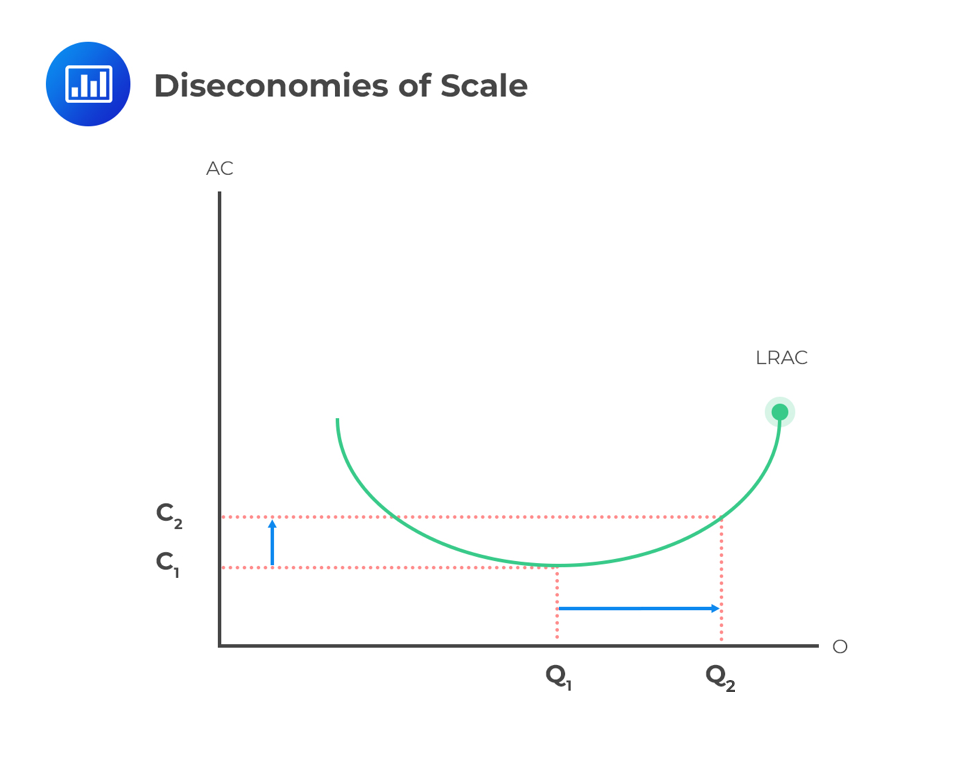
As output increases, long-run average costs fall. This is true up to the minimum efficient scale where costs begin to rise again as the firm suffers from diseconomies of scale.
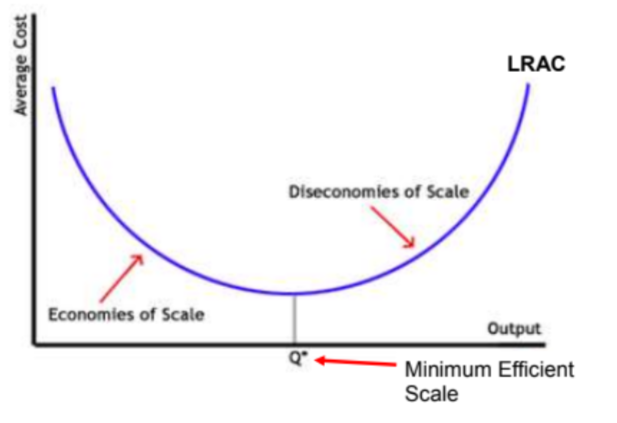
Use the diagram to show that as output increases we use economies of scale to spread costs over a greater range of outputs and decrease long-run costs from C1 to C2 when Q1 moves to Q2
If ASDA and Sainsbury merged it would be a horizontal merger and they would double their size effectively doubling output thereby benefitting from economies of scale
When a firm becomes too large as output increases costs begin to rise again as output increases to Q3 costs increase after the minimum efficient scale
Three reasons this can happen
communication - language barriers and general miscommunication
coordination - difficult to have everyone working where they are meant to
control - managing everyone effectively
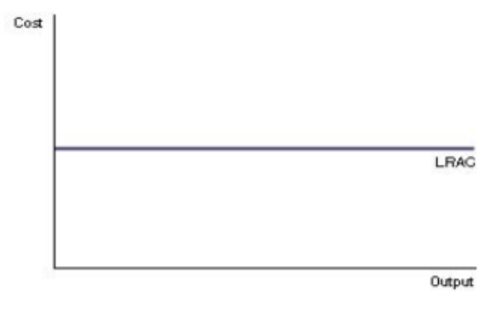
Constant Returns to Scale
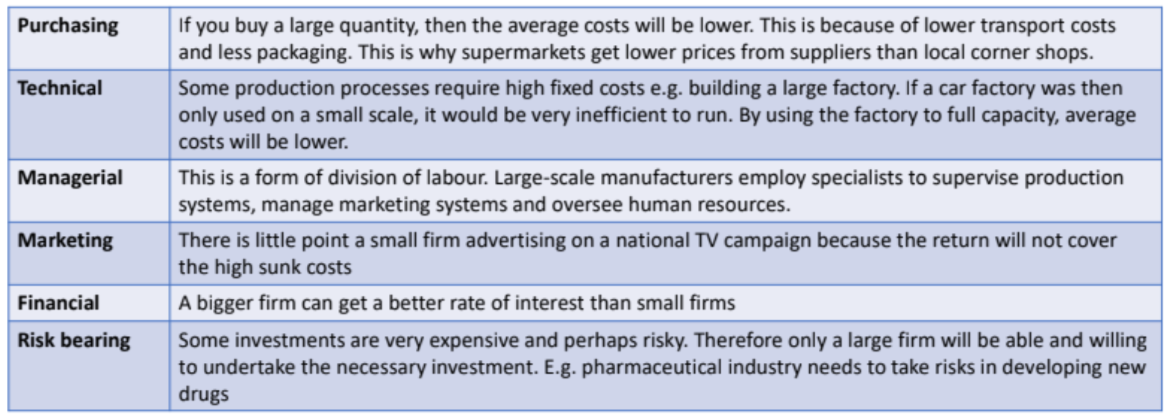
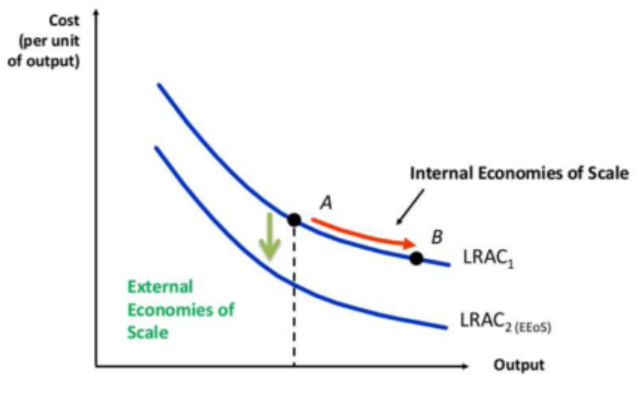
Internal economies of scale
External economies of scale
Advantages firms can gain as a result of the growth of the industry – normally associated with a particular area
Supply of skilled labour
Reputation
Local knowledge and skills
Infrastructure
Training facilities
Everyone in the industry benefits but bigger firms benefit more
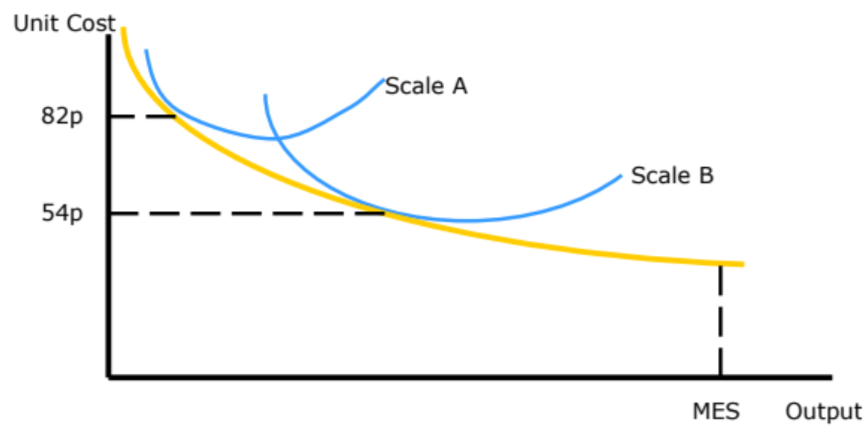
LRAC is a collection of SRAC curves
The LRAC is derived by adding together all the smaller SRAC curves
E.g. The AC for 1 factory + The AC for 2 factories + The AC for 3 factories
Remember in the SR at least one factor of production is fixed i.e. you can’t build more factories In the LR all factors of production are variable
Economies of Scale – Cost curve envelope
Using a diagram, explain why a large firm is more likely to benefit from improvements to the M25/A3 interchange. [5]
Improvements to the M25 interchange are poised to benefit all firms using it by reducing traffic and, subsequently, enhancing delivery times and safety. Despite this, the advantages would be notably more substantial for large firms like Asda and Morrisons.
Smaller firms with limited vehicle presence on the M25 would enjoy some improvement, experiencing faster deliveries and a slightly reduced accident risk. However, for industry giants such as Asda and Morrisons, who operate extensive machinery on main routes like the M25, the benefits would be far more exaggerated.
This discrepancy in benefits exemplifies the concept of external economies of scale. Larger firms, owing to their massive fleet sizes, would maximize the advantages of reduced congestion and increased interchange efficiency. Each of their vehicles would reap substantial benefits, resulting in enhanced operational efficiency, cost savings, and improved delivery times, making their benefit from this improvement much more pronounced.
Discuss the benefits of the merger between Hostess and Smucker. [15]
The horizontal merger between these 2 large firms could benefit consumers through lower prices. By consolidating production and eliminating redundant costs, the combined company can achieve technical economies of scale and reduced average costs per unit. As they would have more money for new technology, they would have greater output at the same time as before. This enables them to pass on lower prices for consumers across their product portfolio of sweets, baked goods, jams, and peanut butter. Lower prices increase consumer access and choice.
However, the merger could also decrease competition and consumer choice. Combining major brands like Hostess Twinkies and Smucker's Jif concentrates market power in the packaged food industry, which is already highly concentrated with a few key players. This could enable the merged company to raise prices or decrease product choices, negatively impacting consumers. Strict regulation is needed to prevent potential abuses of the increased market power.
The merger will increase profitability for the combined company through revenue synergies. Bringing Hostess and Smucker brands together under one roof will allow for cross-promotional opportunities across their products, like offering discounts when buying Twinkies and Jif peanut butter together. This can expand the sales of both brands. Their combined portfolio also commands greater shelf space and influence with retailers, benefiting revenues.
However, the merger risks organizational diseconomies of scale if it becomes too complex. We can see this on the graph as c1 increases to c2 and q1 goes to q2 after the minimum efficient scale, this could be due to communication errors in such a large-scale merger. The managerial challenges of integrating two large corporations with long, distinct histories and different corporate cultures could cause issues in several areas. Trying to manage an entity that is too large or unwieldy could result in coordination issues that erase potential synergies and actually decrease efficiency and profitability. Therefore careful integration is essential.