Dawson 3 - Fatty Acid Oxidation
Biological Roles of Fats
Fats (lipids) have multiple biological roles in living organisms.
Fats are generally hydrophobic but can have their properties modified by various chemical groups.
Fat as a Fuel
Triacylglycerol (TAG):
Most important form of fat storage in mammals, accounting for approximately 85% of stored energy.
TAG stores significantly more energy than glycogen:
TAG: ~38 kJ/g
Glycogen: ~17 kJ/g (lower energy density due to water binding and hydrous, so weight increases without energy increase)
Metabolic States and Fat Utilization
Fasting:
Increased use of fats by most tissues, preserving glucose for other tissues.
Fats can be used to create ketone bodies, an alternative fuel for the brain.
Exercise:
Mobilization of metabolic fuels (both glucose and fat) for muscle activity.
Sources of Fat
Liver:
Can synthesize fat and release it into the bloodstream.
Adipose Tissue:
Main site of fat storage.
Circulates in plasma as free fatty acids (FFAs) bound to albumin or as TAG in lipoproteins.
Types of Muscle Fibres:
Some contain fat droplets for energy.
Lipase Enzymes and Fatty Acid Release
Lipases release fatty acids from TAG:
Intracellular lipases: Stimulated by adrenaline (exercise), noradrenaline (cold), and low insulin (during fasting).
Lipoprotein lipase:
Secreted by tissues like muscle and adipose tissue to act on TAG in lipoproteins.
Plays roles during fasting, exercise, and the late fed state.
Mechanism of Fatty Acid Entry into Mitochondria
Fatty acids enter mitochondria through diffusion.
Coenzyme A (CoA) is attached to acyl group of the fatty acid via thioester linkage by acyl-CoA synthetase.
Acyl-CoA synthase are enzymes that "activate" fatty acids by thioesterification to coenzyme A. It represents the initial step of fatty acid metabolism.
The reaction requires the hydrolysis of ATP to AMP. Pyrophosphate is also produced with AMP.
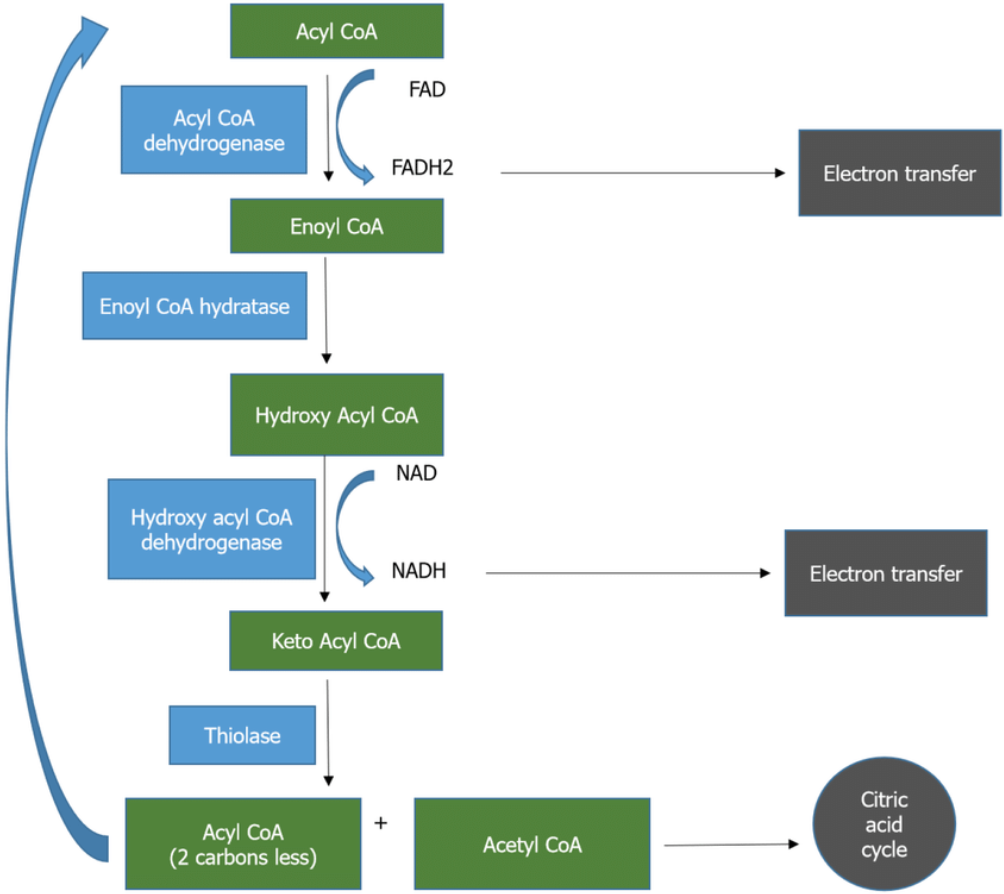
Process of Fatty Acid Oxidation (Beta-Oxidation)
Produces no ATP directly but generates:
Acetyl-CoA goes to the TCA cycle.
NADH and FADH₂ go to the electron transport chain (ETC).
Enzymes involved: Acyl-CoA dehydrogenase, enoyl-CoA hydratase, Hydroxy-acyl-CoA dehydrogenase, Thiolase.
These products then feed into the Electron Transport Chain (ETC) for ATP production:
FADH2 and NADH contribute to the ETC as long as O2 is available.
Flavoprotein (FADH2) P:O ratio
Notice one FADH2 is produced by Fatty acyl-CoA dehydrogenase.
2 electrons of FADH2 are transferred to the ETC, pumping 6 H+ out.
So P:O ratio is 6/3.67=1.6 (3.67 is the efficiency of our mitochondria)
Regulation of Fatty Acid Oxidation
Fatty acid oxidation can be limited by:
Insufficient mitochondria.
Lack of blood supply (low oxygen levels).
In the ETC, electrons from NADH and FADH₂ are passed through complexes and eventually transferred to oxygen, which becomes water.
This regenerates NAD⁺ and FAD, which are absolutely required for fatty acid oxidation to continue.
No oxygen → ETC backs up → NADH and FADH₂ accumulate → NAD⁺ and FAD run out → β-oxidation grinds to a halt.
So, fatty acid oxidation is indirectly oxygen-dependent because it depends on the ETC, which directly requires oxygen.
Certain tissues, like neurons in the brain, do not oxidize fatty acids.
Fatty acid oxidation and glycolysis generally do not occur simultaneously at high rates, except in exercising muscle.
During fasting or prolonged exercise, acetyl CoA from fatty acid oxidation can be converted in the liver into ketone bodies for energy.
Metabolic States and Fatty Acid Oxidation
Fed State:
Fatty acid oxidation is inhibited due to increased glycolysis.
Fasting State:
Glycolysis is inhibited, and fat utilization increases as adipose tissue releases fatty acids into circulation.
Starvation:
Body uses both glucose and ketone bodies. Fats are oxidized, and acetyl CoA is utilized to create ketone bodies.
Exercise:
Fatty acid oxidation increases as the supply of fatty acids is enhanced.
Key Questions for Review
Describe the structure and importance of triacylglycerol.
Explain how fatty acid availability is controlled in different metabolic states.
Discuss how fatty acid oxidation is regulated in various tissues and metabolic states, including its relation to other pathways.
Describe the fatty acid oxidation process and calculate its net yield for a given fatty acid.
Explain the fate of oxidation products in different tissues and metabolic states.